
OpenAI Structured Output: The 100 Percent Reliable Schema Most Builders Miss
OpenAI's structured output is not just tidier JSON, it is a schema enforced by a grammar constraint so the structure never breaks. That reliability is what finally lets a business automate messy text work without a human babysitting every run.

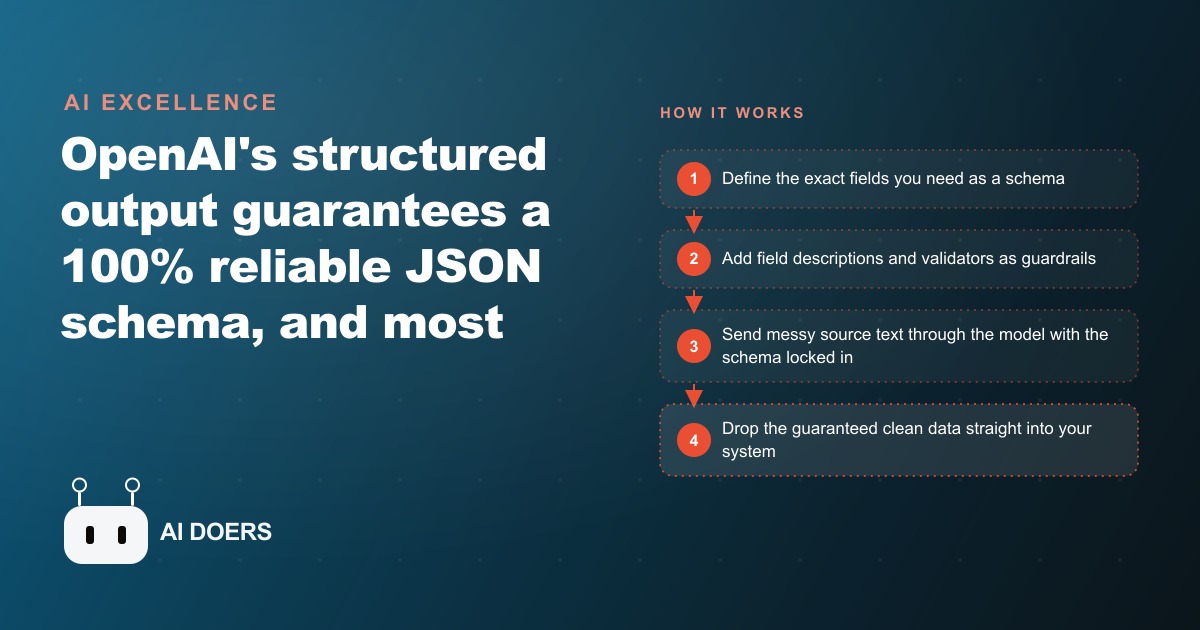
OpenAI's structured output shipped as a reliability feature, but the teams who understand it correctly treat it as an architecture decision. The gap between those two framings explains most of the failures in production AI pipelines built over the past year.
GPT-4o without structured output achieves around 93% JSON compliance on a good run. That sounds acceptable until you model what 7% failure looks like across 10,000 daily transactions: 700 broken records per day, each requiring a fallback, a retry, or a human review. Structured output closes that gap to zero. The mechanism is constrained decoding, which converts a schema into a grammar and filters out invalid tokens in real time as the model generates. The model cannot produce output that violates the schema because invalid tokens are removed before they can be selected.
Constrained Decoding Is Not a Post-Processing Step. It Is a Token-Level Filter.
This distinction matters practically. Earlier approaches to reliable JSON output applied a parsing or correction layer after the model generated its response. The model produced something close to JSON, a validator caught deviations, and a retry or repair step attempted to fix them. Post-processing compounds latency, adds cost per retry, and still fails on edge cases where the deviation is subtle enough to pass a surface-level check but wrong enough to break downstream logic.
Constrained decoding eliminates the problem at the source. The schema is converted into a grammar. As the model generates each token, only tokens consistent with a valid next state in that grammar are permitted. The model never has the option to produce a stray comma, an extra field, a missing closing brace, or a string where an integer was specified. The output is structurally guaranteed before it leaves the model.
For engineering teams building production systems, this changes the error handling model entirely. A pipeline with post-processing validation needs retry logic, error monitoring, alert thresholds, and fallback handlers. A pipeline using structured output with constrained decoding needs none of that infrastructure for schema compliance. The 93% accuracy case requires a distributed error recovery system. The 100% accuracy case requires a well-designed schema.
Pydantic Descriptions Are Prompts, and That Changes How You Should Write Them
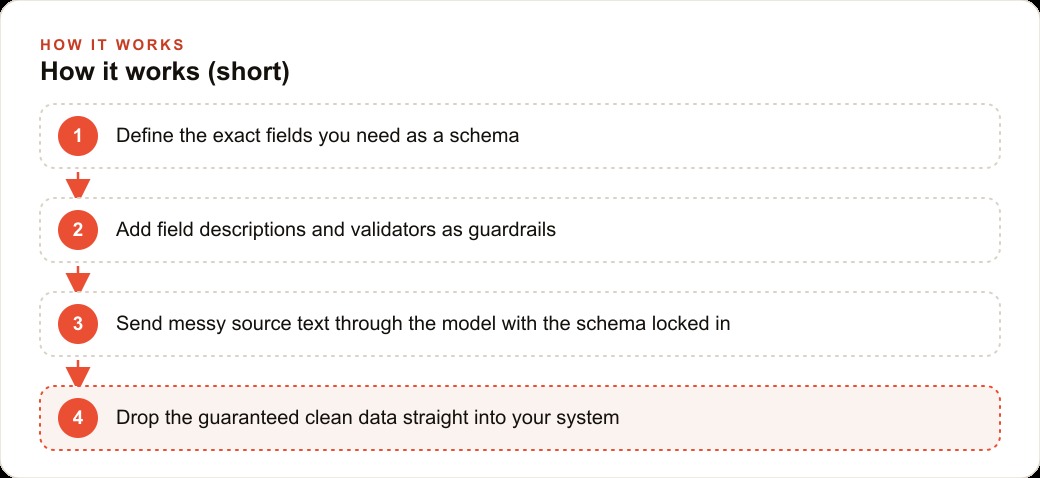
OpenAI's structured output integrates with Pydantic, Python's standard library for data validation. The integration is straightforward: define a class with field names, types, and optional validators, and the model's output is guaranteed to match the structure. What most teams underuse is the field description parameter.
In the structured output context, a field description is not documentation for developers. It is an inline instruction to the model. When Madhuranjan Kumar demonstrates this in a real extraction pipeline, the descriptions on each field are written as directional prompts: "The full name of the menu item as listed, without paraphrasing or abbreviation" rather than "menu item name." The model reads the description as part of its instruction set. A poorly written description produces a structurally valid but semantically wrong result. A well-written description produces a structurally valid and semantically correct result.
Custom validators in Pydantic add a second layer. A field defined as a four-digit account identifier can have a validator that raises a validation error if the extracted value is not exactly four digits. The model cannot produce a structurally invalid value because of constrained decoding, but a structurally valid value that is semantically wrong, such as a six-digit number where four digits are expected, will be caught by the validator before the data enters any downstream system.
The combination of constrained decoding and field-level validators creates a two-checkpoint reliability system. The first checkpoint guarantees structure. The second guarantees domain-specific semantic correctness. Together they produce output that is not just parseable but usable without a cleaning step.
Restaurant Menu Extraction Demonstrates What 100% Accuracy Actually Means in Production
Madhuranjan Kumar demonstrates the gap between theoretical and practical reliability with a restaurant menu extraction task. A site with 50 to 100 items, each with a name, ingredient list, and size-based pricing, is extracted using a structured output schema with carefully written field descriptions. The extracted data is verified against the live site.
The result is not approximately correct. It matches exactly. Every item name is captured without paraphrasing. Every ingredient is extracted in the form it appears on the site. Size-based pricing, which requires associating a price with a size label rather than extracting a single price value, is handled correctly through a nested schema that defines the pricing structure explicitly.
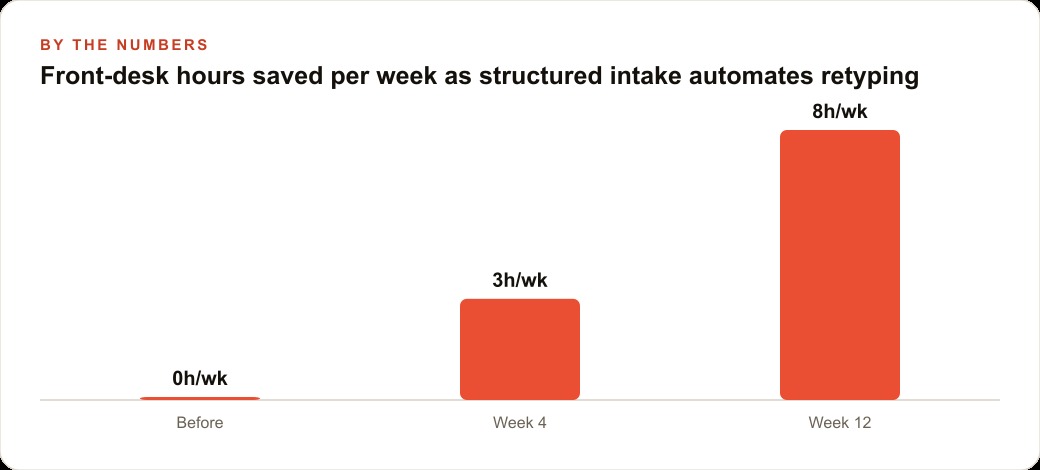
This kind of extraction task, which would require significant post-processing cleanup with a standard prompt-based approach, is clean on the first pass with structured output. The downstream consequence is that the extracted data is ready to import into a catalog system, a pricing database, or an inventory management tool without a human review step.
For businesses running web-based extraction at scale, removing the human review step from each extraction job changes the economics fundamentally. What required a reviewer becomes a fully automated pipeline. What cost $0.50 per reviewed record costs $0.05 per automated record. The scale at which the investment in schema design pays back is smaller than most teams expect.
Forcing Chain-of-Thought Before the Final Answer Is a Reliability Pattern, Not a Trick
One of the more underutilized patterns in structured output is using the schema itself to force reasoning before the answer. The approach is straightforward: add a reasoning field to the schema, defined as a required string that appears before the answer field. The model must produce reasoning before it can generate the answer, because the schema requires the reasoning field to be completed first in the token sequence.
This is not a prompt engineering trick. It is a structural guarantee about the order of computation. When the model is required to articulate its reasoning in a dedicated field, it cannot shortcut to an answer that its own reasoning would contradict. The reasoning field is visible in the output and can be logged, audited, or used as a secondary signal in systems where the quality of the reasoning matters alongside the answer.
In agentic workflows, a guaranteed pass or fail field makes branching logic completely deterministic. When the model evaluates a condition and the structured output schema includes a boolean field for the result, the downstream agent knows with certainty whether to branch left or right. There is no parsing ambiguity, no threshold decision about how confident the output is. The field is true or false and the agent branches accordingly.
The Video Clipper Workflow Shows How Structured Output Enables Reliable Multi-Step Pipelines
A video clipper workflow illustrates the multi-step reliability advantage clearly. The pipeline starts with AssemblyAI transcribing a video with word-level timestamps. The transcript and timestamps are passed to a model with a structured output schema that includes a required reasoning field followed by a list of clip objects, each with a start timestamp, end timestamp, and topic label.
The reasoning field forces the model to evaluate which segments of the transcript contain complete, self-contained ideas before it commits to timestamps. The resulting clips are accurate not because the prompt asked nicely for accuracy but because the schema required the reasoning to precede the decision. The clips can be cut automatically using the timestamps without a human review step, because the structured schema guarantees that every clip object has a valid start time, valid end time, and non-empty topic label.
For a business producing video content at volume, automating clip selection from long-form content with this level of reliability changes the economics of repurposing video. A single recording session produces structured, timestamped clip metadata that feeds directly into a content distribution system. The same principle applies to any pipeline where one model's output becomes another model's input, which covers the majority of agentic workflows being built today.
Universal Web Extraction Scales When the Schema Is Right
Spider Cloud converts web pages to markdown. That step is independent of structured output. The structured output layer takes that markdown and extracts a defined set of fields reliably across any page that matches the schema pattern. The combination produces a universal web extraction pipeline that works on any site in the target category without custom scraping code per site.
For SEO and content operations, structured extraction from competitor pages, review platforms, and directory listings becomes a reliable data source rather than a brittle scraping script. The extracted data feeds directly into SEO and organic content pipelines, content gap analysis, keyword mapping, and competitive positioning workflows without a cleaning step. The schema defines what the business needs. The model extracts it. The constrained decoding ensures the output matches the schema on every run.
For businesses with a CRM stack feeding off web research, the same approach applies to structured extraction of contact information, product data, and pricing from target company sites. The CRM and website stack stays clean because the extraction layer guarantees field types and required values before the data enters any system of record.
Nested Schemas for UI Generation Show the Full Depth of Structured Output
Nested Pydantic models can describe parent and child component relationships in a UI structure. A top-level component schema has a children field that is a list of the same component type. The model generates a structured tree describing a UI layout, with each node defined by a component type, label, style properties, and nested children. The tree is structurally valid by construction. It can be passed directly to a rendering layer without a validation step.
For teams building AI-assisted UI generation, structured output eliminates an entire class of parsing and validation work. The model cannot produce a malformed component tree because the schema prevents it at the token level. The engineering effort shifts entirely to schema design and prompt quality rather than being split between those tasks and error recovery infrastructure.
The Operational Case Most Tutorials Miss
Most of the structured output conversation focuses on data cleanliness: fewer parsing errors, more reliable extraction, cleaner databases. The more significant business case is what structured output enables at the system design level.
When every AI-generated output is structurally guaranteed, teams can build automation with confidence rather than anxiety. A business automating lead qualification can define a schema with fields for qualification status, reasoning, follow-up action, and priority score. Every lead that passes through the AI qualification step produces a structured record that feeds directly into the CRM and website stack without a human review for structural correctness. The human review is reserved for the cases where the agent's reasoning field indicates uncertainty.
For businesses running digital advertising with AI-assisted creative generation or audience analysis, structured output makes the connection between AI output and ad platform inputs reliable. Ad copy variants, audience segment descriptions, and bid strategy parameters can be generated and piped directly to campaign management systems without an intermediate cleaning step. The schema guarantees the ad platform receives exactly the fields it needs in exactly the format it expects.
The broader principle is that every workflow where the output of one step is the input to another step is a structured output candidate. The more steps in the pipeline, the more the reliability guarantee compounds. A pipeline of five steps where each step has 93% reliability produces correct end-to-end results about 70% of the time. A pipeline of five steps where each step has 100% schema compliance produces correct end-to-end results at whatever rate the semantic accuracy of each step achieves, without compounding structural failures adding noise to that baseline. That is not a marginal improvement. It is a different class of system.
The teams that get this right early will also get a compounding operational advantage that is hard to overstate. Every pipeline built on structured output accumulates a schema library: a set of tested, production-verified definitions for the data structures the business actually needs. Each new automation can start from a working schema rather than from a blank Pydantic file. The library becomes a shared language across every team member building with AI, and it enforces the data standards that make every downstream tool, from ad platforms to CRM systems, receive clean input without special handling. Building that library is the investment. The operational leverage it creates is the return.
That is exactly what we do at AI DOERS. Book a private 30-minute call with Madhuranjan Kumar and we will map the fastest path to it for your specific business.
Book your call →
Madhuranjan Kumar
Madhuranjan Kumar brings 20 years of performance-marketing experience and has managed over $200 million in Facebook ad spend for brands across the United States and beyond. His expertise spans the full modern marketing stack: Meta, Google Ads, TikTok, email automation, CRM, and the websites that hold it together. At AI DOERS he turns that track record into lead-generation systems for businesses across every industry.