
xAI Is Rebuilding Grok From Scratch, and What That Race Means for Your Business
While xAI trains several Grok models at once and bets on giant compute, the useful lesson for a business is simpler: match the right AI to the right job today.
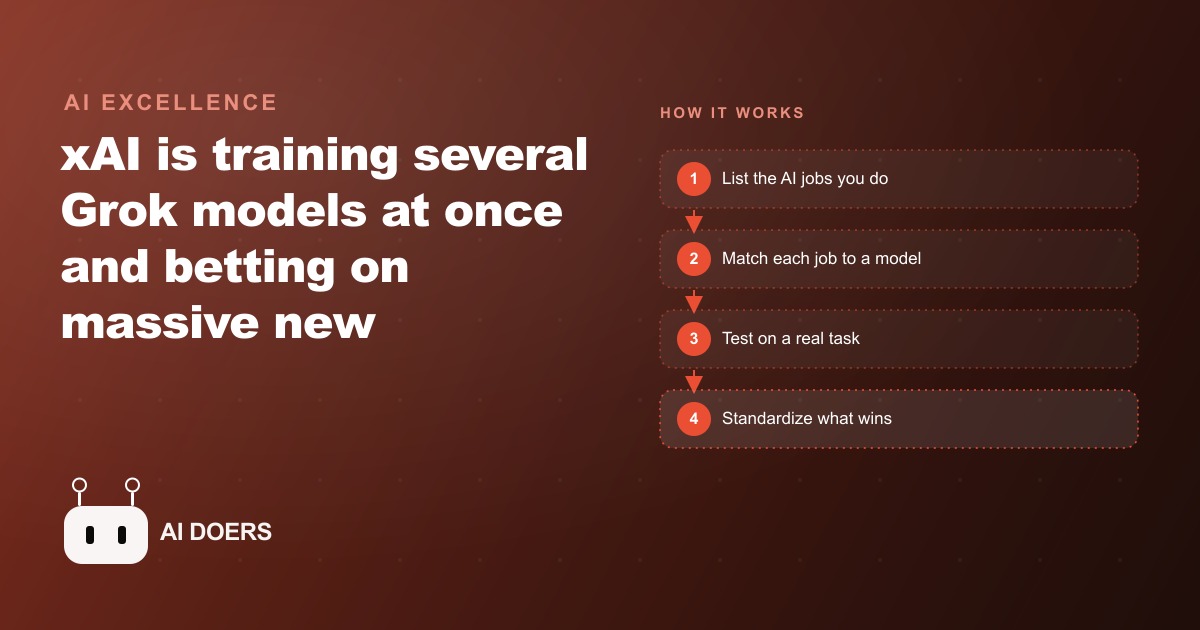
There is a moment in every hype cycle when the loudest promise and the quietest lesson point in opposite directions, and the Grok 5 story is one of those moments. The founder of xAI says the company is being rebuilt from the foundations, that several Grok models are training at the same time, and that within three years the rest of the field will be so far behind you would need a telescope to spot second place. That is the headline. The lesson buried underneath it is far more useful to anyone running a business, and it has almost nothing to do with who wins the model race.
I have watched enough of these announcements to hold the grand claims loosely. What matters is not whether one lab pulls ahead by a nose in some benchmark. What matters is that the tools sitting in front of you right now are already good enough to change how your week runs, if you stop looking for one perfect machine and start matching each job to the tool that actually wins it.
The rebuild is a talent-and-compute bet, and both halves are revealing
xAI is not tweaking Grok. It is rebuilding the company, and it is doing so on two fronts. The first is talent. The team went on an aggressive hiring spree, pulling engineers out of the leading coding-tool companies and other labs, with a clear goal of turning Grok into a top-tier coder. It is also recruiting domain experts, including finance professionals, to act as trainers who feed the model expert data in narrow areas like company analysis and market sentiment. The logic is simple. Give a model concentrated expertise in one lane and it gets noticeably sharper in that lane. The honest open question, the one the marketing skips, is whether that sharpening spills over into general ability or stays trapped inside the narrow task it was trained on.
The second front is compute, and the numbers here are genuinely large. Grok 5 is being trained on a gigawatt-scale cluster, and the longer vision floats the idea of data centers in orbit, where sunlight is constant and cooling is essentially free. It sounds like science fiction, and maybe it is premature, but serious people have studied the idea and it is less absurd on a long timeline than it first appears. For the day-to-day reality of a business owner, though, none of the orbital talk changes what you can do this afternoon. It is a bet on the future, not a feature you can use today.
Capability is not the same thing as fit
Here is the reframe I keep coming back to. The race between labs produces raw capability, and capability keeps climbing across all of them. But capability is not the thing you actually buy. What you buy is fit, the match between a specific tool and a specific job. And on fit, there is no single winner.
Grok today has a real, concrete edge, and it is worth naming precisely because it is so easy to overlook. It is excellent at fast, real-time search, often pulling from hundreds of sources at once. When news breaks and you need to know what is happening right now, a search-first model that scans the live web beats a model that reasons carefully but slowly over a stale snapshot. Meanwhile, other models still lead on deep, patient research, on writing with a tone you actually enjoy reading, or on writing clean code. None of these tools is best at everything. Each one is best at something.
The businesses getting real value from AI figured this out quietly. They are not loyal to a brand. They route each task to the tool that wins it, and they retest as new versions ship, because the leaderboard keeps reshuffling. Loyalty to one model is a comfort, not a strategy. The strategy is a short, honest map of which tool you reach for when.
Personality is a feature, not a footnote
There is a second lesson hiding in plain sight, and it is the one most people dismiss as fluff. When two models are close on raw skill, the one that is pleasant and helpful to work with wins your daily habit. That is not a soft observation. It is the whole game, because a tool you avoid because it feels annoying to use delivers exactly zero value, no matter how capable it is on paper.
I think about this the way I think about software a team actually adopts versus software a company paid for and nobody opens. The adoption is the value. If a model argues with you, buries good answers in hedging, or has a tone that grates, you will drift away from it even when it is technically the stronger option. Personality is the thing that keeps the tool in your hands every day, and a tool in your hands every day is the only kind that changes your output.
What this looks like inside a small business
Let me ground the whole argument in one example, because the abstract point only matters if it survives contact with a real week of work. Picture a small real estate agency, one owner and two agents, no technical staff. The temptation is to pick one AI, learn it, and use it for everything. The better move is to split the work by task.
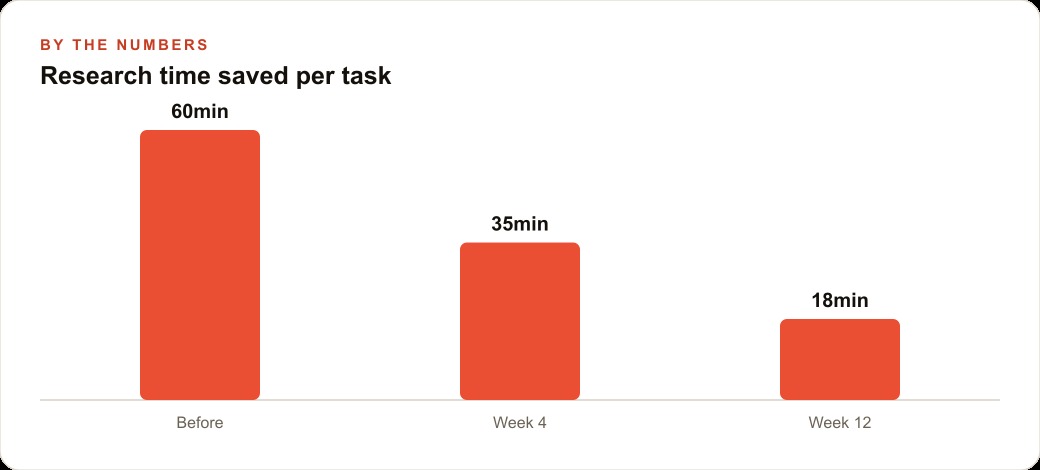
Market intelligence goes to the fast, real-time search model. Before a showing, an agent asks it to scan new listings, recent price cuts, school news, and local development chatter, and it hands back a clean summary of what changed in that neighborhood this week. That is exactly the breaking, current-events work a search-first model is built for. Say it saves the agent forty minutes of manual scanning per showing. Across three showings a day, that is two hours back.
Content goes to a different model, one with a warm, clear writing voice, for listing descriptions, neighborhood guides, and follow-up emails that read like a person wrote them. Deeper work, like comparing a year of comparable sales to price a tricky property, goes to a model built for careful long-form analysis. The agent's job shifts from grinding through every search and draft to reviewing and approving, which is where their judgment actually earns its keep. Handled this way, a three-person shop produces the research and content output of a much larger team without adding a single hire.
Notice what makes this work. It is not that AI wrote the listing. It is that each part of the pipeline went to the right tool, and a human stayed in the loop to catch the confident mistakes that every model still makes. That content foundation also does double duty. The neighborhood guides and market summaries the agent generates feed SEO and organic search on the agency's site, and the same tone and messaging carry straight into Facebook and Instagram ad campaigns, so the research work pays off in more than one channel. When those inquiries come in, they land in the agency's CRM and website stack, where follow-up automation handles the next several touches without anyone remembering to send them.
The quiet danger of betting everything on one lab
There is a flip side to the pick-the-right-tool argument that deserves its own space, because it is where a lot of businesses quietly hurt themselves. The instinct to standardize on one vendor is understandable. One login, one bill, one interface to learn, one relationship to manage. Simplicity is real value, and I am not against it. But standardizing on a brand is different from standardizing on a job, and confusing the two is how you get locked in.
When you route work by task, your standard is the outcome. You have decided that this kind of research goes to whatever tool currently wins that kind of research, and if a better one appears, you swap it in without disrupting anything else. When you standardize on a brand, your standard is the vendor, and every one of that vendor's weak spots becomes your weak spot too. If they are mediocre at writing and you have committed to them for everything, your content is mediocre, and you will not even notice, because you have nothing to compare it against. Loyalty quietly lowers your ceiling.
The three-year telescope claim is a good reminder of why this matters. Even if xAI hits its target and pulls far ahead, that lead would not be permanent, because the whole history of this field is one lab leaping ahead and another catching up months later. Betting your entire workflow on whoever is in front today means re-platforming every time the lead changes hands, which is exactly the disruption that task-based routing avoids. You do not have to predict the winner. You just have to keep your process flexible enough that the winner does not matter.
There is a cost angle too. Different models charge very differently, and the most capable model is not always the one you need for a given task. Sending a simple summarization job to your most expensive model out of brand loyalty is money spent for no gain. A task-based approach naturally sends cheap jobs to cheap tools and expensive jobs to the tools worth paying for, which is a kind of quiet cost control most owners never think to apply. Over a year, on the volume a busy business runs, that difference is not trivial.
None of this means you need ten subscriptions. Most businesses land on two or three tools that cover the jobs they actually do, and that is a healthy number. The point is that the two or three were chosen by testing against real work, not inherited from whichever brand got loudest this quarter. Keep the set small, keep it earned, and keep it under review.
The healthiest way to hold all of this is to treat your AI setup the way a good tradesperson treats a toolbox. A carpenter does not own one tool and force it to do everything, and does not own every tool ever made either. They own the right tools for the work they actually do, they know exactly which one to reach for, and they replace a tool when a genuinely better one appears. That is the mindset the Grok rebuild should leave you with. Not awe at the size of the compute clusters, not anxiety about the three-year prediction, but a calm, practical habit of matching the tool to the job and swapping when the job calls for it. The businesses that win with AI are not the ones with the fanciest single tool. They are the ones with the clearest sense of which tool does what, and the discipline to keep that map current.
The move to make while everyone argues about the leaderboard
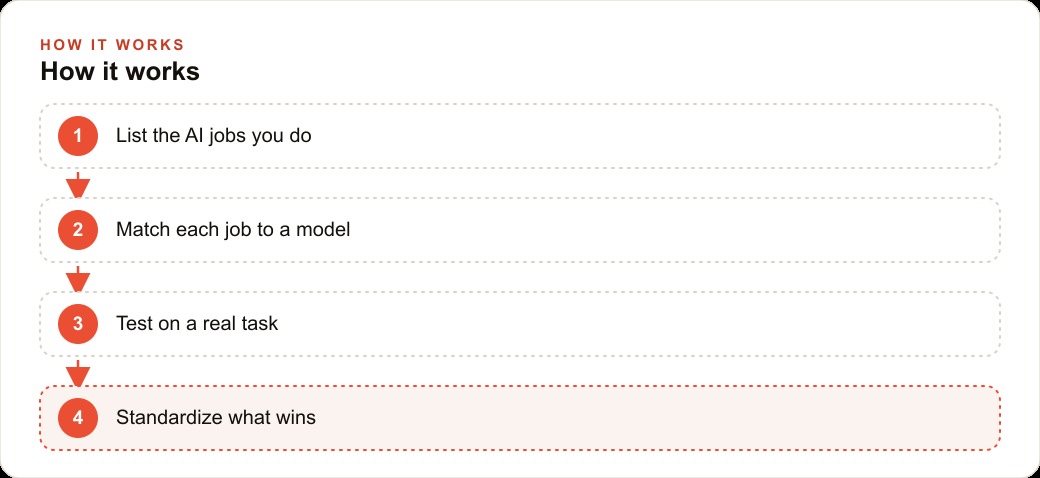
If you take one thing from the Grok rebuild, let it be this. Stop waiting for the one model that does everything, and stop reading the three-year telescope predictions as if they change your Tuesday. They do not. What changes your Tuesday is a short, deliberate audit of the AI jobs you actually do in a week, and a decision about which tool wins each one.
The path is not complicated. Write down the AI-shaped jobs you already do, research, drafting, summarizing, analysis, and be honest about which ones eat the most time, because those are where a better tool pays off fastest. Then match each job to a model and test it on a real task, a real listing, a real client question, a real data set, not a toy example off a demo page. Whichever tool gives you the most useful answer with the least cleanup wins that job. Standardize it so your team stops guessing, then retest every few months because today's winner may be passed next quarter. And keep a human reviewing the output the whole time, because even the strongest models still make confident mistakes.
You can absolutely set this up yourself with a little patience and a willingness to test rather than assume. The habit is the asset, not any single model. If you would rather have someone map your workflow, pick the right tools for each job, and wire them together so the whole thing simply runs, that is the kind of setup work I do for clients. Either way, the winning move is the same one the Grok drama accidentally teaches. The future belongs to the operator who matches the right tool to the right job, not to the one who bet everything on a single brand.
That is exactly what we do at AI DOERS. Book a private 30-minute call with Madhuranjan Kumar and we will map the fastest path to it for your specific business.
Book your call →
Madhuranjan Kumar
Madhuranjan Kumar brings 20 years of performance-marketing experience and has managed over $200 million in Facebook ad spend for brands across the United States and beyond. His expertise spans the full modern marketing stack: Meta, Google Ads, TikTok, email automation, CRM, and the websites that hold it together. At AI DOERS he turns that track record into lead-generation systems for businesses across every industry.