
Why Your Agentic AI Trading Bot Lives Or Dies On Its Data Pipeline
An agentic AI agent has no real-world knowledge on its own, so the data pipeline that feeds it fresh, multi-source information decides the quality of its output, far more than the choice of model. The same pattern applies to any decision your business makes from scattered data.

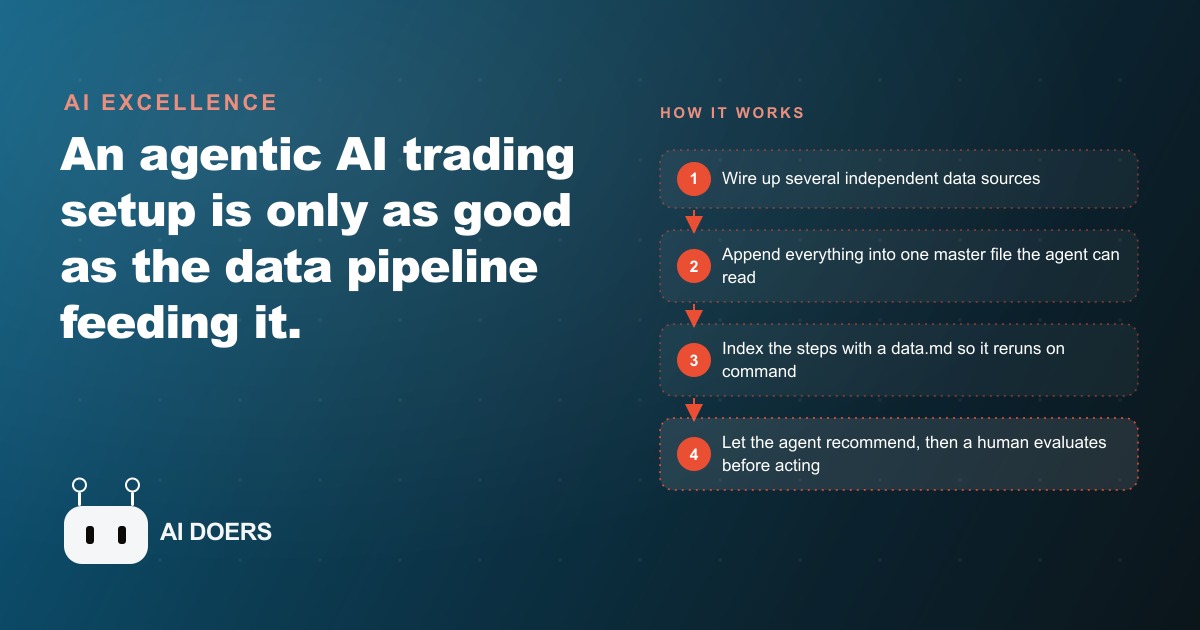
The counterintuitive truth: the data is the edge, not the model
I am Madhuranjan Kumar, and I want to take one idea apart carefully, because it is the idea most people get backwards when they build with AI agents. Everyone obsesses over which model to use. They compare benchmark scores, argue about which lab is ahead this month, and treat the choice of model as the decision that determines the outcome. When you actually watch an agentic system succeed or fail in the real world, the model is rarely the thing that decided it. The data pipeline feeding the agent is.
An agentic AI setup, the kind that pulls information, reasons over it, and recommends an action, knows nothing about the real world on its own. It has no live prices, no current news, no sense of what a crowd is feeling right now. Every single thing it concludes has to be supplied to it. A brilliant model with no fresh data is a brilliant person locked in a windowless room being asked to trade. The room does not matter. The window does. This is why a walkthrough of an agentic trading system spends almost no time on the model and almost all of it on the sources. Whoever builds the better pipeline gets the better output, and that is true no matter which model sits in the middle.
Five windows onto the same question
The example that makes this clearest uses a prediction market as its testing ground and wires up five independent data sources around a single keyword, something as simple as the word Bitcoin. What matters is not the specific sources but the logic of why there are five and why they are different from each other.
The first source is a competing prediction market. It answers one question: how is another market pricing the exact same event? That is a fast read on consensus, a way to see where the crowd of people putting money down has already landed. The second and third sources are community forums and a social feed. These answer a different question entirely: what is the mood? A browser-automation agent logs in like a person, scans the relevant discussions, and reads sentiment, the negative crypto feeling in the air, the specific worries people keep repeating. The fourth source is on-chain whale data, which shows where the largest bets are leaning. It is not perfectly real time, but it flags where big money is positioned. The fifth is a news feed, which supplies the latest headlines that might move things.
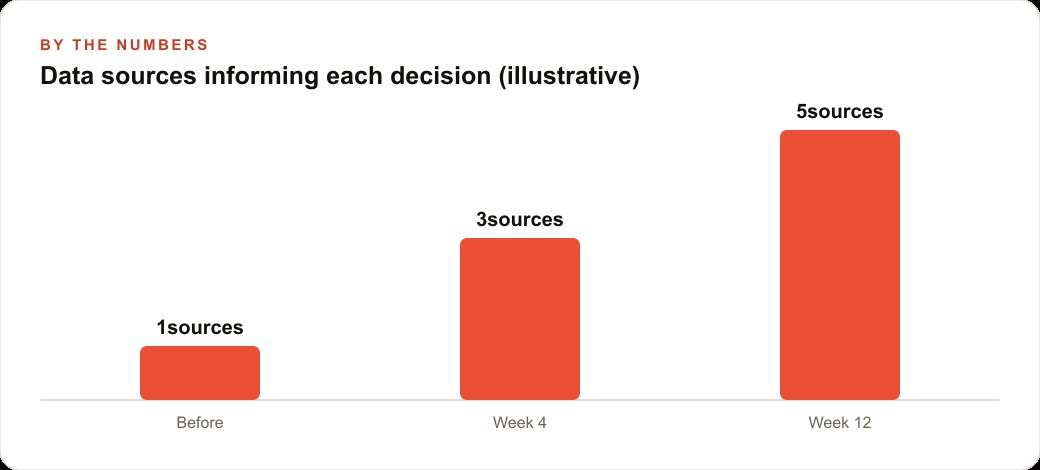
Notice the design. Price, mood, big money, and news are four genuinely different angles on one question. If you fed the agent only price data, it would be blind to a story breaking right now. If you fed it only sentiment, it would miss where the serious capital is sitting. The pipeline is not about volume of data. It is about coverage of perspectives. Each source closes a blind spot the others cannot see.
Why everything must land in one file
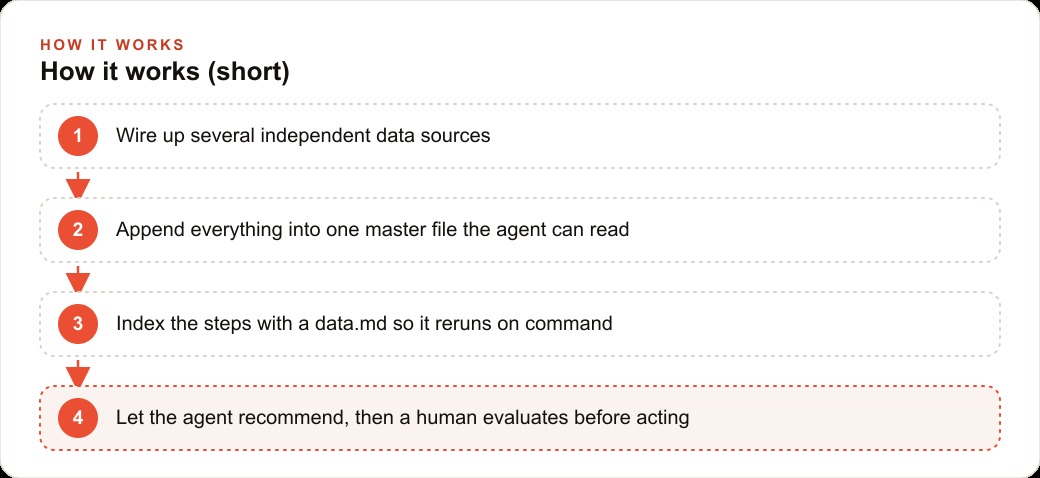
Here is the design choice that quietly makes the whole thing work, and it is the part people skip. All five sources do not get handed to the agent one at a time. They get appended into a single master text file, and that one compiled file becomes the source of truth the agent reads when it looks for an answer.
This matters more than it sounds. When you feed an agent information in fragments, it reasons about each fragment in isolation and struggles to hold the whole picture together. When you hand it one document containing everything, price next to mood next to whale positioning next to news, it can see relationships across the sources. It can notice that the price is calm but the mood is fearful and the whales are quietly exiting, which is a very different situation than any single source would suggest. The file is loosely structured and a little messy, and that is fine. Completeness beats tidiness here, because the agent's strength is reading a large body of mixed information and finding the pattern in it.
The index file is what turns a stunt into a system
A one-time scrape is a party trick. A repeatable pipeline is a tool. The thing that separates the two is a small index file, written in plain markdown, that lists every source and the exact steps to collect it.
This is the piece I want people to pay attention to, because it is the least glamorous part and the most important. The index describes the pipeline the way a recipe describes a dish. The agent reads the index, understands what each source is and how to gather it, and then runs the entire pipeline on any keyword you give it. Ask it about a different market tomorrow and it reruns the whole gather without you rebuilding anything. That is the difference between doing the research once and owning a machine that does the research on demand. The cost of the tenth run is nearly zero, because the index made the process reproducible.
Once the index exists, execution collapses to a single command. You tell the agent to read the master file, pull the live markets, calculate expected value, and think carefully. It surfaces the option with the best positive expected value from everything it gathered. Then a human steps in and evaluates before any real money moves. The agent researches and recommends. The person still decides. That boundary is not a limitation to engineer away. It is the correct design, and I will come back to why.
Browser automation reaches what an API cannot
There is a facet here worth pausing on, because it is what makes the sentiment sources possible at all. A lot of the richest information a decision depends on lives behind a normal login and has no clean data feed. Community mood, the top posts in a forum, the tone of a discussion thread, none of that is neatly exposed the way a price ticker is. The pipeline handles this with a browser-automation agent that drives a real, logged-in browser through the pages at speed, scrolling and reading the way a person would while the model collects everything it sees. That is the piece that lets you reach mood and context, not just numbers, and it is the reason the compiled file feels like a genuine read of the situation rather than a spreadsheet of prices.
The pattern generalizes far beyond trading
Now here is the facet that makes this worth your time even if you will never touch a prediction market. Strip away the trading context and look at the skeleton: gather several independent sources, compile them into one file the agent can read completely, index the steps so it reruns on command, and keep a human checkpoint before any action. That skeleton is universal. Trading is just a vivid place to see it because the feedback is fast and the stakes are obvious.
Think about how much of business is exactly this shape. A marketing team makes a decision by blending customer reviews, ad performance data, and competitor landing pages, and today they do it by opening ten tabs and holding it all in their heads. A product team decides what to build by folding together support tickets, usage data, and survey notes, again by hand. Anywhere a person currently gathers scattered inputs and tries to synthesize them under time pressure, the pipeline-plus-agent pattern applies. The value scales with two things: how scattered your inputs are, and how often you repeat the same research. The more tabs you open and the more often you open them, the more a pipeline pays off.
This connects directly to the work I do. When a business runs Facebook and Instagram ad campaigns alongside search ads and organic content, the raw signal about what is working lives in a dozen different dashboards. A pipeline that gathers those into one file, indexed so it reruns every Monday, turns a scattered mess into a single readable brief. The same discipline that feeds a trading agent can feed a decision about where to move next week's budget.
A worked example: the pre-meeting brief
Let me make this concrete with a financial advisory firm, and let me be careful, because this is a domain where the human checkpoint is not optional. I would frame this strictly as research support, never as automated advice.
Advisors lose hours every week to preparation. Before a client review, someone pulls together market commentary, fund performance, news on the client's holdings, and notes from the last meeting. It is scattered, repetitive, and easy to rush when the calendar is full. So I would build a pipeline around it. Each of those inputs becomes an independent source. They get appended into one master file per client or per portfolio. An index describes how to refresh each source, so an advisor can rerun the whole gather with a single command on the morning of a review.
The agent then produces a structured pre-meeting brief that flags what changed since last time and what is worth discussing. Put illustrative numbers on it. Suppose a review currently takes ninety minutes of prep and the advisor does eight of them a week, that is twelve hours gone before a single conversation happens. If the pipeline cuts prep to twenty minutes per review, the firm recovers most of a working day every week, and, just as important, no source gets skipped under time pressure, so the quality of every review goes up. The hard rule I would build in is the checkpoint: the agent compiles and highlights, but a licensed advisor reviews and signs off on everything before it reaches a client. The leads and client records that feed this live in the CRM and website stack, so the brief pulls from the same system the firm already trusts.
Why the human checkpoint is a feature, not a weakness
I keep returning to the human step because people treat it as the embarrassing part they hope to automate away later. I think that is exactly wrong. The checkpoint is what makes the whole system safe to rely on, and in a regulated field it is what makes it legal.
The agent's job is to eliminate the tedious gathering and produce a strong first-pass synthesis. That is enormously valuable and it is also the part machines are good at. Judgment, accountability, and the final call are the part machines are not good at and should not own. A pipeline designed with that boundary is not a compromise. It is the correct division of labor: the machine handles breadth and repetition, the human handles judgment and responsibility. Systems that try to erase the human step do not become more powerful. They become more dangerous, and eventually someone gets hurt by a confident recommendation nobody checked.
How to build your first pipeline
Start small, with two or three sources, not ten. Pick the information you already check by hand before a decision and find a way to collect each source on demand. Append them into one file so the agent reads the full context at once. Write a short index that lists each source and how to refresh it, so the run is repeatable rather than a one-off. Add the agent step last, and always keep a human evaluation between the recommendation and any real action. Treat the output as a researched suggestion, never an order.
You can absolutely build this yourself, source by source, and I would start with the two inputs that cost you the most time today, because those are where the payoff shows up first and clearest. If you would rather have someone design the pipeline, wire up the sources, and put the human checkpoints in exactly the right places so it is genuinely safe to depend on, that is the kind of build I do for clients, and you can bring me in to handle it.
That is exactly what we do at AI DOERS. Book a private 30-minute call with Madhuranjan Kumar and we will map the fastest path to it for your specific business.
Book your call →
Madhuranjan Kumar
Madhuranjan Kumar brings 20 years of performance-marketing experience and has managed over $200 million in Facebook ad spend for brands across the United States and beyond. His expertise spans the full modern marketing stack: Meta, Google Ads, TikTok, email automation, CRM, and the websites that hold it together. At AI DOERS he turns that track record into lead-generation systems for businesses across every industry.