
Why Tokens, Not Perfect Code, Are the Real Edge in Agentic Coding
The advantage in agentic coding has moved from writing perfect code to two things: who can afford the tokens to run agents and who has the judgment to direct them. That is what lets a small team using internal tools outproduce a much larger one.

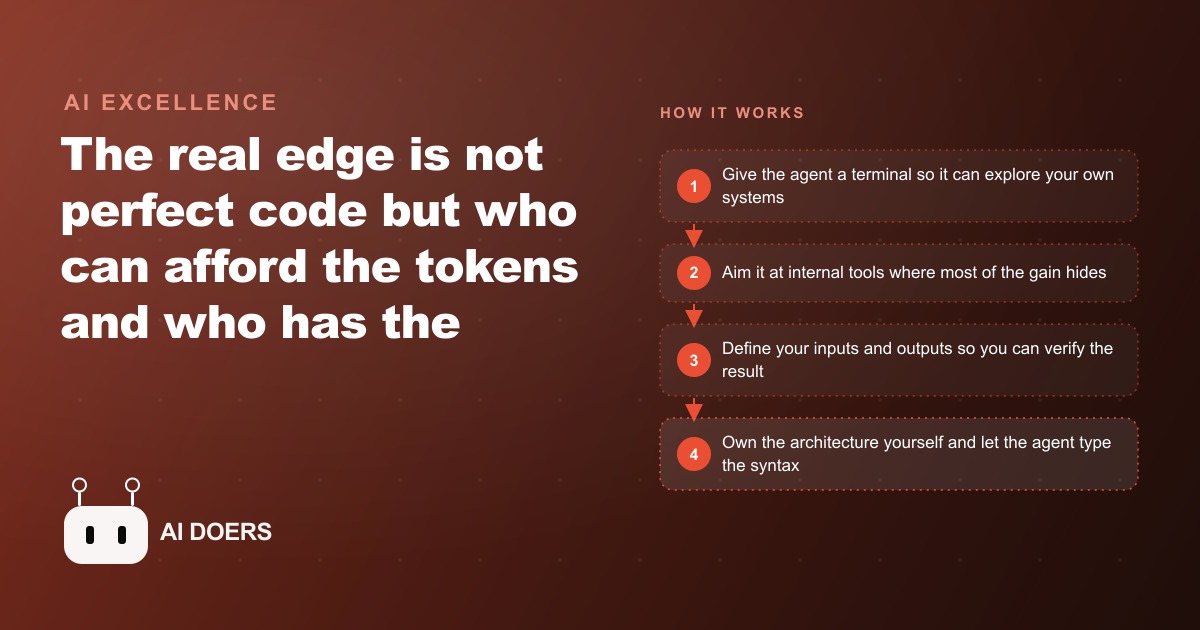
Perfect code stopped being the prize the moment agents learned to explore a codebase on their own. For years the promise of AI coding was that it would write cleaner functions than a tired human at 2am. That framing turned out to be a distraction. The real shift, and the one that actually changes how a business should think about building software, is that the advantage has quietly moved to two things almost nobody talks about: who can afford the tokens to run agents at scale, and who has the judgment to point those agents at the right problem. I am Madhuranjan Kumar, and the more I work with these tools, the clearer that thesis becomes.
There is a reason agentic coding suddenly works when it did not before. The early tools indexed your codebase and then fed the model a limited, curated slice of it. The model was reasoning about a shadow of the real system. The breakthrough was almost embarrassingly simple: give the agent a terminal and a shell, and let it run commands itself. Once it could search files, grep for a function, read a config, and follow a trail the way a human developer does, the quality jumped. Language models turn out to be very good at exploring a system when you stop holding their hand. That single design choice, a real terminal instead of a curated index, is the hinge the whole current wave turns on. Everything downstream, the productivity, the small teams beating big ones, the non-technical people shipping real tools, traces back to that one decision to let the agent look for itself.
Slop that saves an hour beats elegance that never ships
The instinct that dies hardest is the belief that the code has to be good. It does not. If a script reliably saves you an hour every morning, it can be total slop under the hood and still be one of the best investments you make this quarter. This is deeply uncomfortable for anyone who came up caring about craft, and I understand the discomfort, but the market does not reward elegance you never shipped. It rewards time saved. Internal tools, quick experiments, the little utility that flags a weird number in a report before a client sees it, none of these need to survive a code review. They need to run and be right often enough to trust.
The reason this matters is that most business software is not a product you sell. It is plumbing. Nobody outside the company will ever see the code that turns your raw export into a clean weekly report, so the only quality metric that counts is whether the report is correct and whether it saved you time. Holding internal plumbing to the same standard as a public product is how good teams talk themselves out of shipping the thing that would have paid for itself in a week. Let the plumbing be ugly. Judge it by the hour it gives back, not by how it reads.
Once you accept that, the economics of a team change shape. Make six people meaningfully more productive with coding agents and they can outproduce a fifty or even hundred person team that is still doing everything the old way. Small and fast becomes a structural advantage rather than a scrappy underdog story. The larger team is carrying coordination cost, meetings, and handoffs that the six person team simply does not have. When each of those six can spin up the tool they need in an afternoon, the org chart stops being the bottleneck. That is not a motivational poster. It is a direct consequence of the cost of building a small tool falling toward zero.
The value is hiding inside companies that already exist
Here is the part that gets missed in all the noise about flashy startups. Roughly eighty to ninety percent of the real benefit is internal, inside companies that already exist, built by people who are not developers. The headline demos are the least interesting part of the story. The interesting part is this breakdown editor who builds a script that flags outlier clips and spins out variations for testing, or the accountant who automates a reconciliation that used to eat a full day, or the operations lead who turns a messy export into the exact dashboard the team pictures in their heads.
The most telling example I keep coming back to is a non-technical researcher who used a coding agent to multiply her scientific output by five. She never learned to program. What she had was complete clarity about her inputs, the raw and messy data, and complete clarity about her outputs, the specific charts she needed. Because she could look at the result and instantly tell whether it was right, she could verify work she did not write herself. That is the entire pattern, and any business can copy it. Know your inputs, know exactly what the output should look like, and let the agent handle the middle you do not care about. The judgment lives at the two ends. The typing lives in the middle.
This is where the internal tools quietly feed the rest of the business. The same clean data pipeline a team builds to run its operations often becomes the backbone for how leads move through the CRM and website stack, and the same structured content an agent helps produce can strengthen SEO and organic search without a second project. You do not set out to build a marketing asset. You build the internal tool, and the marketing asset falls out of it because the underlying data is finally clean and accessible. I have watched a single reconciliation script turn into a reporting habit that turned into a content engine, all because the data underneath finally lived in one trustworthy place.
Context, not the model, is what decays
There is a persistent myth that the models secretly get worse over time, that some lever gets pulled and last month's magic is gone. The honest explanation is less dramatic and more useful. Most perceived degradation comes down to two things, and neither of them is a quantized model. The first is the honeymoon effect. Early excitement carries you through trivial demos, and then you push into real work and the shine comes off, so it feels like the model got dumber when really the task got harder. The second is the harness changing underneath you. One change that cleared older reasoning traces from idle sessions effectively erased what the model had built up during that session, which felt like a lobotomy but was really a context problem.
That is why serious builders obsess over context and why some of them build their own minimal agents just to keep control of it. Context rot, not a magic model swap, is what makes an agent feel worse over a long session. The practical takeaway for anyone using these tools is boring and important: start fresh sessions for fresh tasks, do not let a single conversation sprawl across five unrelated jobs, and treat the context window as the scarce resource it actually is. The model is rarely your problem. What you fed it and what got quietly dropped almost always is. When someone tells me the tool used to be smarter, my first question is never about the model. It is about how long that session had been running and how much unrelated history was still hanging around in it.
Own the architecture, rent the syntax
If there is one rule I would tattoo on every young builder, it is this: do the architecture and system design yourself, and let the agent handle the syntax. The agent learned from the average of the internet's code. Ask it to design your system and it will propose the average, because the average is what it was trained on. Ask it to write a function whose shape you have already decided, and it will type faster and more accurately than you can. Semantics are yours. Syntax is rented. The people who blur that line, who let the agent decide the structure because they never learned to, end up with systems that look fine and rot fast.
None of this is free of a hard edge, and I will not pretend otherwise. It is becoming, in a real sense, a rich person's game. Whoever can afford the tokens has a genuine advantage, and a two hundred dollar a month plan already prices out most of the world. Means of production used to mean factories and land. Increasingly it means access to compute. The counterweight is that open-weight models like the ones you can run on your own cluster are catching up fast, and cheaper tokens push affordable intelligence out beyond the first world a little more every month. The gap is real today. It is also closing. For a small business the honest read is that you do not need the most expensive tier to win. You need enough tokens to run the handful of internal tools that give you back real hours, and the discipline to spend them on the jobs that matter instead of burning them on novelty.
What this actually means for an owner
Let me make it concrete with one illustrative example. Picture a dental practice front office, the kind of place drowning in repetitive data work that nobody was ever trained to code. The office manager knows the inputs cold: the raw schedule export, the recall list, the insurance aging report. She knows the output she wants: a clean weekly view of who is overdue, which claims are stuck, and where tomorrow has open chairs. An agent can turn that messy export into exactly that dashboard, and because she can glance at it and tell whether the numbers match reality, she can verify it without writing a line herself.
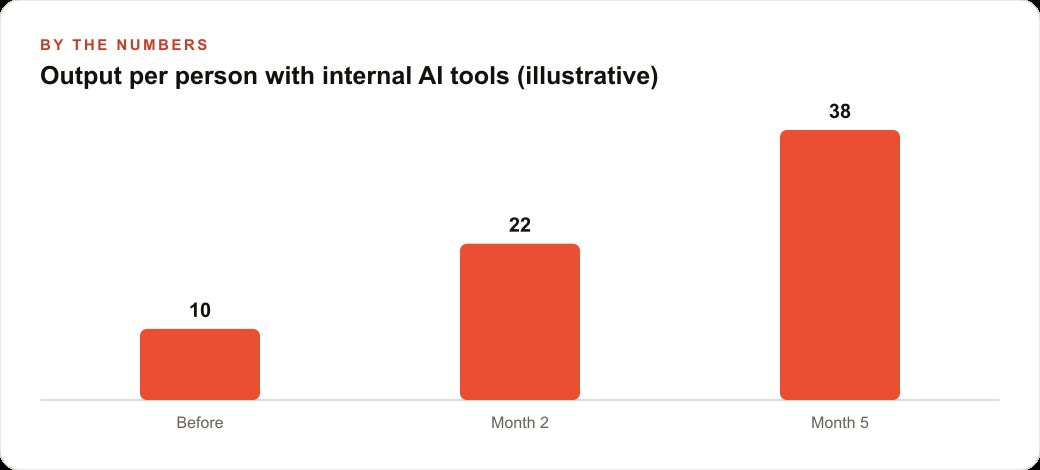
The code underneath can be slop. It does not need to be elegant, it needs to save an hour every morning. Now follow the logic outward. A six person front office that builds two or three of these little tools will outrun a much larger practice still doing it all by hand, and the leads those tools help capture flow straight into the CRM and website stack where follow-up is automatic. The dentists keep doing dentistry. The office quietly runs on tools the staff built and trust, because they defined the inputs and outputs themselves. If you imagine that saved hour compounding, from ten units of output before, to twenty two by month two, to thirty eight by month five, the numbers are illustrative but the shape is real. Small tools, verified by the person who knows the domain, compound.
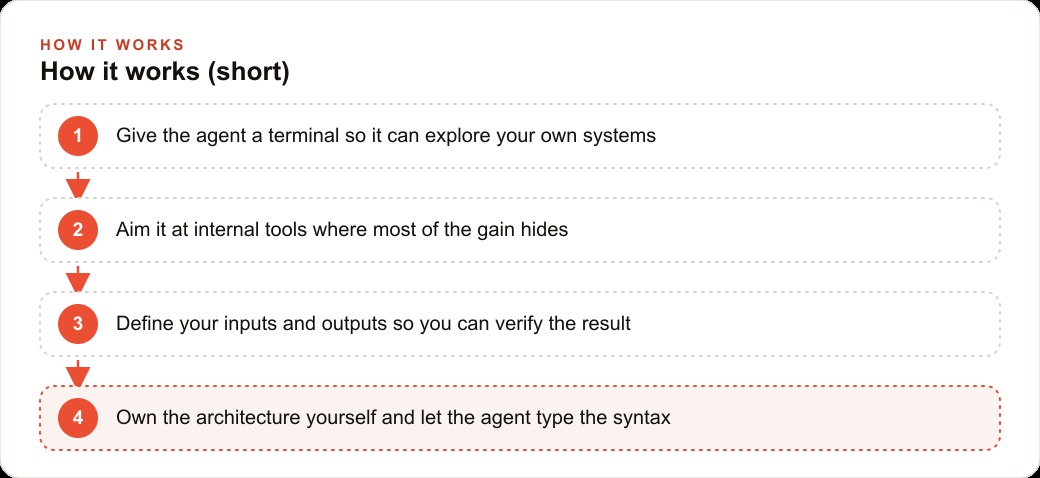
It is worth sitting with how ordinary that example is. There is nothing exotic about a schedule export or an aging report. Every business has three or four of these unglamorous piles of data, and every one of them is a candidate for a small verified tool. The barrier was never talent or headcount. It was the cost of building, and that cost has collapsed to the point where the only real constraint left is knowing which pile to point the agent at first.\n\nSo where does that leave a business owner deciding whether any of this is for them? It leaves you with a simple sequence. Aim agents at internal tools first, where the hidden gains actually live, instead of chasing a polished product. Define your inputs and outputs so precisely that you could verify the result blindfolded. Watch your context and start clean for each new job. And keep the architecture in your own hands while the agent types. The edge was never perfect code. It is the judgment to know what to build, the discipline to verify it, and, yes, the willingness to pay for the tokens that do the work.
You can absolutely build these tools yourself, and I would push any owner to start with one messy report this week and feel what changes. If you would rather have someone map where the hidden hours are hiding, build the tools around your real inputs and outputs, and wire them into your operations so the whole team trusts them, that is exactly the kind of build I do for clients, and you can bring me in to handle it.
That is exactly what we do at AI DOERS. Book a private 30-minute call with Madhuranjan Kumar and we will map the fastest path to it for your specific business.
Book your call →
Madhuranjan Kumar
Madhuranjan Kumar brings 20 years of performance-marketing experience and has managed over $200 million in Facebook ad spend for brands across the United States and beyond. His expertise spans the full modern marketing stack: Meta, Google Ads, TikTok, email automation, CRM, and the websites that hold it together. At AI DOERS he turns that track record into lead-generation systems for businesses across every industry.