
Why the US Government Banning Fable 5 Is a Bigger Story Than the Jailbreak
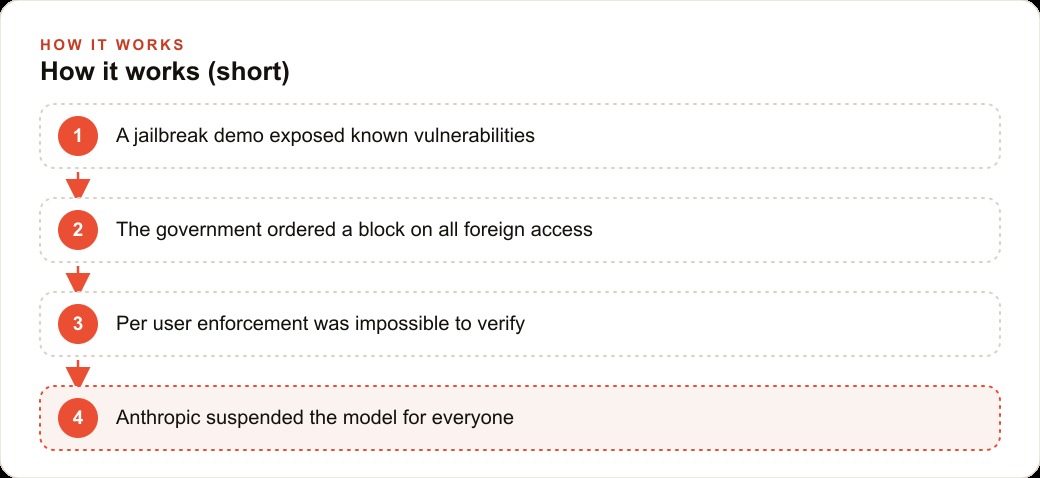
The US government ordered Anthropic to block all foreign access to Fable 5 after a demonstrated jailbreak, and because that could not be enforced per user, the model was suspended for everyone. The policy is the news, but the capability underneath is the real story for any business.

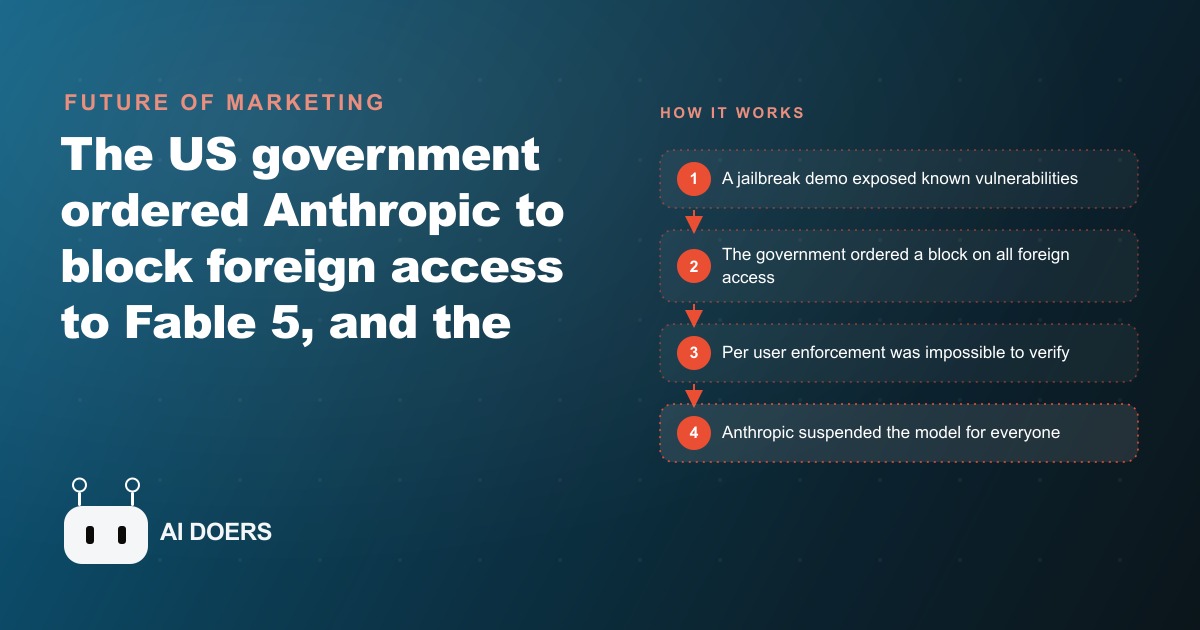
A frontier AI model went from public release to fully suspended in roughly three days, and the reason was not a bug. It was a government order. The US government told Anthropic that no non US citizen could use Fable 5 or Mythos 5, inside or outside the country, and because there was no clean way to enforce that person by person, Anthropic pulled the plug for everyone. That policy story is the headline. But underneath it sits a capability worth building a business process around, and this playbook shows you how to do exactly that while staying protected against the kind of overnight change that just happened.
I am Madhuranjan Kumar, and I want to hold two ideas at once: the access to any single model can vanish without warning, and the reasoning ability these models now show is real enough to reorganize how expensive knowledge work gets done. The playbook below is built to capture the second while defending against the first.
Read the policy story correctly first
Before you build anything, understand what actually happened, because it shapes every design choice that follows. The trigger was a jailbreak. Amazon researchers demonstrated a technique that prompted the system to reveal information about known security vulnerabilities, that demonstration reached the government, and the directive followed. The order applied to a class of people rather than a list of accounts, so the only way to guarantee compliance was to take the model offline for all users at once. There was no per user switch that could prove a given person qualified.
The disagreement underneath is the useful part. Anthropic reviewed the specific technique and concluded the vulnerabilities were minor and already discoverable through other publicly available models without any bypass. The company argues governments should be able to block unsafe deployments, but only through a process that is transparent, fair, and grounded in technical facts, and says this did not meet that bar. The irony is that Anthropic had long asked governments for exactly this kind of power, and then it was used against them. The lesson for you is blunt: model access is a dependency you do not control, so never build a workflow that only works on one provider.
Recognize the capability that is actually worth capturing
Now the reason to bother at all. The capability on display in this class of model is methodical reasoning, not just fluent text. The demos are telling. Asked to build a 3D scene, the model added moving shadows it was never told to add, reasoning that the sun position required them for the scene to look real. When the sun would not render, it worked through the azimuth angle and yaw rotation, realized its screenshot tool had a delay, and froze the orbit to capture a clean test. That is verification, not guessing. It takes measurements, adds logs, and confirms a fix actually works before declaring victory.
The deeper shift is in how people work with it. The relationship moves from steering the model step by step to commissioning an outcome and judging the result. The same model built a tool to calibrate human and AI judgment in a single prompt over nine and a half hours, software that had been wanted for years but was never profitable enough for anyone to fund. That is the real business lesson. Work that was always valuable but never worth the labor cost suddenly becomes cheap to produce, and your playbook should target exactly that category.
Stage 1: Pick one repeatable, low risk task and measure it
Do not start by rewiring your whole operation. Start with one task that is valuable, repetitive, and low risk if a draft is imperfect. Write a clear prompt that includes your standards and preferred format, then run it on real but already completed work so you can compare the output to known good results. The goal at this stage is calibration, learning where the model is reliable and where it needs a human check, before you trust it with anything live.
Crucially, read the model's reasoning, not just its answer. The demos showed the value is in the verification steps, and you want to see whether the model is checking its own work or just sounding confident. A model that shows its measurements is one you can learn to trust in specific lanes.
Stage 2: Adopt the commission and judge model
Once you know where it is reliable, change how you use it. Stop steering it prompt by prompt for those tasks and start commissioning outcomes. Describe the finished result you want, let it produce a thorough draft, and spend your human time judging and correcting rather than writing from a blank page. This is where the productivity actually comes from, because a strong first draft plus expert review is far faster than expert authorship from scratch.
Use the methodical trait deliberately. Point the model at tasks where verification matters: cross checking a document against a checklist, flagging inconsistencies between sections, or summarizing a long record with citations back to the source lines. The same behavior that made it add logs and verify its own rendering in the demo is what makes it useful for careful, checkable work.
Stage 3: Build the small internal tools that were never worth funding
This is the highest leverage stage, and it is the one most businesses miss. There is a whole category of small internal tools that would help but were never worth a developer's time. A clause library search. An intake summarizer. A simple dashboard that pulls the day's numbers into one view. These are the things that got wished for in meetings and then died in the backlog because the labor cost never justified them.
That math just flipped. The model can now produce tools like these in an afternoon, which means the backlog of never quite worth it ideas is suddenly buildable. Walk your operation and list every small tool someone has asked for and never gotten. That list is your build queue.
Stage 4: Keep a human in the loop, always
The non negotiable rule across every stage is human review, because these models are confident even when they are occasionally wrong. Output gets reviewed. Sources get verified. Nothing sensitive leaves the building without a qualified person signing off. This is not a limitation to work around. It is the design that lets you use a fast, capable, sometimes wrong tool safely. Build the review step into the process from the start, not as an afterthought.
A worked example: routine drafting inside a law firm
Let me run the playbook on a law firm, because legal work is full of tasks that are valuable but slow, which is exactly the category these models attack. Stage one: point the model at first draft engagement letters and document summaries, run it on already completed matters, and compare the output to known good work while reading its reasoning. Stage two: adopt commission and judge, so a senior associate describes the outcome, the model produces a thorough draft of a standard agreement or a discovery summary, and the human exercises judgment on the result rather than starting from nothing. Use the verification trait to cross check a contract against a required clause checklist, flag inconsistencies between sections, and summarize a deposition with citations back to the source lines.
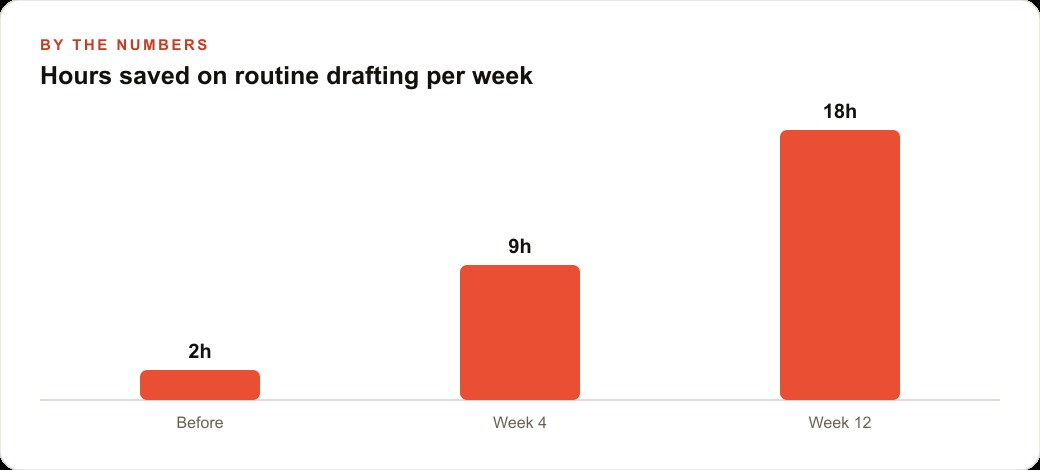
Stage three: build the small tools nobody ever funded, like a clause library search or a matter intake summarizer, each now an afternoon of work. Stage four: keep every output behind attorney review. Put illustrative numbers on it. A firm that saved a couple of hours a week on routine drafting at the start could realistically reach double digit hours saved within a few months as more tasks come online, which is real associate time returned to higher value work. Those recovered hours can go straight into client development, and the clean intake data those tools produce can flow into the firm's CRM and website stack so no inquiry falls through, while the extra capacity lets the firm actually follow up on the leads its Google Ads and Facebook and Instagram ad campaigns bring in instead of letting them sit.
Stage 5: Design the process to survive a model disappearing
Come back to the Fable 5 lesson to close the loop. The policy story is a reminder that access to any single model can change overnight, so never build a firm's workflow on one provider alone. Design the process around the task, document the prompts and the review safeguards separately from any one tool, and keep the whole thing portable across models. If a provider goes dark, you should be able to point the same prompts and the same review steps at another capable model and keep running. Portability is not a nice to have here. It is the direct, practical response to what just happened.
Why verification, not fluency, is the trait to build around
It is easy to be impressed by how well these models write, but fluency is not the capability that changes your business. Plenty of tools produce smooth text. What is genuinely new is the willingness to check. When the model added shadows nobody asked for because the sun position demanded them, worked through an azimuth angle to fix a render, and froze an orbit because it noticed its own screenshot tool had a delay, it was doing something a fluent text generator never does. It was testing its own work against reality before declaring it done.
That is the trait to organize your process around, because it maps directly onto the work that is expensive precisely because it must be correct. Cross checking a document against a checklist, reconciling numbers between sections, confirming a summary actually matches its source: these are verification tasks, and they are the ones where a model that measures and confirms is worth far more than one that merely sounds confident. When you design a pilot, choose a task where you can see the checking happen, and read the reasoning to judge whether it is genuinely verifying or just performing confidence. That distinction is the whole game.
The commission and judge shift changes who does what
The larger change is not the model's ability, it is the redistribution of human effort. The old workflow had a professional producing work from a blank page and using the tools to speed up parts of it. The new one has the professional describing an outcome, receiving a thorough draft, and spending their expensive time judging and correcting rather than generating. That sounds subtle, but it moves the human up the value chain, from author to editor, from producer to decision maker.
For a business, that reallocation is where the real return lives. Your most experienced people stop spending hours on first drafts that anyone could start, and instead spend that time on the judgment only they can provide. The recovered hours do not just vanish into slack. They flow into the higher value work that was always getting squeezed: client development, careful review of the hardest matters, the follow up that keeps good leads from going cold. Designing the process so that shift actually happens, rather than letting people keep authoring out of habit, is the difference between a firm that adopts these tools and one that merely owns them.
Portability is the lesson the ban is teaching
The Fable 5 episode is not really a story about one model. It is a warning about dependence. Any provider can go dark overnight for reasons that have nothing to do with your business, so the smart move is to design every workflow around the task rather than the tool. Document your prompts and review steps separately, keep them portable, and treat access to any single model as a convenience you can swap, not a foundation you cannot move. Build that way and a suspension becomes an inconvenience instead of a crisis.
You can absolutely begin this yourself with one careful pilot on a single low risk task. If you would rather have the prompts, the review safeguards, and the internal tools built and tested for your practice so the professionals only ever see vetted output, that is the kind of setup my team does, and a short call is the fastest way to see whether it fits your firm.
That is exactly what we do at AI DOERS. Book a private 30-minute call with Madhuranjan Kumar and we will map the fastest path to it for your specific business.
Book your call →
Madhuranjan Kumar
Madhuranjan Kumar brings 20 years of performance-marketing experience and has managed over $200 million in Facebook ad spend for brands across the United States and beyond. His expertise spans the full modern marketing stack: Meta, Google Ads, TikTok, email automation, CRM, and the websites that hold it together. At AI DOERS he turns that track record into lead-generation systems for businesses across every industry.