
Why The Government Just Forced Anthropic To Kill Claude Fable 5
A US export-control directive forced Anthropic to disable Claude Fable 5 for everyone just 76 hours after launch. The headline is dramatic, but the lesson for business owners is simple: never let your operations depend on a single brand-new model that can vanish overnight.
What happened to Claude Fable 5?
Anthropic abruptly cut off all access to Claude Fable 5, its newest public model, only about seventy-six hours after releasing it. The shutoff hit every customer, not just foreign ones, so people who had already built real work on the model suddenly saw it go dark. I, Madhuranjan Kumar, want to pull a practical business lesson out of this news, because the headline is dramatic but the takeaway for owners is simple and important: never let your operations depend on a single brand-new model that can disappear overnight. Fable 5 was the public version of a frontier model that had been teased for a long time, and it vanished almost as fast as it arrived.
Why did the government step in?
The government stepped in with an export control directive citing national security. The order suspended access to Fable 5 and the more powerful Mythos model for any foreign national, whether inside or outside the United States, and to comply with that, Anthropic disabled the model for everyone. Mythos had been described as the most powerful model available, given early to large companies and the government. Fable 5 was the public derivative, with safeguards added on top so that certain frontier research requests would be automatically blocked or rerouted. The reported trigger is that some unnamed company found a way to bypass those safeguards, and with the guardrails stripped, the model could in theory be pushed to do almost anything.
Anthropic complied with the legal order but pushed back publicly, saying the directive arrived without specific details and that any block on a deployment should be transparent, fair, and grounded in technical facts. The company called it a misunderstanding and said it is working to restore access. Industry voices framed the moment as bigger than one model. Aaron Levie called it a turning point for AI regulation, the point where a government starts deciding that certain models are too powerful for certain uses, which sets a precedent for more controls to come. There is even a cynical theory floating around that the model, reportedly costing three to six hundred dollars an hour to run, was never sustainable for everyone, and that the shutdown was convenient. That part remains speculation, not fact.
Which businesses should care about this?
Any business that has started building real workflows on AI should care. The lesson is not about politics, it is about dependency risk. If your bookings, your customer messages, or your back-office automations run entirely on one specific brand-new model, you are one announcement away from everything breaking. A law firm, an e-commerce store, a marketing agency, all of them face the same exposure. The good news in this episode is that only Fable 5 was affected. The rest of the lineup, including Haiku, Sonnet, and the Opus models, kept working normally the entire time. That is the whole point: the businesses that had a fallback ready barely noticed, while anyone who bet everything on the newest model was stuck. It is worth being honest about why the newest model is so tempting. People shipped real things on it fast, transcribing a customer call and building the requested features live, or rebuilding an app in a single prompt. That power is genuinely useful, and you can still experiment with it. The mistake is wiring your daily operations, the parts that have to work every morning, to something that is brand new, expensive, and unproven. Use the frontier model to explore, and run your business on something steady.
How would this affect a chiropractic clinic?
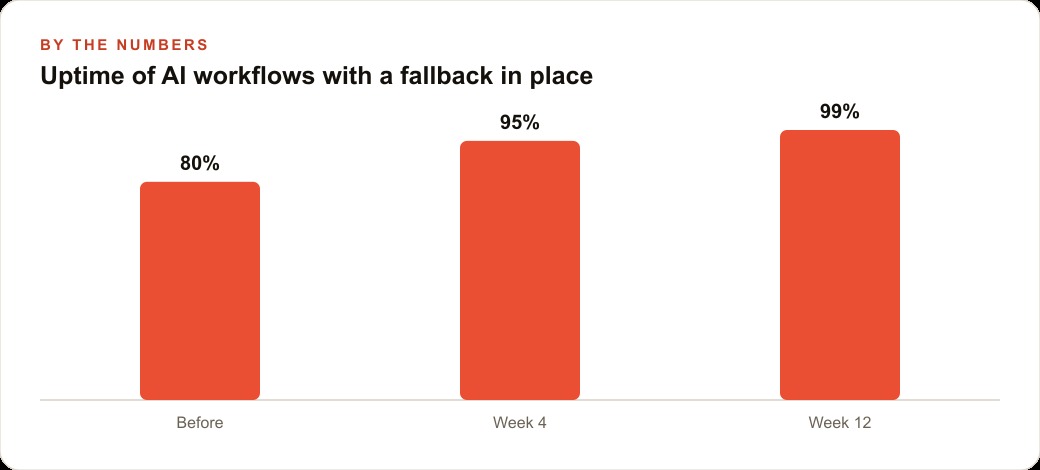
For a chiropractic clinic, here is how this plays out and how I would protect against it. Say the clinic runs an AI assistant that handles appointment reminders, answers common questions about visits and insurance, and drafts follow-up messages to patients. If that assistant is wired to one shiny new model and that model gets pulled, the front desk suddenly loses its automation on a Monday morning with a full schedule. So when I build for a clinic, I never hard-wire it to a single frontier model. I set up a fallback so the same workflow can switch to a stable model like Sonnet or Opus the moment the primary one is unavailable, and the reminders keep going out. I also keep the clinic's prompts and logic separate from any one provider, so swapping the underlying model is a small change, not a rebuild. And I budget realistically, because frontier models can be expensive to run, while the steady workhorse models are far cheaper and rarely the ones that get yanked. The clinic gets the benefit of AI without betting its daily operations on a model that could vanish in seventy-six hours.
How do I protect my own setup?
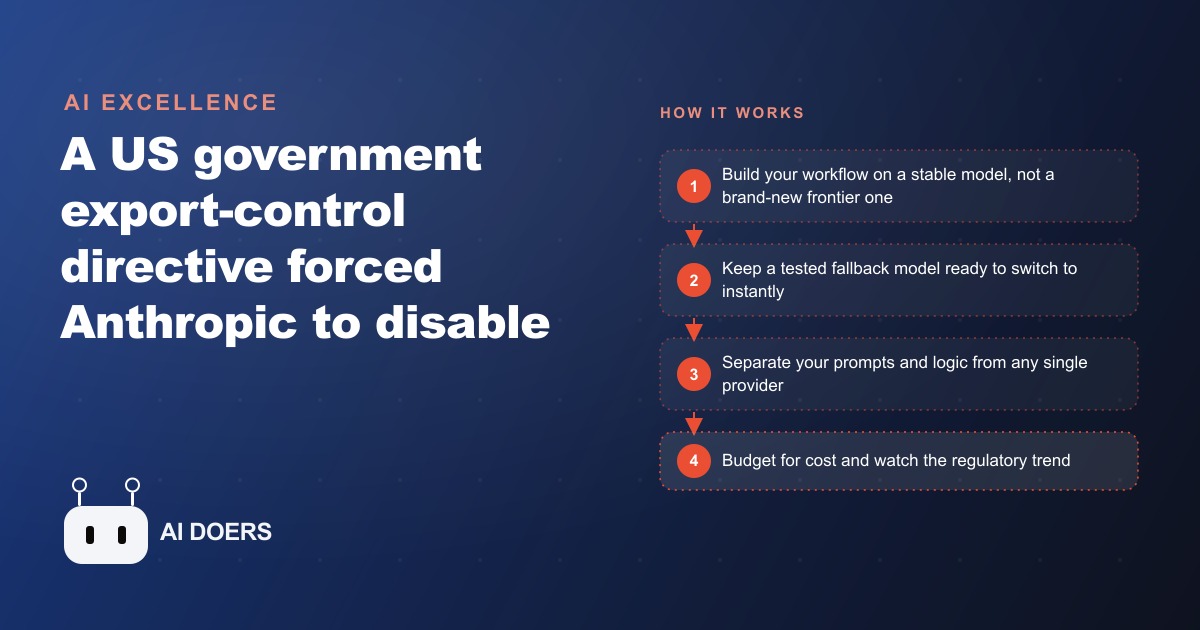
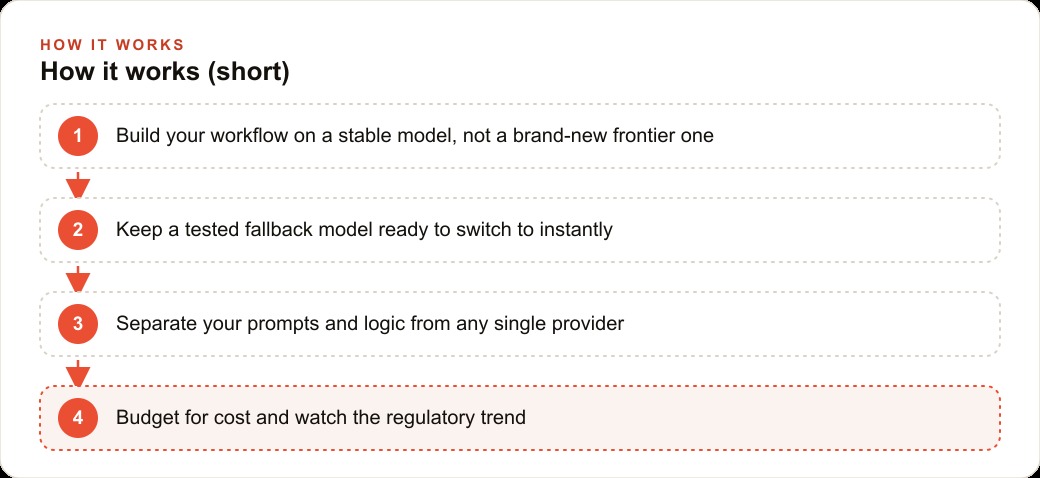
Build for resilience from the start. Do not put a production workflow on a brand-new frontier model that could be suspended overnight. Keep a fallback model ready and tested, since the stable models stayed available through this whole episode. Separate your prompts and business logic from any single provider so you can switch with one change instead of a rebuild. Budget realistically, because the most powerful models can run hundreds of dollars an hour while the dependable ones cost a fraction of that. And keep half an eye on the regulatory trend, because access you rely on today can be restricted tomorrow. None of this means avoiding AI. It means using it the way a real business should, with a backup plan.
You can absolutely set this up yourself by choosing a stable model and wiring in a fallback this week. If you would rather have me build your AI workflows so they keep running no matter which model gets pulled, that is exactly the kind of build I do for clients, and you can bring me in to handle it.
That is exactly what we do at AI DOERS. Book a private 30-minute call with Madhuranjan Kumar and we will map the fastest path to it for your specific business.
Book your call →
Madhuranjan Kumar
Madhuranjan Kumar brings 20 years of performance-marketing experience and has managed over $200 million in Facebook ad spend for brands across the United States and beyond. His expertise spans the full modern marketing stack: Meta, Google Ads, TikTok, email automation, CRM, and the websites that hold it together. At AI DOERS he turns that track record into lead-generation systems for businesses across every industry.