
Why the End of 2026 Feels Like a Turning Point for AI
Three forces are converging at once: reasoning models are producing original frontier math, agents are becoming the default interface, and the real moat has shifted from model quality to how much context an agent has about you. Here is how to put each shift to work in a business.

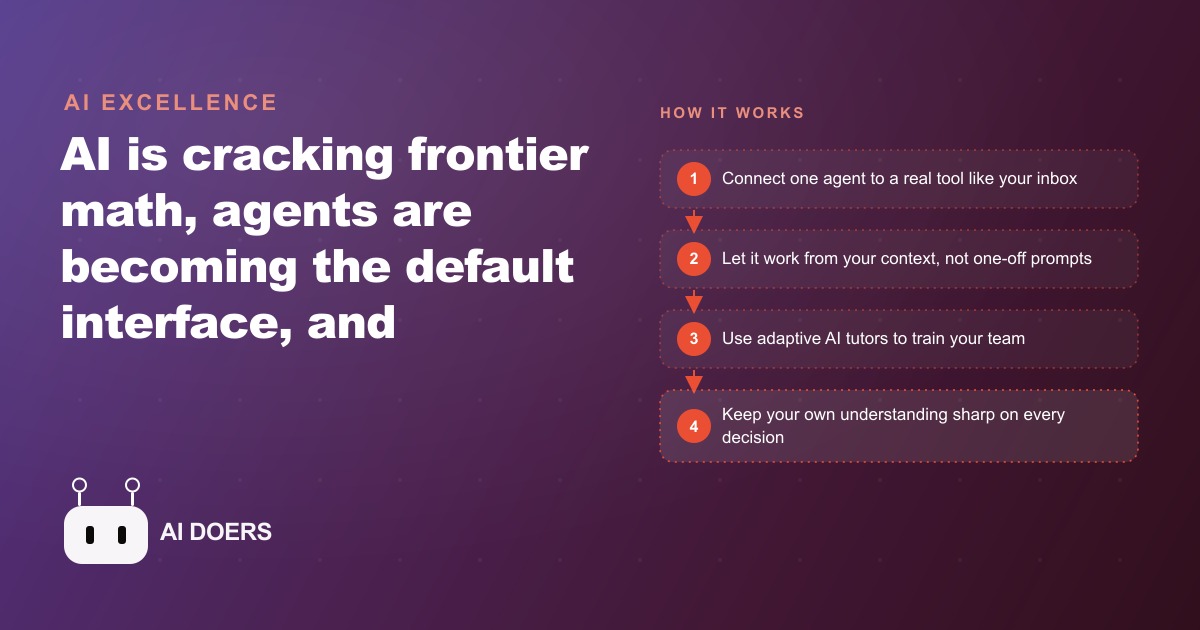
Here is a position most businesses are getting wrong at the end of 2026: they are still shopping for the best model, when the model is no longer the thing that decides who wins. The obsession with which system scores highest on the latest benchmark is a distraction from the two shifts that actually matter, and clinging to it is how a business ends up with an impressive tool that changes nothing. My argument is simple and I will defend it with the evidence this year handed us. Model quality has become close enough to a commodity that it is not your advantage. Context is your advantage, and the willingness to start now rather than wait is what separates the businesses that will pull ahead from the ones that will spend the next two years catching up.
The frontier is real, which is exactly why the model is not the moat
Start with the evidence that the frontier is genuinely advancing, because I am not arguing the technology plateaued. For years the assumption was that hard theorems would only fall to a purpose-built proof engine. Instead a general large language model, the same kind of system people use to draft emails, won the Math Olympiad gold. Reasoning models are now cracking real Erdos problems, and one produced an original proof disproving an eighty-year-old geometry conjecture first posed in 1946. One of the greatest living mathematicians stated publicly that these models recently turned a corner and became genuinely useful for mathematical discovery, which is a far higher bar than acing a benchmark. The capability curve is not slowing down.
Now here is why that cuts against the model-shopping instinct rather than for it. If a general model can produce original frontier mathematics, then the raw reasoning you need for ordinary business work is already sitting in several systems at once, and it is improving across all of them. When top-tier capability is broadly available and rising everywhere, picking the marginally better model buys you almost nothing, because your competitor can buy the same one tomorrow. Intelligence is starting to look like electricity: broad, universal, and increasingly a utility you plug into rather than a secret you own. The advantage was never going to live in the model once the model became a commodity. It has to live somewhere the commodity cannot reach.
Agents changed the interface, and that quietly changed the game
The second shift is structural and easy to underrate because it does not announce itself as a breakthrough. Nearly every major product is sprouting an agent layer, so instead of opening five tools and switching between them, you describe what you need to one agent that already knows your situation. Background agents now run around the clock, managing an inbox and a schedule and continuing to process in the cloud even when your device is offline. The number of buttons you push and sites you visit keeps dropping. This is not a feature. It is a change in the interface model itself, from operating software to delegating to something that operates it for you.
That change is what makes context decisive, and it is the hinge of my whole argument. An agent is only as useful as what it knows about you, and the moment the interface becomes delegation rather than operation, the differentiator stops being the intelligence doing the work and becomes the information it has to work from. Two agents running the same commodity-grade model will produce wildly different results if one of them lives inside your real email, calendar, and records and the other starts from a generic description of your business every time you open it. The interface shift did not just make AI more convenient. It relocated the entire competition onto context.
Context, not intelligence, is what actually compounds
This is the core of the position, so let me make it precise. An agent that already lives inside your email, calendar, contacts, and document history starts with context a standalone tool has to earn from scratch over many interactions. The same underlying model, applied with more context about you, produces a noticeably better result, which is why companies whose products already sit inside your daily workflow have a structural advantage over those asking you to adopt something new. And unlike model quality, which depreciates the moment a better model ships, context appreciates. It scales with use. An agent embedded in your systems for two years will feel dramatically more capable than one set up today, not because the model got better, but because it accumulated two years of understanding of how your business actually operates.
That asymmetry is the whole case. Model quality is a rented advantage that resets with every release. Context is an owned advantage that compounds with every interaction. If you spend your energy chasing the former, you are running to stay in place. If you spend it building the latter, you are building something a competitor cannot simply purchase. The same logic is why the data already in your CRM and website stack is worth more than most owners realize: it is the raw material of the only moat that lasts.
The counterargument, and why it fails
The honest objection to all of this is: why not wait? The tools are changing fast, they will be more mature and easier to adopt in a year, so surely the patient move is to let the dust settle and buy the finished version later. This sounds prudent and it is exactly wrong, because it misunderstands what you are actually building. If the advantage were the tool, waiting would be sensible, since a better tool arrives later. But the advantage is the context, and context only accumulates while the agent is running inside your business. You cannot buy two years of accumulated context in a year. You can only grow it, and the clock does not start until you connect the first tool.
There is a second, subtler flaw in the wait-and-see stance. It assumes the hard part of adoption is the tool, when the hard part is almost always the organizational change around it: cleaning the data the agent will read, defining what it may and may not do on its own, and getting people to actually route their work through it. None of that gets easier by waiting, and much of it takes weeks regardless of how polished the tool is. A business that starts now spends those weeks while the stakes are low and the expectations are modest. A business that waits still has to spend them later, except now it is behind and under pressure to catch up fast, which is the worst possible condition for careful change.
Waiting does not defer the cost. It hands the compounding head start to whoever started sooner. The competitor who connects an agent to their real systems this year will, by the time you finally begin, have an agent that knows their operation intimately while yours knows nothing, and no amount of superior model quality closes a gap made of accumulated context. The mid-market reality underlines how much room there is to move: companies doing serious revenue still run on-premises servers and spreadsheets, because adoption moves only as fast as people will actually change their behavior. That slowness is not a reason to wait. It is the opening, because the bar to being early is genuinely low right now.
A worked example: a real estate brokerage that stops waiting
Make it concrete with a real estate brokerage, using illustrative numbers. The biggest daily drain in most brokerages is context-switching: chasing email threads, updating calendars, answering the same buyer questions for the fifth time that week, and keeping listing details straight across several live deals. Every one of those is expensive in broker attention and cheap for an agent that already has the context, which is precisely the argument in miniature.
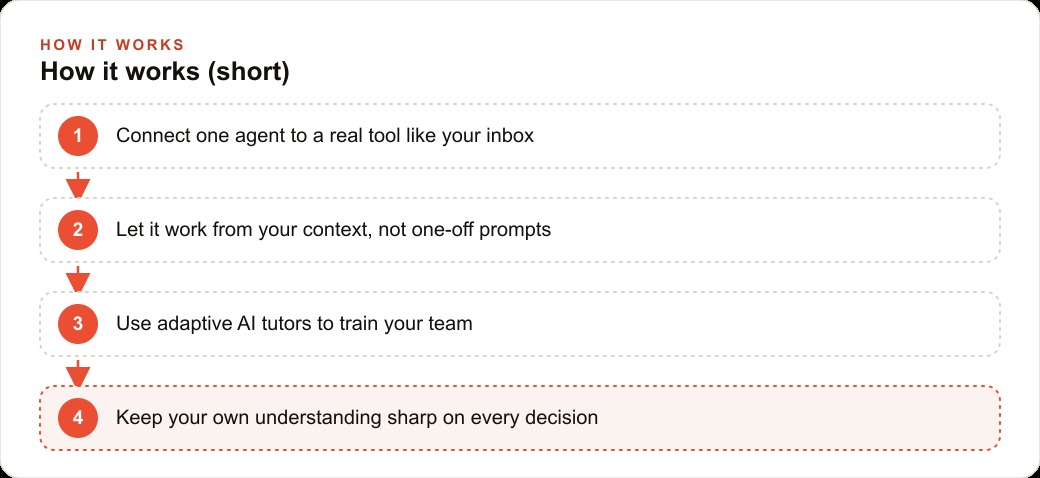
Step one connects the agent to the real systems, wiring a background agent into the brokerage's email, calendar, and contact records so it knows who each client is, where they are in their search, what they have seen, and what they said about it. It does not need to be told this each time. It drafts follow-ups from the actual history of the deal, schedules showings against the real calendar, and surfaces the next action for each active lead. Step two makes context the operational moat by deliberately feeding the agent what a national portal cannot have: the neighborhoods the brokerage specializes in, the buyers each broker works best with, and the common objections at each stage and how the team handles them, so outreach drafts read in the specific broker's voice rather than sounding automated. Step three sets up adaptive AI tutoring for new brokers on contracts, negotiation, and local market knowledge, so each new hire gets a tutor that finds their gaps and adjusts pace instead of covering material at the speed of the slowest learner. The research behind the well-known two-sigma finding shows self-paced learning paired with one-on-one tutoring can move an average learner up by roughly two standard deviations against a conventional classroom, and adaptive AI tutors finally make that affordable, so a new broker reaches competence faster, stays longer, and costs less to train.
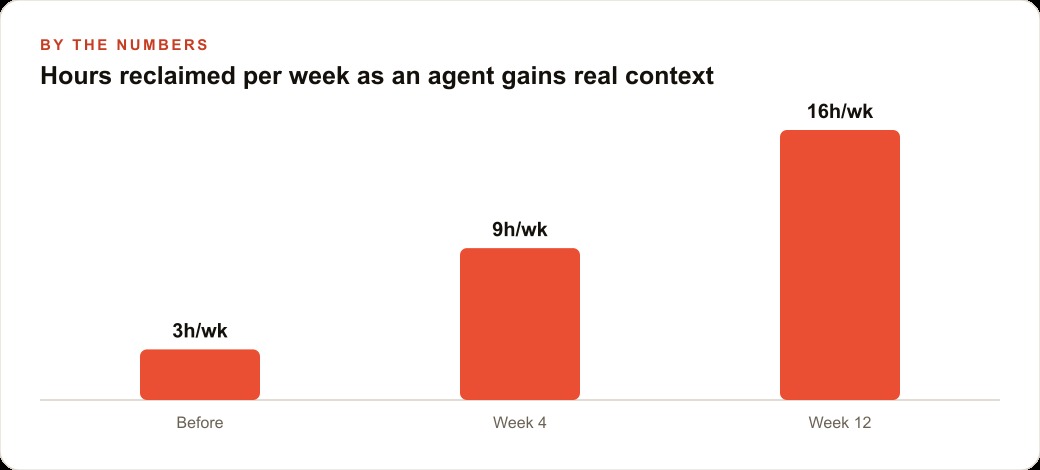
Put rough numbers on the payoff. In a mid-size brokerage, brokers might start out losing only a few hours a week to work an agent could carry, because the agent has almost no context on day one. As it accumulates history, that reclaimed time climbs, plausibly to nine hours a week per broker by the second month and toward sixteen by the third, with the exact figure depending on how clean the existing data is and how well the agent integrates with the tools in use. Those reclaimed hours go back into the judgment and relationship work that actually closes deals, and the whole system runs better when the leads feeding it arrive pre-qualified from well-targeted Facebook and Instagram ad campaigns and the listings are structured to be found through SEO and organic search. Notice that the gain grows over time, which is the compounding context argument showing up directly in the numbers.
The one thing you must not outsource
There is a limit baked into this position that protects every business, and ignoring it is the mistake that turns an advantage into a liability. You can outsource research, notes, and charts to AI. You cannot outsource understanding. The simple test still holds: if you cannot explain something simply, you do not really grasp it, and a generated script read aloud is not comprehension. Heavy AI users are already developing an ear for AI-written copy being performed as if it were real knowledge, which means the people you deal with can increasingly tell the difference too. Authentic understanding of your own analysis is a form of credibility the model cannot simulate, only support.
So the brokerage sets a firm rule: every broker must be able to explain the agent's recommendation for any deal in their own words before acting on it. The agent carries the research and drafting. The broker carries the judgment and the relationship. That boundary costs nothing to implement and prevents the failure mode where no one can say why the AI made the call it made. It is the counterweight that lets you lean hard on agents without being fooled by them.
My position, restated plainly: stop optimizing for the best model, because that race is a commodity now, and start compounding context and protecting your own understanding, because those are the only advantages that last. The businesses waiting for the tools to feel inevitable are handing the head start to the ones building context today. You can begin this yourself this week with one agent and one real tool. If you would rather have someone wire the agent into your actual systems, build the context layer properly, and set up training that keeps your team's understanding sharp, that is exactly the kind of work I do for clients, and you can bring me in to handle it.
That is exactly what we do at AI DOERS. Book a private 30-minute call with Madhuranjan Kumar and we will map the fastest path to it for your specific business.
Book your call →
Madhuranjan Kumar
Madhuranjan Kumar brings 20 years of performance-marketing experience and has managed over $200 million in Facebook ad spend for brands across the United States and beyond. His expertise spans the full modern marketing stack: Meta, Google Ads, TikTok, email automation, CRM, and the websites that hold it together. At AI DOERS he turns that track record into lead-generation systems for businesses across every industry.