
Why Simple AI Agents Beat Complex Ones, and What Context Engineering Means
The tempting idea of an army of AI agents working under you is mostly a trap. Reliable agents share full context and avoid conflicting decisions. Here is how that principle would shape an automation for an insurance agency.

Most businesses building AI automations are designing for the wrong failure mode. They are guarding against the agent not knowing enough, so they add more agents, more tool calls, more parallel processes, and more decision points. The automation fails anyway, not because the agent lacked information, but because the information it did have was wrong, incomplete, or out of order.
The principle that fixes this is context engineering: giving an agent exactly the right information in the right order, so it makes consistent decisions. The architecture that makes context engineering work is simpler than most automation builders expect. A single linear agent making all decisions outperforms a multi-agent architecture for the majority of real business automation tasks. This is not intuition. It is what the engineering evidence consistently shows.
The Context Problem Is More Expensive Than the Compute Problem
When an AI agent makes a bad decision, the most common cause is not that the model is insufficiently capable. It is that the agent was missing information that would have changed its decision, or it received that information in an order that made it inaccessible when the decision was made. This is the context problem, and it is more expensive than the compute problem because it is invisible until it manifests as a failed output.
The compute problem is easy to see. A model is slow, or it runs out of context window, or it costs too much per call. These failures are measurable and correctable. The context problem is harder to see because the agent produces an output that looks reasonable. It just happens to be wrong in a specific way that only becomes visible when checked against the ground truth or when a downstream step fails because its input was not what it expected.
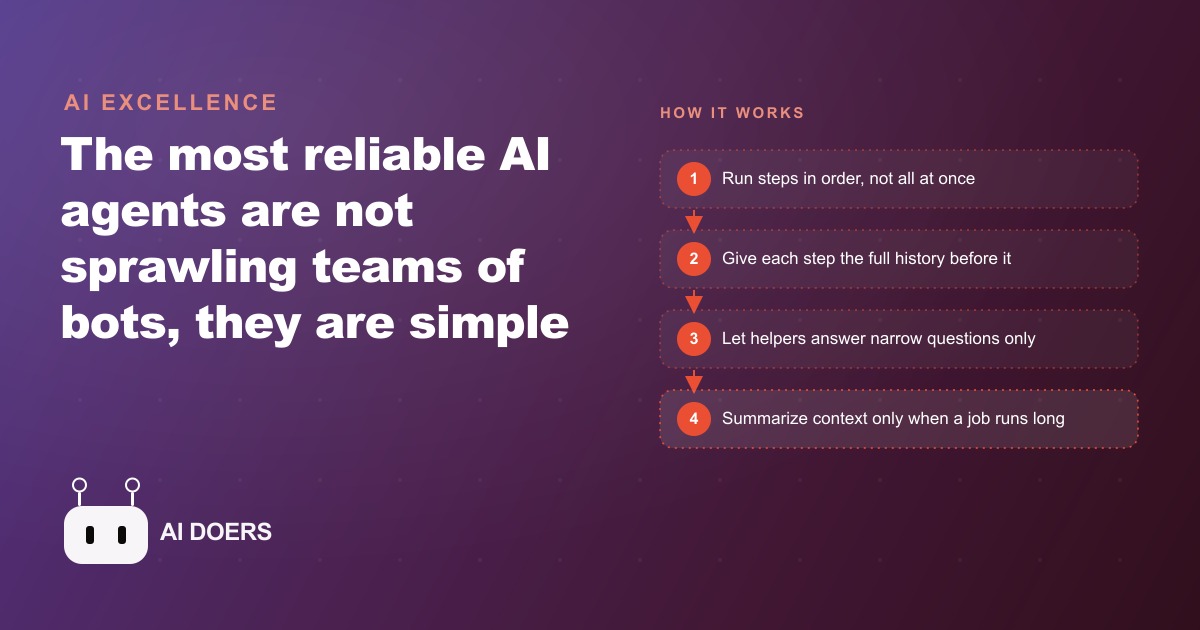
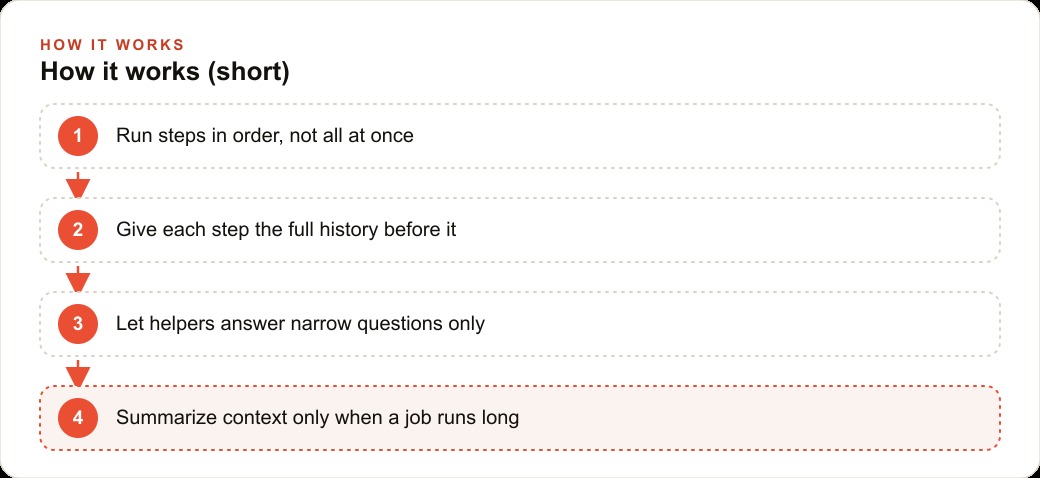
Context engineering is the discipline of making the context problem visible and solvable before deployment rather than after. The four principles that make it practical are: every step sees the full history of what happened before it; actions carry the context that explains why they were taken; parallel agents without shared context make conflicting choices; and sub-agents answer narrow questions but never make decisions.
Full History at Every Step Prevents the Most Common Agent Failure
The most common failure in multi-step automation is an agent that takes an action without knowing what the previous steps established. A second-step agent that does not know what the first step decided will either repeat work, contradict the first step's decision, or make assumptions inconsistent with what has already happened. Any of these outcomes breaks the automation.
Full history visibility is the fix. Every step in a well-designed agent workflow receives the complete record of every previous step: what was done, what was found, what was decided, and what was deferred. The agent does not need to infer what happened before. It can read it. The cognitive overhead of maintaining coherence across steps falls to near zero when the context is complete.
For business automations that involve multiple information-gathering steps before an action step, full history visibility is not optional. Consider a client intake automation that reads a form submission, queries a CRM for the client's history, checks a calendar for available time slots, and then sends a personalized booking confirmation. If each step has access only to its immediate input and not to what the previous steps found, the confirmation email cannot reference the client's history, the calendar query cannot account for preferences the form revealed, and the CRM query cannot skip fields the form already captured. Full history makes the automation coherent. Partial history makes it fragmented.
Actions That Carry Hidden Decisions Break Parallel Architectures
Parallel agent architectures appeal to developers because they look efficient. Run multiple agents simultaneously, combine their outputs, move faster. The problem is that each parallel agent makes decisions independently, and those decisions may conflict in ways that are not visible until the outputs are combined.
Consider a parallel architecture where one agent drafts a client email and another agent selects a follow-up date, both operating simultaneously. The email agent drafts a message that references "the meeting we discussed" and proposes a specific tone based on its read of the client situation. The date agent selects a follow-up date based on a calendar availability rule. When the outputs are combined, the email may reference a meeting that the date agent did not account for, or the date selected may be inconsistent with commitments the email implies. Neither agent made an error in isolation. They made conflicting decisions because they were not sharing context.
The fix is not to make the parallel architecture more complex. The fix is to recognize that the tasks these agents were performing were not actually independent. One of them needed to happen first. The decision it produced needed to be in the context of the second. This is a sequential dependency, and sequential dependencies belong in a linear architecture.
The Single Linear Agent Pattern Works for More Tasks Than Teams Expect
The model router pattern, where one main agent makes all decisions and takes all actions while helper agents answer only narrow research questions, handles the majority of real business automation tasks correctly. The main agent has full context. It takes an action, observes the result, and incorporates the observation into the context before taking the next action. Sub-agents are called when a narrow question needs answering, such as "what is the current status of this order" or "what does the policy say about this exception case." The sub-agent returns a factual answer. The main agent decides what to do with it.
This architecture is not intellectually satisfying to developers who want to build complex distributed systems. It is the architecture that produces correct outputs reliably. For business owners building their first automations, the single linear agent pattern is the one to start with, and the evidence suggests it is also the one to stick with unless a specific bottleneck demands a different approach.
The key distinction is between research tasks and decision tasks. Research tasks are those where the answer can be determined by looking something up, calculating a value, or checking a condition. Decision tasks are those where judgment is applied and an action is taken based on that judgment. Research tasks are safe to delegate to sub-agents. Decision tasks must stay with the main agent that has full context. When teams violate this boundary by having sub-agents make decisions, the automation becomes unpredictable in the same way that parallel agents become unpredictable.
Building the Insurance Agency Automation: Information Gathering First
An insurance agency following up on quote requests illustrates the playbook in practice. The automation outcome is a personalized, contextually accurate follow-up message sent to every prospect within a defined time window, without human intervention for the majority of cases.
The first stage is information gathering. The main agent reads the prospect's quote request form, retrieves their CRM record if one exists, and pulls the policy type and coverage amount they inquired about. All of this information is captured in the running context. Nothing is summarized or discarded. The agent now knows who the prospect is, what they asked about, and what history the agency has with them.
Every field the form captures goes into the context: the prospect's name, the policy type they inquired about, the coverage level they indicated, the channel they came through, and any specific questions they raised in the comments field. If the CRM record exists, the agent adds the history of previous interactions, any past quotes, and any expressed preferences from prior conversations. The context at the end of this stage is a complete picture of who this prospect is and what they need from this follow-up.
Evaluating the Context Before Taking Any Action
The second stage is context evaluation. The main agent reviews the gathered information and makes a routing decision: is this a standard follow-up case, an edge case that needs human review, or a case where additional information is needed before an action can be taken?
The routing logic is defined in the agent's instructions before deployment. Standard cases are those where the prospect's request is unambiguous, the CRM shows no prior issues, and the coverage request falls within the agency's standard product range. Edge cases are those where the prospect has a history of disputes with the agency, the coverage request is outside standard parameters, or the form contains conflicting information. Cases requiring more information are those where the form is incomplete in a field that affects the message content.
The agent applies the routing logic to the specific context and produces a routing decision with a reasoning trace that explains which rule was applied and why. The reasoning trace is logged with the decision. If the automation's routing behavior needs to be audited later, every decision has a documented rationale.
Drafting and Compliance Checking as Separate Steps
The third stage is action selection and drafting. For standard follow-up cases, the main agent drafts a personalized message referencing the specific policy type, the coverage amount, and any relevant history from the CRM record. The draft is not sent immediately. It is checked against a compliance rule list before it goes out.
The compliance check is a narrow question delegated to a sub-agent: "Does this draft contain any of the following prohibited phrases or coverage commitments?" The sub-agent returns a pass or fail with an explanation of what triggered the fail if one occurred. The main agent reads the result and acts on it: sending the message if the check passes, revising the specific flagged element if the check fails, or escalating to human review if the issue cannot be resolved by revision.
This two-step draft-and-check process is the pattern that makes the automation trustworthy enough to run without a human reviewing every output. The compliance check is not judgment. It is a defined rule set applied to a specific draft. That is exactly the kind of narrow, answerable question that belongs with a sub-agent.
Execution, Logging, and the Human Review Queue
The fourth stage is execution and logging. The message is sent through the agency's preferred outreach channel. The CRM record is updated with the follow-up event, the message content, the compliance check result, and the timestamp. The context for this prospect's case is marked complete.
If any stage produced an unexpected result, such as a CRM lookup that returned no record for a prospect who should have one, a form field that contained an impossible value, or a compliance check that flagged an issue the revision step could not resolve cleanly, that result is flagged in the human review queue. The automation does not attempt to handle the unexpected case by guessing. It surfaces the case for human judgment with the full context of what it found and what it could not resolve.
This is the correct design for a business automation: the system handles the standard cases without human intervention, and it routes the non-standard cases to humans with enough context that the human can act quickly without having to re-gather information the system already collected.
Context Compression for Long-Running Jobs Requires Deliberate Design
For automations that run over many steps, such as a multi-day onboarding sequence or a complex research task that spans hours, the context eventually grows too large to fit in a single model call. Context compression is the solution: the running context is summarized at defined intervals, and the summary replaces the full detail in the active context window.
Compression is powerful but it introduces risk. A poorly designed compression step loses information that later steps need. The agent makes a decision based on a summary that omits a relevant detail from an earlier step, and the output diverges from what a full-context run would have produced. The guidance on compression is specific: compress only when the context length makes the automation impractical to run, define exactly what information the compression step must preserve, and verify the compression output against that definition before proceeding.
For most business automations, the context length stays manageable without compression. A standard client intake, follow-up, or data processing task completes in fewer steps than the context window requires. The compression question only becomes relevant for automations that run continuously over extended periods or that involve research tasks spanning large volumes of source material.
Simplicity in Agent Design Mirrors Simplicity in Business Operations
The same principle that makes simple agent architectures outperform complex ones applies to business operations at every level. A workflow with one owner, clear sequential steps, and full information at each step outperforms a workflow with multiple owners, parallel tracks, and partial information at handoff points.
Businesses that run Facebook and Instagram ad campaigns with a clear sequential testing methodology produce better results than businesses that run parallel tests without a consistent decision framework. Businesses managing Google Ads campaigns with a single account lead who sees the full performance history make better optimization decisions than those splitting the account across multiple managers who each have partial context. The operational principle and the agent design principle are the same: full context, clear sequence, decisions made by whoever has the most complete picture.
The automation architecture a business builds reflects and reinforces its operational discipline. Starting with a simple linear agent is not a limitation. It is a structural choice to build something that works reliably and can be extended deliberately, rather than something complex that works intermittently and fails in ways that are hard to diagnose.
What a Reliable Automation Actually Requires
A business automation that completes correctly without human intervention needs four properties. It needs full context at every decision point. It needs a clear decision owner. It needs narrow, answerable sub-tasks delegated to helpers rather than judgment delegated to helpers. And it needs a defined boundary for when human review is appropriate.
None of these properties requires a sophisticated architecture. They require deliberate design choices made before the first line of agent instruction is written. The teams that make those choices before building produce automations that run correctly from the first deployment. The teams that discover the need for these properties through failed runs in production spend significantly more time and budget on the learning curve.
Simple systems scale faster and break less. That is an engineering observation confirmed every time a well-designed linear agent handles a real business workflow reliably while a complex multi-agent architecture fails at an edge case the designers did not anticipate. The businesses that understand this before they build their first automation will be running reliable systems while their competitors are still debugging their third.
That is exactly what we do at AI DOERS. Book a private 30-minute call with Madhuranjan Kumar and we will map the fastest path to it for your specific business.
Book your call →
Madhuranjan Kumar
Madhuranjan Kumar brings 20 years of performance-marketing experience and has managed over $200 million in Facebook ad spend for brands across the United States and beyond. His expertise spans the full modern marketing stack: Meta, Google Ads, TikTok, email automation, CRM, and the websites that hold it together. At AI DOERS he turns that track record into lead-generation systems for businesses across every industry.