
Why Running Many Small AI Pods Beats One Big Bet
A single strategy tempts you to micromanage out of impatience and hurt your own returns. Many unrelated pods, each built with one model for data and another for analysis and watched by automation, let losers and winners net out positive across the whole portfolio.

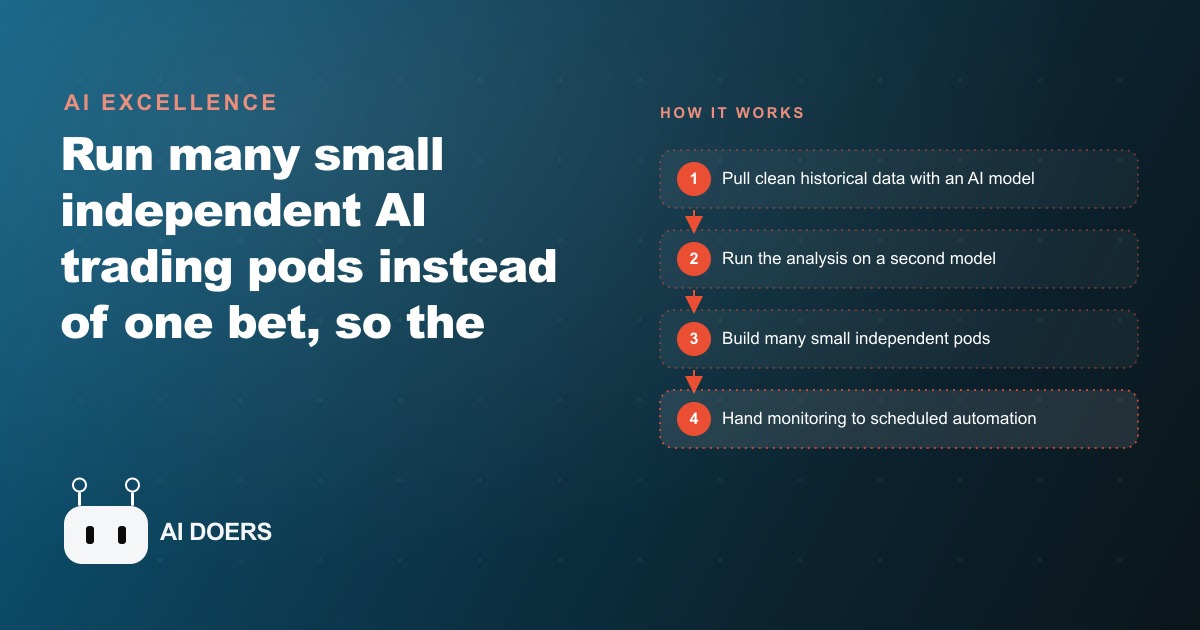
Taking apart the idea of a portfolio of AI pods
Most people hear "AI trading" and picture one clever model making one big bet. The more durable idea is almost the opposite, and it is worth taking apart carefully because the structure, not the strategy, is what makes it work. I am Madhuranjan Kumar, and the concept is this: instead of pouring everything into a single setup, you build many small independent units, each running its own approach in its own instance. I think of them as pods. One pod might run a short-term routine, another a mean-reversion pair trade, another a longer directional position. They are unrelated, and they run in parallel. The rest of this piece pulls that idea apart from a few angles, because each angle reveals something the surface description hides.
The first facet: this is a structure, not a magic strategy
The most common misread is treating pods as a special money-making technique. They are not. A pod is a container. What goes inside can be an ordinary, well-understood approach. The power is in running many of them at once rather than in any single one being brilliant. That distinction matters because it changes what you optimize. You stop hunting for the one perfect strategy and start building a system that survives the fact that no single strategy stays perfect. The structure is the edge, and the individual bets are almost interchangeable parts within it.
Once you see it as a structure, the goal clarifies. You are not trying to make every pod win. You are trying to make the combined result come out green. Some pods lose, some gain, and that spread is a feature, not a flaw. A single strategy has to be right to survive. A portfolio of unrelated pods only has to be right in aggregate, which is a far more forgiving bar.
The second facet: the reason is psychological before it is financial
Here is the angle that surprises people. The strongest argument for pods is not diversification math, it is human behavior. If you run only one thing, you stare at it. You start interfering out of impatience, forcing activity where none is needed, and you quietly hurt your own expected value. The single position becomes a screen you cannot look away from, and the looking is what does the damage.
Spread the same capital across a dozen unrelated pods and the psychology flips. No single pod is worth obsessing over, because no single pod can sink you. You can let each one run like an index fund and judge the whole basket instead of any one bet. The structure protects you from your own worst instinct, which is to meddle. That is why I keep saying the structure is the point: it is not just financially diversified, it is behaviorally diversified. It removes the emotional single point of failure, which for most operators is the real risk.
The third facet: the two-model split between fetching and judging
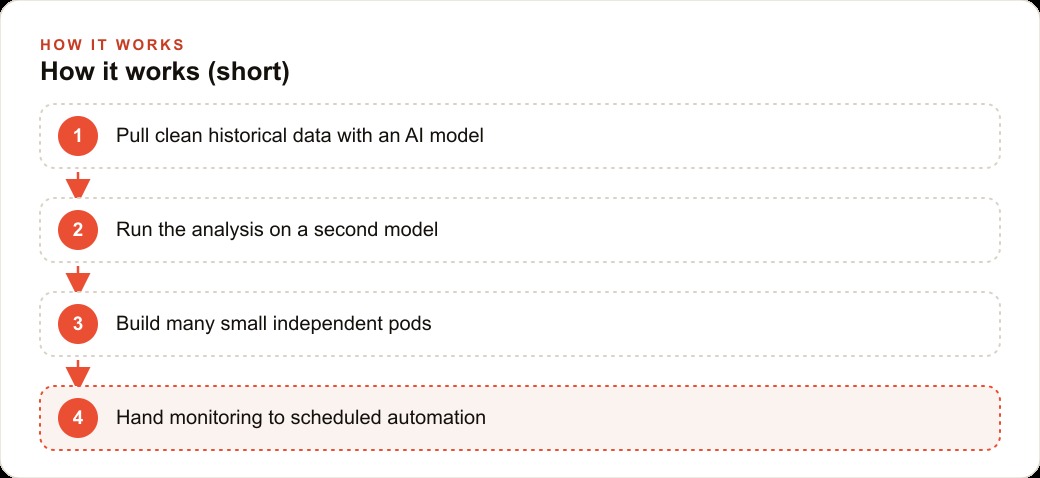
Every pod starts with data, because the data is the gold that leads to everything else. The models cannot do anything useful here without good inputs, so the workflow begins by pulling clean historical records, for example several years of closing prices through a free data package. But the interesting design choice is that this is a two-model job, not one. One model is good at finding the right source and wrangling the data. A second, stronger reasoning model runs the actual analysis on that data, looking for the pattern and judging whether it still holds.
That split is deliberate and it generalizes far beyond trading. Fetching and judging are different skills, and pretending one model must do both is how you get mediocre results at both. You can also start from either end of the pipeline: begin with a strategy idea and hunt for the data to test it, or begin with the data you already have and let the model find the pattern. Both directions work. The discipline is to keep the roles separate, so the tool that gathers is not the tool you trust to decide.
The fourth facet: correlation decays, so the hunt matters more than the pair
This is the facet that keeps the whole idea honest. Take a classic example, two well-known beverage stocks that historically moved together. The clean mean-reversion trades between them happened during a window when their ratio was stable. Then a real-world shock changed one company's fundamentals, and the pair stopped being reliably correlated. The trade that used to work stopped working. If you were married to that one pair, you would have kept running a dead strategy.
The right response is not to abandon the approach, it is to hunt for a better pair. Ask the reasoning model how to find candidates, then have the data model list fresh ones. In the example, a replacement pair showed far stronger recent correlation, with something like fifteen winners out of twenty-one trades and a structurally sounder profile. The lesson is bigger than trading: no relationship stays stable forever, so the process of hunting matters more than any single pair you find. A pod is not a permanent bet, it is a slot you keep refilling with whatever currently works. Systems that assume permanence break. Systems that assume decay and plan to re-hunt survive.
The fifth facet: understanding beats blindly running the code
There is a temptation to let the model build the pod and just run it without grasping why it works. That is a trap. The better practice is to make the model teach you, to explain its signal in plain language before you commit. A good analogy for a mean-reversion pair is two twins linked by a rubber band: the band stretches when they drift apart and snaps them back together, so when the spread stretches to your threshold you bet on the snap-back, and if the band goes dangerously slack you exit because the pair may have simply broken. When you can explain the signal that simply, you can spot the same pattern in your next pod and you can tell when it has stopped applying. Understanding is not a nicety, it is what lets you run many pods without being fooled by any one of them.
The sixth facet: automation is what makes a dozen pods survivable
The final piece is what turns a nice idea into something a real operator can actually run. Once a pod is built and you understand it, you hand the monitoring to a scheduled job that checks the health of each setup on its own, say every couple of hours. Without that automation layer, a portfolio of a dozen pods would be a full-time job of anxious staring, which reintroduces the exact psychological problem pods were supposed to solve. The scheduled check is what lets you run many experiments without babysitting any of them. It is the mechanical enforcement of the "do not meddle" rule.
A worked example outside trading: an auto repair shop's lead pods
The pod structure is really a way of thinking, and it travels well beyond markets. Consider an auto repair shop that treats lead generation and pricing as a set of small independent pods instead of one big marketing gamble. Pod one is a local search and reviews push for brake jobs. Pod two is a seasonal tire-changeover offer. Pod three is fleet-maintenance outreach to nearby small businesses. Pod four is a simple win-back text to customers who have not visited in a year. Each pod gets its own small budget, its own message, and its own tracking, exactly like the trading pods each get their own instance.
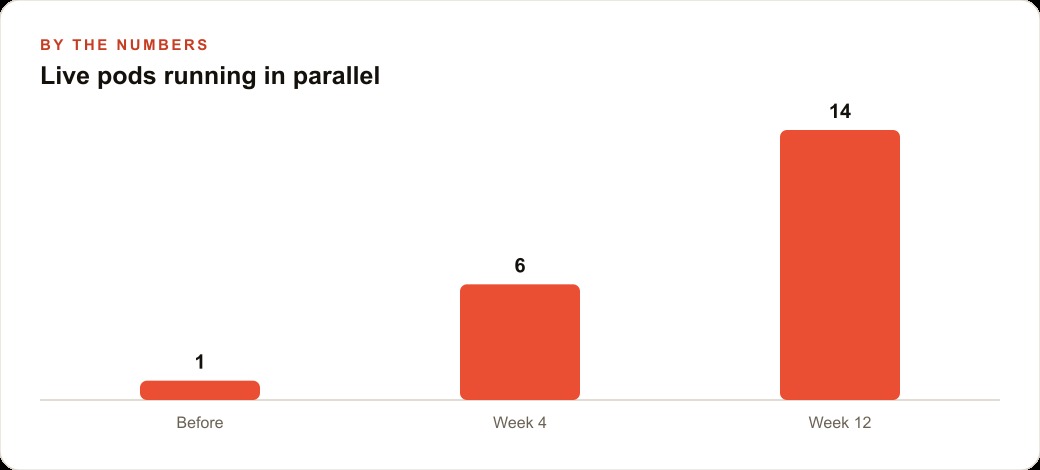
The data-first discipline applies here too. The shop pulls its own clean records first, past invoices, service intervals, and which jobs actually carry margin, then a model analyzes that history and flags which offers historically convert and which season drives them. Some pods underperform in a given month, and that is fine, because the goal is that across all four the shop ends the quarter green. The two search-driven pods lean on Google Ads and local visibility, the reviews and content work compounds into SEO and organic search, the win-back texts run out of the shop's CRM and website stack where follow-up is automated, and the whole set is watched by a scheduled weekly report so the owner steers the portfolio instead of obsessing over one slow campaign. Framed as illustrative, the shop might go from one lonely marketing channel to six running in parallel over a few months, with the combined result trending positive even as individual pods rise and fall.
A seventh facet: position sizing and failure isolation
There is one more angle that deserves its own treatment, because it is where the pod structure quietly protects you: sizing and failure isolation. Running many pods only works if no single pod can do catastrophic damage when it fails, and pods do fail, that is designed in. The whole premise is that some lose while the combined result stays green. That premise collapses the moment one pod is sized large enough that its failure sinks the portfolio. So the discipline is not just to diversify the strategies, it is to size each pod small enough that any one of them going to zero is survivable and boring rather than fatal.
This is where the "run each pod in its own instance" detail stops being a technical footnote and becomes the point. Isolation means a failure stays contained. If one pod's assumption breaks, the correlation decayed, the pattern stopped holding, the world changed, the damage is walled off inside that pod and does not cascade into the others. Contrast that with a single large strategy, where one broken assumption takes down everything at once. The pod structure is, at its heart, a way of buying insurance against being wrong, and you are always eventually wrong about something. Small, isolated, replaceable units are how you make being wrong a routine cost rather than a disaster.
The sizing rule also solves the psychology problem from a different direction. Earlier I argued that pods protect you from meddling because no single bet is worth obsessing over. Correct sizing is what makes that true. If a pod is too large, you will obsess over it no matter how many others you run, because your outcome hinges on it. Size every pod so that its individual result genuinely does not matter to your sleep, and the temptation to interfere evaporates on its own. The math and the psychology reinforce each other: small pods are both financially safer and emotionally easier to leave alone, which is exactly the combination that lets automation carry the monitoring.
The same discipline transfers cleanly to a business running marketing pods. A shop that puts its entire budget into one channel is running a single oversized pod, and when that channel underperforms, the whole quarter suffers and the owner panics and starts meddling. A shop that splits the same budget across several small, isolated channels, some on Google Ads, some on content that feeds SEO and organic search, some on win-back campaigns run out of the CRM and website stack, has bought itself both diversification and calm. When one channel has a bad month, it is a contained, expected event, not a crisis. Framed as illustrative, that is the difference between an operator who steers a portfolio and one who lurches from one desperate bet to the next.
The idea, reassembled
Pull the facets back together and the shape is clear. A portfolio of AI pods is a structure, not a spell. Its first virtue is psychological, protecting you from meddling with a single bet. It runs on a two-model split between fetching and judging, it assumes correlation decays so it keeps re-hunting, it demands that you understand each signal in plain language, and it survives only because automation carries the monitoring. Every one of those facets is a design choice you can copy into any domain where you make repeated bets under uncertainty.
You can build this yourself with patience and clean inputs, and I would encourage you to start with one small pod, prove it, then copy the structure for the next. If you would rather have the data pipeline, the analysis split, and the automated monitoring set up correctly from day one, that is the kind of system worth standing up deliberately. The core insight is portable: many small independent bets, watched by machines and understood by you, beat one big bet you cannot stop touching.
That is exactly what we do at AI DOERS. Book a private 30-minute call with Madhuranjan Kumar and we will map the fastest path to it for your specific business.
Book your call →
Madhuranjan Kumar
Madhuranjan Kumar brings 20 years of performance-marketing experience and has managed over $200 million in Facebook ad spend for brands across the United States and beyond. His expertise spans the full modern marketing stack: Meta, Google Ads, TikTok, email automation, CRM, and the websites that hold it together. At AI DOERS he turns that track record into lead-generation systems for businesses across every industry.