
Why OpenAI Killing Sora Is a Lesson in Focus, Not Failure
OpenAI is shutting down Sora entirely, the consumer app, the developer API, and video inside ChatGPT, because it is compute constrained and is redirecting GPUs toward coding and business productivity. The real lesson is not about video, it is about focus, and any small business can apply it.

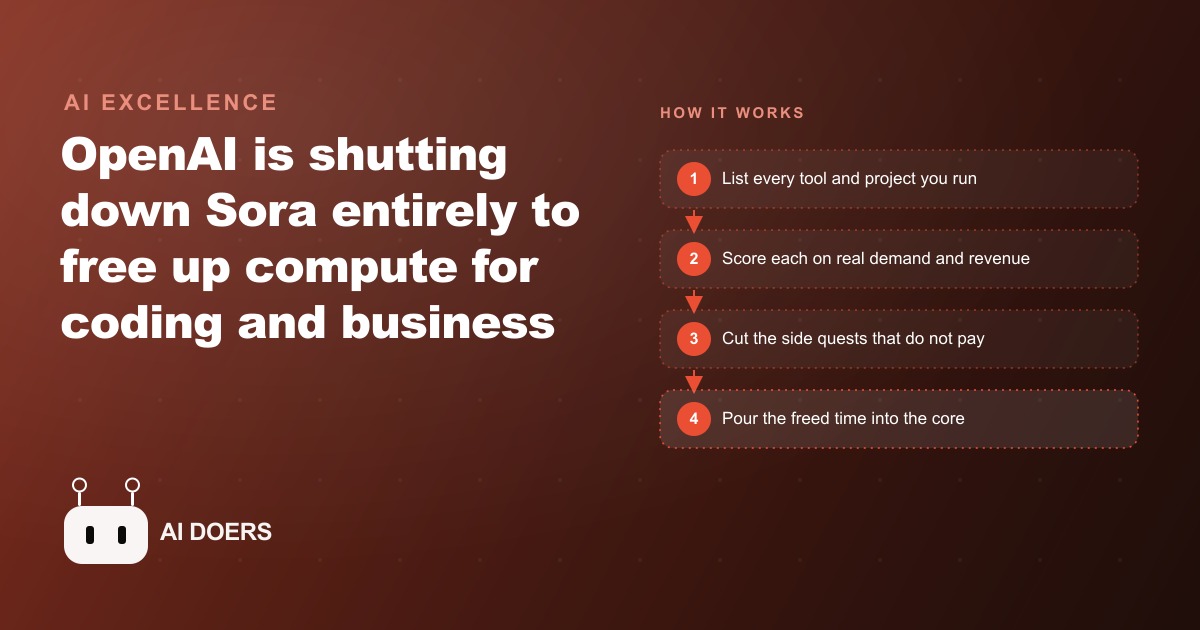
I am going to say something most coverage of the Sora shutdown missed: this is the most strategically correct thing OpenAI has done all year. Not the most impressive, not the most technically ambitious, and certainly not the one that generated the most enthusiastic press. The most correct. The most disciplined. And the practical business lesson embedded in it applies directly to how almost every small operation I work with should be managing its time and resources right now.
Most reporting framed the Sora shutdown as a retreat, evidence that OpenAI is under competitive pressure and cutting losses. That reading misses what actually happened. A company with genuine resource constraints made a hard call about what to stop doing so it could do the important things better. That is not failure in any meaningful sense. That is the kind of prioritization decision that most organizations, large or small, struggle to make because it requires publicly admitting that a project you built, announced, celebrated, and sold major partnerships around is not worth continuing. That kind of honesty is harder than it sounds, and the fact that OpenAI executed it quickly and explained the reasoning directly makes the episode worth studying regardless of what you think about the original Sora launch.
Killing a product you built is not failure, it is the hardest kind of discipline
OpenAI is shutting down the entire Sora product line. The consumer app, the developer API, and video generation inside ChatGPT are all ending together. This is not a quiet archive or a rebrand into a different product name and a reduced-visibility tier. It is a product that launched publicly, had enthusiastic early users, attracted a major entertainment industry partnership, and generated real press as the future of AI-powered video creation. Now it is being ended.
The reason is compute. OpenAI is bounded in how much raw computing power it can deploy across products simultaneously, and every GPU pointed at generating consumer video is a GPU not pointed at the chat, coding, and business productivity tools that generate the subscriptions and enterprise revenue that fund the whole operation. The applications CEO was direct: the company cannot miss this moment by chasing side quests.
That phrase is the key. Sora was not a failed experiment. It was a working product. The question was never whether it functioned. The question was whether it belonged at the top of the priority stack when the core opportunity in AI for coding and business productivity is as large as it currently is. The answer was no, and the company acted on it.
The discipline required to arrive at that decision and then publicly execute on it is genuinely difficult. There is sunk engineering cost. There is the team identity built around the product they shipped. There is the promotional cycle from only months earlier. All of that institutional weight argues for one more quarter, one more experiment, one more wait for the numbers to turn. OpenAI set all of that aside and made the call. That is the discipline worth studying.
OpenAI was losing on both quality and economics at the same time
The competitive picture on AI video was not a close race by the time of the shutdown. VEO from Google, along with Kling and SeeDance, were consistently rated above Sora by the practitioners who benchmark these systems. OpenAI was investing significant compute into a product that was already behind the leaders, and the trajectory of the quality gap was not clearly closing.
Compounding the quality problem was a structural economic disadvantage. Google funds its AI development from search and YouTube advertising, which together generate enormous quarterly cash flow. That base allows Google to subsidize video generation for years while the market matures, without needing that product to be profitable on its own terms. OpenAI earns from the generation products themselves. Its revenue is the product. Every dollar invested in video must return a dollar or more from video, and that math was not working.
When you are losing on quality and losing on unit economics at the same time, you are in a specific trap. More investment might close the quality gap eventually, but you are doing that work while burning resources at a rate your competitor is not constrained by, because the competitor does not need video to make money. The rational move is to exit the competition and redirect the capability somewhere with better odds. OpenAI exited and is pointing the Sora research team toward world models, systems that learn to simulate physical environments in high fidelity. That capability has genuine long-term scientific value in developing AI that understands cause and effect in the real world. The consumer video product becomes a serious research bet on simulating the world. That reframe is itself strategically clean.
The super-app consolidation is not copying Anthropic, it is surviving against Google
While cutting Sora, OpenAI is simultaneously merging its ChatGPT desktop application, its Codex coding environment, and its browser into one unified product. Many observers described this as copying what Anthropic has done by bundling Claude, Claude Code, and collaborative tools in a single place.
That framing makes the move sound like a design preference. It is a survival decision under pressure from a competitor with effectively unlimited capital. Google can build and maintain ten separate AI products funded by advertising revenue. OpenAI has to make every dollar of product investment compound across as many use cases as possible. A unified surface means every model improvement, interface refinement, and new tool benefits every use case simultaneously instead of being split across separate products that each need independent support and iteration cycles. Users build one habit rather than managing three separate product relationships.
The parallel with Anthropic is real but secondary to the structural reason behind the consolidation. What matters is that a company in an asymmetric capital competition has to concentrate rather than disperse. The new model called Spud, which completed a full pre-training run and is expected to ship soon, completes the picture. A full pre-training run is not an incremental update. It is a net-new model with independent architecture choices and training data. That investment alongside the surface consolidation and the Sora cut tells a coherent story: narrow the product footprint, invest in the next core model, and stop subsidizing the periphery.
Every small business is running its own Sora right now
I review the service portfolios of small businesses regularly, and the pattern I see most often is a version of the same strategic mistake OpenAI was making before this cut. The business is doing too many things, spreading finite time, money, and scheduling attention across a service menu that looks comprehensive from the outside but is actively diluting the owner's capacity to do the core work at the quality and speed it deserves.
The roofing company is a useful illustration. A typical residential roofer often handles repairs, gutter cleaning, holiday lighting installation, full roof replacements, and storm-damage insurance claims. The full menu feels like a competitive advantage because it makes the operation look versatile and customer-friendly. In practice, the side services absorb a disproportionate share of the crew's time and the owner's coordination overhead relative to what they return in revenue.
The numbers make this concrete. Twenty repair jobs at 300 dollars each produces 6,000 dollars in total revenue. The crew might spend three to four working days scattered across a week completing those 20 jobs, which means significant driving, setup, and per-job coordination overhead for that return. One full roof replacement at 12,000 dollars takes roughly the same elapsed calendar time from the crew's perspective and delivers twice the revenue with a simpler logistics chain. Most roofing operators understand this math. Very few act on it decisively because cutting the repair line feels like shrinking the business, disappointing customers who expect the full menu, and admitting that a part of the operation was not worth its weight.
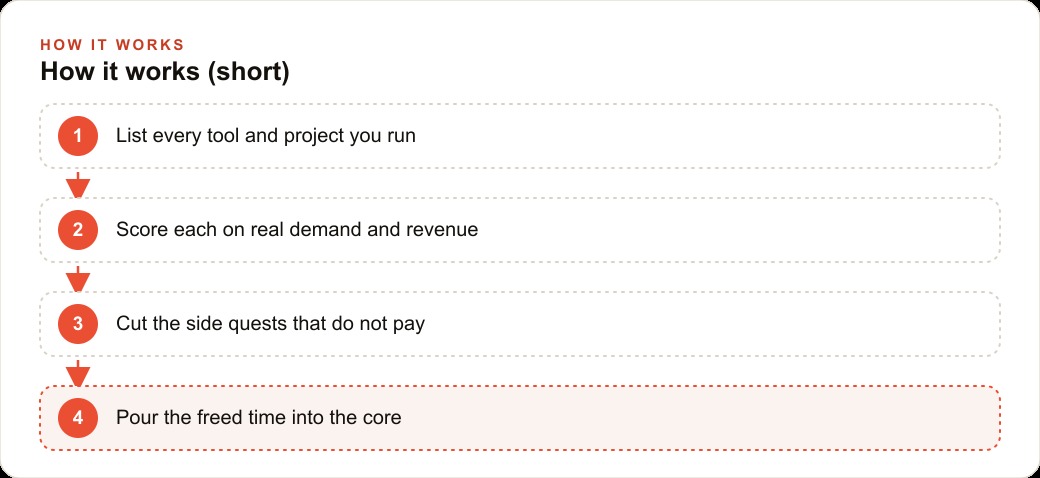
OpenAI just did the equivalent of this at billion-dollar scale, in public, under scrutiny from every AI commentator with a platform. If a company with those stakes can do the audit and make the cut, an owner running a crew of six has no structural reason not to run the same exercise. The move is always the same: list every service or project you currently run, score each on real demand and actual margin after costs, and cut the ones that score low even when you personally find them interesting. What remains is the core that actually builds the business, and the freed capacity goes into doing that core better than before.
The Disney deal is a cautionary tale about exclusive partnerships with platform features
One of the more complicated details in the Sora shutdown is what it means for Disney. Disney invested a billion dollars in OpenAI and licensed more than 200 characters specifically for Sora video creation. That agreement is now in an unusual position because the platform feature at the center of it no longer exists.
The practical lesson for a smaller operator is not about billion-dollar investments. It is simpler: be careful about building a significant portion of your workflow or competitive positioning around a specific feature of a platform you do not control. Vendors reprioritize. Products get cut. The capability you built your process around can disappear regardless of how committed you are to using it.
The most useful version of this check is to ask, before building a significant dependency on any platform feature: what is the operational plan if this feature is deprecated in 12 months? If the honest answer is that the whole arrangement falls apart, that is worth knowing before signing a long-term commitment rather than after. Exclusive partnerships with platform features are only as durable as the vendor's internal prioritization, and that prioritization can change on a quarter's notice regardless of what external parties have committed to paying.
Altman's kill criterion deserves to be framed and hung in every operations room
At Sora's launch, Sam Altman stated publicly that if Sora did not make users' lives meaningfully better, he would discontinue it. Five months later, he discontinued it. That is unusually direct follow-through on a stated decision criterion, and it deserves more attention than the shutdown announcement itself has received.
Most organizations that set kill criteria either do so informally or raise the threshold when the project underperforms, because the people assessing whether to kill the project are the same people who have been invested in building it. The incentives work against the criterion. The project gets one more quarter, then another, and the resources that could have been redirected months earlier are still sitting in the wrong place.
The discipline of setting the criterion before you know the outcome, and then honoring it when the evidence arrives, requires separating the emotional investment in the project from the business judgment about its value. That separation is the specific skill. It is the same discipline a good investor applies when setting a stop-loss before entering a position. The rule is made before the loss is happening, so the decision cannot be contaminated by the loss aversion that activates when the number is actually falling.
For a small business owner, this transfers directly. Before starting a new service line, a new marketing channel, or a product experiment, write down the specific condition under which you will stop. Not a feeling, a number. If this service does not generate a defined revenue amount in the first 90 days, stop it. If this channel does not produce a defined number of qualified leads per month by the end of the quarter, move the budget. Making the criterion explicit before you start removes the ability to rationalize continuing past the point where the data has already given the answer. Altman set the criterion at launch and honored it five months later. That practice transfers directly to any size of operation.
What compounding focus looks like in the months after the cut
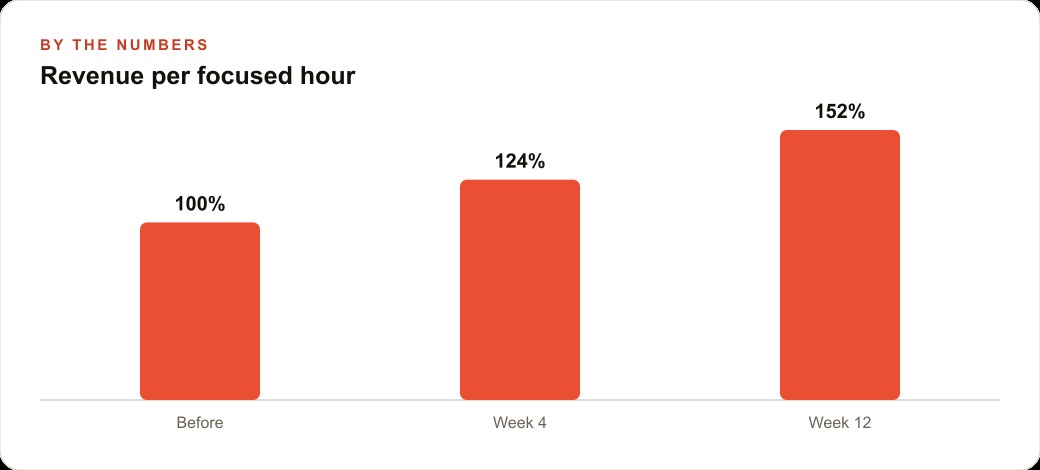
The argument for cutting your own Sora is not about this quarter's numbers alone. The return from focus compounds over time in a way that feels slow at first and then becomes obvious. When a roofing company stops taking repair jobs and redirects capacity entirely toward replacements and storm-damage claims, the first month looks like a revenue dip because the repair pipeline drains before the replacement volume builds. By month three, the crew runs a tighter schedule with less coordination overhead. By month six, the referral pattern has shifted because satisfied full-replacement customers refer their neighbors for replacements rather than small repairs. The average job value and the average customer lifetime value both increase together.
OpenAI is in the early months of that same compounding. The freed compute goes to coding and business productivity, which attract enterprise contracts, which fund the next model. The new model Spud, which completed a full pre-training run, is the first visible result of that redirection. The pattern is not guaranteed, but it is substantially more likely when resources are concentrated than when they are spread across products competing in fights the company is already losing on both quality and price.
The businesses I have seen make this shift consistently report the same pattern. The month of the cut feels like shrinkage. By the second quarter, the owner is doing fewer total jobs, earning the same or more, and working with less friction because the work is more uniform. By the end of the year, the operation is doing better work in less time and positioned more clearly in the market. Focus is not a sacrifice. It is a compounding investment in the core. OpenAI just made that investment publicly and under competitive pressure. The lesson is there for any business willing to apply it.
The lesson is not about AI video, it is about having the courage to narrow
Reading the Sora shutdown as a story about AI video market dynamics misses what is actually instructive about it. The story is about knowing what your core is, admitting when a project is not part of it, and acting on that admission before the cost of delay grows larger. That discipline is not a corporate strategy concept available only to large organizations. It is available to every business owner willing to do an honest audit and make a clear-eyed decision about what to stop.
OpenAI had a billion-dollar Disney partnership built around Sora and still cut it. That should put the fear of cutting a marginally profitable side service into the correct perspective. If they could make that call with those stakes, the decision about whether to keep offering gutter cleaning or holiday lighting or small repairs is a much easier one.
The only thing standing between most small business owners and a clearer, more profitable operation is the willingness to name the side quest honestly and then honor the kill criterion they set for it. Altman said it at launch, followed through five months later, and redirected the team toward something with better odds. That is the complete playbook. Write down the criterion. Honor it when the evidence arrives. Pour the freed capacity into the core. The compounding starts from the day of the cut.
That is exactly what we do at AI DOERS. Book a private 30-minute call with Madhuranjan Kumar and we will map the fastest path to it for your specific business.
Book your call →
Madhuranjan Kumar
Madhuranjan Kumar brings 20 years of performance-marketing experience and has managed over $200 million in Facebook ad spend for brands across the United States and beyond. His expertise spans the full modern marketing stack: Meta, Google Ads, TikTok, email automation, CRM, and the websites that hold it together. At AI DOERS he turns that track record into lead-generation systems for businesses across every industry.