
Why OpenAI and Anthropic Both Asked the World to Slow AI Down
Two rival labs publicly asked the world for a way to slow AI, then both moved to go public the same week. Here is what they actually proposed and the one personal takeaway that matters for your business.

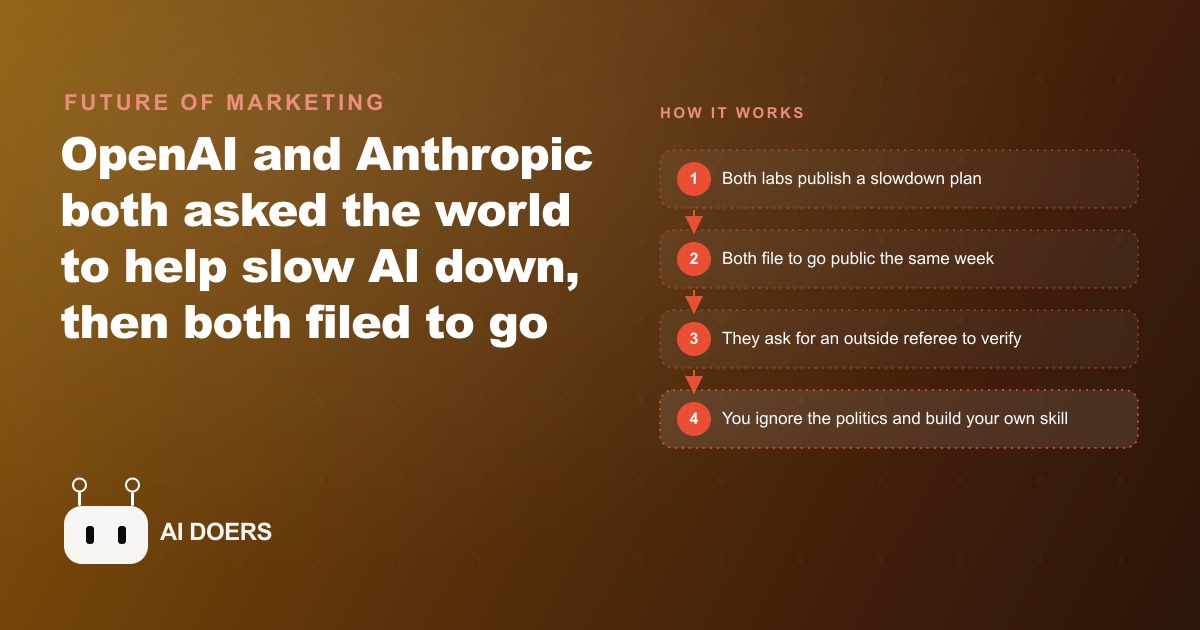
In the same week of June 2026, OpenAI and Anthropic each published detailed plans asking governments and international bodies to create mechanisms for slowing down frontier AI development when those mechanisms become necessary. Both companies also filed paperwork to go public in that same week. Madhuranjan Kumar reads a considerable amount of AI industry news, and this particular convergence required sitting with it for a while before writing anything about it.
Two companies racing as hard as anyone on the planet at the precise activity they are asking the world to slow down, filing papers to collect billions from public investors in the same breath. That is worth examining carefully.
Two Rival Labs Published Nearly Identical Safety Plans Four Days Apart
OpenAI's plan outlined three goals: reach the capability to do meaningful AI research autonomously by March 2028, build economic structures that distribute the gains from AI broadly rather than concentrating them in a handful of companies and individuals, and establish international coordination to prevent a race to the bottom on safety among competing nations.
Anthropic published a plan that tracked closely with OpenAI's framing. The same call for international coordination. The same concern about a competitive dynamic in which one player's caution creates an opening for another player operating under fewer constraints. The language used by each company differed in tone but the structure was nearly identical.
Four days separated the publications. That is not a coincidence of timing. Both companies have arrived at the same analysis of the situation. They believe the systems they are building, and plan to build over the next several years, represent a genuine risk if the development continues without some form of coordination. They also believe they cannot unilaterally slow down without ceding ground to competitors who will not slow down. So they are asking for external mechanisms to create a shared floor that applies to everyone.
This is a coherent position if you accept the premises. It is also a position that requires you to believe several things simultaneously: that the risk is real enough to warrant international coordination, that neither company can stop itself without losing competitive position, and that publishing a plan is a meaningful step toward the mechanism existing. The first two premises are widely shared among people who follow this closely. The third is the most uncertain of the three.
The Coordination Problem Is Not a Technology Problem
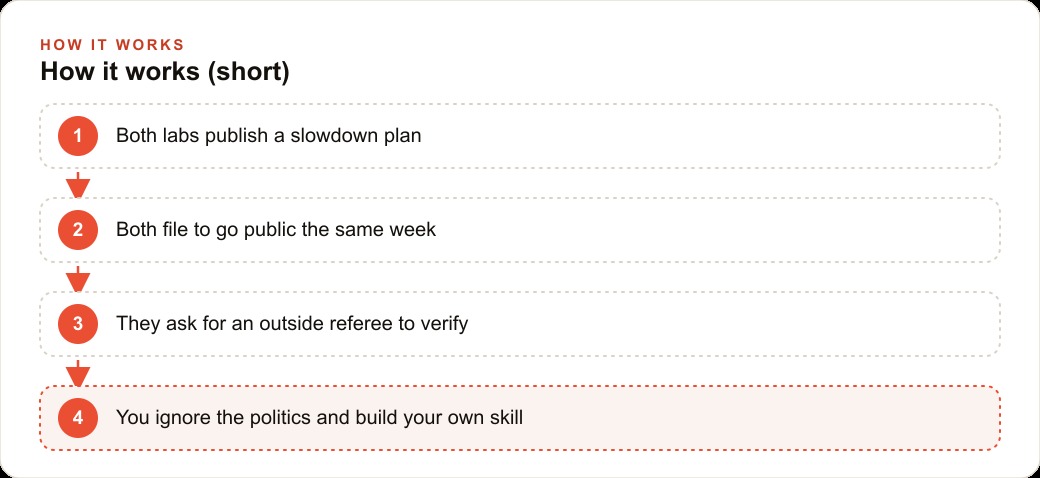
The document that explains what is actually happening here comes not from either company but from game theory, specifically the body of research on coordination problems in which all participants would be better off with a shared constraint but none will adopt the constraint unilaterally because doing so creates a disadvantage against those who do not comply.
Nuclear weapons provide the closest historical parallel that most people find legible. The countries that developed nuclear capabilities did not slow down because they unilaterally decided the risk outweighed the advantage of continued development. They slowed down through negotiated treaties that included inspection regimes, verification mechanisms that gave each party confidence the others were actually complying rather than simply claiming to comply. The inspection regime was the load-bearing piece. A treaty without verification is a public promise that can be broken in private.
Compute is the approximate equivalent of uranium in this context. Training large frontier models requires enormous concentrations of specialized computing hardware, hardware that is manufactured by a small number of companies, shipped to a limited number of facilities, and draws enough electricity that the infrastructure footprint is visible from outside monitoring. Any serious international coordination on AI development timelines would most likely run through compute visibility, not through monitoring model behavior. You cannot easily inspect what is inside a trained model, but you can see the cluster it was trained on.
The incentive wall is the hard part of any coordination attempt. A treaty breaks the moment one party calculates that it can sprint ahead without the others learning about it in time to respond effectively. The history of arms control includes cases where countries honored agreements they had the capability to violate, and cases where they did not. The same dynamics will apply to any AI development coordination agreement, if one is ever negotiated.
What makes the current moment harder than early nuclear negotiations is the pace of change. AI capability development is advancing faster than treaty negotiation by a large margin. A coordination framework that takes three to five years to negotiate may be calibrated to a technology landscape that no longer exists by the time it enters into force.
What the IPO Filings Signal About Where AI Is Right Now
Filing to go public is a statement about business fundamentals. Companies pursue public offerings when they need to raise substantial capital at favorable terms, when early investors and employees need liquidity, or when the business has reached a scale where public market accountability is appropriate and the business can sustain the reporting requirements that come with it. What companies do not do is file to go public when they believe they are in the early risky phase of development where fundamental questions remain unresolved.
Both filings signal that both companies believe the commercial moment is now. That AI products are generating revenue at a scale that justifies public market valuation. That the technology has reached a point of sufficient maturity to present to institutional investors who require documented, auditable business cases rather than projections built on hypothetical future capabilities.
That is a significant transition in how the technology is being positioned. The public framing around AI has often presented it as approaching but not yet arrived, as something the world is getting ready for rather than already using at scale. The IPO filings implicitly position it as arrived. The revenue is real. The products are embedded in actual workflows. The business models are established enough to underwrite valuation analyses.
The juxtaposition with the safety plans is instructive. The safety plans speak to a future risk: systems that may make consequential decisions autonomously in high-stakes contexts where errors are difficult to reverse. The IPO filings speak to a present commercial reality: businesses and consumers paying for AI capabilities at scale today. Both can be true simultaneously. The present commercial success and the future risk exist in the same timeline. The challenge that neither filing resolves is how to manage the transition between them.
The ChatGPT and Claude Brand Distinction Is Under Pressure
For several years the practical experience of using ChatGPT versus using Claude was distinct enough that the choice between them reflected a real preference. ChatGPT was fast and willing to attempt a broad range of tasks without much pushback. Claude was more careful on complex reasoning, more willing to flag when it was uncertain, more useful for tasks that required following long instructions precisely.
Both companies going public introduces a pressure that is less visible than the capability competition but potentially more consequential for how those products evolve. Public investors expect growth and margin improvement on quarterly timelines. Both companies will face pressure to expand their addressable markets and reduce the friction that currently keeps some users from paying. That pressure tends to make products more broadly accessible and less distinctively specialized. The differentiation in approach and tone that currently makes one platform preferable for specific use cases may narrow under that pressure.
For businesses building products on top of either API, this matters as context. The two platforms may become more interchangeable over the next few years, which reduces switching costs but also reduces the distinctive advantages that make one preferable for a specific workload. The practical implication is to avoid deep architectural commitments to capabilities that are unique to one platform and are not guaranteed to persist as the business priorities of that company evolve.
The One Move That Is Entirely Within Your Control
The international coordination question is outside the reach of any individual business or practitioner. The IPO timelines are set by the companies and their advisors. The regulatory conversations that will eventually produce or fail to produce some form of coordination framework will happen over years in institutions most people will never enter.
What is within reach is the practical decision about how to use AI capabilities now, in a specific business context, with the tools that are currently available, reliable, and affordable.
To make this concrete: a dental practice with a single office, four treatment chairs, and a team of eight people has several administrative tasks that repeat daily and consume staff time that would otherwise go to patient care. Recall reminders go out manually to patients who are due for checkups. Common insurance questions from patients get routed to a staff member who is also managing the appointment calendar and handling paperwork for the front desk. These tasks are not complex. They follow well-documented patterns. They can be described precisely enough to automate reliably.
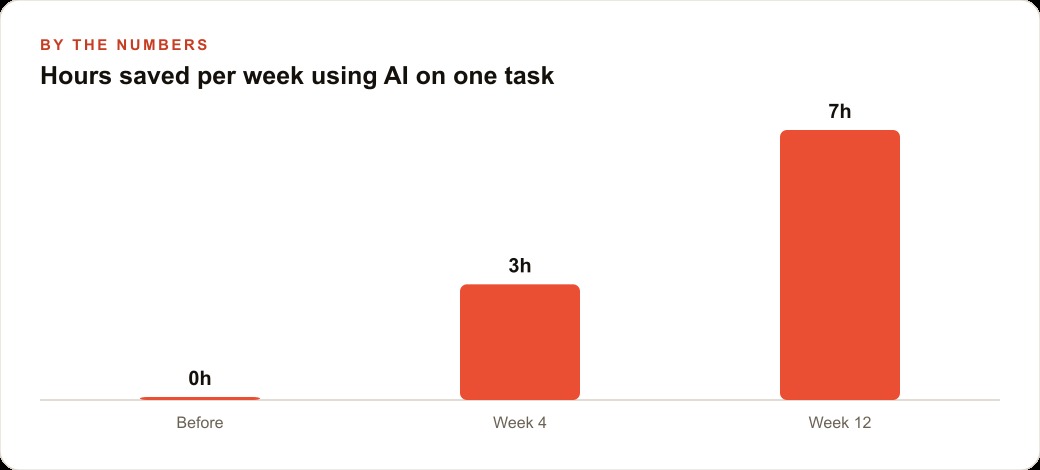
A practice that configures an AI system to handle two of these tasks, drafting recall reminders for the week and generating responses to the twelve most commonly asked insurance questions, recovers approximately seven hours of staff time per week. At a fully loaded cost of $28 per hour, including salary, benefits, and overhead allocation, that is $196 per week returned to higher-value work. Over a month that is approximately $820 recaptured. The cost of the AI tool configuration and subscription for this capability is around $40 per month. The net recapture is roughly $780 per month in labor efficiency, from a two-week setup effort.
That calculation has nothing to do with frontier AI development timelines, the game theory of international coordination, or public market valuations. It is a present-tense decision about a bounded, reliable application of technology that exists right now and has been stable for long enough to deploy with confidence.
What Following This Story Is Actually Good For
Madhuranjan Kumar's read on the week's news is this: the OpenAI and Anthropic publications tell you something important about how the companies leading AI development understand the situation they are in. The simultaneous IPO filings tell you something about where the commercial development of AI has reached. Both pieces of information are worth holding.
What they do not tell you is whether to implement the dental recall system this month, or which of your repetitive internal processes should be the first candidate for AI assistance, or how to evaluate which tools are reliable enough to deploy on customer-facing workflows. Those are operational decisions that belong to the people running actual businesses with actual constraints, and they get made based on specific circumstances rather than on the trajectory of frontier AI development.
The frontier news is context. Understanding the coordination problem helps you reason about how the regulatory environment might evolve and what kinds of dependencies to avoid building too deeply. Understanding the IPO signals helps you reason about how the tools you use today might change as the companies behind them pursue public market accountability. But context is not a plan. The plan is built from the specific tasks that are currently consuming time and money in your specific operation, and the question of whether AI can handle them reliably enough to be worth deploying.
The dental practice example above is deliberately ordinary. Recall reminders and insurance question templates are not glamorous applications of AI technology. They are not the kinds of use cases that generate coverage in technology publications. They are, however, the kinds of use cases that produce a clear, measurable return in a real business without requiring the business to make a large upfront investment or accept significant operational risk. The tools needed to automate those two tasks are available today, the implementation is straightforward, and the outcome is predictable.
Most businesses have several tasks at that same level of clarity. Tasks that repeat daily or weekly. Tasks that follow a defined pattern. Tasks where the inputs are consistent enough that an AI system, given a clear description of the pattern, can produce outputs that are good enough to use or nearly good enough to use with light review. Finding those tasks in your specific operation and addressing them in sequence is the work. It does not require waiting for international coordination frameworks or public market events to signal that the moment is right.
That question has a practical answer most of the time, and finding it requires less attention to the frontier than to the specific workflow in front of you.
That is exactly what we do at AI DOERS. Book a private 30-minute call with Madhuranjan Kumar and we will map the fastest path to it for your specific business.
Book your call →
Madhuranjan Kumar
Madhuranjan Kumar brings 20 years of performance-marketing experience and has managed over $200 million in Facebook ad spend for brands across the United States and beyond. His expertise spans the full modern marketing stack: Meta, Google Ads, TikTok, email automation, CRM, and the websites that hold it together. At AI DOERS he turns that track record into lead-generation systems for businesses across every industry.