
Why o3-mini Is the First Reasoning Model Worth Building Agents On
Because it pairs reasoning with function calling and structured output while costing about 93 percent less than o1 and running four times faster, o3-mini is cheap and reliable enough to power production research agents that out-plan GPT-4o.

A reasoning model that costs less than GPT-4o and runs four times faster than its predecessor removes both objections that kept reasoning models out of production systems for the past two years: price and speed. For any business that runs structured research tasks daily, that combination is not an incremental improvement. It is the threshold that makes automation economically rational. I am Madhuranjan Kumar, and o3-mini is the first model in that class I would put behind a real customer-facing workflow rather than a weekend experiment. What makes it worth examining closely is not any single benchmark number. It is the architecture it enables, and what that architecture does to the cost of research tasks that businesses currently pay humans to run.
The Tool-Calling Loop That Is Simpler Than It Sounds
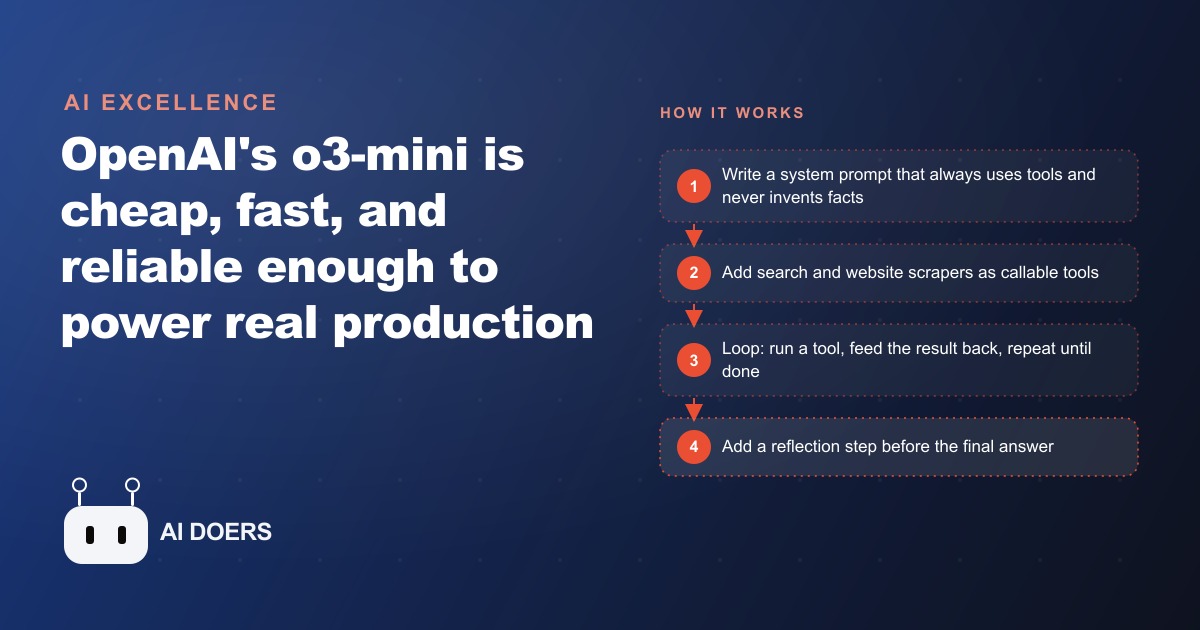
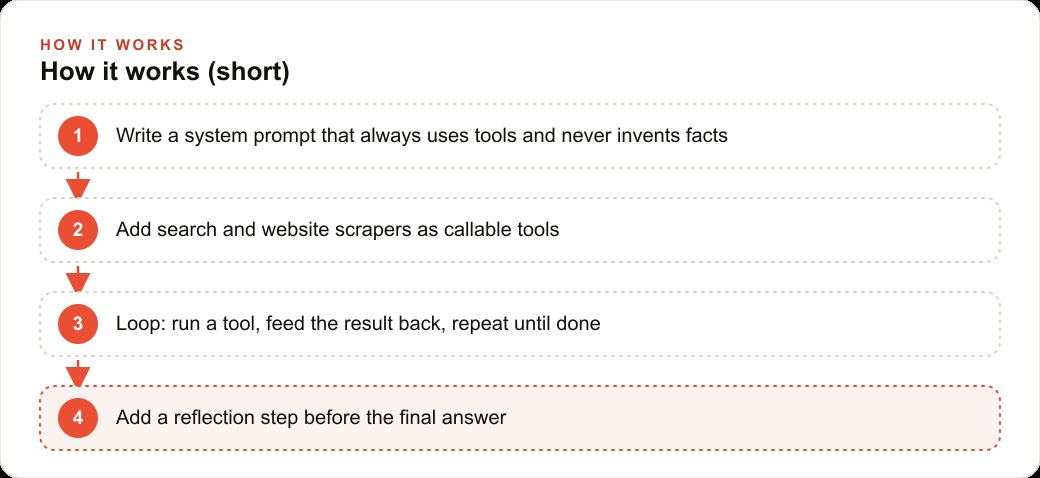
The word "agent" makes people expect a complex system. The reality is a loop of about 30 lines of logic. You start with a system prompt that tells the model it is a researcher who always uses tools to find information and never invents anything. The model produces an output. If that output requests a tool, you run the function and append the result to the conversation. The model reads the result and either calls another tool or produces a final answer. You repeat until the final answer arrives.
That is the entire architecture. No framework, no orchestration layer, no infrastructure beyond the model's API and a few callable functions. The pattern is closer to a while-loop in a script than to a multi-agent orchestration system, and understanding it as such removes most of the intimidation from the phrase "AI agent."
Building this manually gives you one important advantage over using a packaged agent framework: you understand every part of the loop because you wrote it. When the agent produces a bad result, you can pinpoint whether the problem is the system prompt, a specific tool returning incomplete data, the reflection step being skipped, or the model misinterpreting a tool result. Frameworks that hide the loop also hide the failure modes. For production systems where reliability matters, owning the loop is worth the extra 20 lines of code. The sophistication is not in the plumbing. It is in the system prompt, the tools you wire in, and the reflection step that sits between the last tool call and the final answer.
The loop also means the agent naturally handles tasks of variable depth. A simple question might resolve in two tool calls. A complex multi-part research question might take eight. The model decides how many loops it needs based on what it finds along the way, which is the core behavior that distinguishes this architecture from a single-pass chat response. A chat model answers once with what it knows at the time of the question. A tool-calling agent keeps searching until it has enough to answer well.
Why a Reasoning Model Specifically Enables Multi-Step Research
Standard chat models are trained to complete. They take the conversation as input and produce the most likely continuation. That training is excellent for generation tasks and for answering questions that can be resolved in one step. It runs into trouble on tasks that require planning a multi-step search, recognizing when a result is insufficient, and adjusting the search direction based on what was found.
A reasoning model deliberates before answering. It generates intermediate thinking that evaluates what it knows, what it is missing, and what the next logical step should be. That deliberation is exactly the skill a human researcher uses when they realize the first search result did not answer the question and they need to reformulate the query rather than accept the partial answer.
On the GAIA benchmark, a set of multi-step assistant tasks that require planning and synthesis, an o3-mini agent passed hard queries where a GPT-4o agent failed. The failures on GPT-4o were not failures of knowledge. They were failures of planning: the model accepted early partial results and stopped searching before it had enough to answer correctly. The reasoning model kept going, adjusted its approach when initial results were thin, and arrived at the correct answer after more loops. That difference is the practical case for paying attention to model type rather than just model generation when building research tools.
The reasoning behavior also changes the economics of prompt design. With a chat model, getting better research output requires elaborate prompt engineering: chain-of-thought instructions, explicit step-by-step directions, decomposed sub-questions, all built by hand to simulate the planning behavior the model does not produce naturally. With a reasoning model, the deliberation happens internally during the model's thinking pass. The system prompt can focus on the research mission and the output format rather than on scaffolding the thinking process step by step. This saves substantial prompt-engineering time, especially for research domains that require different search strategies depending on what the initial results surface.
The Reflection Tool as the Cheapest Accuracy Gain Available
Before producing a final answer, the agent calls a reflection tool. That tool does one thing: it prompts the model to review its findings, check for contradictions between results from different tool calls, and confirm that the question as originally asked has actually been answered by what was found.
This is a cheap step. It adds one additional model call and perhaps 10 or 15 seconds to a research run. What it prevents is a specific and common failure mode: the agent produces a confident final answer based on the last tool result it received, even when an earlier result contradicted it or when the overall finding does not fully address the original question.
Think of the reflection step as a forced second opinion from the same model. The first pass of tool calls is the research phase. The reflection tool forces a synthesis phase before the answer is committed. Without it, the agent answers with whatever state the last tool call left it in. With it, the agent pauses, checks its own work, and flags gaps before reporting back.
For a recruiting firm building a candidate-research agent, this step was the difference between a profile that sometimes included a past role that was actually listed under a different person with a similar name, and a profile that caught that ambiguity and flagged it for human review rather than presenting it as fact. The reflection tool did not add intelligence. It added the habit of checking before committing, which is a habit every human researcher applies and every automated one should too.
Why Scraping Quality Sets the Actual Ceiling
The clearest lesson from comparing a custom o3-mini agent to ChatGPT's built-in deep research mode came from the queries both failed. On those queries, deep research won because it could access sites that basic scrapers could not reach. Dynamic JavaScript-rendered pages, sites with aggressive bot-detection, and sources behind soft paywalls were accessible to ChatGPT's internal infrastructure and opaque to a Firecrawl or Spider Cloud scraper running a standard fetch.
That gap is not a model intelligence gap. It is a data access gap, and it is the most important thing to understand when scoping a research agent for production use. The model's reasoning ability sets the ceiling for how well it can synthesize the data it receives. The scraper's ability to reach the relevant sources sets the ceiling for what data it can receive in the first place. Investing in better scrapers, or choosing vertically-tuned data sources for your specific domain, does more for agent output than switching to a more expensive model.
For a business building a competitive-intelligence agent for retail, scraping competitor product pages matters more than the exact model used to analyze them. For a firm tracking regulatory filings, getting clean structured access to the right government databases matters more than model generation. The practical implication for anyone building an agent is to test five or ten of your real target pages against your scraper before trusting the agent's output at scale. If the scraper is returning thin results or HTML error pages, fix the scraping layer before debugging the model.
The Model-Agnostic Principle and What Vendor Independence Actually Means
Because the architecture is a tool-calling loop with a system prompt, the model is a modular component. Swap o3-mini for DeepSeek R1 and the rest of the system stays identical. The tools, the reflection step, the output schema, the database that stores results: none of it changes. The only change is which API endpoint the model call hits.
This matters for two reasons. First, it means you are not locked to a single vendor or a single pricing tier. If a cheaper model reaches sufficient quality for your specific research tasks, you can switch without rebuilding anything. If a better model releases next quarter, you can upgrade without rebuilding anything. The value you built is the workflow and the tooling, not the model integration.
Second, it means the system naturally absorbs the rapid model releases that have become the norm in the industry. A research agent built in January does not become obsolete in March because a new model released. The agent gets better in March when you swap the model component for the improved one. Businesses running /meta-ads optimization workflows or /google-ads keyword research agents built on this architecture can capture every model quality improvement without a rebuild cycle.
The practical discipline this requires is to resist the temptation to hard-code model behavior into the architecture itself. System prompts and tool schemas should be written to work with any capable model, not to exploit quirks of a specific one. That discipline is what makes the workflow durable.
It also changes how you should evaluate AI tools when a new release comes out. Instead of asking whether the new model is better in a general sense, you ask whether it improves on the specific tasks your agent calls it to perform: multi-hop synthesis, instruction-following on complex tool outputs, and output formatting. If the answer is yes, a swap takes minutes. If the answer is no, you stay where you are. The architecture absorbs vendor competition rather than being disrupted by it. For businesses running /seo-content research workflows or lead-enrichment pipelines, that stability is worth building for from the start.
What o3-mini's Cost Position Below GPT-4o Actually Changes
Before o3-mini, reasoning models were a separate premium tier. You paid more to get deliberation and you accepted slower responses. That made reasoning models suitable for high-stakes, low-frequency tasks: due diligence, complex legal analysis, strategic planning where cost per query was not the primary concern. The cost position below GPT-4o changes which tasks become economically viable.
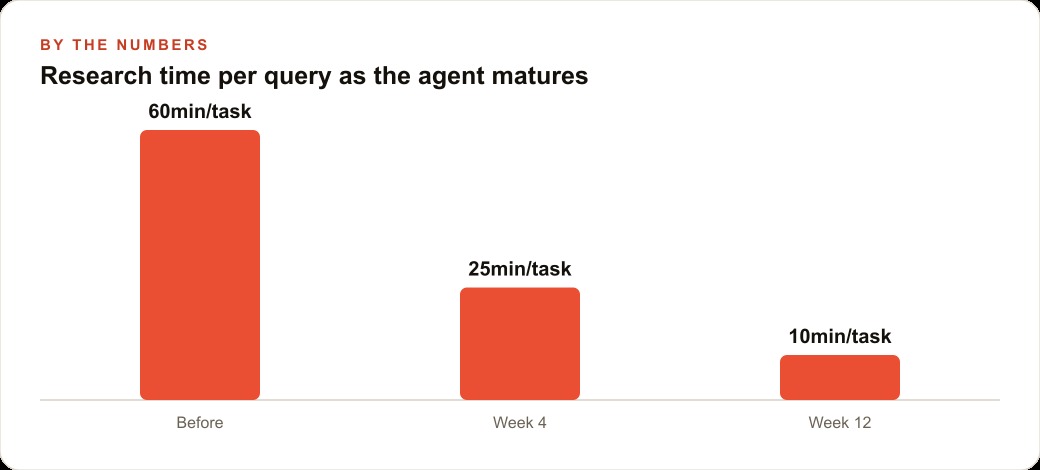
A recruiting firm running candidate research provides a concrete illustration. Before building an agent, the standard workflow was 60 to 90 minutes per candidate profile: searching LinkedIn and relevant news sources, finding published writing or conference appearances, identifying the questions most relevant to the specific role, and writing up a structured briefing. At a researcher's hourly rate, that came to roughly $25 to $40 per candidate profile, and a busy week might include 15 to 20 candidates.
With an o3-mini agent, the same profile runs in 7 to 10 minutes of automated research and two minutes of human review. The agent searches LinkedIn via a structured data source, pulls any published articles, finds relevant talks or panels, identifies the topics the candidate has spoken about most, and writes a structured brief in the format the recruiting team actually uses, ready to push directly into the CRM and hiring pipeline where interview scheduling and status tracking picks up from there. The reflection step checks that the candidate being profiled is the same person at each source before finalizing. Total API cost per profile: a few cents.
Over a month of active use, a team processing 60 candidates per week saves approximately 50 hours of researcher time. At $30 per hour, that is $1,500 per month in recovered labor, on an API cost that does not reach $50 per month at that volume. The ratio is what changes when a reasoning model moves below GPT-4o pricing: tasks that were economical only at low frequency become economical as daily infrastructure. That is the shift worth building around.
That is exactly what we do at AI DOERS. Book a private 30-minute call with Madhuranjan Kumar and we will map the fastest path to it for your specific business.
Book your call →
Madhuranjan Kumar
Madhuranjan Kumar brings 20 years of performance-marketing experience and has managed over $200 million in Facebook ad spend for brands across the United States and beyond. His expertise spans the full modern marketing stack: Meta, Google Ads, TikTok, email automation, CRM, and the websites that hold it together. At AI DOERS he turns that track record into lead-generation systems for businesses across every industry.