
Why Narrow AI Agents Beat One Do-Everything Agent
Reliability falls as you pile skills onto a single agent. A team of narrow agents, each capped at seven to ten skills with one clear goal, stays dependable, easy to copy, and simple to grade.

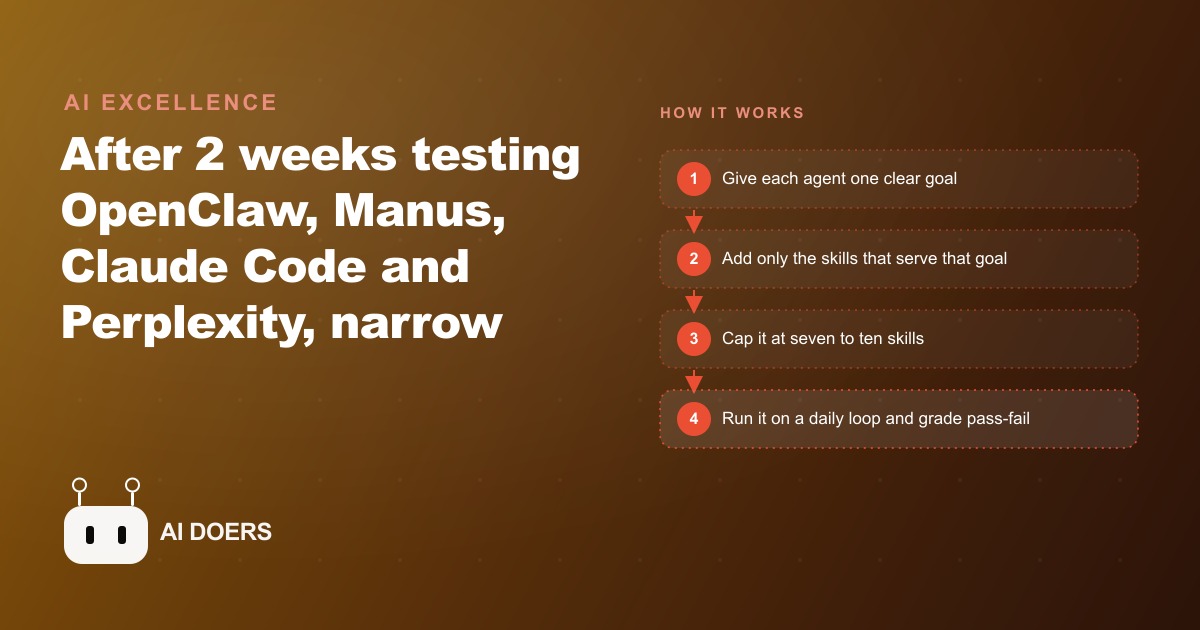
After two weeks building hundreds of agent workflows, the most consistent finding is that reliability falls in direct proportion to the number of skills you add to a single agent, and the ceiling arrives much sooner than most builders expect.
The reliability-collapse mechanism inside an overloaded agent
Each skill loaded onto an agent is not just a button. It is a description, a set of instructions, and a range of trigger conditions that compete for attention in the agent's context window every time it decides how to act. Add one skill and the agent has one clear signal to evaluate. Add ten and the evaluation is still manageable, because the signals are few enough that the agent can reliably reach for the right one. Add thirty and something predictable happens: the agent begins to misidentify which skill applies to a given situation. It reaches for the wrong tool with misplaced confidence. It produces outputs that were technically possible but contextually wrong, and it does so without any visible error message. The output arrives looking reasonable. That is the failure mode that makes overloaded agents dangerous. The agent does not crash. It answers incorrectly with confidence.
There is a useful frame for this that has nothing to do with AI. When a professional team asks one person to be receptionist, bookkeeper, marketer, and dispatcher simultaneously, performance does not drop gradually. It collapses in a specific pattern. The person is effective until two roles demand attention at once, then a third, then a fourth while the second is still unresolved. Each role is individually manageable but the combination creates interference that individual capability cannot overcome. An overloaded agent fails in exactly this pattern. The context window is the agent's working memory, and when it is full of competing skill descriptions and trigger conditions, the signal-to-noise ratio for any individual decision falls below a reliable threshold. The result is an agent that sometimes reaches for the wrong skill with no visible indication that it chose incorrectly.
The number at which this collapse becomes clearly noticeable in practice is consistently around the thirty-skill mark. At that point the agent does not just slow down. It starts misusing the skills it already has, applying integrations in the wrong sequence, and producing outputs that suggest it has lost track of its own purpose. The practical ceiling before reliability starts slipping is seven to ten skills. That number is not a limit set by any platform or model. It is a property of how context saturation works at the decision layer, and understanding it precisely is what separates agent systems that hold up in production from ones that look impressive in demos and then quietly fall apart within weeks.
Why goal clarity is the design unit that replaced prompts
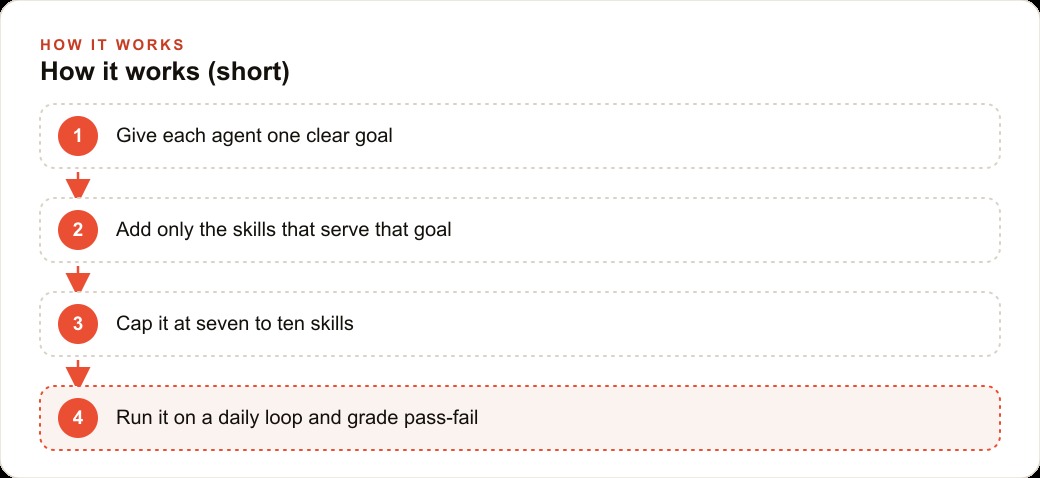
The shift that makes narrow agents work is not a technical change. It is a conceptual one: the design unit is no longer the prompt. It is the goal.
A prompt is a single instruction given once for a specific task. It tells the agent what to do right now. A goal is a standing purpose that the agent carries every day, the same way a reliable employee knows what their job is without being told each morning. When Madhuranjan Kumar began building agent systems seriously, the turning point came from this distinction. Instead of writing long prompts that described everything the agent should consider, the work started with writing the agent's goal in one clear sentence, then building everything else from that sentence outward.
A content agent whose goal is to grow subscribers, increase video views, and convert viewers into buyers is a fundamentally different system from a content agent given a long prompt describing thirty possible tasks. The goal-bearing agent can evaluate any new situation and decide, on its own, whether a given skill is relevant to its purpose. A skill that does not move at least one of the three goal metrics simply does not belong on this agent. That is the entire evaluation framework for skill addition. It is the reason well-designed narrow agents become more useful over time rather than more bloated. The agent's goal acts as a filter that keeps the skill set sharp and the context clean.
Goal clarity also produces something that prompt engineering alone cannot: emergent usefulness. An agent that understands its goal at depth begins to make suggestions that the builder did not anticipate. It notices that research gathered for one task is also relevant to a scheduled publication. It recognizes that a drop in one metric has a likely cause in another skill's output and surfaces the connection without being explicitly asked. These behaviors are not possible in an agent that is simply following a long instruction list, because the list tells the agent what to do but not why. Without the why, the agent cannot generalize from its instructions to the novel situation in front of it. Goal clarity enables generalization, and generalization is what makes an agent feel like a capable collaborator rather than a sophisticated script that breaks the moment circumstances deviate from what was explicitly written.
What the seven-to-ten skill ceiling reveals about context saturation
The seven to ten skill ceiling is not a hardware constraint or an API limit. It is a signal about how context saturation works at the decision layer, and understanding the mechanism explains why the same ceiling appears consistently across different platforms, different models, and different use cases.
Context saturation is what happens when the agent's working memory is full of competing descriptions to the point where the signal for any individual decision is overwhelmed by noise from irrelevant skill descriptions that happen to share surface features with the task at hand. Each skill in an agent's configuration requires multi-sentence explanation: when to invoke it, what inputs it accepts, what outputs it produces, which conditions should trigger it versus a different skill that might superficially apply to the same situation. Those descriptions are not short. They do not become shorter as the skill count grows. They become longer and more cross-referential as skills begin to interact with each other. At seven to ten skills, the web of descriptions is compact enough that the agent can navigate it reliably even under time pressure or ambiguity. At thirty, the navigation cost shows up as wrong skills being invoked at wrong moments, and the failure rate compounds with each additional skill added past that point.
The practical implication for builders is uncomfortable if you are used to maximizing theoretical capability. More is not better. An agent that can theoretically do thirty things is weaker in production than an agent that reliably does eight. Every skill added past ten is not an enhancement. It is a reliability tax on every skill that came before it. The right response is not to search for a more powerful model that can handle more skills without degrading. The right response is to design around the constraint by distributing skills across multiple narrow agents that each stay within the ceiling. The capability of the system grows by adding agents, not by overloading each one.
This constraint also has an important implication for how agent systems scale over time. A team of narrow agents can grow incrementally, with each new agent added when a new function is needed, without any of the existing agents degrading. A mega-agent that absorbs new skills as the operation grows degrades with every addition, and the degradation is invisible until it shows up as wrong outputs that cost time and trust to identify and fix. The ceiling is a design principle, not a temporary limitation to be engineered around. Accepting it early is what makes the architecture hold up at scale.
How a shared memory agent gives narrow agents continuity without merging their goals
The obvious objection to narrow agents is coherence. If the research agent does not know what the content agent published last week, the team is a collection of isolated workers rather than a coordinated operation. The answer to this objection is a shared memory agent, sometimes called a journal agent, and it is the architectural piece that makes the entire narrow-agent design practical rather than merely clean in theory.
The journal agent has one job: observe the activity of every other agent on the team, record anything useful, and make the log available to any agent that needs context for its next cycle. It runs on a fixed interval, every twenty to thirty minutes in practice, checks what each other agent has done since its last cycle, and writes the meaningful outcomes to a shared log. The content agent completed a research summary. The scheduling agent moved a publication to a different day because a slot was already filled. The email agent received three replies on a topic that might affect the next piece of content. All of that goes into the log. None of it merges the goals of the agents that produced the information.
This is the key distinction that makes the architecture work without collapsing back into the mega-agent problem. The journal agent does not absorb any other agent's goal. It is not the content agent's memory and it is not the scheduling agent's calendar. It is a shared information layer that every agent reads at the start of its daily cycle without inheriting any other agent's responsibilities. The email agent starts its morning by reading the log, sees that the scheduling agent moved something, and adjusts its follow-up timing accordingly. It does not become the scheduling agent. It simply has the context it needs to do its own job well. This is how a real professional team operates. Each member reads the same shared notes but owns a separate lane. Nothing falls through the cracks because the notes exist rather than because any one person is responsible for tracking everything that happens across every function.
In practice, Madhuranjan Kumar found that building the journal agent early, before the team reaches more than two agents wide, is significantly easier than retrofitting shared memory into an established multi-agent system. When the journal agent is built first, its integrations are already in place. Every subsequent narrow agent can be built to read the log from its first day of operation rather than being modified to do so later, when the team is already running and changes carry more risk of breaking something.
Pass-fail grading as the property that makes a narrow-agent team auditable and scalable
The property that separates a narrow-agent team from a mega-agent is not just reliability in operation. It is the ability to audit, correct, and scale the system without losing control of it. A narrow agent with a tight goal and a small skill set can be graded on a pass-fail basis every week, and that grading capability is what makes the system correctable in production rather than opaque and resistant to improvement.
Consider what auditing a mega-agent looks like after a week of real operation. It handled forty-seven tasks across twelve different domains. Some went well, some went poorly. Diagnosing which skills or behaviors caused the failures requires parsing a sprawling log where any of thirty skills could have been the contributing factor. A change meant to fix one failure has an unknown probability of breaking three others. The system resists diagnosis and resists correction, which means problems that appear in week two remain in week six because isolating them precisely enough to fix them cleanly is too difficult for any team that has other work to do.
A narrow content agent whose goal is to grow subscribers, views, and conversions has a weekly grade that fits in a short table: did each metric move in the right direction, and were the daily tasks completed on schedule. Pass or fail on each dimension. When the agent misses on one dimension, the skill set is small enough that the cause is usually findable in a single focused review session rather than a multi-day debugging process. The fix is targeted, the effect of the fix is visible in the next week's numbers, and the feedback loop is fast enough to actually improve the system in real time.
The scaling consequence is equally significant. A team of fifteen narrow agents, each graded on pass-fail metrics weekly, is far easier to maintain and improve than one mega-agent whose behavior across hundreds of task types is effectively opaque to anyone without deep context about the entire system. Each narrow agent can be improved independently without risk of breaking anything else. A failing agent can be replaced with a rebuilt version without taking any other part of the operation offline. A working agent can be duplicated and modified for a new channel or purpose in a fraction of the time it would take to extract that capability from a monolithic system. The narrow design is not just more reliable in week one. It is more scalable across every subsequent month as the team grows and the operation adds complexity.
A worked example: twelve weeks of a restructured agent team and the numbers it produced
To make this concrete, here is what a narrow-agent growth division produced over twelve weeks, starting from a single overloaded agent and finishing with a coordinated team of eight narrow agents covering the same functions.
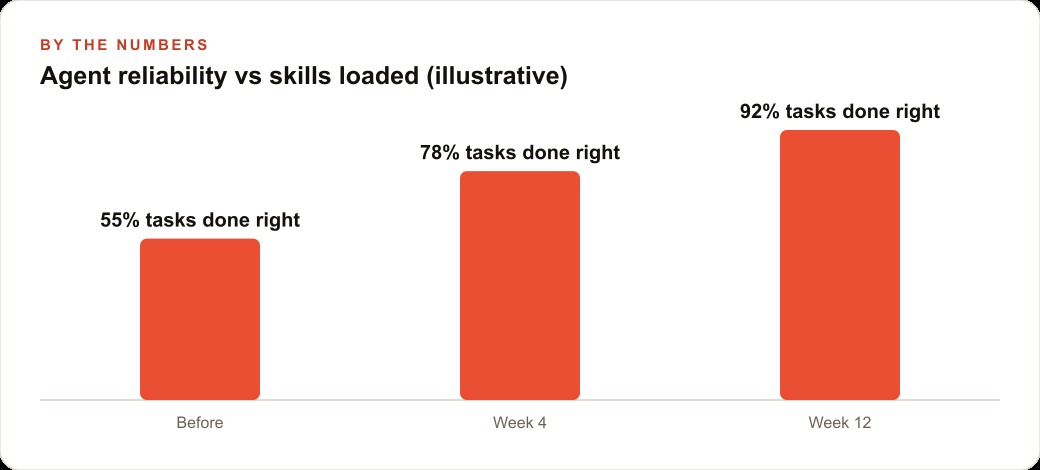
At week zero, the baseline was one general-purpose agent loaded with twenty-six skills. It handled research, draft writing, scheduling, email follow-up, thumbnail generation, analytics review, and social distribution from a single context window. Task completion was measured at around fifty-five percent, meaning roughly four in nine tasks completed correctly on the first pass without a human having to intervene and correct the output. That rate was not a model capability problem. The model was capable. It was a context saturation problem. Too many skills, too many competing trigger conditions, and no clear goal to arbitrate between them when the situation was ambiguous.
The restructuring split the twenty-six skills across eight narrow agents. The research agent carried six skills and one goal: gather usable material for upcoming content. The content agent carried eight skills and one goal: produce drafts that move subscribers, views, and conversions. The scheduling agent carried five skills and one goal: keep the publishing calendar full and consistent. The email agent carried four skills and one goal: reply to inbound queries within two hours and log meaningful responses to the shared journal. The journal agent ran every thirty minutes and had one skill: observe, record, and maintain the shared log. Three additional agents handled thumbnail generation, analytics review, and distribution, each carrying four to six skills and one clear performance metric.
By week four, task completion across the team had risen to seventy-eight percent. The largest single gain came from the research agent, whose outputs became significantly more focused once research was the only job in its context and no longer competed with scheduling, email, and distribution for the same decision bandwidth. By week twelve, the team completed ninety-two percent of tasks correctly on the first pass. The journal agent had accumulated enough shared context by that point that each morning's cycle started with real situational awareness rather than the blank-slate behavior that had characterized the early single-agent deployment.
The lesson from that trajectory is the one Madhuranjan Kumar returns to every time a new agent system is being scoped: start narrow, add agents rather than skills, grade every agent pass-fail on a weekly schedule, and build the journal agent before the team reaches more than two agents wide. The ceiling on reliability is real. The path around it is a team built from narrow agents, not a single agent loaded past the point where it can reliably do its job.
That is exactly what we do at AI DOERS. Book a private 30-minute call with Madhuranjan Kumar and we will map the fastest path to it for your specific business.
Book your call →
Madhuranjan Kumar
Madhuranjan Kumar brings 20 years of performance-marketing experience and has managed over $200 million in Facebook ad spend for brands across the United States and beyond. His expertise spans the full modern marketing stack: Meta, Google Ads, TikTok, email automation, CRM, and the websites that hold it together. At AI DOERS he turns that track record into lead-generation systems for businesses across every industry.