
Why MCP Is a Real Startup Opportunity, and How to Build Your Own
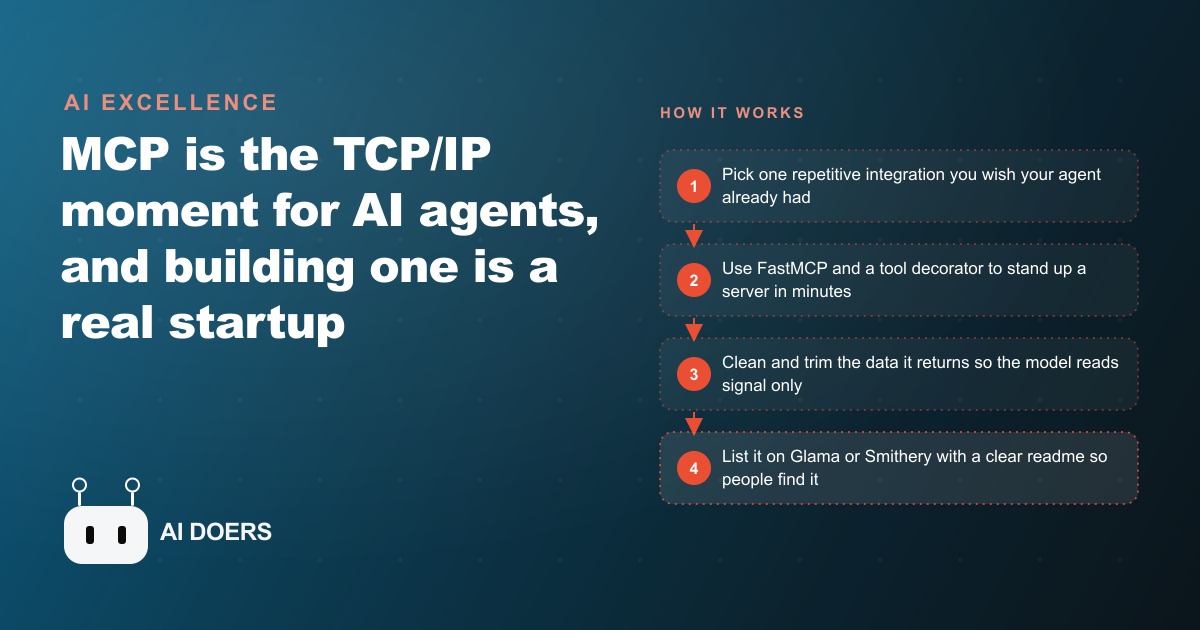
MCP is the single standard that lets any AI agent talk to outside systems in one format instead of a different one per model provider. Because it lowers the cost of integration the way TCP/IP did for networks, it opens room for marketplaces, paid servers, and businesses built on distributing connectors. Here is how I would put it to work for a real business.

Six months before the term MCP became part of everyday developer vocabulary, a team building a chatbot for internal support found themselves maintaining four separate integration layers: one for OpenAI's tool-call format, one for Claude's function schema, one for Gemini's JSON specification, and a fourth for the open-source model they were testing on the side. Every time one provider updated their format, at least one layer needed patching. That situation was not unusual. It was the default condition for anyone connecting an AI agent to real external systems, and it is exactly the problem Model Context Protocol was designed to eliminate once and for all.
Before MCP, every integration was its own translation problem
Function calling gave language models their first real mechanism for taking actions in outside systems rather than only generating text. The concept was important and necessary. But the execution created a new kind of friction that slowed down every team trying to build with AI seriously.
Each model provider defined tool calls differently. OpenAI used one JSON schema for describing function parameters and receiving results. Claude had a different syntax for tool use. Gemini defined things differently again. Open-source models based on Llama added yet another variation depending on which version and fine-tune was in use. A connector built for one model simply did not work with another, and there was no shortcut around rebuilding it from scratch for each new provider.
For a business wanting to connect an AI assistant to its scheduling system, its customer database, or the data it uses for its seo-content competitive research and keyword tracking, this meant a permanent commitment to one model provider. Switching models meant rebuilding every integration at cost. The teams that could afford to maintain a portfolio of custom integration layers were large engineering organizations at well-funded companies. For everyone else, AI-powered internal tools were either locked to one provider indefinitely or simply out of reach.
Madhuranjan Kumar describes this as the translation problem. Every integration was custom software that knew about one model's format and one external system's API. That knowledge was buried in glue code, could not be reused across providers, and was owned entirely by whichever developer originally wrote it. It was ongoing maintenance work that added no customer value and produced no reusable asset.
What a shared standard actually unlocks for builders
Model Context Protocol normalizes how AI agents discover tools, call them, and receive results. The TCP/IP analogy is accurate and worth unpacking precisely. Before the internet settled on a single networking protocol, computer manufacturers used proprietary standards that could not communicate without custom bridging software. IBM had SNA. Apple had AppleTalk. DEC had DECnet. Building a product that worked across different networks required writing a separate adapter for each standard. When TCP/IP became the shared layer, that problem disappeared. A service built once could be reached by any device on the network, and that normalization created the conditions for the web and every business that grew on top of it.
MCP does the same job for the agent layer. A connector built to the MCP specification works with any agent client that has adopted the protocol: Cursor, Claude Desktop, Windsurf, and any future client that implements the standard. The developer builds the connector once and makes it available to the entire ecosystem without further adaptation work. Agent clients benefit equally, because they no longer have to build every integration themselves. They connect to existing servers the way a browser connects to websites.
For a business owner running AI tools day to day, the immediate benefit is model independence. A connector to your scheduling data, your customer pipeline, or your web-crm works regardless of which model your assistant uses this month. Switching models no longer breaks your integrations. That freedom removes the most common reason small teams stay locked to one provider for longer than they should.
Marketplaces like Glama and Smithery have emerged to make connectors discoverable, and their structure mirrors early app stores closely. In the first years of mobile, the hardware was table stakes. The value was in the catalogue of applications that ran on it. Developers who built useful apps early owned categories before competition arrived. MCP is in a similar early moment. The gap between the connectors that exist today and the integrations that agent users need is still wide, and the businesses that fill that gap early will hold those positions before the market crowds in.
Standing up the first server in under an hour with FastMCP
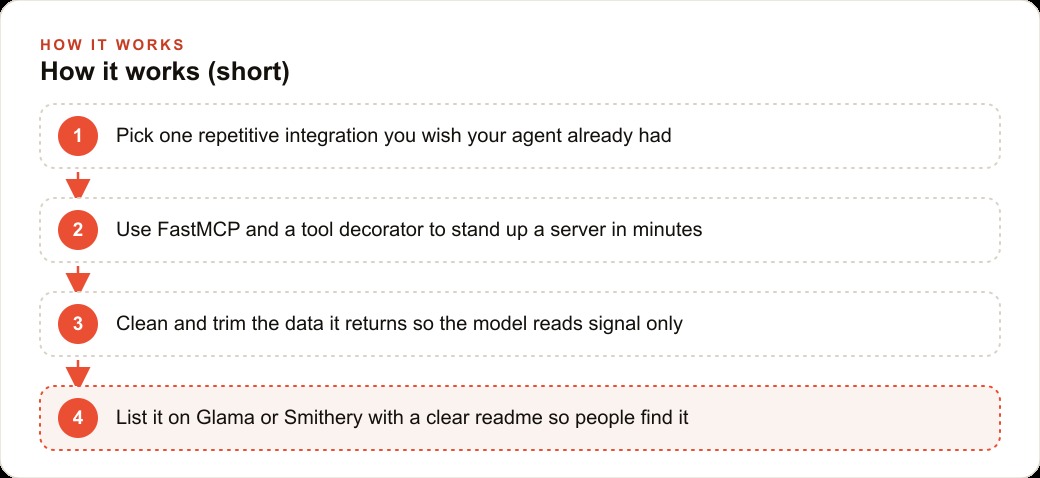
The actual build is simpler than the standard-setting language makes it sound. Anthropic publishes SDKs for Python, TypeScript, Java, and Kotlin. A popular wrapper called FastMCP reduces the code required to start a working server to a decorator applied to a well-described function.
The pattern is this: write a function that wraps the API call or data lookup you want your agent to be able to make. Annotate it with `@mcp.tool` and give the decorator a precise description of what the function expects as input and what it returns as output. That description is not documentation written after the fact. It is the interface the model reads to decide when your tool is relevant and how to call it correctly. A clear description produces accurate tool calls. A vague description produces missed calls, wrong arguments, and failures that look like model problems but are actually description problems.
The practical starting point is one action. Pick the most repetitive thing your agent currently handles through copy and paste, and turn that one action into a function. Wrap it with FastMCP and point an agent at the server. The gap between idea and working server is genuinely under an hour for a simple case, and the confidence from getting one tool working makes every subsequent one easier.
A server with three well-described, clean-returning tools is more useful than one with twenty vague ones, because the model can reliably select and call a small precise set in a way it cannot reliably navigate a large noisy menu. Start narrow and expand only when the existing tools work correctly in real use. The description is as important as the code itself: say exactly what the function does, what its parameters represent, and what the output structure looks like, then test by asking an agent to use it and watching whether it is called correctly on the first attempt.
The Figma experiment: raw data versus cleaned data
The difference between a good MCP server and a mediocre one almost always comes down to a single decision: what the server returns to the model. A concrete illustration comes from a design-to-code workflow built on a Figma connector.
The Figma API exposes an endpoint that returns detailed information about the nodes in a design file. Call it on a specific frame and you get back everything Figma stores about that component: every layer including invisible ones, every style property, metadata about editing history, positioning data for the Figma canvas coordinate system, and dozens of other fields the API keeps for its own internal purposes. On paper this is exactly what a coding agent should need to turn a design into HTML.
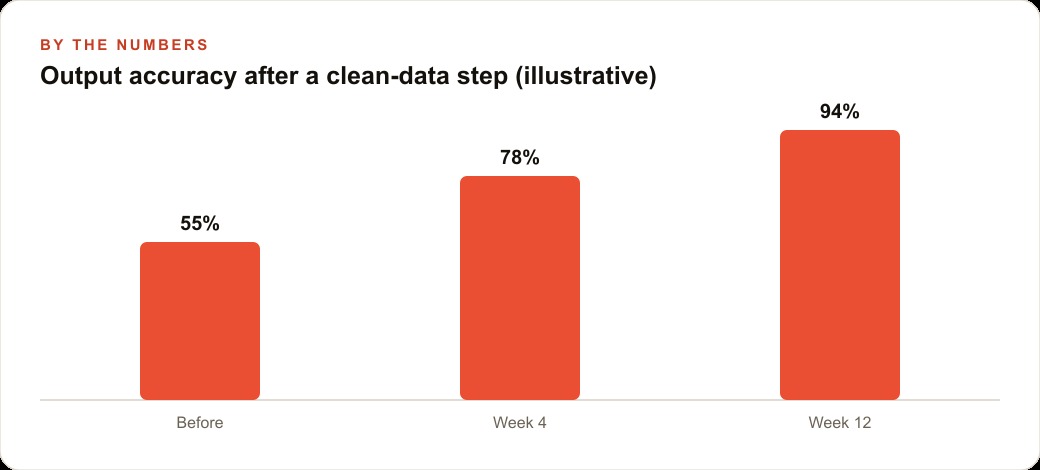
In practice, the raw JSON is enormous and noisy. A large portion of the response has no relevance to writing code. The model processing it works through hundreds of fields where only a fraction carry useful signal for the task. The result is output code that is less precise than it should be. The agent is not making a traditional mistake. It is spending attention budget on irrelevant fields and producing rougher output because of the noise in its input.
The fix is a clean-node step inside the MCP server itself. Before returning anything to the agent, the server strips the Figma response down to only the fields that matter for code generation: layout dimensions, color values, text content, font properties, and component hierarchy. The agent receives a compact and readable description of the design rather than the full API export. The result is that Cursor, the code editor that uses this MCP connector, produces pixel-accurate HTML in a single pass rather than a rough approximation needing multiple rounds of correction.
This is the core craft of building a valuable connector. Not just wrapping an API, but shaping the response so the model reads signal without noise. Any business connecting an AI agent to its own data benefits from this decision. A connector to your product catalog, your lead data, or your customer pipeline in your web-crm should return exactly what the agent needs to answer the next question, not a full database dump that forces the model to search for relevance across hundreds of irrelevant fields. The clean-data step is often the difference between a connector that occasionally works and one that works reliably enough to trust in a real workflow.
From a GitHub repo to the first marketplace installs
Distribution requires two things once the server works locally: a public repository and a clear readme. Glama and Smithery both allow you to list a server by pointing at a GitHub repo. The marketplace verifies that the server starts correctly, checks that the tool descriptions are parseable, and surfaces it to users already searching for that kind of integration.
The readme matters more than its name suggests. When someone finds your connector in a marketplace, it is the first thing they read to decide whether it solves their specific problem. A good readme names the problem plainly in the first sentence, lists the tools the server exposes with their expected inputs and outputs, and shows two or three concrete examples of real output. Those examples persuade more effectively than paragraphs of feature description because they show the actual result rather than a promise about it.
Keep the readme honest about scope. State clearly what the server does not handle. Connectors that overpromise get uninstalled quickly. Connectors that do one specific thing well and say so clearly build trust at a steady rate and accumulate installs over time. The version history matters too: a server that was updated recently signals that it is maintained, which is a meaningful trust signal for anyone deciding whether to add it to a production workflow.
The audience for these marketplaces is expanding beyond developers. As more non-technical AI tools adopt MCP, operators and business owners searching for ready-made integrations make up a growing share of the install base. A connector to a popular scheduling tool, a standard accounting system, or the reporting layer of a meta-ads campaign management workflow will be found by people who will never read the source code but will install the server readily if the readme explains in plain terms what it unlocks for their workflow.
The connector as a product, not a side project
The most durable commercial opportunity MCP creates is treating the connector as the primary product rather than internal infrastructure that happens to be public. Companies like 21st are already building high-quality connectors that help agents produce polished outputs, gating access, and charging subscription fees. The structure is familiar: build useful software once, wrap it with a clean interface, distribute it through a marketplace, and collect a recurring fee from everyone who installs it.
A builder who understands a specific industry has a meaningful advantage here. A connector built for the data systems common in one vertical carries embedded expertise: knowledge of which fields matter for the actual use case, which edge cases appear after real-world use, and how to shape the response so the model produces accurate results. That expertise cannot be replicated quickly from outside the industry, and it gives the connector a natural durability that a generic alternative cannot easily match.
The revenue math is worth working through even on a modest target audience. Consider a vertical where ten thousand businesses share the same operational system. If each pays a small monthly fee for a well-maintained server with reliable uptime and clear documentation, the total is a meaningful recurring revenue base for a single focused product. Distribution cost is low because the marketplaces handle discovery. Maintenance cost is manageable because the server runs independently, can be versioned, and does not require rebuilding for each customer. What looks like a side project on the first commit tends to look like a focused software business after the first five hundred installs.
The window to own a category is open now. The catalogues on Glama and Smithery today are sparse relative to demand. Businesses that build useful, well-documented connectors for specific verticals in the next year will hold those positions before competition fills the gaps. The early movers in every platform moment built durable businesses not because they predicted the future with unusual accuracy, but because they shipped something useful early and maintained it carefully while others waited. The MCP marketplace is in that same phase right now, and Madhuranjan Kumar sees the vertical connector opportunity as one of the clearest near-term openings in the agent ecosystem for a builder with real domain expertise and the discipline to write a clean, well-described server.
That is exactly what we do at AI DOERS. Book a private 30-minute call with Madhuranjan Kumar and we will map the fastest path to it for your specific business.
Book your call →
Madhuranjan Kumar
Madhuranjan Kumar brings 20 years of performance-marketing experience and has managed over $200 million in Facebook ad spend for brands across the United States and beyond. His expertise spans the full modern marketing stack: Meta, Google Ads, TikTok, email automation, CRM, and the websites that hold it together. At AI DOERS he turns that track record into lead-generation systems for businesses across every industry.