
Why the Real AI Product Is the Wrapper, Not the Model
The lasting edge in AI is not the model, which everyone shares, but the wrapper around it: your context, skills, memory, and data. Build that and any good model works better for you.

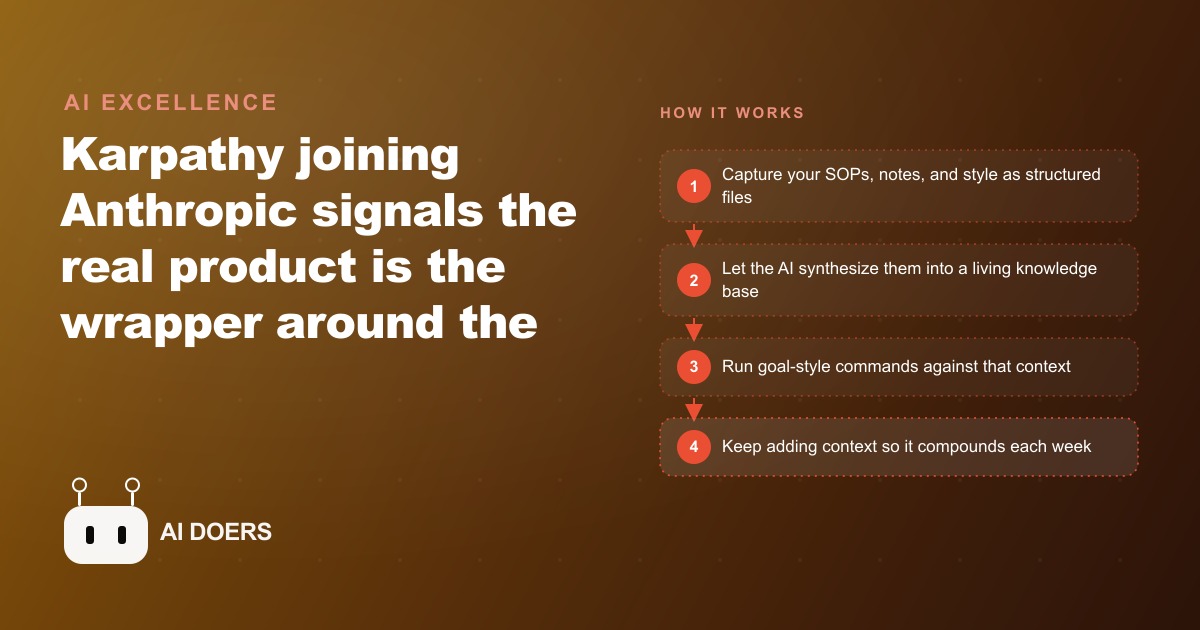
Andrej Karpathy, one of the people who built OpenAI from the beginning and later led AI at Tesla, joined Anthropic this year, and the most interesting part of that announcement was not the name. It was what the move implied about where the value in AI is actually accumulating. I am Madhuranjan Kumar, and I want to use this event to make a point that matters more for how you run your business than any model benchmark does: the lasting edge in AI is not the model, which is becoming a commodity, but the wrapper around it.
1. The model itself is converging toward a commodity
Models from the leading labs cluster together on benchmarks, and the distance between them is narrowing fast. When a new model ships and the headline is that it tops a leaderboard, the gap over the previous leader is often a few percentage points on a test that most users never notice in practice. The raw capability keeps improving, but the competitive moat from raw capability is not growing at the same rate. Everyone gets roughly the same model.
Karpathy's career arc tells this story from the inside. He built the first large-scale AI systems at one lab, taught the internet to understand these models through clear public writing and courses, then moved to the lab whose developer tooling is pulling ahead. The signal in that move is that the next phase is not about training a smarter base model. It is about what you build with the models you already have.
2. Claude Code is proof that the wrapper beats the model
Claude Code is not a model release. It is a wrapper, and it has pulled ahead of competing developer tools precisely because the wrapper is that much better. Sub-agents, skills, hooks, connectors, and a project memory system mean that the same Claude model does categorically different work inside Claude Code than in a plain chat window. Ramp's AI index showed Anthropic passing OpenAI in business adoption, and the reason is not that Claude scored higher on a benchmark. It is that Claude Code turned the model into a development environment that professionals actually trust daily.
The wrapper is the product. The model is the engine. Nobody buys a car for the engine alone.
3. Context engineering is a different skill than prompt-writing
Most people think of AI proficiency as writing clever prompts. Context engineering is different: it is building the right files, folder structure, memory, and connectors so that the model is consistently useful without needing a new clever prompt each time. You front-load the work once, and every future interaction benefits from what you built.
The LLM Wiki pattern is a concrete version of this. You keep a folder of raw markdown notes, the agent synthesizes them into a connected, living knowledge base, and a small schema file tells it how to ingest more material. That is a real knowledge base the agent maintains and updates, not a one-time data dump that goes stale. The difference between a dead document folder and a living knowledge base is whether the agent can read, update, and reason over the files without you opening them first.
For a business running Google Ads campaigns, the living knowledge base might hold your historical performance patterns, your best-performing ad copy, your audience notes, and your campaign structure decisions. Instead of re-explaining all of that every time you need to adjust strategy, the context is already there and the model works from it intelligently.
4. Goal-mode commands change what delegation means
The shift from prompts to goals is the behavioral change that matters most. Earlier autonomous research tools ran loops toward an objective metric. That pattern now appears as goal-style commands in several tools: you describe the outcome and the agent works until a condition is true, rather than you describing every step of how to get there.
For a business owner, this changes the kind of task you can delegate. A prompt that says draft a response to this email is still you doing the thinking. A goal that says handle my inbox triage and flag anything that needs my personal attention is delegating a category of judgment. The same principle applies to longer work: instead of scripting each step of a research task, you describe the deliverable and let the agent find the path.
This is still early, and goal-mode agents make mistakes that require human review. But the direction is clear, and the businesses that build the context structure to support goal-mode delegation now will be years ahead of the ones still writing step-by-step prompts.
5. Your SOPs and customer notes are the moat nobody can copy
When people say data is the competitive moat, they picture a giant proprietary database. For most businesses, the real moat is much smaller and more practical: your meeting notes, your customer call recordings, your internal procedures, your naming conventions for what a good result looks like, and your staff's accumulated judgment about how to handle edge cases.
Feed those to an AI as usable context and it gets smarter for your specific business every week. A competitor using the exact same model without your context gets generic output. You get output that reflects your methods and standards. That gap compounds.
This is equally true for Facebook and Instagram ad campaigns as for anything else. A business that has captured its best creative briefs, its highest-performing hooks, its audience insight notes, and its offer testing results in a form the AI can read has a context advantage that shows up every time a new campaign brief is needed. The model is the same. The wrapper is different.
6. Lock-in comes from accumulated context, not a contract
You can switch AI models any time. The APIs are open, prices are competitive, and migration is generally straightforward. The reason users who build serious context inside one system tend to stay is not that leaving is technically hard. It is that the context itself has become an asset. Your project files, your memory, your workflows, and your skills represent months of careful work to encode your business knowledge into the system. That is what you are protecting, and it mostly lives in the system you built it in.
This is a healthy form of lock-in because it is based on value created rather than switching costs imposed. The businesses that understand this and invest in building real context will have genuine leverage. The ones chasing each new model release will be starting over every few months.
7. Education is the bottleneck Karpathy is positioned to fix
Karpathy built one of the most successful AI education platforms on the internet. His visual, from-first-principles explanations of how these models actually work reached millions of people who had never been able to engage with the concepts before. The fact that he moved to a lab whose central challenge is getting professionals to use AI effectively is not random.
The business adoption barrier is not raw capability. It is that most professionals do not know how to build a wrapper. They do not know what context engineering means, how to set up a living knowledge base, or how to write a goal-mode command. They know the model exists and occasionally use it to draft emails. Closing that gap is a massive opportunity, and it is exactly where focused education matters most.
For a business owner, the practical implication is that the skills to build a wrapper around an AI model are learnable, they are not obscure, and the window where learning them gives you a genuine advantage over competitors is right now, before the mainstream catches up.
Starting this week
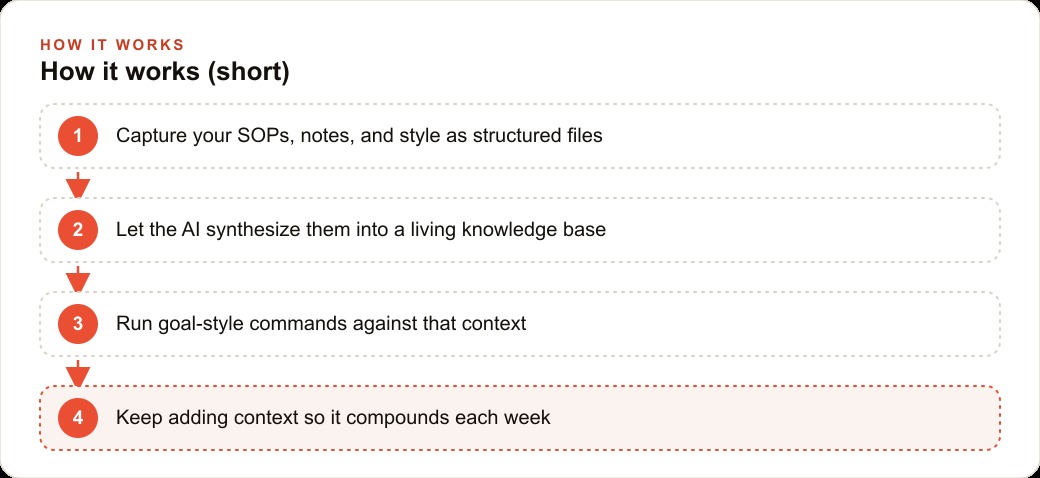
Begin by building a context folder. Pull together your standard operating procedures, your best email and proposal examples, your naming conventions, and a plain description of what a good result looks like for your most important tasks. Put them in structured files. Then try the living-knowledge-base pattern: a folder of raw notes, a synthesized version the agent maintains, and a simple rule for how to add more material.
That context folder is the wrapper in its earliest form. From there you can experiment with goal-mode commands for your most repetitive tasks, add skills for the work you do most often, and build the memory that makes every future interaction smarter. The CRM and website infrastructure that already runs your customer relationships becomes a natural target for these connections, because that is where the real institutional knowledge lives. The winners over the next few years will not be the businesses with the best model access. They will be the businesses that invested earliest in the context that makes any good model work better for them specifically. ## A worked example: how a marketing consultant built a wrapper that compounds
A marketing consultant I work with runs a small practice with two junior associates. The senior consultant carries years of judgment about which ad structures work for which types of service businesses, which offers convert for which audiences, and how to sequence a campaign from awareness to conversion. None of that judgment is written down. It lives in her head, and the associates produce work that requires significant revision before it is ready because they do not have access to the patterns she has accumulated.
She spent four hours building a context folder. The senior consultant dictated her frameworks and preferences as voice notes. The notes were transcribed and organized into structured markdown files: one for audience analysis frameworks, one for offer structure patterns, one for creative brief templates, and one for the questions she always asks before recommending a campaign structure. Each file is one to two pages of clear, specific guidance.
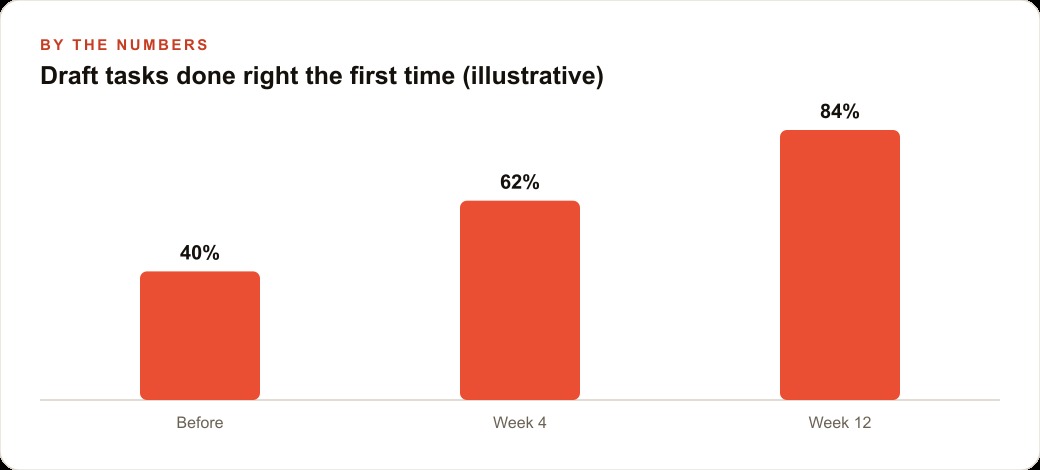
Those files now load into every AI session the associates open. When a junior account manager needs to analyze a new client's audience, the AI already has the senior consultant's audience analysis framework. When they need to write a creative brief, the template is already in the context. The output they produce on the first draft is now 70 to 80 percent of the way to the senior consultant's standard, compared to the 40 to 50 percent she was seeing before the context folder existed.
The senior consultant estimated she was spending six hours per week revising and coaching on work that should have been closer to standard on delivery. After the context folder, that dropped to two hours per week. Four hours of time saved each week, compounding across the year, from four hours of upfront investment in writing down what she knew.
The goal-mode application followed naturally. She identified the campaign briefing process as a good candidate: instead of the junior writing a brief and waiting for feedback in two rounds, the AI now runs through the context folder's questions automatically when asked to draft a brief, flags the decisions that need senior input, and produces a near-final document that requires one review pass rather than two revision cycles. Three fewer revision cycles per week means faster campaign launches and more client capacity at the same headcount.
The context folder is also now updated whenever the senior consultant learns something new. When a campaign structure she had not tried before produces strong results, the insight goes into the context folder that same week. When a client type she had not worked with before reveals a pattern, it goes in. The folder grows, and every addition makes every future session smarter. That compounding is what makes the wrapper more valuable than the model, and it is why investing in it now, when the advantage is still visible, is the highest-return activity available.
The final point worth making is about timing. The businesses that build a strong context layer now, when most of their competitors are using AI with no context at all, create an advantage that is difficult to close. A context folder built over six months of real use reflects the actual patterns of what works for that business in its specific market with its specific clients. A competitor who starts six months later is starting from a blank slate. The accumulated context is a genuine proprietary asset, not a prompt template that can be copied. Building it now, deliberately and systematically, is the investment that makes the wrapper durable.
That is exactly what we do at AI DOERS. Book a private 30-minute call with Madhuranjan Kumar and we will map the fastest path to it for your specific business.
Book your call →
Madhuranjan Kumar
Madhuranjan Kumar brings 20 years of performance-marketing experience and has managed over $200 million in Facebook ad spend for brands across the United States and beyond. His expertise spans the full modern marketing stack: Meta, Google Ads, TikTok, email automation, CRM, and the websites that hold it together. At AI DOERS he turns that track record into lead-generation systems for businesses across every industry.