
Why Google DeepMind Is Training AI Agents Inside A 20-Year-Old Space Game
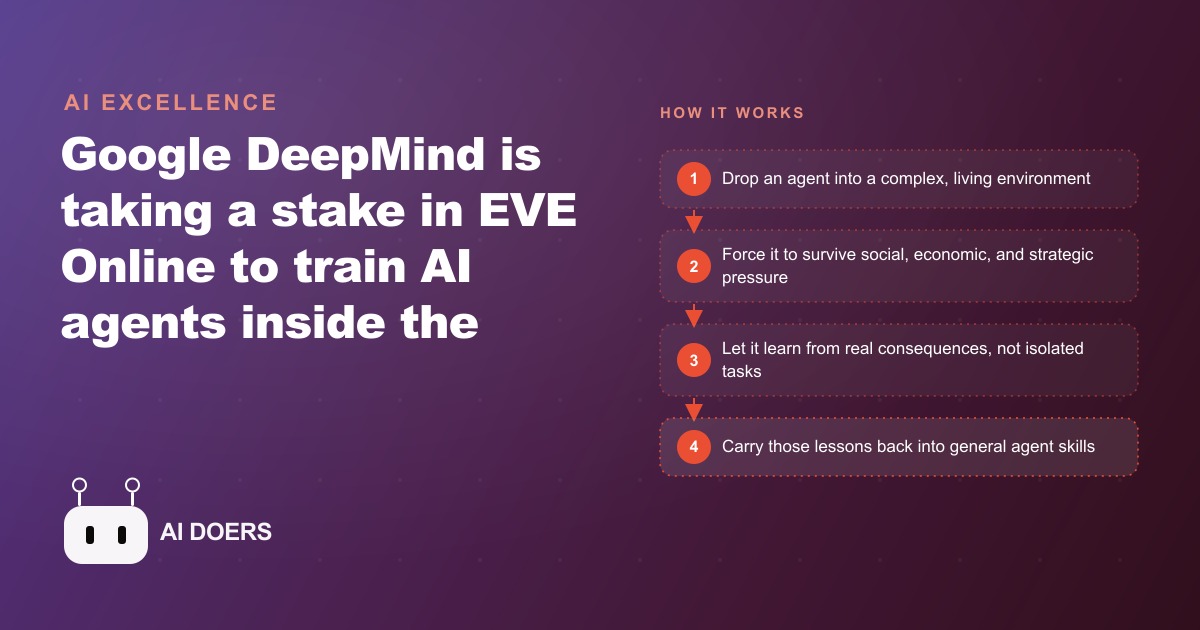
DeepMind is putting AI agents inside EVE Online's player-driven economy because surviving a messy, living system teaches an agent far more than a clean test ever could.

Google DeepMind just took a minority stake in a twenty year old space game so it could raise AI agents inside one of the most complex economies ever built. I am Madhuranjan Kumar, and while that headline sounds like a curiosity, it is actually a compact lesson in how capable AI gets made, and how a normal business should think about the whole AI market right now. Rather than retell the announcement, I have pulled out the seven ideas inside it that actually matter, each one a takeaway you can use even if you never touch a video game in your life.
1. Capability comes from messy worlds, not clean tests
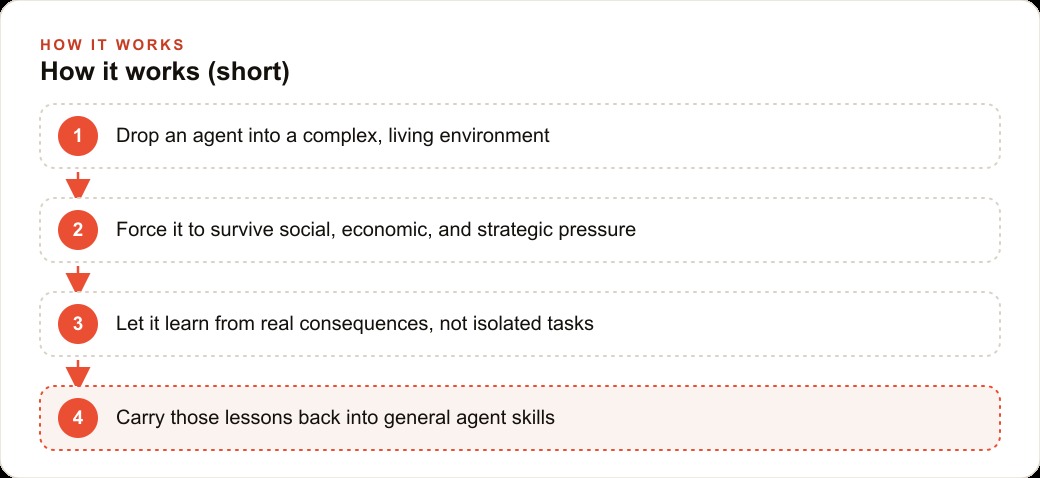
The single most important idea is why DeepMind chose a game at all. Most AI tests isolate one skill in a tidy setting and measure it. EVE Online does the opposite. It throws an agent into a world where survival depends on social, economic, and strategic decisions happening all at once. DeepMind is not buying the game and not taking it over. It entered a research partnership for one reason: the game contains a living, player driven economy, and the team wants to teach agents inside messy, realistic systems instead of sanitized labs. The takeaway for you is that an agent gets genuinely good only when it practices against real, chaotic conditions with real consequences. A demo that works on clean inputs tells you almost nothing about how the same agent behaves on a bad Monday.
2. A real economy is the hardest possible training ground
The second idea is what makes EVE special. Its economy is entirely player driven. If someone wants a ship, another player has to mine the raw ore, refine it, research a blueprint, manufacture the parts, and sell the result on an open market where traders post bids and asks like a real stock exchange. Prices move with supply and demand, and the riskier regions hold the rarer resources. That means an agent dropped into it cannot win by mastering one narrow trick. It has to manage logistics, weigh alliances and betrayals, and plan campaigns that unfold over long stretches. The lesson is that decision quality shows up only when decisions interact. Your business is a small version of this same web, where a pricing choice affects scheduling which affects staffing, and an AI that cannot feel those connections will make confident, wrong calls.
3. Real stakes teach what pretend stakes cannot
The third idea is about consequences. Ships and resources in EVE carry genuine value, so wars and betrayals inside the game have cost people real money. Those high stakes are exactly why it is a powerful arena to study how an agent makes decisions. When a mistake actually hurts, the quality of reasoning that survives is very different from the quality that survives a consequence free sandbox. Translate that to your own operation: if you want to trust an AI with a decision that matters, you have to test it where getting it wrong has a cost, not just where the output looks plausible.
4. Games have always been DeepMind's stepping stone
The fourth idea gives the move context. The people behind DeepMind have used games as both benchmark and training environment for years, going back through Atari, where systems learned to play from raw pixels and reward signals alone. EVE is the natural next step, swapping arcade scores for a living economy and short games for campaigns that play out over long horizons. The takeaway is that this is a deliberate progression toward agents that can strategize over time, not a stunt. When the most serious lab in the field keeps returning to messy environments, that is a strong signal about what actually builds capability.
5. The agents run in a sealed sandbox, and that matters
The fifth idea addresses the obvious worry. The agents are not merged into the live player universe. DeepMind gets a separate sandboxed instance, so this is a research lab bolted onto the game, not a takeover of real players. That design choice carries its own lesson for businesses adopting AI: you train and stress test in an isolated copy of your real conditions, using real data, before anything touches live customers. You want the realism of your actual chaos without exposing real people to an agent that is still learning. A sealed sandbox fed with genuine history is the sweet spot.
6. Compute is an asset you acquire, not just a bill
The sixth idea steps outside the game and helps you read the AI market. Labs have looked unprofitable, and many people concluded the whole thing is a bubble. But a large share of that spending went into acquiring compute and training models, which behaves far more like buying a factory than paying a monthly utility bill. Treat compute as an asset you are acquiring, and the gloomy math flips, because you are looking at investment on the balance sheet, not runaway running costs. For an owner, the practical version of this lesson is simple. When you spend on AI tooling and infrastructure that makes your operation permanently sharper, judge it as an investment that compounds, not as an expense to minimize. The same instinct applies to the systems that carry your growth, from your Facebook and Instagram ad campaigns to the CRM and website stack that follows up on every lead.
7. Data flywheels turn a small lead into a large one
The seventh idea is the flywheel, and it shows up everywhere in AI right now. In robotics, some makers produce a unit roughly every hour and sell them even at a loss, because each one collects real world data that feeds training, and being slightly ahead today compounds into a big lead tomorrow. Early household robots are even guided remotely to finish tasks while capturing exactly how those tasks get done, because that real data is the bottleneck everyone is racing to fill. The lesson for your business is that the value is in the data your operation generates. Every job, quote, and customer interaction is fuel. Capture it deliberately and your AI gets sharper over time. Ignore it and you hand that compounding advantage to a competitor who did not.
A worked example: an auto repair shop training its own agent
Let me put these seven ideas together in a shop, because you will never need EVE, but you will apply the exact same principle: train your AI inside the real, messy conditions of your business rather than a perfect demo. Picture an agent that helps run the front desk. In a clean test it answers tidy questions flawlessly. In the real shop it faces a customer angry about a delay, a parts supplier whose price just jumped, three jobs competing for one lift, and a quote that has to balance a tight budget against a fair margin.
Following idea one and idea three, you make that agent useful by letting it practice against your real history of jobs, quotes, no shows, and supplier swings, with the actual consequences attached, so it learns which trade offs hold up. Following idea five, you run it first in a sandbox on that history, not live on real customers. Following idea seven, every interaction it handles becomes data that sharpens the next decision. When it learns that a certain follow up wording books more delayed job customers back in, that lesson sticks and compounds, and it feeds cleaner intent into the Google Ads and local pages behind SEO and organic search that bring those customers in the first place.
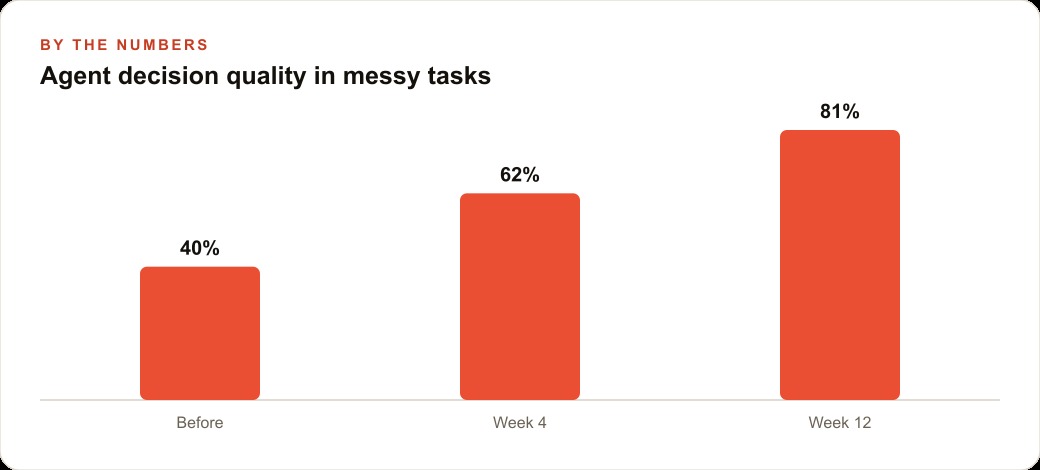
Now put illustrative numbers on it. Suppose you score the agent's decision quality on messy, real world tasks, the awkward calls a clean bot fumbles. An agent that only ever saw tidy inputs might handle those correctly around forty percent of the time. After a month of training against the shop's real history and feeding failures back in, that climbs to roughly sixty two percent. By the twelfth week, with the flywheel turning, it reaches about eighty one percent. Those figures are illustrative, not a guarantee, but the shape is the whole point: an agent trained inside your real chaos gets meaningfully better at the decisions that actually matter, while one trained on clean demos plateaus early.
The market read hiding inside the game story
There is a bonus lesson worth pulling out separately, because it changes how you should interpret every scary AI headline you read. The story that AI labs are wildly unprofitable, and therefore the whole thing is a doomed bubble, rests on reading their spending as running costs. But a huge share of that money went into acquiring compute and training models, which is closer to buying a factory than paying a monthly bill. One is capital you own that keeps producing value. The other is expense that vanishes each month. Confuse the two and the numbers look like disaster. Read them correctly and they look like heavy investment in durable assets.
This reframe matters for an owner far from Silicon Valley, because the same logic applies to your own AI spending at a tiny scale. When you buy tooling and infrastructure that makes your operation permanently sharper, you are acquiring an asset that compounds, not burning cash. Judged as an expense, every dollar looks like a cost to cut. Judged as an investment, the same dollar looks like a stake in a system that gets better over time. The mindset you bring to the ledger changes which decisions you are willing to make.
The flywheel idea sharpens this further. In robotics, being slightly ahead on data today compounds into a commanding lead later, which is why some makers sell hardware at a loss just to collect real world information. The generalizable point is that early, deliberate investment in capability and data pays off non linearly. A competitor who starts capturing and using their operational data now will not be a little ahead of one who starts a year later. They will be far ahead, because every month of data made the next month's decisions better. That is the same compounding that DeepMind is chasing inside a game, and it is available to your business the day you decide to start capturing what your operation already produces.
Why a game teaches your business anything at all
The reason this story is worth your attention is that the frontier players win by training inside worlds that fight back, and you can apply that same discipline at a much smaller scale in your own operation. Start by picking one real, decision heavy job in your business and gathering the messy history around it, including the awkward cases that usually break a simple tool. Put your agent to work against that real data rather than a tidy sample, watch where it makes bad calls, and feed those failures back in as lessons. Treat the compute and tooling you buy as an investment that pays off as the agent gets sharper, not just a cost to trim.
One more practical point before you start. The awkward, exception heavy cases are the ones worth gathering most carefully, because they are exactly what a clean demo hides and exactly what breaks an agent in production. The angry customer, the supplier who changed terms mid job, the quote that did not fit the usual template, these edge cases are not noise to filter out of your training data. They are the most valuable part of it, because handling them well is what separates an agent you can trust from one that only works when nothing goes wrong. Collect the mess on purpose, and treat every failure the agent produces as a lesson to feed back in rather than a reason to give up on the tool.
DeepMind chose a twenty year old space game because it fights back harder than any benchmark. Your business fights back too, every day, in its own smaller way. That is not a problem to hide from your AI. It is the exact training ground that makes the AI worth having. If you would rather not run that experiment alone, my team and I do exactly this kind of practical AI setup, and a short call is the easiest way to see what it would look like for your business.
That is exactly what we do at AI DOERS. Book a private 30-minute call with Madhuranjan Kumar and we will map the fastest path to it for your specific business.
Book your call →
Madhuranjan Kumar
Madhuranjan Kumar brings 20 years of performance-marketing experience and has managed over $200 million in Facebook ad spend for brands across the United States and beyond. His expertise spans the full modern marketing stack: Meta, Google Ads, TikTok, email automation, CRM, and the websites that hold it together. At AI DOERS he turns that track record into lead-generation systems for businesses across every industry.