
Why Everyone Is Suddenly Getting Hacked, and What Actually Protects You
AI did not create software vulnerabilities, it accelerated their discovery and made attacking small targets profitable. The defense is rotating credentials, demanding app-based 2FA, setting a passphrase, and telling your coding agent to skip packages younger than 14 days.

A single stolen token used to be a nuisance. This month it became a weapon that deletes your home directory the instant you try to revoke it. That is the tone of the new hacking wave, and the reason so many people feel like everyone around them is suddenly getting breached at once. I am Madhuranjan Kumar, and I want to walk through what actually changed, because the panic online is louder than the facts, and the facts point to a very short list of things that genuinely protect a small business.
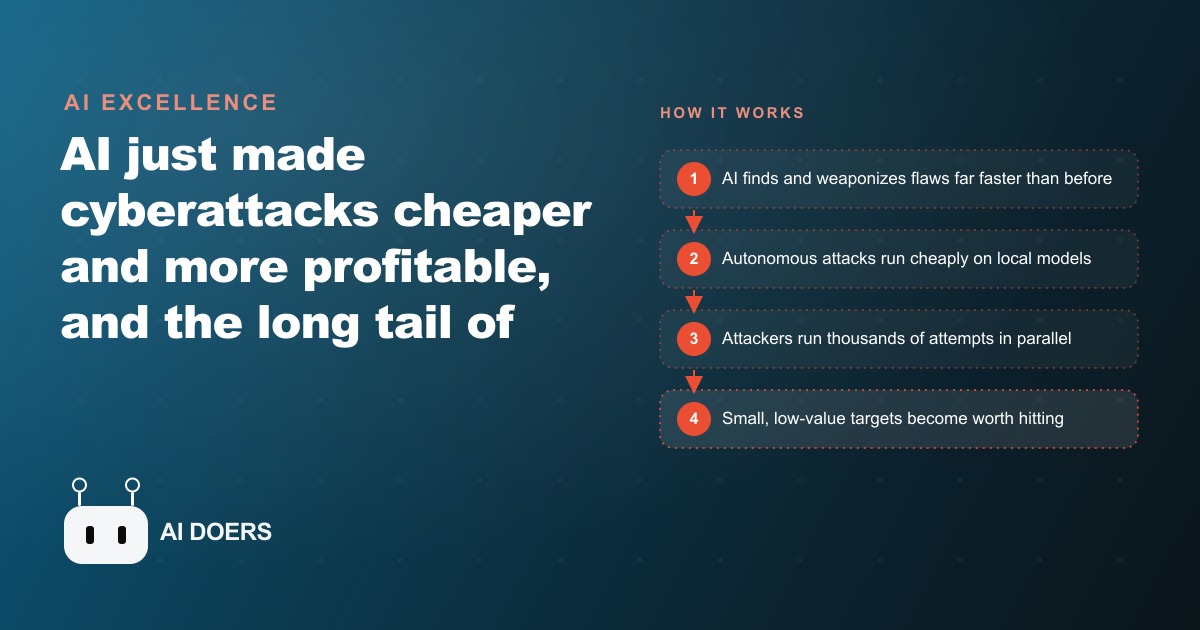
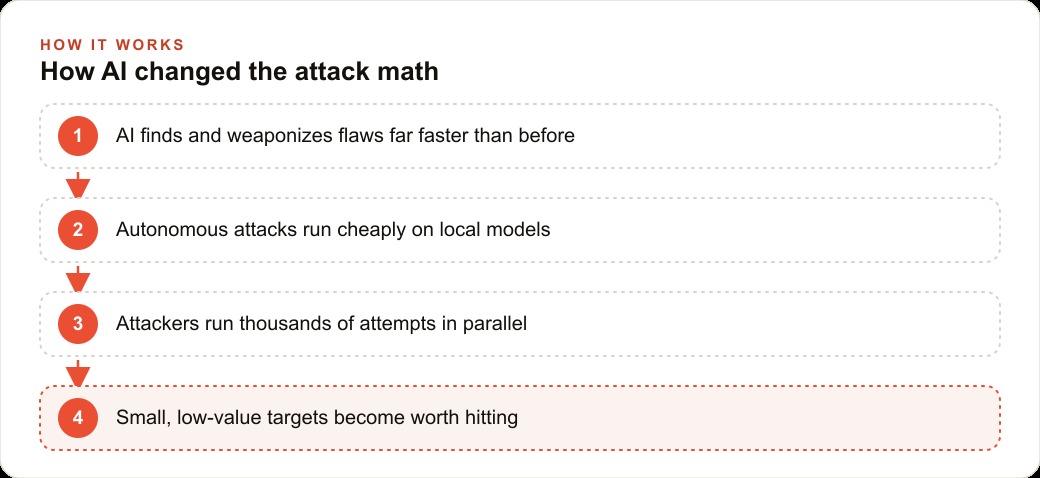
The important reframe is this. AI did not invent software vulnerabilities. Humans wrote the flawed code, the way they always have. What AI did was collapse the cost of finding those flaws and, more importantly, collapse the cost of attacking targets that were never worth attacking before. Below are the shifts that matter and the moves that answer them, in the order I would act on them.
1. The first AI-discovered zero-day is already loose in the wild
Google's Threat Intelligence Group flagged the first known threat actor using a zero-day exploit that was developed with AI help. A zero-day is a live, unknown bug that nobody has patched yet, the kind of thing state actors normally hoard and pay millions to keep secret. The headline is not that one exists. It is that the discovery pipeline just got a force multiplier. A model can read code all day, never get bored, and understand a codebase better than most humans skimming it under deadline pressure. Point that at open-source projects, which anyone can inspect, and the rate at which fresh flaws surface goes up. For a business owner this is context, not a to-do item, but it sets the stage for everything that follows.
2. A worm called Shy Halud proved the supply chain is the soft underbelly
The scarier real-world event was a worm that tore through the open-source package ecosystem. It began as an NPM supply chain attack, planting a quiet watcher on the developer's machine, and it wired up a dead-man's switch. The moment someone revoked the GitHub token it had already stolen, it wiped the home directory as retaliation. It spread to 373 malicious package versions across 169 NPM names and then jumped into PyPI, the Python side. If your website, app, or automation stack pulls in third-party packages, and almost every modern one does, this is the attack that reaches you without anyone targeting you by name. It rides in through a dependency you trusted last Tuesday.
3. Your smallness used to protect you, and it no longer does
This is the shift almost nobody internalizes fast enough. Attacking a single small business or individual used to make no economic sense, because the payoff was tiny relative to the human hours involved. AI flips the math. When finding a weakness is cheap and attacks run in parallel by the thousand, the long tail of small, low-value targets becomes profitable in aggregate. No attacker is sitting there thinking about your specific dental office or boutique. A campaign is sweeping thousands of businesses at once, and you are one row in a spreadsheet. That is oddly reassuring, because broad and opportunistic attacks are exactly the kind that basic hygiene knocks you out of.
4. Autonomous attackers never sleep and barely cost anything
Just as a builder can hand a goal to a coding agent and let it grind for days, an attacker can set up a harness that runs on its own. Run it on a local open-source model and the marginal cost is basically hardware and electricity. The guardrails that ship on those open models can be fine-tuned away, so the same openness that lets small teams build useful things also lets small malicious teams write cheap attack code. When the cost of an attempt trends toward zero, attempts multiply until something gives. For most businesses the thing that gives is a reused password or an old, forgotten access token.
5. Deepfaked voices turn a phone call into a break-in
Voice and video cloning crossed the line from novelty to convincing. A cloned call to your office manager, sounding exactly like you and urgently asking to wire a payment or hand over a login, now works often enough to be a standard tactic. This matters most for the businesses that move money or hold sensitive records, because the weakest link is rarely the firewall. It is a trusting human on the phone at 4pm. The defense here costs nothing and I put it near the top of the list below.
6. Rotate the credentials you have quietly been ignoring
Now the moves. The single highest-leverage action for most teams is boring: rotate the passwords and access tokens nobody has touched in months. The token-stealing attacks above only pay off if the stolen token still works. Rotation shrinks that window. Pay special attention to the credentials tied to the systems that make you money, like the login to your ad manager. A hijacked ad account is a favorite because attackers can spend your budget on their own Facebook and Instagram ad campaigns before you notice the charges. The same goes for anything with a saved payment method attached.
7. Move two-factor authentication off text messages
Two-factor is good. Two-factor over SMS is the weak version, because SIM swapping, where an attacker convinces a carrier to move your number to their device, is a real and well-practiced attack. Move your important logins to an authenticator app instead, so the second factor lives on a device the attacker does not physically hold. This one change quietly defeats a whole category of account takeovers, and it is a fifteen-minute job per account. Do the money-adjacent accounts first: banking, payment processors, ad platforms, and the admin login to your website.
8. Tell your coding agent to refuse packages younger than 14 days
If you or anyone on your team uses AI coding or automation tools, add one rule to how they operate: never install a software package that is less than 14 days old. Most malicious supply chain payloads get caught and pulled within that window, so a short quarantine on new dependencies filters out the majority of poisoned releases before they ever reach you. This is the specific, practical answer to the Shy Halud style of attack. It costs you nothing except occasionally waiting a couple of weeks for a genuinely new tool, which is almost never urgent.
9. Set a passphrase before you ever need one
Agree on a simple family or office passphrase, a word or short phrase that any urgent money request must include to be treated as real. If a call comes in sounding exactly like the owner and demanding a fast wire transfer, the person on the other end simply asks for the passphrase. A deepfake cannot supply what it was never told. This defeats the voice-cloning tactic with zero technology and zero cost. Decide it once, tell the handful of people who move money, and you have closed the door that the fanciest AI attack walks through.
10. Assume the surface area is wider than it was a year ago
The final shift is a mindset, not a task. A year ago you could reasonably assume that being small and unremarkable kept you off the radar. That assumption is now wrong, and quietly holding onto it is the most dangerous position of all, because it leads to doing nothing. The correct posture is not panic. It is a calm acknowledgment that the pool of viable targets got much larger, and that the cost of being in the easy-target group is higher than the cost of the handful of habits that pull you out of it. Every one of the moves above takes minutes and costs little or nothing, while a single serious breach can cost a small business its client trust, its data, and weeks of recovery. Weigh those against each other and the decision makes itself. Treat basic security hygiene the way you treat locking the front door at night: not because you expect a break-in tonight, but because leaving it open is a needless invitation, and the lock is nearly free.
A worked example: what this looks like for a med spa
Let me make this concrete with one business. Picture a med spa with online booking, stored client photos, payment details on file, and a small front-desk team. A year ago an attacker would have scrolled right past it as too small to bother with. Today that same spa sits squarely in the long tail that just became profitable, not because anyone chose it, but because it got swept up in a campaign hitting thousands of small businesses at once. And it holds exactly the things that make a breach painful: sensitive client data, payment information, and a reputation built entirely on trust.
Here is how I would harden it in an afternoon, using only the list above. First, rotate every shared password and access token the team has not changed recently, starting with the booking system and the payment processor. Second, move two-factor onto an authenticator app for the booking admin, the email account, and the ad manager, since a hijacked ad account would drain the marketing budget fast. Third, set a passphrase so a cloned call to the office manager asking to wire a vendor payment gets stopped cold. Fourth, if the spa runs any automation or a custom booking page, add the rule to skip brand-new packages. None of this is exotic, and none of it requires a security consultant on retainer.
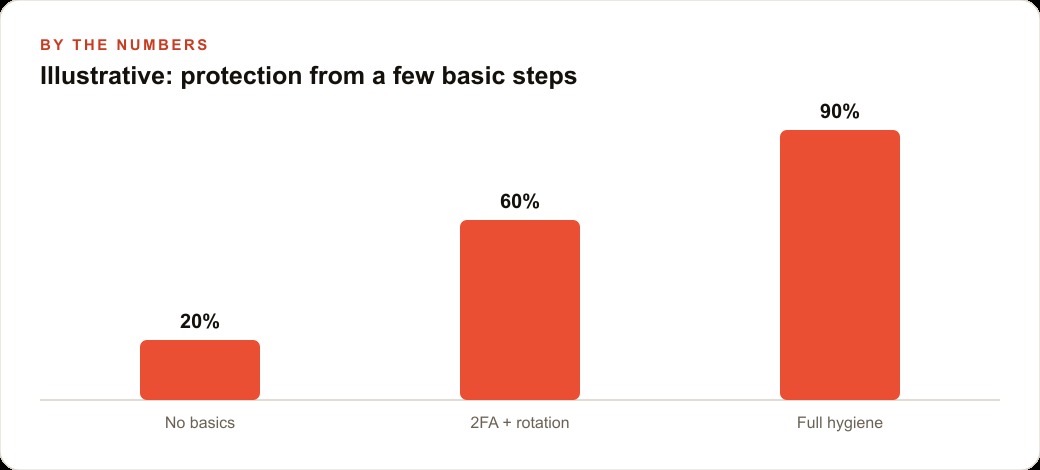
The payoff is easiest to see in illustrative terms. Imagine scoring a business on basic exposure. With none of these in place, call it 20 out of 100 on defensibility, wide open to the automated sweep. Add authenticator-based two-factor and credential rotation and that jumps to roughly 60, because you have removed the two attacks that actually reach small businesses. Layer on the passphrase and the package rule and you are near 90, having closed the deepfake path and the supply chain path too. Those numbers are illustrative, not measured, but they capture the real shape of the risk: a handful of cheap habits move you from easy target to not worth the trouble.
The realistic threat is not the headline threat
It helps to separate the news from the reality. The AI-found zero-day and the self-propagating worm are the cutting edge, and they make for dramatic reading. But the attack that actually lands on a med spa, a law office, or a home-services company is almost always something dull: a reused password, an unrotated token, or a convincing fake phone call. The dramatic stuff drives the trend. The dull stuff drives the breaches. That is good news, because the dull attacks are exactly the ones that basic hygiene defeats.
There is also a longer game worth naming. As NVIDIA's Jensen Huang puts it, this becomes my AI versus your AI, and the strongest models demand the most compute and money, so well-funded defenders should out-defend weaker attacker models over time. Frontier labs are already using models on defense, uncovering and patching decades-old bugs, including a 27-year-old OpenBSD flaw and a 16-year-old FFmpeg flaw, with one lab holding back a particularly capable tool because it judged the release too dangerous. That is encouraging at the ecosystem level, but a small business cannot wait for someone else's frontier model to save it. It has to close its own cheap holes.
Where this connects to the rest of your operation is simple. The systems most worth protecting are the ones that touch money and customer trust: your ad accounts, your payment processor, and the CRM and website stack where client records and follow-up automations live. Those are the crown jewels, and the nine moves above are aimed squarely at them. Even your content and SEO and organic search assets, the pages and accounts you have spent months building, deserve the same authenticator-app treatment, because a hijacked publishing login can undo a lot of quiet work in an afternoon.
You can put all of this in place yourself this week, and I would encourage you to start today with credential rotation and app-based two-factor, because those two alone remove the attacks that realistically reach you. If you would rather have someone map your actual exposure, prioritize the fixes for your specific stack, and lock it down properly, that is exactly the kind of work worth handing to an expert so you can get back to running the business.
That is exactly what we do at AI DOERS. Book a private 30-minute call with Madhuranjan Kumar and we will map the fastest path to it for your specific business.
Book your call →
Madhuranjan Kumar
Madhuranjan Kumar brings 20 years of performance-marketing experience and has managed over $200 million in Facebook ad spend for brands across the United States and beyond. His expertise spans the full modern marketing stack: Meta, Google Ads, TikTok, email automation, CRM, and the websites that hold it together. At AI DOERS he turns that track record into lead-generation systems for businesses across every industry.