
Why Codex Became The New Best AI Coding Tool
Codex pulled ahead because a great coding model is now a great general model, and it wraps that model in the smoothest single super app for both coding and knowledge work.

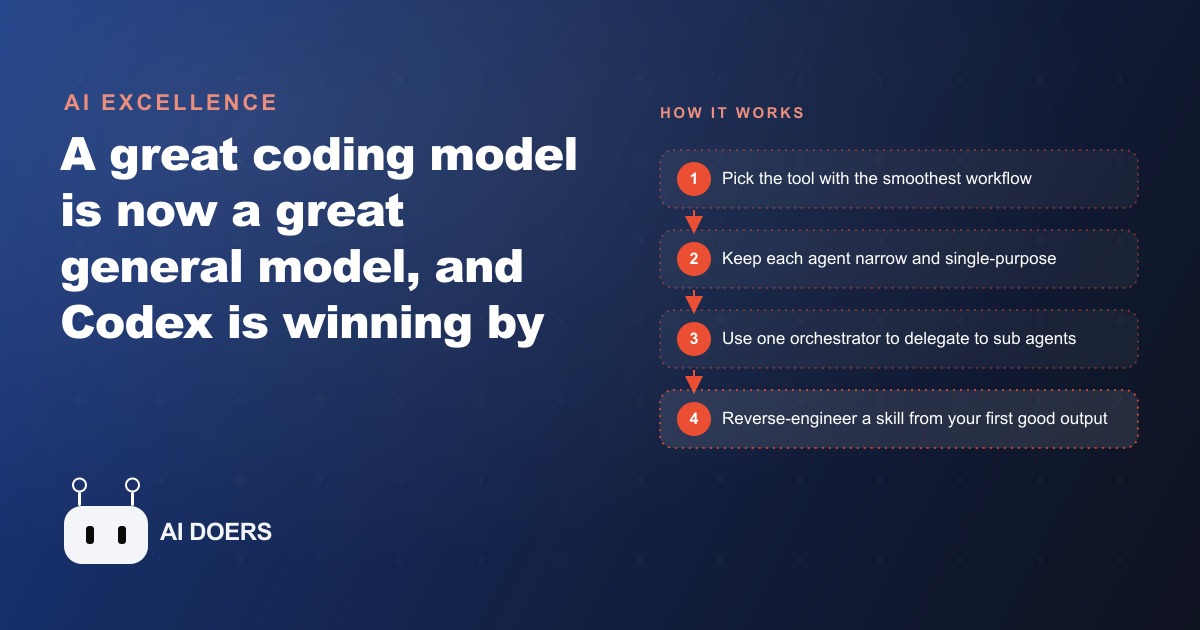
The realization that changed everything: all business outputs are files
I am Madhuranjan Kumar, and I want to start with the claim that reframed the entire AI coding race, because once you understand it, the market dynamics of the past year make complete sense. The claim is this: a great coding model is a great general model. Not a useful coincidence. Not a side effect of training scale. A logical necessity.
Here is the reasoning. Most of what a business produces is either documents, which are structured text files, or data, which are structured numerical files. Proposals are text files. Spreadsheets are structured data files. Reports are text files with embedded data. Customer records are database files. Social posts are text strings. Marketing assets are image files. The entire output of a modern business is, at the hardware level, a collection of files with different structure and format.
A model that can write reliable code to produce, parse, transform, and analyze files is therefore a model that can reason about the contents of those files, summarize what they say, find patterns across them, and produce new ones from instructions. The coding capability and the general reasoning capability are not separate skills. They are the same skill applied to different file types. When a model learns to write code that correctly transforms a data file, it learns the same kind of logical precision that makes it reliable when reasoning through a complex proposal or a scheduling problem.
This is why every major AI lab now builds the coding model first and positions everything else as a layer on top. The coding model is the foundation that makes the general model capable. The lab that builds the best coding model ends up leading in general reasoning, writing quality, and instruction following, not because they separately optimized for each but because the underlying capability transfers.
What a super app is, in terms that survive the marketing
The term super app gets used to describe many different things, but the specific meaning that matters for evaluating tools like Codex is more precise. A super app is a wrapper around a strong coding model that handles both coding work and knowledge work from a single interface without requiring a mode switch, a separate login, or a different mental model for each task type.
The logic is straightforward. If the coding model and the general model are the same model under the surface, there is no reason to give them separate interfaces. A developer writing code and a business owner drafting a proposal are both working with files that the same model can handle. Splitting them into two different tools with two different interfaces, two different accounts, and two different prompt formats is an artifact of historical product organization, not a technical necessity.
A super app resolves that historical artifact by giving both tasks the same interface. You open one tool, you describe what you want to produce, whether code or content or analysis, and the model produces it. The interface does not change based on task type. The model does not change. The cost structure does not change. The skill you develop using the tool on one task type transfers to every other task type because the underlying model is the same.
The practical value for a team is coherence. When everyone on a small team uses the same tool for drafting, analysis, coding, and data work, the workflows align. The prompting styles are consistent. The output formats are consistent. The habits compound in a single direction rather than fragmenting across five different interfaces that each have their own learning curve.
Why focus won where breadth failed
The product story of the past few months makes more sense through this lens. One lab consolidated its AI product line into a single application and emerged looking more focused than it had in years. Another lab added new surfaces, new modes, and new naming conventions, and the product began to feel sprawling, with the same capability sometimes having two different names depending on which surface you reached it from.
The pattern is not surprising. Focus compounds. A team building one excellent interface for one capable model can dedicate every engineering hour to making that interface better. A team building multiple overlapping interfaces for the same model has to divide engineering attention and inevitably produces multiple things that are each somewhat less than excellent. The consolidated product gets better faster. The sprawling product improves more slowly across more surface area, and the user has to learn more to extract the same value.
For a business choosing tools, this has a direct implication: the tool to invest time learning is the focused one, not the feature-rich one. Every hour you spend learning the quirks of a secondary interface is an hour that does not compound into mastery of the interface where most of your work actually happens. The tool with the cleaner surface, even if it offers fewer explicit feature options, often produces more output per hour of use because the user's mental model is simpler, the habits transfer across task types, and the interface does not require decision points that interrupt the work.
The narrow agent architecture and why it beats a single capable one
The conversation about which AI tool is best often frames capability as a property of the model alone. The insight that changes this framing is that the architecture of how you deploy the model matters at least as much as the model's raw capability. A single capable model given broad instructions and many connected tools performs worse than a set of narrow agents each with specific instructions and a small number of directly relevant tools.
This is not a limitation of current AI. It is a structural property of task focus. A model given thirty connected tools and instructions to handle reporting, follow-up communication, data analysis, and customer service simultaneously is trying to hold the context of thirty different capability options while reasoning about each new input. The cognitive overhead of maintaining that breadth produces less reliable output on each individual task. A model given five tools and a specific job definition can allocate its full reasoning to that job and produce more consistent results.
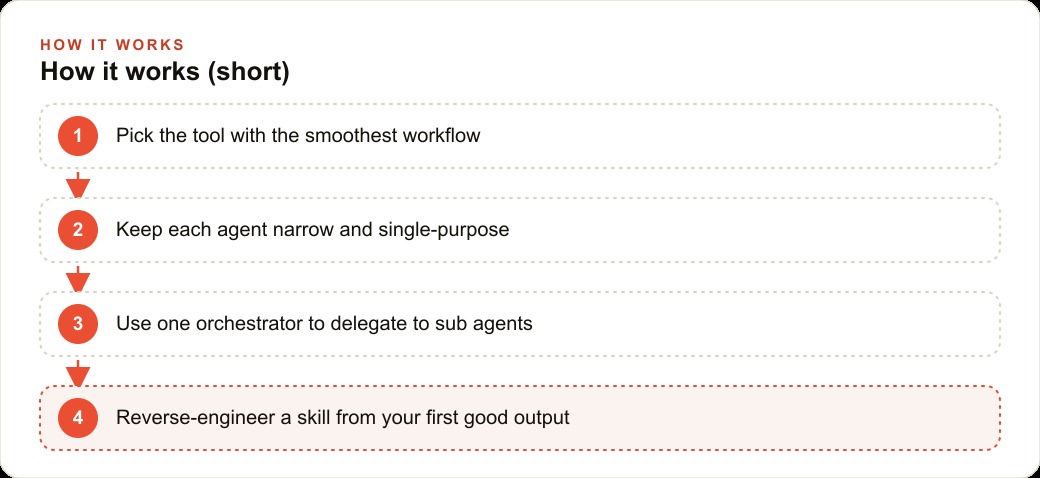
The correct architecture for a business that wants to use a super app at scale is an orchestrator plus specialists. One agent handles all communication from the human and routes incoming work to the right specialist. Each specialist is narrow: one handles reporting, with only the data access and formatting tools it needs. One handles follow-up communication, with only the messaging tools and the relevant templates. One handles data analysis, with only the analysis tools and the output format it produces. The orchestrator routes. The specialists execute. No single agent is overwhelmed by scope.
Skill capture as the real asset, not the model itself
The most durable competitive asset in an AI tool deployment is not which model you use. It is the collection of skills, templates, and workflows that encode how your business produces its best outputs. A skill in this context is a precise description of what excellent output looks like for a specific recurring task, detailed enough that the model can reproduce it reliably without the human re-explaining context, format, or tone each time.
Building a skill begins with producing excellent output once. When the model gets a task exactly right, the specific prompt, the output format, and the handling of edge cases are captured as a reusable template. The next time the same task surfaces, the skill is applied rather than a fresh prompt written. The quality is consistent because the definition of quality is baked into the skill rather than re-created each time from memory.
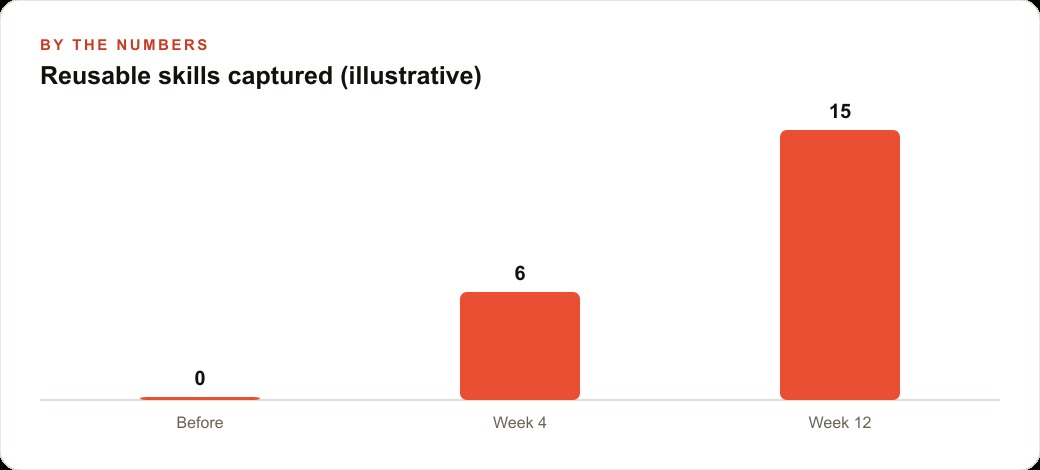
A roofing company's skill library after three months of disciplined use might contain ten or twelve skills: the weekly pipeline report format, the follow-up message template for unconverted quotes, the cost breakdown structure for a new job estimate, the review request message for completed jobs, the supplier inquiry template, the morning brief format. Each skill was captured from a moment when the model produced something the owner recognized as exactly right. The library grows through use rather than through planning, which means it reflects the actual recurring work of the business rather than an anticipated set of tasks.
The skill library is also the portability asset when the model market changes. Because the skills describe desired outputs in business terms rather than model-specific terms, they transfer to a new model when a better or cheaper option emerges. The investment in the library does not depreciate when the underlying model changes. The business keeps its institutional knowledge about what good output looks like, and the new model is evaluated against that standard rather than starting fresh.
How a roofing company's reporting system illuminates the whole principle
Let me make this concrete with a single example that ties the architectural principles to an actual business outcome. A roofing company wants consistent weekly reporting: leads by source, quotes sent, jobs closed, revenue in the active pipeline, and cost per lead from the ad platforms. The owner wants this every Monday morning before the day starts.
The naive approach is to write a prompt that asks for this report and send it fresh every Monday, sometimes getting good output and sometimes having to re-prompt when the format is wrong or a metric is missing. That approach costs roughly the same effort every week and does not improve over time because nothing is captured.
The orchestrator approach looks different. One narrow agent handles pulling and cleaning the data exports from the platforms. It connects to only those platforms, formats the data into a consistent intermediate structure, and hands it to the next agent. A second narrow agent takes that structured data and produces the report in the exact format the owner wants to see. Its skill definition includes the column headers, the order of sections, the handling of a job that was quoted in a previous period but converted this week, and the format of the summary paragraph. The orchestrator coordinates the two agents and delivers the result.
After this system is built and the skills are captured, the Monday report arrives automatically in consistent format without any prompting on Monday morning. The first version took an afternoon to design. The tenth version takes zero additional effort because the system handles it. The quality does not drift over time because the skill definition holds the standard. And when the owner wants a new metric added, one prompt to the skill definition updates every subsequent report rather than requiring re-prompting each week.
This is the compound return that super apps with strong agent architecture deliver. The first good output earns back the time spent building it on the first use. Every subsequent use of the skill is pure return. Over a year of weekly reports, that Monday morning brief has been delivered fifty-two times from a system built in an afternoon. The total time investment in year one is one afternoon of building and fifty-two minutes of Monday morning reading. Every alternative was fifty-two mornings of manual assembly, re-prompting, or skipping because the week was already full.
That is exactly what we do at AI DOERS. Book a private 30-minute call with Madhuranjan Kumar and we will map the fastest path to it for your specific business.
Book your call →
Madhuranjan Kumar
Madhuranjan Kumar brings 20 years of performance-marketing experience and has managed over $200 million in Facebook ad spend for brands across the United States and beyond. His expertise spans the full modern marketing stack: Meta, Google Ads, TikTok, email automation, CRM, and the websites that hold it together. At AI DOERS he turns that track record into lead-generation systems for businesses across every industry.