
Why ChatGPT Uninstalls Surged 295% In One Weekend
ChatGPT uninstalls jumped 295% over a single weekend after a trust shock sent users to Claude, which had just made switching frictionless, and the durable lesson for any business is that trust is a moat and switching costs decide who keeps customers.

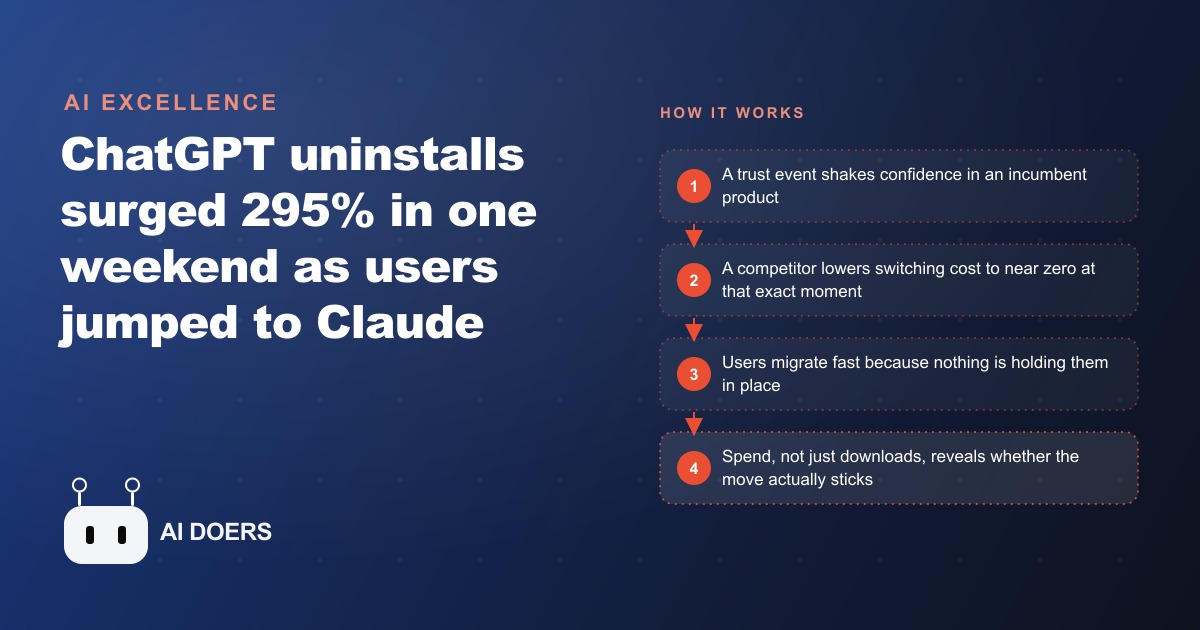
Between Friday evening and Monday morning, ChatGPT uninstalls surged 295 percent, Claude went from outside the top ten to the most downloaded app in the App Store, and a years-long assumption about user loyalty was quietly revised.
A trust event and a frictionless exit arrived on the same Friday afternoon
The weekend that reshuffled the AI platform market started with a news story most users never went searching for. Reports surfaced that a leading AI lab had been excluded from a government contract after refusing two requests: the use of its models for domestic surveillance of American citizens, and the building of fully autonomous weapons systems without a human in the decision loop. The company held those limits openly. The same Friday, a competitor announced a defense arrangement and cited similar principles, but the timing of both announcements made the contrast between them visible to anyone reading the news that afternoon.
By Monday morning, the behavior data was sharp. ChatGPT uninstalls had surged 295 percent. Claude had moved from outside the top ten downloaded applications to the number one position in the App Store. I am Madhuranjan Kumar, and the significant thing about those numbers is not their size. It is their speed. A trust event that surfaced on a Friday afternoon had produced measurable, large-scale behavior change by Monday morning. That is a 72-hour window from news story to market shift, compressing a process that standard churn models expect to play out over quarters or years into a single weekend.
The trigger was not a benchmark result. Nobody released new performance numbers that week that established one platform as clearly superior. The trigger was not a pricing change or a service failure. It was a values question, answered publicly and under real cost, that revealed something about how a company behaves when holding a principle conflicts with a large contract. For a meaningful population of users, that signal was more decisive than any feature advantage the incumbent had accumulated through years of product development.
The decision to move was fast and emotional, not analytical. Users who uninstalled that weekend did not run careful feature comparisons or evaluate migration costs methodically. They reacted to how a company's publicly visible choices made them feel about alignment with their own values, and they acted on that reaction while the emotional energy of the news cycle was still present. That behavioral dynamic, rapid and values-driven and not well-predicted by satisfaction scores or feature preferences, is new enough at this scale and speed that most churn models have no mechanism to account for it.
What made the migration mechanically possible at that speed was something the alternative platform had shipped at nearly exactly the right moment. A tool appeared that let users import their memory and prior context from other AI platforms with minimal friction, so the investment in customization and working patterns built over months could carry forward. Memory features that had been restricted to paid plans were opened to free accounts. The cost of leaving, the accumulated context and personalization that had functioned as a soft retention mechanism, dropped toward zero at the precise moment the trust case for staying came into question.
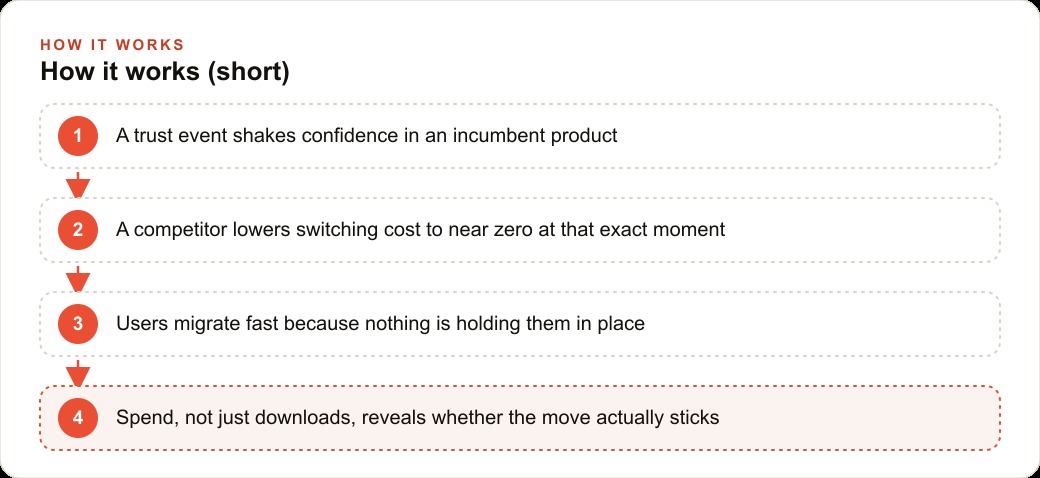
This is the mechanism that breaks loyalty in any market. Two variables move in opposite directions simultaneously: the value of staying weakens, and the cost of leaving drops. When both move at once, migration is the expected outcome. When only one moves, the incumbent survives. A trust shock without a low-cost exit produces noise but not mass migration. A frictionless alternative without a trust shock is a product feature with a normal adoption curve. Both together produce weekend-scale market shifts. Understanding the mechanism matters because it applies to every business that retains customers on a relationship, not just to AI platforms.
The second behavioral observation from that weekend is about the nature of the loyalty that broke. The users who moved were not evaluating whether one platform's feature set was superior on the dimensions they used most. Many of them had built working habits and preferences inside the incumbent platform over months. They moved anyway, because the trust signal was strong enough to override the accumulated inertia of those habits. That is a different kind of loyalty failure than the kind product teams typically plan around, which is the gradual erosion of satisfaction through feature gaps or reliability issues. The rapid, values-based migration is harder to predict and faster to play out, and the defenses against it are different from those that address ordinary churn.
The spend data is the signal that the app chart cannot tell you
App store rankings are noisy. They respond to press coverage, social media momentum, and the emotional energy of a news cycle as much as they reflect genuine sustained preference. A number one ranking in a week of high media coverage is a striking signal but an incomplete one. Users who download an application in response to a trust event might return to their prior platform within days once the news cycle cools and familiar habits pull them back. The download chart cannot tell you whether the migration was real or whether it was a temporary expression of frustration that resolved without changing anything durable.
The signal that reveals whether a market shift has substance is spending data, and specifically business spending data. When financial platform data showed AI tool budget allocation shifting from predominantly one provider toward predominantly another over the weeks following the weekend, that was the confirmation that the download spike was not just emotional noise. Businesses do not reroute technology budget on impulse. A firm that reallocates recurring AI tools spending has evaluated the alternative against production workflows, tested it on the tasks that matter to the business, validated the output quality against internal standards, and made a procurement decision that reflects real preference. That process takes weeks, which explains why the spending shift lagged the download spike by exactly the amount of time you would expect an evaluation period to take.
The spending data also told a more specific story about what was driving the preference among businesses. The capability that converted business dollars was coding model performance. This adds precision to the migration story. The trust event made a competing platform visible and salient to businesses that might otherwise have continued with their default tools for months or years. It prompted evaluations that would not have happened without that catalyst. Those evaluations then turned on specific capability metrics, and the platform that retained business spending did so by winning the evaluation on the task type that business users weight most heavily when choosing AI infrastructure. The trust event opened the door. The capability evaluation was what made businesses walk through it and stay.
For any business managing its own customer retention, this sequence points toward a measurement gap worth understanding before experiencing it firsthand. Trust events in your own market are invisible on standard customer satisfaction metrics until the spending data changes, and that change typically occurs months after the emotional trigger. A customer who is quietly evaluating an alternative after a trust wobble looks identical to a retained customer on a monthly survey. The leading indicator that something is shifting is usually a change in engagement depth or frequency, not a stated change in satisfaction. Building the measurement habit to track those leading indicators continuously is the only way to see the wobble forming while there is still time to address it.
There is a more precise way to read what the spending data reveals about trust dynamics. In any market with multiple credible alternatives and low switching costs, most customers maintain a mental short list of vendors they could move to at any point. Most of the time, they stay on the current platform because the expected gain from switching does not exceed the friction cost of doing so. A trust event does not have to make the current platform actively bad. It only has to move the expected gain from evaluating alternatives high enough that the evaluation actually happens. If the evaluation then confirms that the alternative performs comparably or better on what matters, the spending moves. The trust event was the catalyst. The capability evaluation was the confirmation. Together they created a durable spending shift rather than a temporary ranking change.
The portable business is the durable one
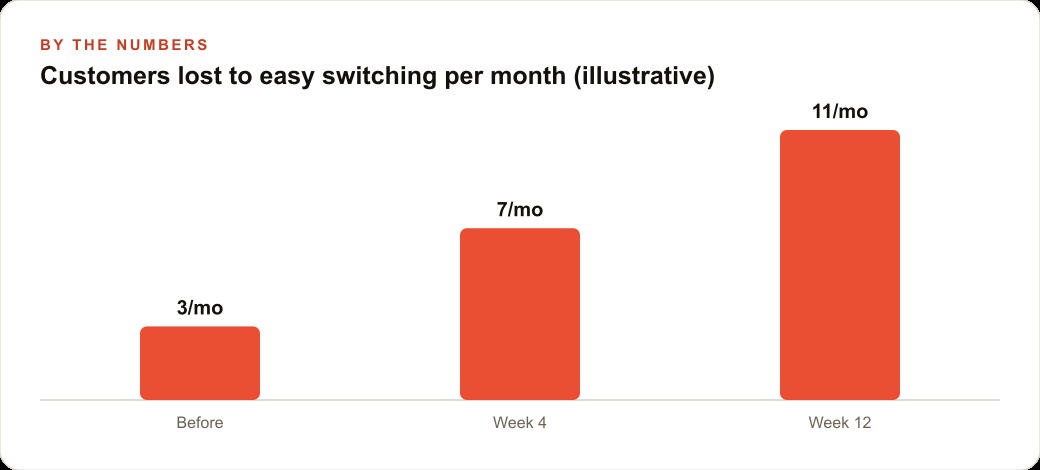
The lesson from this weekend that transfers most directly to businesses outside the AI industry is about the architecture of switching costs, and specifically about the difference between switching costs that reflect genuine accumulated value and switching costs that are purely friction.
Every sustained business relationship carries some switching cost for the customer. Some of that cost reflects genuine accumulated value: the service provider who holds years of context about the client's specific situation, the system configured precisely to the customer's workflow, the relationship where the history of past work makes every future interaction more efficient. These costs have positive value on the other side: the customer stays because the value of the accumulated relationship exceeds the value of starting fresh with someone new. Other switching costs are friction with no corresponding value: export formats that make data portability difficult, processes designed to make cancellation inconvenient, dependencies that create lock-in without creating any benefit the customer can point to. These keep customers in place through inertia rather than through choice.
The frictionless import tool that appeared at exactly the right moment in the weekend's events was a direct product decision about which kind of switching cost to create. Building a tool that made it easy to bring prior context from a competing platform was a choice to reduce the barrier to evaluating the alternative. The implicit argument was that retention should be earned through genuine quality, not through making departure painful. The weekend validated that bet. The customers who moved were not held in place by anything that required them to sacrifice real value. They chose to move, which means the customers who stay going forward can be understood as making an active choice rather than accepting inertia.
Consider a concrete illustration of how this distinction plays out in measurable retention terms. A professional services firm carries 320 ongoing client relationships and a healthy retention rate across several years of operation. A careful analysis of the client base reveals two distinct populations with different retention mechanisms. The first group of roughly 200 clients stays primarily because the firm holds genuine accumulated value: 3 to 5 years of developed familiarity with each client's specific circumstances, communication preferences, and prior work. The cost to these clients of switching is not primarily the friction of transferring documents. It is the loss of that specific relationship and the years of context it carries, which a new provider cannot replicate quickly. The second group of roughly 120 clients stays primarily because finding and onboarding a new provider requires time and effort that exceeds the expected gain from switching, given that the existing service is adequate.
When a competitor launches a streamlined onboarding process that imports the prior firm's documented work into a new client file in 48 hours, the second group becomes genuinely portable. A single trust event in the firm, a billing error handled badly, a missed deadline, a communication failure on a matter the client considered high-stakes, and that group has a direct and low-friction path to a competitor. The first group is different. Their retention is based not on inertia but on a relationship whose value exceeds anything an import tool can replicate. A trust event may make them evaluate alternatives, but if the relationship is genuinely strong and the trust event is addressed well, they typically stay.
Both groups produce identical numbers on a monthly retention dashboard before any trust event occurs. Only careful analysis of engagement patterns, relationship depth, and the nature of client interactions reveals which group is which. The firm that invests actively in deepening the client relationships in the first group is building retention that survives trust wobbles. The firm that allows the second group to grow through inertia rather than genuine value is accumulating a vulnerability that is invisible until a trust event and a frictionless competitor coincide.
Madhuranjan Kumar works with businesses on this distinction regularly. The question of what actually retains your customers is not the same question as whether your retention numbers look healthy. The weekend's events compressed the consequence of that distinction into 72 hours and made it visible at scale. The practical work is building retention infrastructure, relationship depth, documented context, and demonstrated alignment with the customer's values, that holds its value when the test arrives. The portable business, the one whose customers stay by active choice rather than by inertia, is the durable business when the market shifts.
That is exactly what we do at AI DOERS. Book a private 30-minute call with Madhuranjan Kumar and we will map the fastest path to it for your specific business.
Book your call →
Madhuranjan Kumar
Madhuranjan Kumar brings 20 years of performance-marketing experience and has managed over $200 million in Facebook ad spend for brands across the United States and beyond. His expertise spans the full modern marketing stack: Meta, Google Ads, TikTok, email automation, CRM, and the websites that hold it together. At AI DOERS he turns that track record into lead-generation systems for businesses across every industry.