
Why Anthropic Just Voided Thousands of Secondary Share Deals
A trillion-dollar private company restricts who can own its stock, so deals that skipped board approval were declared void. The fee-stacking and red flags behind it are a lesson for any business owner tempted by a hot private deal.

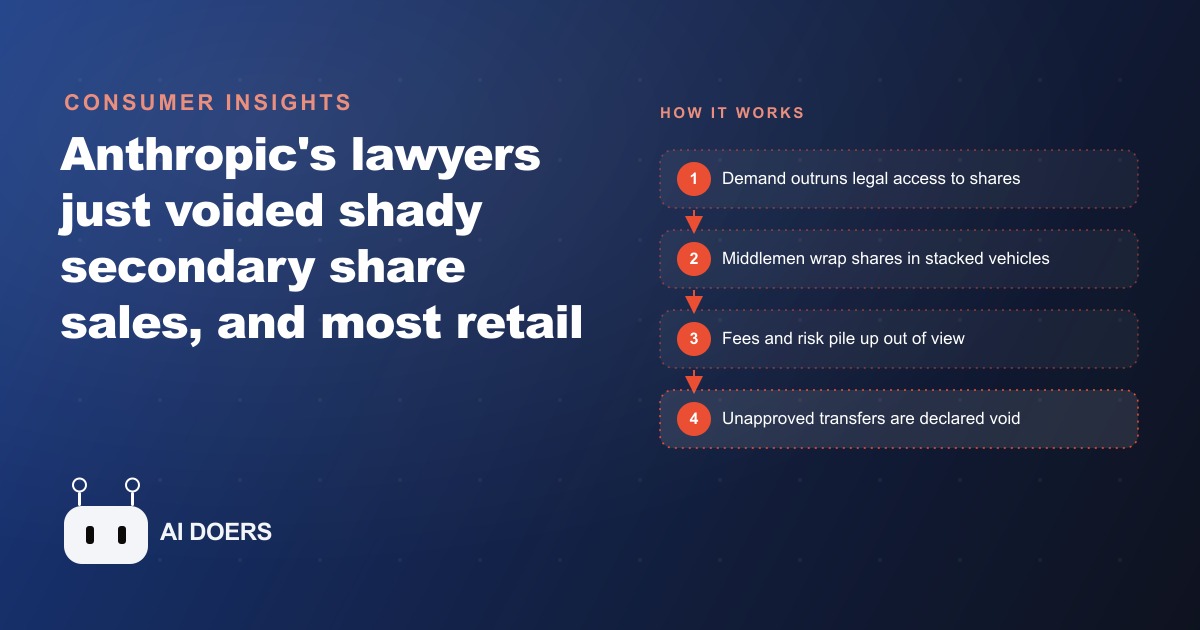
A trillion-dollar company just told thousands of people that the shares they thought they bought are worth nothing. Anthropic, one of the fastest-growing private companies in history, moved to void a wave of secondary sales of its own stock because those deals never had the board approval its rules require. The story is entertaining if you follow AI, but the real value is a set of hard, transferable rules for spotting the exact structure that leaves ordinary buyers holding nothing. I am Madhuranjan Kumar, and here are the seven things every operator should take from it.
1. Demand with no legal door creates a gray market
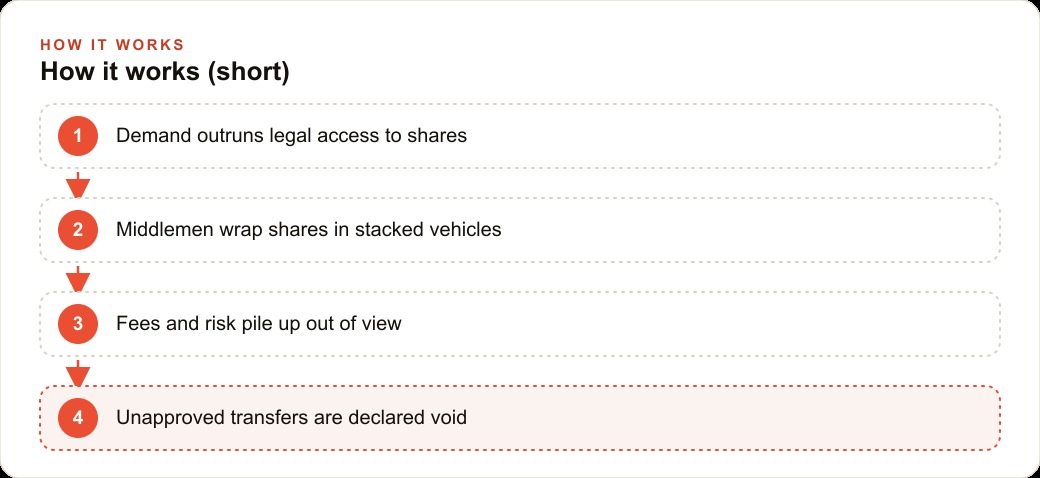
The whole mess starts with a simple mismatch. Anthropic is private, not public like Nvidia or Apple, so you cannot open a brokerage account and buy in. Yet its valuation has been climbing toward a trillion dollars, with revenue reportedly growing many times over in a single year, which created enormous demand for its shares. When intense demand meets a locked front door, people build side doors. That gap between what buyers want and what the law easily allows is the soil every one of these schemes grows in. Any time you see huge appetite for an asset that has no clean, public way to buy it, expect a gray market to appear, and expect it to be messy.
2. Middlemen stack until nobody can see the bottom
Here is how the plumbing actually worked. Occasionally an early employee sells some shares to take money off the table, maybe to buy a house. A buyer scoops up shares from several employees, bundles them into a single investment vehicle, and resells access to that vehicle. Then someone wraps another vehicle around the first, and sometimes a third around that. Each layer is a person taking a cut and adding a sheet of frosted glass between the final buyer and the underlying asset. By the time an offer reaches you at the end of that chain, you may be four parties removed from anyone who actually holds the stock, and you cannot see past the nearest wrapper.
3. Fees compound quietly at every layer
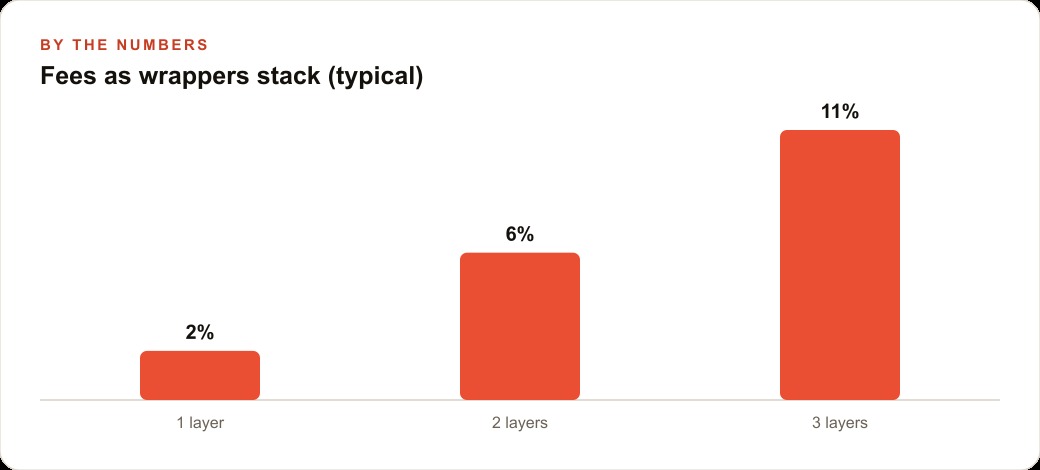
The stacking is not just a transparency problem, it is a cost problem, and the two hide each other. A normal wrapper might charge around two percent. That sounds fine. But stack two and you are near six percent. Stack three and the end buyer can be paying ten percent or more before a single share moves, with almost no visibility into the real terms. Picture paying a tenth of your investment in fees, on top of an inflated price, for something you cannot fully inspect. The compounding is the trap. Each individual layer looks reasonable, and the total is anything but. Whenever a deal reaches you through several intermediaries, assume the fees have quietly multiplied and ask exactly who is taking what.
4. The board holds a veto that most buyers never check
This is the fact that voided everything. Both common and preferred stock carry transfer restrictions written into the company's bylaws. Any sale not approved by Anthropic's board is void and will not be recognized on the company's books. Not disputed, not penalized, void. It never happened as far as the company is concerned. Buyers in these chains were paying real money for a transfer the issuer had the explicit right to refuse and did refuse. The lesson generalizes far past this case: before you buy any interest in anything, find out who has the authority to approve the transfer, and confirm they actually did. If that approval is missing, you are not buying an asset, you are buying a story about one.
5. The wrapper vehicles were banned outright
It goes further than needing approval. Anthropic stated plainly that it does not permit these special purpose vehicles to acquire its stock at all. Any transfer of shares into one of those wrappers is void under the transfer restrictions, full stop. So the very structure the middlemen used to package and resell access was itself forbidden by the company whose shares they were packaging. Read that carefully, because it is the tell. When a deal exists primarily because someone engineered a structure to get around the normal rules, the structure being clever is not reassurance. It is the red flag. A vehicle built to route around a prohibition is a vehicle built on sand.
6. No approval means no rights, no matter what you paid
People in these chains imagined they owned a slice of a soaring company. If a sale went through without board approval, the buyer is simply not recognized as a stockholder. They get none of the rights they thought they were paying for, no standing, no recognition on the books, nothing. The money left their account and what came back was not ownership. This is the coldest part of the story and the most important to internalize. Paying for something does not make it yours. Only a valid, approved, recorded transfer makes it yours, and if that chain is broken at any link, everything downstream of the break is empty regardless of how much changed hands.
7. The warning signs are always the same five
Anthropic's own notice, and common sense, point at a consistent pattern. Unsolicited offers that arrive out of nowhere. Claims of exclusive or limited-time access. Requests to pay by crypto or wire. Pressure to move fast before you can think. And no documentation of the board approval that would make the transfer real. The company even named funds claiming indirect access, listing brokers by name, and noted that some may be legitimate but that without board authorization the sale is still void. That nuance matters. A recognizable name is not the same as an approved deal. When several of those five signs appear together, treat it as a scam until proven otherwise, not a scam only if it turns out badly.
Putting the rules to work in a real business
For a real estate brokerage this whole saga is a mirror, because chain of title and authorization is the brokerage's entire world. Picture a deal where a property interest is offered through a series of intermediaries, each claiming they can deliver access, none of them the party with actual authority to transfer. A brokerage already lives by the rule that a transfer is only real if the right party signs off and it is recorded properly. The same discipline protects the firm and its clients when someone pitches a syndicated investment, a fractional ownership wrapper, or an off-market interest stacked through several vehicles. Before anyone wires a cent, you verify who actually holds the asset, confirm the transfer is authorized by whoever controls it, and read the underlying documents rather than the marketing.
There is a marketing angle worth naming too, because caution is a story people want to hear. A brokerage that openly walks buyers through how it verifies authorization, reads the underlying documents, and refuses to rush a deal positions itself as the safe pair of hands in a market full of pressure tactics. That is exactly the kind of trust message that performs on Facebook and Instagram ad campaigns, where a clear I will keep you out of a voided deal promise cuts through noise. It is also the substance behind strong SEO and organic search content, because buyers are actively searching how to avoid these traps and rewarding the firms that answer honestly. And a diligence checklist that lives inside the CRM and website stack makes the whole thing repeatable, so every client gets the same protection without anyone relying on memory. In a market where buyers are increasingly worried about being scammed, being the firm that slows down at the right moments is a genuine competitive edge, not a drag on the sale.
8. The refund that only came because it went viral
There is an eighth lesson hiding in how this story resolved, and it is the most quietly important one. The pressure that forced clarity here was public attention. The rules were always in the bylaws, but they got enforced loudly and visibly only once the situation drew scrutiny. For an ordinary buyer sitting at the end of a stacked chain, that is a sobering thing to sit with. You cannot count on a company issuing a blunt public notice to save you from a deal you should never have entered. Most bad private deals do not generate headlines. They simply leave one more buyer holding something worthless, quietly, with no viral moment to trigger a rescue.
The takeaway is that your protection has to come from your own diligence, not from the hope that a scandal will surface in time to warn you. By the time a structure like this makes the news, plenty of people have already paid. The buyers who stayed safe were not the ones who read the notice, they were the ones who never needed the notice because they asked for documented board approval before they ever wired money. Enforcement after the fact is a poor substitute for verification before the fact, and only one of those is under your control.
None of this means every private opportunity is a trap. Legitimate private deals exist, and some of them are genuinely good. The point is that legitimacy leaves a paper trail and illegitimacy hides behind structure, so your job is simply to insist on seeing the trail before you commit. A real opportunity survives that scrutiny easily, because the people running it can show you exactly who owns what and who approved the transfer. A trap falls apart the moment you ask, which is precisely why the people running traps work so hard to make you feel that asking would be rude or that the window is closing. Slow down at exactly that moment, because the pressure to hurry is itself the clearest signal that something does not want to be examined.
What separates a real broker from a wrapper salesman
It helps to have a simple mental picture of the difference between a legitimate deal and one of these traps, because in the moment they can look similar. A real broker can show you a clean line from the asset to you: who holds it, who has the authority to transfer it, and the documented approval that makes the transfer valid. A wrapper salesman sells you access to a structure and talks about upside, exclusivity, and speed, while the actual chain of ownership stays vague. One leads with proof. The other leads with pressure. When you learn to notice which one is happening, most of these schemes announce themselves before you are ever at risk.
That distinction is worth teaching to anyone in your business who handles money or evaluates opportunities, because the same shape shows up far beyond AI shares. Fractional real estate, pre-IPO promises, private fund access, even certain crypto offerings all reuse the stacked-wrapper pattern. Train the habit of demanding a clean, documented chain of authority and treating urgency as a warning rather than an opportunity, and you inoculate the whole operation against a category of loss that is entirely avoidable. The people who get burned are almost never the ones who asked one more question. They are the ones who felt rushed and did not.
The one-sentence test to keep
Underneath all seven rules sits a single test. Ask yourself whether you could explain, in one plain sentence, who actually owns the thing and who has the authority to sell it to you. If the answer disappears into a chain of vehicles and intermediaries, you do not really know what you are buying, and that uncertainty is itself the risk. The more layers there are between you and the underlying asset, the more places fees and false promises can hide. The bigger and more uncomfortable truth is that everyday people keep getting locked out of the biggest value-creation events because the real liquidity flows to insiders and large funds. That is not a reason to chase shady shortcuts. You can vet a private deal yourself with patience and documentation. If you would rather have someone help you build a simple checklist for evaluating opportunities and spotting the structures that leave buyers with nothing, that is exactly the kind of thing worth a short conversation before money ever changes hands.
That is exactly what we do at AI DOERS. Book a private 30-minute call with Madhuranjan Kumar and we will map the fastest path to it for your specific business.
Book your call →
Madhuranjan Kumar
Madhuranjan Kumar brings 20 years of performance-marketing experience and has managed over $200 million in Facebook ad spend for brands across the United States and beyond. His expertise spans the full modern marketing stack: Meta, Google Ads, TikTok, email automation, CRM, and the websites that hold it together. At AI DOERS he turns that track record into lead-generation systems for businesses across every industry.