
Why Anthropic Got Blacklisted by the US Government Over Claude's Guardrails
The Department of War demanded Anthropic remove the guardrails that block Claude from mass surveillance and fully autonomous weapons. Anthropic refused, so the Pentagon designated it a supply chain risk and ordered every federal agency to stop using its technology. Here is what the standoff teaches anyone building on AI.
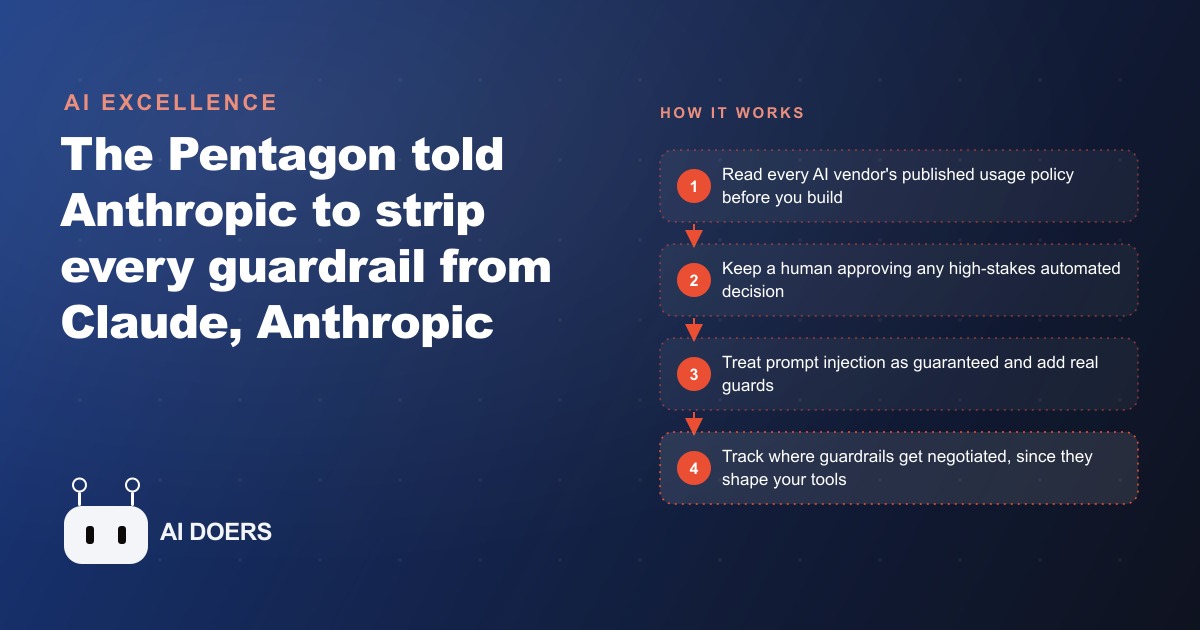
The US government just blacklisted an AI company for refusing to remove its safety guardrails, and buried inside that dramatic standoff is the most practical guide to running AI in your own business that you will read this year. The Department of War told Anthropic to strip every guardrail out of Claude so it could be used for defense without restriction, or be cut off. Anthropic said no. Within days the dispute escalated into the first time the federal government has ever designated an American company a supply chain risk to national security. I am Madhuranjan Kumar, and I want to use that fight as a template, because the exact principles Anthropic defended are the ones that keep your own AI tools from causing real damage. This is a playbook. Each stage is a decision the standoff illustrates, and a step you can take.
First, the context that makes the lesson land. This was not a company refusing to work with the military. Anthropic signed a two-hundred-million-dollar contract with the Department of Defense earlier in the year and was the first AI lab to integrate its models into mission workflows on classified networks. The fight was narrower and far more consequential than the headlines suggested. Anthropic held exactly two red lines and the Pentagon demanded it erase both: mass surveillance of the American people, and fully autonomous weapons that operate with no human in the loop. Everything else, Anthropic signaled, was negotiable. Hold those two red lines in mind, because they are the spine of the whole playbook.
Decide your red lines before anyone pressures you
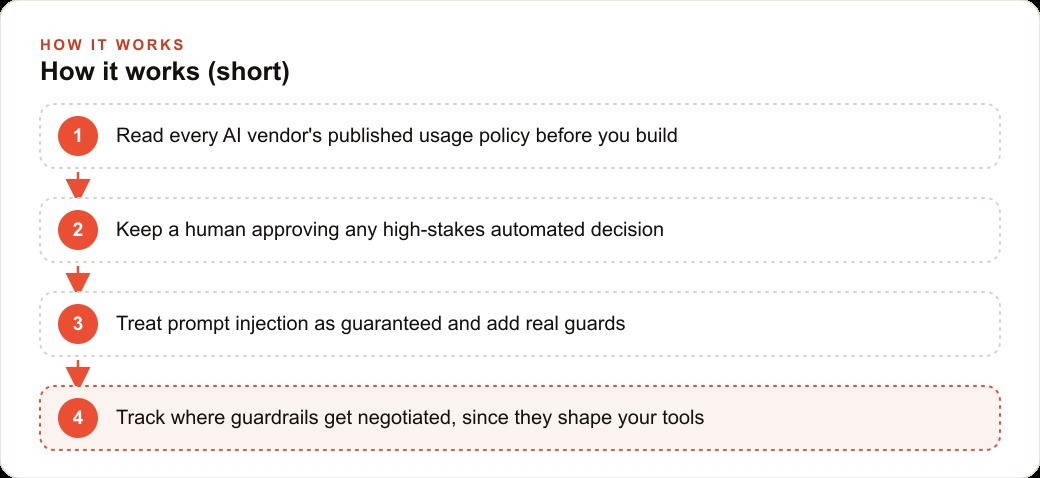
The first stage is the one Anthropic got right, and it is the one most businesses skip. Decide, in advance and in writing, the things your AI tools will never be allowed to do, no matter how convenient it would be to allow them. Anthropic did not invent its red lines in the heat of the argument. It had already drawn them, which is why it could hold the position under enormous pressure. You need the same clarity at your own scale. What decisions will you never fully automate. What data will your assistant never be allowed to expose. What actions always require a human signature. Writing these down when you are calm is what lets you hold the line when a deadline or a tempting shortcut pushes you to cross it. Red lines defined under pressure are red lines that move.
Read the usage policy of every tool before you build on it
The second stage is unglamorous and skipped constantly. Before you build any part of your business on an AI model, read that vendor's published usage policy, so you know the rules you are actually operating under. This standoff made the reason vivid. A major newspaper reported that Claude had surfaced in a raid abroad through a defense-software contract, despite Anthropic's own rules against facilitating violence. The gap between a stated policy and a real-world deployment is exactly where risk hides. For you, the practical version is simpler but just as important. If you build a workflow on a tool whose policy forbids a use you were counting on, you can be cut off with no warning, the same way an entire government just was. Knowing the policy up front means you are never blindsided by a rule you never read.
Put a human on every high-stakes decision
The third stage is the heart of it, and it rests on the strongest argument Anthropic's leadership made, which was technical rather than moral. Frontier AI systems are simply not reliable enough to be trusted alone on decisions that cannot be undone. Models still hallucinate. A single confident mistake in a lethal system could kill the wrong person, which is why a trained human must stay in the loop for any high-stakes call. Scale that reasoning down to your business and it holds perfectly. Your model does not need to be malicious to be dangerous, it only needs to be confidently wrong at the wrong moment. So identify every place an AI can make a decision you would not want made by a confident guess, and insert a human approval step before that decision takes effect. The AI drafts, a person approves. That single discipline is what separates a tool that saves you time from one that eventually costs you a fortune.
There is also a self-consistency lesson here worth naming. The Pentagon's position folded in on itself. It insisted it had no interest in mass surveillance or weapons that act without humans, yet it demanded the removal of the very guardrails that prevent those uses. You cannot credibly promise never to do a thing while deleting the only safeguard against doing it. Apply that test to your own setup. If you claim your AI will never do something harmful, but you have removed every check that would stop it, your claim is hollow. Keep the guardrail that backs the promise.
Treat prompt injection as a guaranteed event
The fourth stage is a mindset shift. The moment you wire a model to live data and let it act, assume that someone will try to manipulate it, because they will. Prompt injection is not an edge case you might eventually encounter. It is a certainty the day you connect an assistant to an inbox that strangers can email. Anthropic's whole posture was built on the assumption that its models would be pushed to their limits by people acting in bad faith, which is why the guardrails mattered so much. Build with the same assumption. Any assistant that reads messages from the outside world needs input guards that strip hostile instructions and output guards that block it from leaking sensitive data or taking forbidden actions. You are not being paranoid. You are matching your defenses to a threat that is guaranteed to arrive.
Watch where guardrails get negotiated, because they shape your toolbox
The fifth stage is about staying informed, and this standoff is the clearest possible reason why. The rest of the industry sided with Anthropic. A rival lab's chief executive said his company is pursuing its own Pentagon deal but intends to keep the same guardrails, and stated plainly that AI should not be used for mass surveillance or autonomous lethal weapons. Roughly two hundred engineers from top AI companies signed a joint letter refusing to permit their models for domestic mass surveillance or autonomous killing without human oversight. There were also threats to invoke the 1950 Defense Production Act, which lets the president compel a private company to supply what national defense requires. The point for you is that these fights, playing out far above your business, decide which capabilities the tools you rely on will and will not have. Keeping half an eye on where guardrails are being negotiated is how you avoid being surprised when a tool you depend on suddenly changes what it allows. A designation that bars an entire class of users from a product, or a policy change that removes a capability you built a workflow around, can land with no warning, and the businesses that saw it coming are the ones that had already lined up an alternative. You do not need to follow every twist of these industry fights, but knowing which way the wind is blowing on AI guardrails is cheap insurance against building your operation on a foundation that shifts under you.
A worked example: the roofing company that borrows the playbook
Let me make the whole thing concrete with an illustrative example. Picture a roofing company leaning into AI. It uses an assistant to quote jobs from drone photos, respond to inbound leads, and handle small refunds or schedule changes automatically. Every stage of the playbook maps straight onto its setup.
First, red lines. The owner decides in advance that no quote above a set dollar amount and no refund ever goes out without a human signing off, full stop. Second, usage policies. Before adopting any tool, the company reads its policy so it is not blindsided later by a rule it never knew existed. Third, human in the loop. The AI can draft a fifteen-thousand-dollar roof-replacement quote, but a person approves it before it reaches the customer, because one hallucinated measurement could cost real money on a real roof. Fourth, prompt injection. Since that assistant reads inbound emails and photos from strangers, the company treats manipulation as a certainty and adds validators so a malicious message cannot trick the assistant into issuing a refund or leaking a customer's details. Fifth, awareness. The owner keeps an eye on the wider fights over AI guardrails, because those decisions determine which tools stay available to a small business like this one.
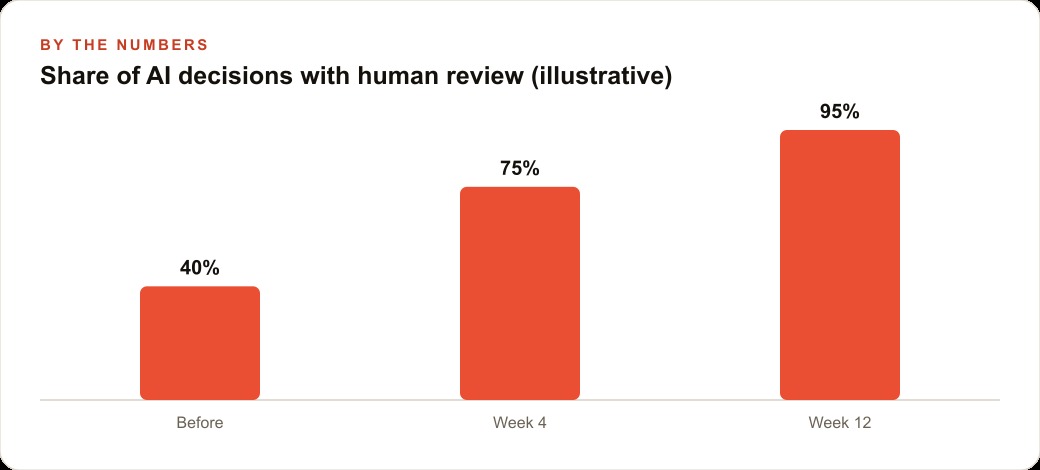
Now the illustrative numbers, meant to show the shape of the change rather than promise a result. Before applying the playbook, maybe forty percent of the AI's consequential actions had any human review, and the rest went out on trust. After a focused month of inserting approval checkpoints, that might rise to seventy-five percent. By the twelfth week, with the habit fully baked in, it might sit near ninety-five percent, with only the genuinely trivial actions left fully automated. The roofer captures most of those leads through Facebook and Instagram ad campaigns and its landing pages, so the assistant that greets and quotes them is standing directly on the revenue line, which is exactly why it deserves guardrails rather than blind trust, and why the quotes and approvals should flow through the company's CRM and website stack where a human can see and sign them.
The instinct worth copying
The roofer does not need to follow defense policy, and neither do you. What is worth copying is the instinct Anthropic showed under real pressure: decide your red lines in advance, read the rules you are operating under, keep humans on the consequential calls, treat manipulation as guaranteed, and never let a tool act without a guardrail just because removing it would be a little more convenient. That is the entire playbook, and it works at every scale from a two-hundred-million-dollar defense contract down to a roofer answering leads on a phone.
The reliability argument is the one that will age best
Of all the arguments in this standoff, the one worth carrying into your own decisions is the reliability point, because it does not depend on politics and it will not go out of date. The case against handing full autonomy to a model was not that autonomy is wrong in principle. It was that the technology is not reliable enough yet to be trusted alone on decisions that cannot be undone, because models still hallucinate, and a confident mistake in an irreversible system is a disaster. That is an engineering fact, not an opinion, and it applies with equal force whether the irreversible decision is a weapon firing or a refund going out or a customer's data getting exposed.
Hold onto that framing, because it gives you a clean rule that survives every new model release. Ask of any task you are tempted to fully automate: if the model is confidently wrong here, can I undo it. If the answer is yes, automate freely and review at your leisure, because the worst case is a quick correction. If the answer is no, keep a human in the loop no matter how good the model looks in the demo, because the demo is the best case and the irreversible mistake is the one that defines your risk. As models improve, the set of tasks that pass the undo test will grow, and you can safely automate more over time. But the test itself never expires, and it is the same instinct that let one AI company hold its ground against the full weight of the government. Decide what cannot be undone, and never let a confident guess be the last word on it.
You can put these guardrails in place yourself, and I would start this week by writing down every AI tool you use and listing the high-stakes decisions each one could make. If you would rather have someone audit your AI tools, set the human-in-the-loop checkpoints, and harden everything against prompt injection properly, that is exactly the kind of work I do for clients, and you can bring me in to handle it.
That is exactly what we do at AI DOERS. Book a private 30-minute call with Madhuranjan Kumar and we will map the fastest path to it for your specific business.
Book your call →
Madhuranjan Kumar
Madhuranjan Kumar brings 20 years of performance-marketing experience and has managed over $200 million in Facebook ad spend for brands across the United States and beyond. His expertise spans the full modern marketing stack: Meta, Google Ads, TikTok, email automation, CRM, and the websites that hold it together. At AI DOERS he turns that track record into lead-generation systems for businesses across every industry.