
Why an Anthropic Co-Founder Says Autonomous AI Research Is Likely by 2028
An Anthropic co-founder now puts a 60 plus percent chance on AI building its own successors with no human involved by the end of 2028, and the practical takeaway for any business is to automate the recurring perspiration work now while protecting the judgment you cannot outsource.

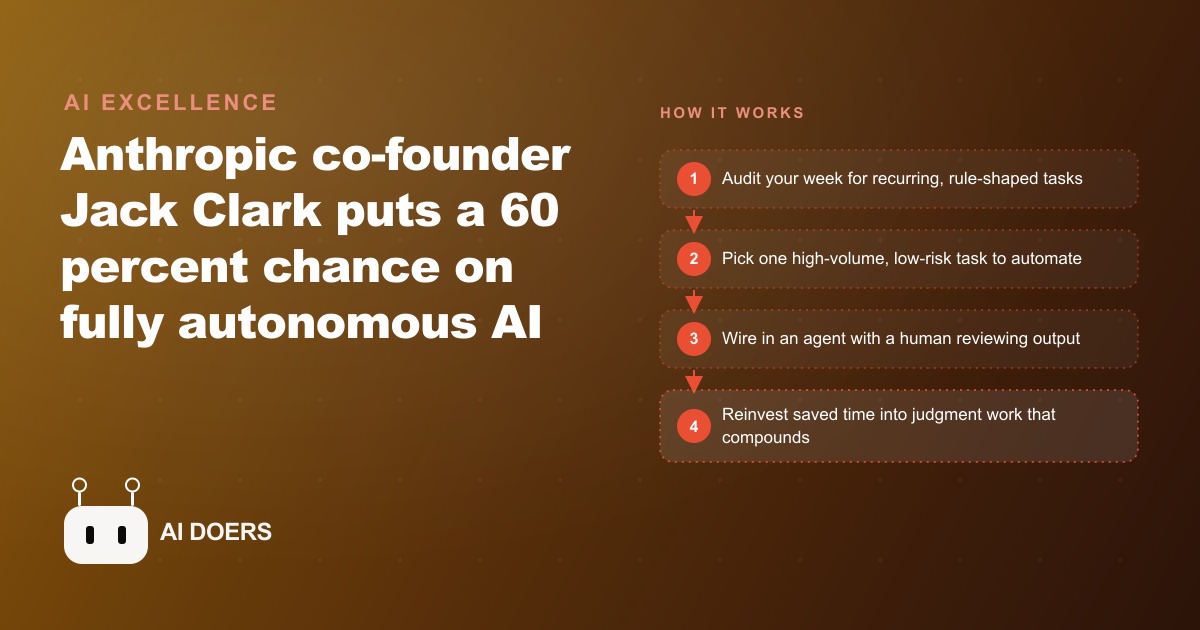
An Anthropic co-founder assigned a 60-plus percent probability to fully autonomous AI research, meaning no human researchers in the loop at all, arriving by end of 2028. That is roughly 1,000 days, and the detail that makes it worth planning around is not the number. It is the tone: he says he feels dwarfed by the implications and is not sure society is ready.
I am Madhuranjan Kumar, and I follow these signals not to bet on specific dates but because the direction they point changes what a business should prioritize right now. Even if the timing slips by 12 or 18 months, the shape of this transition is already visible in benchmark data, in lab hiring decisions, and in at least one recursive feedback loop already running in production. Here are the five things this forecast changes for any business paying attention.
1. "Fully autonomous AI research" is not a metaphor, it is a measurable operational milestone
Strip the jargon and the term means one thing: an AI system that can identify a research objective, design the experiments to advance it, run those experiments, interpret the results, and use those results to train or build a more capable successor, all without a human researcher guiding any step of the process.
The benchmark evidence that this is approaching is concrete. Core Bench tests whether a model can reproduce machine-learning research papers from scratch, reading a paper and producing the results the paper describes. In early 2024, the best available model scored 21 percent on that test. By December 2025, a frontier model reached 95.5 percent and the benchmark was declared solved. That is not a forecast. It is a measured capability jump inside twelve months on a task that required genuine research skill.
The software engineering benchmarks tell the same story. SWE-bench and the METR time-horizon plot both track model performance on real software tasks. Both curves are steep and have not flattened. When a model can reproduce research papers and write the code to implement them, the human contribution to what the co-founder calls the perspiration portion of research, which he estimates at about 99 percent of the total work, becomes optional. The rare creative insight that generates new research directions is still human. The volume work that turns insights into results is already automatable, and the gap between almost and fully is closing on a schedule the benchmarks confirm.
The recursive element makes this a threshold, not a gradual trend. Before this crossing, AI capability grows as fast as human researchers can do their jobs. After it, the constraint is compute and energy, not human bandwidth. Those two growth rates are not similar in degree. They are different in kind, and the switch is what the 1,000-day window is pointing at.
2. Why a reluctant estimate from a safety-focused insider outweighs a hundred optimistic ones
Forecasts about transformative technology are published constantly and are mostly wrong. The ones worth building assumptions around share a specific structure: they come from people close enough to the technology to know what they do not know, who are not rewarded professionally for optimism, and who frame their estimate with genuine caution.
This estimate has all three of those properties. The person making it co-founded Anthropic, one of the most safety-focused organizations in AI, and previously ran policy work at OpenAI. His professional reputation benefits from measured caution, not from exciting predictions. He framed the 60-plus-percent estimate explicitly as reluctant, said he wishes the number were lower, and described his reaction to the implications as feeling dwarfed rather than excited.
That structure is the opposite of motivated forecasting. A prediction made to attract funding, generate press, or drive attention would be framed with enthusiasm and a confident round number. This one was framed as a probability from someone who would professionally prefer the probability were smaller.
The corroborating signals reinforce rather than contradict the estimate. Google DeepMind hired a director of AGI economics, whose entire role is modeling the economic consequences of this transition for the broader economy. That is not a speculative hire made based on a distant possibility. It is an institutional signal that the largest labs are treating this transition as a near-term planning assumption, not a long-range research question. For a business owner, that signal means the transition is being actively modeled and resourced at the institutional level while most individual businesses have not yet started thinking about it at all.
3. How 1,000 days maps onto a business planning cycle most companies already use
Most businesses plan in two time frames: a 12-month operational and budget plan, and a 3 to 5 year strategic outlook. The 1,000-day window, just under three years, lands precisely in the middle of the longer-range horizon that most businesses already use for hiring, technology investment, and market positioning.
This positioning matters because it means the transition being forecasted is not in a speculative future that can be safely ignored for now. It is inside the window in which businesses are already making commitments. Hiring decisions made today will still be relevant in 1,000 days. Technology investments made this quarter will have either paid off or proven fragile by then. Market positions being staked out right now will be worth more or less depending on how well they anticipated this shift.
The specific thing the window changes is what counts as a durable competitive advantage based on human expertise. A business that competes primarily by having more knowledgeable people doing faster knowledge work than its competitors is investing in a capability that the forecast says will be dramatically disrupted within a standard planning cycle. The people still matter. Their judgment, relationships, and creative direction still matter. The volume knowledge work, the reading, the drafting, the analysis, the pattern matching, is not a durable advantage to build around.
A three-year plan that takes this seriously looks like this. In the first year, identify the high-volume, rule-shaped work in the operation and start automating it. In the second year, build the team's ability to work effectively alongside AI agents so the hours freed up by automation go into higher-value work rather than getting absorbed by other low-value tasks. In the third year, have a market position that assumes AI handles the perspiration and the team handles the judgment, which means the business is structured to scale on intelligence rather than on headcount.
This is not a radical transformation plan. It is a logical adaptation of a realistic forecast to a planning process most businesses already run. The businesses that make this kind of adjustment inside the window will be structurally different, and more resilient, by the time the window closes.
4. Which jobs and functions change fastest in this window, and why the list is longer than people expect
The co-founder names coding as the fastest-moving capability and describes it as a coding singularity, a phrase that refers to the fact that software engineering benchmark scores are climbing on an exponential curve rather than a linear one. Coding is the most visible and most measured example. But the broader category is wider and more relevant to most businesses.
The functions that change fastest in this window are the ones where the primary output is produced by reading existing information, applying a set of rules or patterns to it, and generating a written or coded result. That category includes legal research and first-draft brief writing, financial analysis and report generation, marketing strategy documentation, technical writing, compliance review, data synthesis, and most forms of desk research. All of these are high-perspiration functions. The judgment at the top of the stack, deciding what matters, advising on strategy, maintaining the client relationship, is still genuinely human. The volume work underneath it is already automatable.
The AlphaFold example illustrates the recursive dimension of this for businesses to watch. AlphaFold, a system built on large AI models, has already been used to help optimize the design of the next generation of chips that will train future AI models. That is early recursive feedback running in production, not in a lab. The loop is: AI helps design better hardware, better hardware trains better AI, better AI helps design even better hardware. The implication is that improvement rates do not stay constant. They accelerate.
For a business owner, the most useful question is not whether their function will be affected. The answer to that is almost certainly yes within this window. The more useful question is which part of each function survives automation and which part becomes dramatically cheaper to perform. The surviving part is the judgment, the relationship management, the creative direction, and the strategic interpretation. The part that gets automated is the high-volume knowledge work underneath those capabilities. Identifying that split in each of your business functions tells you which roles and skills to invest in developing and which to start transitioning.
5. The one preparation move worth making now, illustrated with a worked example
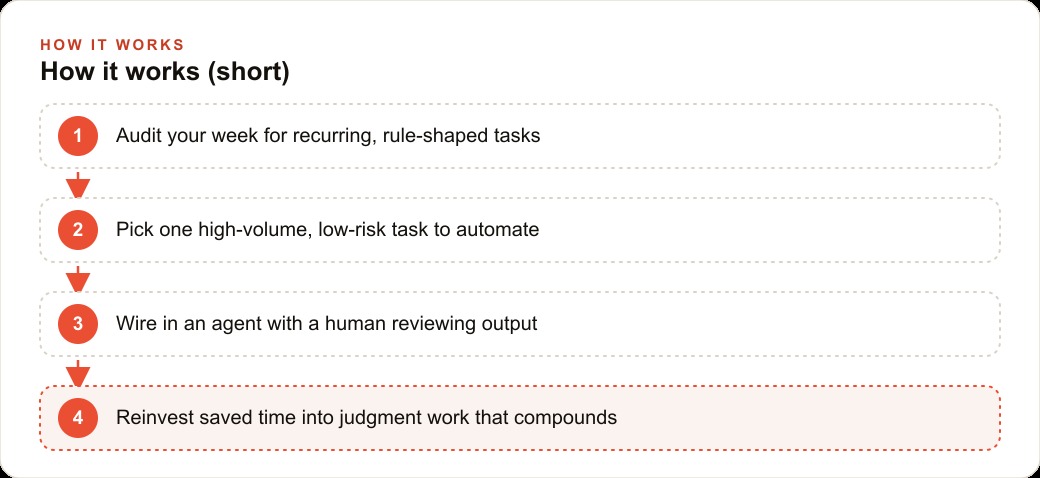
When a forecast has uncertain timing but strong directional support, the only moves that make sense are ones that pay off across a range of possible timelines. One move satisfies that condition for this forecast: building the habit of automating your perspiration work while keeping humans on the judgment work.
This pays today because it frees hours for higher-value tasks. It pays at the threshold because teams already practiced at working with AI agents will adapt faster than teams starting from zero. It pays even if the specific 2028 date slips by a year or two, because the direction of the change is already confirmed by the benchmarks and the hiring decisions at the largest labs.
Here is how this works with specific numbers. A small professional services firm has a three-person team that spends about 14 hours per week collectively on report production. One person reads source material and marks the relevant sections. A second compiles those into a structured draft. A third edits the draft, checks the logic, and formats the final document before it goes to the client. The judgment in that entire process, deciding what conclusion to draw, how to frame it for this specific client, and what to flag as a concern, occupies about 3 of those 14 hours. The remaining 11 hours are perspiration.
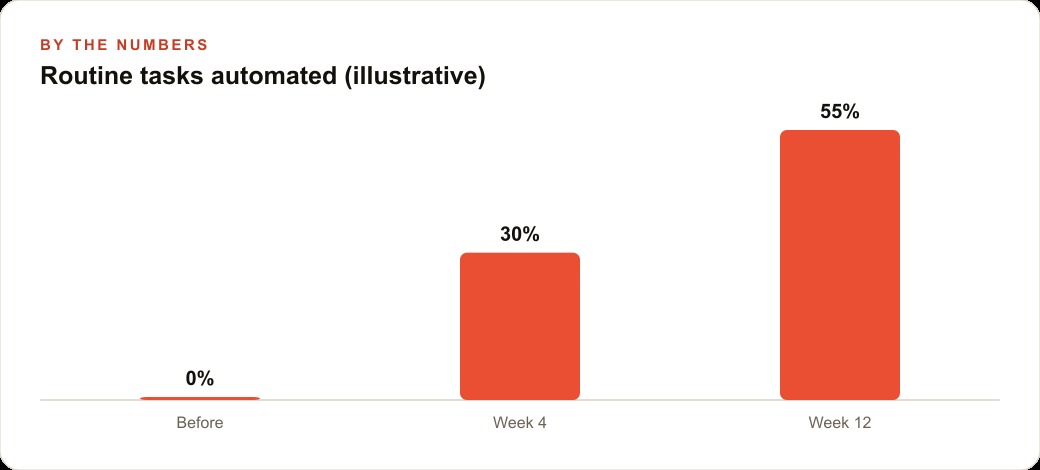
An AI agent set up to handle the reading, flagging, structuring, and first-draft writing takes that 14-hour block down to about 4 hours per week. Those 4 hours are the review, the strategic framing, and the client-specific context that requires understanding the relationship. The agent costs approximately $50 to build as a one-time project and runs on API-usage fees of about $10 per week at that volume. Over a year, the recovered hours are 10 per week for 50 working weeks, at a fully loaded cost of $50 per hour. That is $25,000 in recovered team capacity, redirected from perspiration to the judgment and relationship work that actually compounds the business's value over time.
The economic structure the co-founder describes, companies heavy on AI infrastructure and light on headcount claiming larger and larger shares of the economy, is already available at small scale to businesses that move in this window. A two-person firm using AI agents well can produce output that previously required a team of eight. That structural advantage does not arrive in 2028. It is available now, and it compounds every month between now and whenever the threshold the forecast describes actually arrives.
The businesses that build these habits now, while this kind of move is still unusual enough to matter, will have compounded three years of operating efficiency, team capability, and client trust by the time businesses that waited are starting from scratch. The window is real, the direction is confirmed, and the preparation move is available today at any budget.
Madhuranjan Kumar covers these capability signals and their business implications closely, because the window where early movers accumulate compounding advantages is not permanent. The time to act on a directionally correct forecast is while the move is still uncommon.
That is exactly what we do at AI DOERS. Book a private 30-minute call with Madhuranjan Kumar and we will map the fastest path to it for your specific business.
Book your call →
Madhuranjan Kumar
Madhuranjan Kumar brings 20 years of performance-marketing experience and has managed over $200 million in Facebook ad spend for brands across the United States and beyond. His expertise spans the full modern marketing stack: Meta, Google Ads, TikTok, email automation, CRM, and the websites that hold it together. At AI DOERS he turns that track record into lead-generation systems for businesses across every industry.