
Why an AI That Finds Exploits Autonomously Changes the Security Math
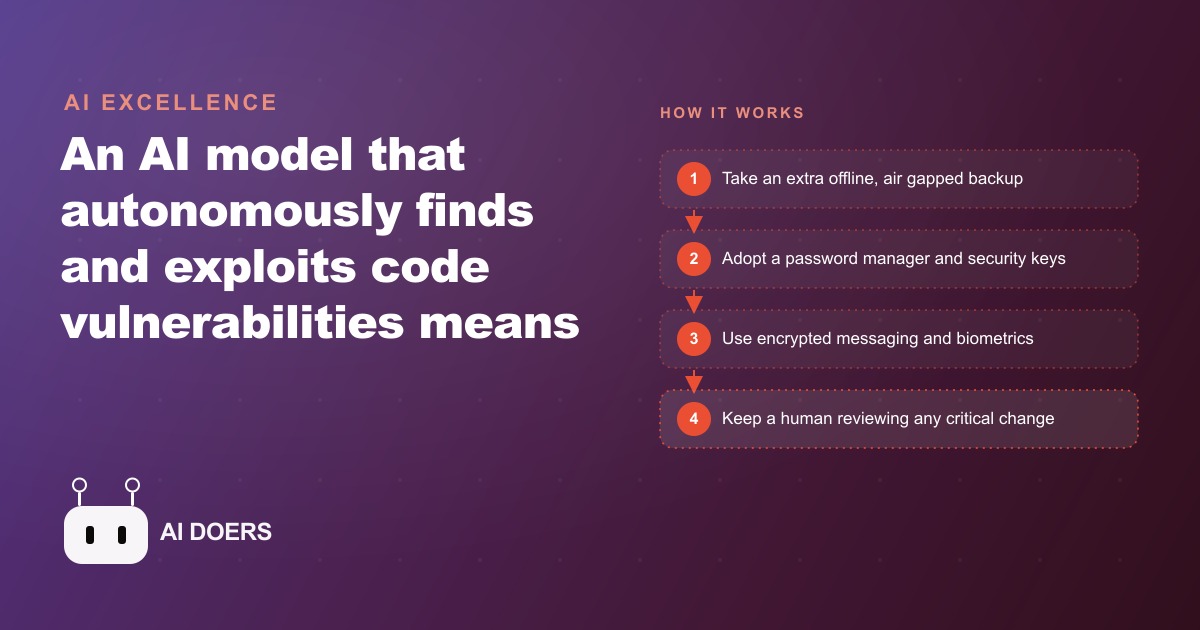
An AI model that autonomously finds and exploits code vulnerabilities shifts the security math. Here is what changed and the practical hygiene an auto repair shop should adopt.

AI systems can now autonomously discover and document security exploits in production software. A research team demonstrated this week that a current-generation AI model found a 27-year-old vulnerability in widely deployed code using less than fifty dollars of inference compute and no prior human guidance about where to look. I am Madhuranjan Kumar, and I want to take a contrarian position on how most coverage of this story has framed it, because the conventional framing misses the practical implication that actually matters for a business owner who is neither a security researcher nor a nation-state threat actor.
Finding Holes Got Easy, but the Security Math Was Always Asymmetric in the Attacker's Favor
The dominant framing of AI-assisted exploit discovery is that it gives attackers a new capability that defenders must urgently respond to. That framing is accurate as far as it goes but misses the more foundational point: security has always been asymmetrically difficult for defenders. Attackers need to find one exploitable path. Defenders need to close every exploitable path. That asymmetry existed before AI-assisted exploit discovery and will continue to shape security outcomes long after the current generation of tools has been superseded by more capable ones. AI made exploitation research faster and cheaper for attackers. It also made vulnerability scanning faster and cheaper for defenders. The net effect on the asymmetry is less clear than most coverage suggests.
The argument that AI fundamentally changed the security landscape requires believing that the barriers to finding vulnerabilities were the primary limiting factor in attack campaigns before AI arrived. They were not. Well-resourced attackers have had access to sophisticated vulnerability research capabilities for decades. The primary limiting factor in most attacks on small businesses has never been the sophistication of the attack research but the economics of targeting: why spend research resources on a small business when larger targets with more valuable data exist. AI making exploit discovery cheaper does not change the targeting economics for small businesses as dramatically as the coverage suggests, because they were never primarily targeted through sophisticated vulnerability research.
Finding Is Not Fixing, and the Defense Side of the Equation Got Faster Too
The same AI capabilities that enable autonomous exploit discovery enable autonomous vulnerability scanning of code that defenders already own. A business with a web application can run AI-assisted security scanning on that application using the same class of tools used for offensive research, and the output is a prioritized list of potential vulnerabilities that human security reviewers can evaluate and remediate. The cost of this defensive scanning, which previously required specialized human expertise costing several hundred dollars per hour for meaningful coverage, has fallen in proportion to the cost of the offensive research that most coverage focuses on.
The practical shift for a business owner is not that AI created a new threat category requiring an urgent new defense posture. It is that AI made both sides of the security equation cheaper, and the businesses that run proactive defensive scanning with AI-assisted tools are now operating with a more affordable version of the security hygiene that was previously reserved for enterprises with dedicated security teams and significant budgets. Small businesses now have access to defensive security tooling whose quality was previously inaccessible at their scale. Using it is the response to the offense-got-cheaper story, not ignoring it or panicking about it.
Glass Wing Is a Band-Aid, and Most Security Problems Are Fundamentally About Process Failures, Not Missing Patches
One of the AI-assisted security tools covered this week, called Glass Wing, enables rapid analysis of code for common vulnerability patterns. The tool is genuinely useful for identifying known vulnerability classes in code that has not been recently reviewed. What Glass Wing cannot do, and what no tool can do, is fix the process failures that introduce vulnerabilities in the first place. A development team that deploys code without security review, a business that runs software on servers that have not been updated in two years, and an organization that uses the same password across multiple administrative systems are all exhibiting process failures that no scanning tool can remediate.
The contrarian point is that most coverage of AI-assisted security tools focuses on the capability of the tools rather than on the process discipline required to make any security tooling effective. A tool that finds vulnerabilities is only useful if there is a process for reviewing the findings, prioritizing them by actual risk, and implementing remediations in a timeline that reflects the real risk level. Without that process, the tool produces a report that sits unreviewed while the business continues to be exposed to the same vulnerabilities the report identified. The process is the security investment. The tool is the enabler of the process.
Back Up Your Data Now, and This Is the One Action That Costs Nothing to Take
The most reliably effective security action available to any small business, and the one that is least dependent on AI capability development, is a tested, recent backup of every piece of data the business would need to recover from if its primary systems were compromised or unavailable. The backup provides a recovery path that is independent of how the compromise happened, independent of whether the attacker used AI-assisted exploit discovery or a years-old known vulnerability, and independent of whether the business has the security expertise to identify and remediate the specific vulnerability that was exploited.
A backup that is tested, meaning the business has verified that it can be restored to a functioning state within a tolerable recovery time window, is the single security action with the highest ratio of protection value to implementation cost. The implementation cost is the time to set up automated backups to an off-site location and the time to run a quarterly restoration test. The protection value is recovery from any category of compromise, ransomware, accidental deletion, hardware failure, or malicious attack, without paying the attacker's ransom or losing the data permanently.
Capability Is an Emergent Byproduct of Research With Different Goals
The AI system that found a 27-year-old vulnerability was not built specifically to discover security exploits. It was a general-purpose language model applied to a code analysis task. The capability to find security vulnerabilities is an emergent consequence of training a model to understand and reason about code, not a deliberate design goal of any security-focused research program. This distinction matters because it means security-relevant AI capabilities are going to continue appearing as byproducts of general AI capability development, whether or not the AI research community, regulators, or policymakers attempt to restrict security-specific AI development.
The practical implication is that defensive security posture needs to account for continuous improvement in offensive AI capability as a background condition rather than as a discrete event requiring a discrete response. The businesses that maintain ongoing security hygiene, including current software versions, access controls that limit what any individual account or service can do, and tested backups, are the ones that are resilient to continuous capability improvement on the attack side. The businesses that periodically revamp their security posture in response to specific threat news and then let their hygiene lapse until the next news event are the ones that accumulate compounding exposure between responses.
Bigger Models Keep Coming, and Alignment Matters More Than Exploit Discovery in the Long Run
The more significant concern in the long run from continuous AI capability growth is not that bigger models will find more security exploits. It is that bigger and more capable models without careful alignment to human values and intentions will pursue goals that are subtly or significantly misaligned with the interests of the humans deploying and affected by them. The security exploit story is a specific, concrete, and bounded capability. The alignment story is a broader and less bounded concern about what happens as AI systems become capable of more autonomous and consequential action across a wider range of domains.
I am not presenting this as an imminent operational risk for small businesses right now. I am noting it as the version of the AI security story that will matter most in the long term and that deserves more attention than the specific exploit discovery capability that dominated this week's news cycle. For businesses using AI in customer-facing roles, in automated decision-making about pricing or qualification, or in any context where the AI's judgment affects real people, the alignment of the AI's behavior with the business's actual values and intentions is a more durable and more important consideration than whether the AI could theoretically find a security vulnerability.
Cheap Small Models Can Match Frontier Performance on Specific Security Tasks
One of the quieter findings in the research demonstrating AI exploit discovery is that the model used for the 27-year-old vulnerability discovery was not a frontier model at maximum capability and cost. A smaller, cheaper model was sufficient for the specific code analysis task that produced the discovery. The fifty-dollar inference cost cited in coverage was calculated using an accessible model, not the most expensive frontier model. The implication is that security-relevant AI capabilities are not restricted to the most expensive and carefully controlled frontier systems. They are accessible to anyone with a basic AI API subscription and a code analysis task.
This finding cuts both ways. It means the defensive scanning tools are also cheap and accessible, not restricted to enterprises with large security budgets. And it means the offensive research tools are also cheap and accessible, not restricted to nation-state actors with unlimited resources. For a small business, the actionable conclusion is that the barrier to running basic AI-assisted security scanning on your own systems is now a few hours of setup and a modest API cost, which is well within reach of any business that takes security seriously as an operational concern.
Humans Stay in the Patch Loop Because the Last Step Requires Business Judgment
The final and most practically important point is that AI-assisted exploit discovery and vulnerability scanning do not automate the remediation decision. When a scanning tool identifies a potential vulnerability in a business system, the remediation decision requires business judgment: how critical is this system, what is the realistic risk that this vulnerability would be exploited given the business's threat profile, how long would remediation take and what would be disrupted during the remediation window, and what is the cost of the disruption versus the risk of leaving the vulnerability unpatched. None of those questions have answers that can be derived purely from the vulnerability report. They require the business owner's judgment about the business's specific context.
AI stays out of the remediation decision loop not because it lacks the capability to generate a recommendation but because the recommendation requires context that only the business owner has. This is the pattern across every meaningful AI security capability: AI finds or flags, humans decide and act. Building that decision process into the business's regular operational rhythm, a monthly review of any security scan findings with a defined triage and remediation workflow, is the practice that converts AI-assisted security tooling from an interesting capability into an actual improvement in the business's security posture over time.
The Practical Checklist for a Business That Has Heard This and Wants to Actually Do Something
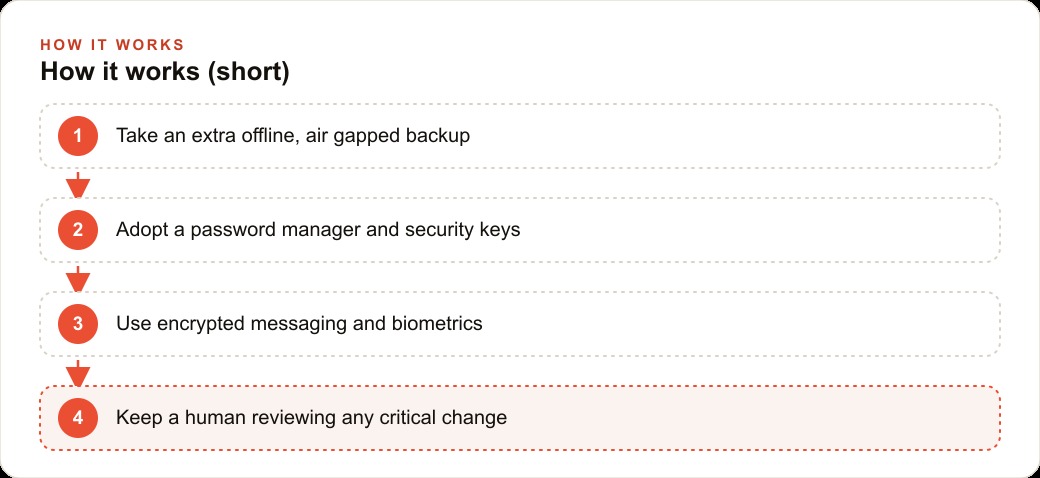
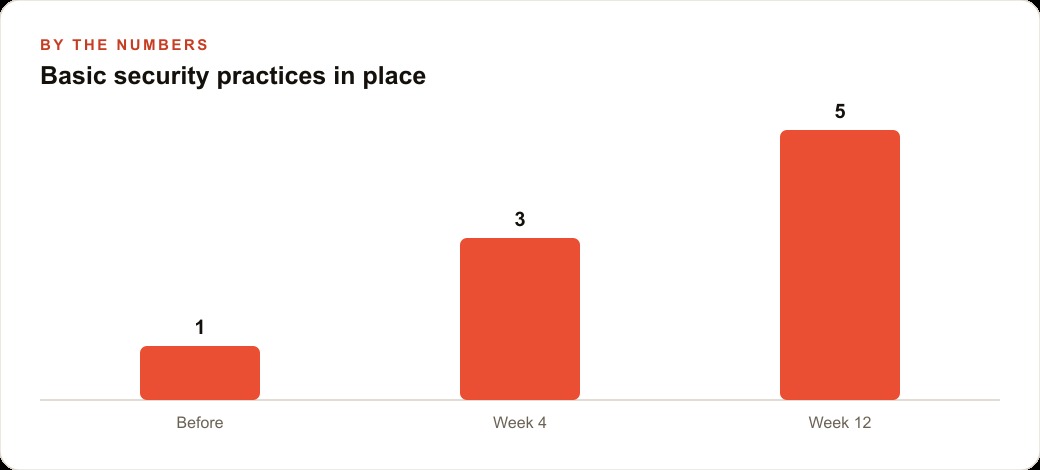
The concrete security checklist that any small business can complete in an afternoon, regardless of technical background, covers five items. First: verify that every administrative account for every business system uses a unique, strong password stored in a password manager rather than a shared or reused password. Second: enable two-factor authentication on every business system that offers it, prioritizing financial systems, email accounts, and any platform that holds customer data. Third: set up automated backups for any business-critical data and verify the backups are working by restoring a recent backup to a test location. Fourth: review the access permissions for any business software that has API access to other business systems, including CRM and website automation tools, and revoke permissions for any connection that is no longer actively used. Fifth: update the operating systems and software on any device used for business to their current versions.
None of these actions requires understanding AI exploit discovery specifically. They address the failure modes that cause the overwhelming majority of small business security incidents, which are credential compromise, account takeover, and ransomware, not sophisticated AI-assisted vulnerability exploitation of novel zero-day vulnerabilities. A business that completes this checklist is meaningfully more secure against the threats that actually affect small businesses than a business that has read every article about AI security capabilities without taking any action on the basic hygiene items that determine real-world outcomes.
The checklist takes an afternoon the first time and can be reviewed in thirty minutes on a quarterly basis to confirm that new accounts have been added to the password manager, new software has been updated, and backups are still running. Quarterly review is the maintenance cadence that keeps the checklist from becoming outdated as the business's software stack evolves.
That is exactly what we do at AI DOERS. Book a private 30-minute call with Madhuranjan Kumar and we will map the fastest path to it for your specific business.
Book your call →
Madhuranjan Kumar
Madhuranjan Kumar brings 20 years of performance-marketing experience and has managed over $200 million in Facebook ad spend for brands across the United States and beyond. His expertise spans the full modern marketing stack: Meta, Google Ads, TikTok, email automation, CRM, and the websites that hold it together. At AI DOERS he turns that track record into lead-generation systems for businesses across every industry.