
Why AI Is Brilliant and Stupid at the Same Time
AI is brilliant where the output is easy to check, like code and math, and weak where it is not, because these models are trained to chase verifiable answers. That uneven, jagged shape is the key to using AI well in a business.

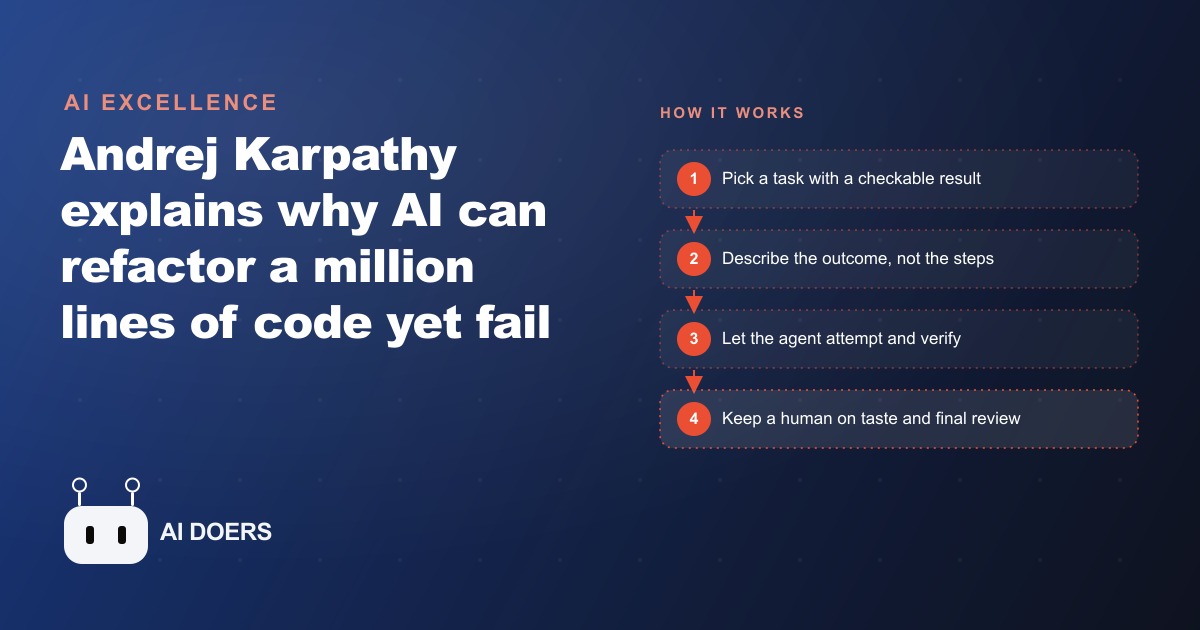
The same model that can read through a hundred thousand lines of code and refactor it cleanly will also, with total confidence, tell you to walk to a place fifty meters away when you should obviously drive. Hold those two facts next to each other and you have the single most useful thing to understand about artificial intelligence today. It is not uniformly smart and it is not uniformly dumb. It is jagged, brilliant in some places and startlingly weak in others, with no smooth line connecting the two. I am Madhuranjan Kumar, and I want to take that jaggedness apart, because once you see where the edges are, you stop asking whether AI is good or bad and start pointing it only at the work where it is genuinely reliable.
The shape nobody warns you about
Most people arrive at AI expecting a dial. Turn it up and everything gets a little smarter across the board. That mental model is wrong and it is the source of nearly every disappointment. The real shape is a jagged coastline. There are deep, capable inlets where the tool performs at a level that feels superhuman, and right beside them are shallow flats where it fails at something a child would get right. A well-known researcher, one who helped build early self-driving systems, co-founded a major AI lab, and coined the phrase vibe coding, laid this out plainly. He even shared a confession that reframed the whole thing for me. Only months before, he had felt more behind as a programmer than at any point in his career. Then something shifted late last year. Using agentic coding tools, he noticed the model had stopped handing him fragments he needed to stitch together and started producing whole working chunks he simply did not need to correct. He began to trust it. The lesson buried in that story is that if you tried these tools even a year ago and walked away unimpressed, the coastline has moved, and it is worth mapping again.
Why the coastline sits where it does
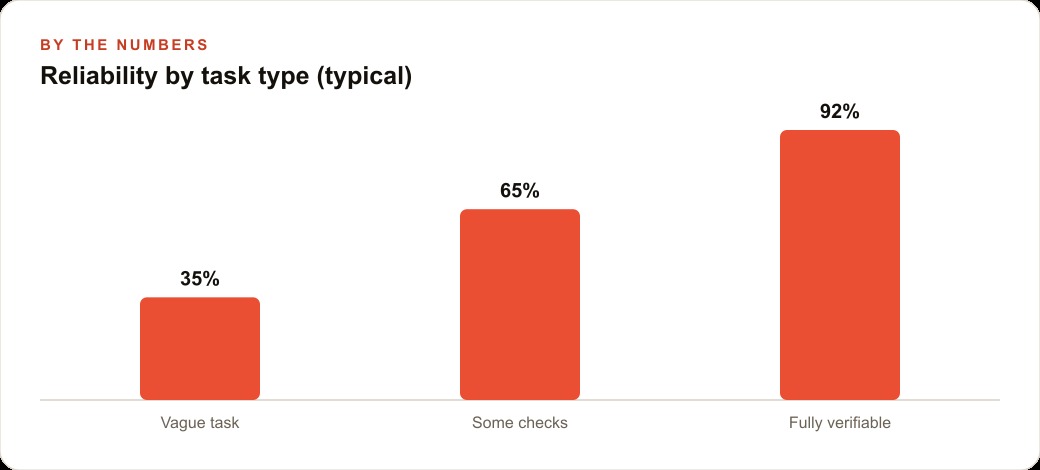
The jaggedness is not random. It follows a rule, and the rule is verifiability. Frontier models are trained inside enormous environments that reward correct, checkable answers. Wherever the output of a task is cheap to verify, the model gets very good, because training can hammer on it millions of times with a clear signal of right and wrong. Wherever a clean check is missing, the model stays rough, because there was never a crisp reward to sharpen it against.
Code is the clearest example of a verifiable task. You compile it, you run it, and the errors feed straight back as a signal. Math is verifiable too. The answer is right or it is not, and no human has to sit in judgment. Now look at the weak flats. Giving good walking directions, weighing a subtle human tradeoff, holding taste across a long piece of writing, none of these have a tidy compile-and-run check. So the model wobbles there. The brilliance and the weakness are two sides of the same training process. This is why a model can surface a real security hole in a codebase and then give you nonsense directions across a parking lot in the same session.
Follow the money and the edges make sense
There is a second force bending the coastline, and it is incentive. Enterprises pay enormous sums for faster software, so the labs poured their effort into coding, which happens to be verifiable, data-rich, and lucrative all at once. When capability, checkability, and money point in the same direction, you get a sharp peak. Coding and math are exactly where those three overlap, which is why they are the most reliable AI tasks in the world right now and why they improved fastest.
This has a strategic edge for anyone building on top of AI rather than just using it. The obviously verifiable domains will get absorbed by the biggest labs, because that is where the reward signal is cleanest and the demand is highest. The durable opportunity sits in the messier, valuable corners the labs are not focused on, the places where your own data and judgment provide a signal the general models never see. If you want an edge that lasts, do not compete on the verifiable ground the labs will own. Find the valuable-but-hard-to-check work near your business and build there.
From describing steps to describing outcomes
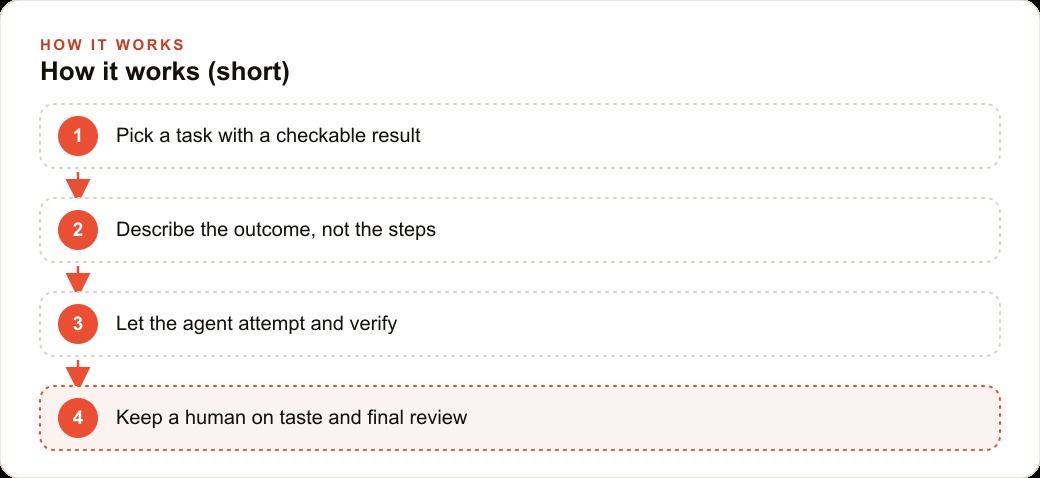
The jaggedness also changes how you should talk to these tools. When a model is genuinely capable on a task and can check its own work, spelling out rigid step-by-step instructions actually holds it back. The stronger pattern is to describe the outcome you want, hand the agent the tools it needs, and let it work toward the result while verifying itself along the way. On the verifiable tasks that is a superpower, because the agent can attempt, test, see the error, and try again without you in the loop for every micro-decision. On the non-verifiable tasks that same freedom is dangerous, because there is no clean check to catch a confident wrong answer, so you keep a human firmly on the wheel. The verifiability of the task decides how much rope to give the agent. That single principle resolves most of the confusion about when to trust it.
Sorting a real business by which tasks are checkable
Take an electrician running a small operation. The jaggedness rule tells you exactly where to aim AI and where to keep your hands on the work. Start by dividing the tasks into checkable and not-checkable, because that line is the whole strategy.
The verifiable office work is the perfect target. Quoting is verifiable, the numbers either reconcile against the rate sheet or they do not. Compliance paperwork is verifiable, it either matches the fixed code requirement or it fails. Scheduling has clear constraints you can check against. Here is how I would set it up. I would have an agent draft estimates from the standard rate sheet and a short job description, then check its own math and flag anything that does not add up. I would let it pre-fill permit and inspection paperwork against the required fields, because that is a checkable template, not a judgment call. I would let it triage incoming job requests and draft the first reply.
What I would never hand it unsupervised is the diagnosis of a tricky fault or the final safety sign-off. Those are not cleanly verifiable, and a confident wrong answer there is genuinely dangerous. The electrician stays the expert on the judgment, and the AI clears the predictable paperwork that eats the evening. Consider the arithmetic of it. If quoting, permit prep, and first-reply triage soak up ten hours a week and the verifiable slice of that is eight, handing those eight to an agent that grades its own output can hand most of an evening back, with essentially no risk on the parts that decide safety and reputation. That split, verifiable to the agent and judgment to the human, is the entire lesson made concrete.
Where this quietly touches marketing and follow-up
The same rule reaches past the back office. The verifiable, repeatable content work around a business, the standard service descriptions, the FAQ answers, the location and pricing pages, is exactly the kind of checkable output AI handles well, and that maintained content is what feeds SEO and organic search over time. When the agent keeps that material accurate and consistent, the copy that drives your Facebook and Instagram ad campaigns gets sharper as a byproduct, because good creative is largely a matter of clear, checkable claims rather than fuzzy judgment. And the tidy, structured lead data that comes out of a verifiable intake flow lands cleanly in the CRM and website stack, where automated follow-up can run without a human re-typing anything. The trick throughout is the same. Point the agent at the parts with a clear right answer, and keep yourself on the parts that need taste.
The letters-in-strawberry problem is not a bug, it is the map
It is tempting to treat the famous failures, the model that cannot reliably count the letters in a word or gives absurd walking directions, as embarrassing glitches that will be patched away. That framing misses the point entirely. Those failures are not noise on top of an otherwise smooth intelligence. They are the map itself. Each one marks a spot where the training had no clean way to check the answer, so the capability never sharpened there. When you see a jagged failure, you are not looking at a defect, you are looking at a coordinate telling you exactly which kind of work to keep away from the agent for now.
Once you hold that view, the failures become useful rather than alarming. A model that stumbles on an open-ended judgment call is quietly telling you that this task belongs to a human. A model that flies through a compile-and-check task is telling you the opposite. Instead of being surprised each time the tool is brilliant in one breath and foolish in the next, you start to predict it. Verifiable, trust it more. Fuzzy, keep your hands on it. The jaggedness stops feeling like unreliability and starts feeling like a legend on a map you can actually navigate.
A useful side effect of thinking this way is that it makes you calmer about the hype cycle. When a new model launches and the headlines swing between it will replace everyone and it is a useless toy, you already have the frame to ignore both. Neither is true, because neither smart nor dumb is the right axis. The model got better at some verifiable things and stayed roughly the same at the fuzzy ones, and your only job is to check whether any task you care about crossed from fuzzy to checkable. That single, grounded question cuts through every overheated announcement, and it keeps you making steady, correct decisions while everyone around you is either panicking or dismissing.
Building the habit of asking one question before you delegate
The practical discipline that comes out of all this is a single question you learn to ask before handing anything to an agent: can I cheaply check whether this is right? Not can a human eventually verify it with enough effort, but is there a fast, clear signal of correct or wrong. If the answer is yes, that task is a strong candidate to automate today, and you should describe the outcome, hand over the tools, and let the agent iterate against that check. If the answer is no, you keep the work close and use the AI only as an assistant that drafts while you judge.
That one question does more to make AI useful in a business than any amount of prompt tricks. It is the filter that separates the tasks where the tool is genuinely reliable from the ones where it will confidently lead you astray. And because it is just a question, anyone in the business can learn to ask it, which means the whole team gets better at pointing the tool correctly rather than relying on one person's intuition. The owners who internalize this stop asking whether the latest model is smart. They ask which of their tasks just became cheaply checkable, and they move those, and only those, onto the agent. That is the entire jaggedness lesson compressed into a working habit.
Re-mapping the coast every few months
The last facet is that this map does not hold still. The frontier moves quickly, and a task that was too fuzzy to trust last year can become reliably checkable as both the models and the tooling around them improve. The owner who wins is the one who keeps re-sorting the work into verifiable and not-yet-verifiable buckets, capturing each new reliable capability the moment it arrives instead of discovering it late. Today's agents are closer to capable interns than seasoned experts. A good intern saves you real hours on the checkable work, but you would never let one sign off unsupervised, and the same rule applies here. You can absolutely sort your own tasks and wire up the verifiable ones yourself. If you would rather have someone map which parts of your operation are safe to automate today, which should stay human, and set the reliable ones up properly, that is exactly the kind of thing worth a short conversation before you trust an agent with the wrong job.
That is exactly what we do at AI DOERS. Book a private 30-minute call with Madhuranjan Kumar and we will map the fastest path to it for your specific business.
Book your call →
Madhuranjan Kumar
Madhuranjan Kumar brings 20 years of performance-marketing experience and has managed over $200 million in Facebook ad spend for brands across the United States and beyond. His expertise spans the full modern marketing stack: Meta, Google Ads, TikTok, email automation, CRM, and the websites that hold it together. At AI DOERS he turns that track record into lead-generation systems for businesses across every industry.