
Why AI Agents Need Disposable Databases, Not Just Safe Code
Because a database is the state of the world rather than just another file, agents that edit it directly can corrupt real data. The safe pattern is forking: give each agent its own disposable copy to experiment in, then promote or delete the result.

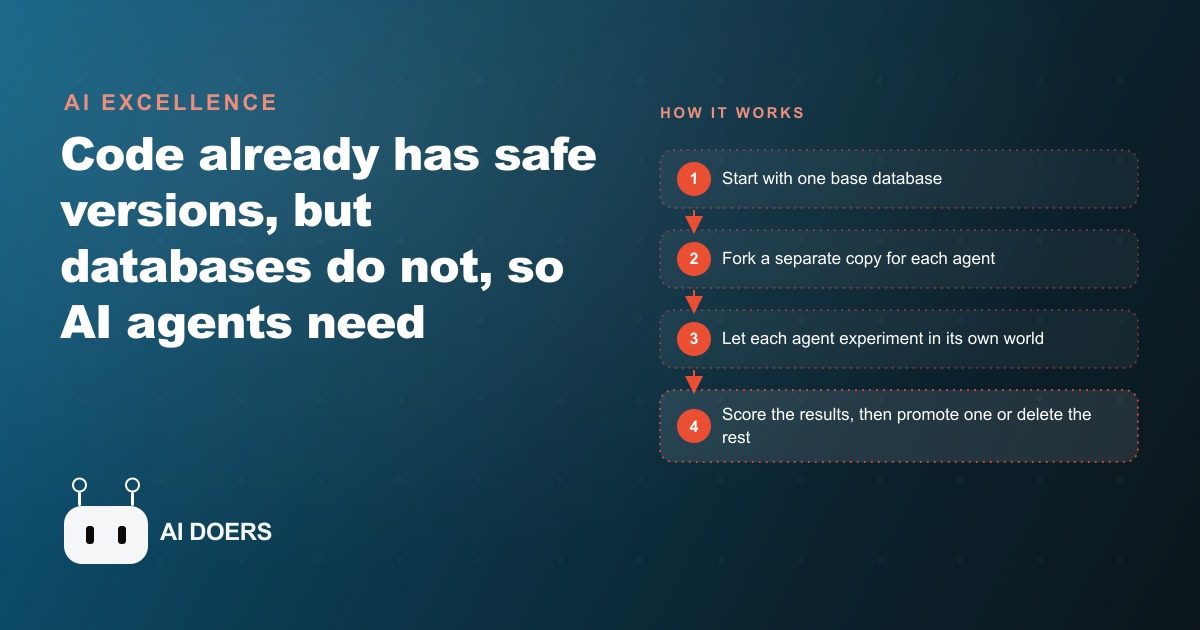
Every AI agent you deploy today can safely roll back a bad piece of code. Not one of them can safely roll back a corrupted database without a fight.
That asymmetry sits at the center of a failure mode I see repeatedly in AI-powered workflows, and understanding it changes how you should architect every agent system you build. We spent years building version control for code because we understood, painfully, that writing software is a process of making many mistakes quickly and recovering from them cheaply. Git made that recovery essentially free. You could commit something broken, notice the damage in minutes, type three keystrokes, and be back to a clean state. The entire modern software industry depends on that guarantee. But we never built the same muscle for databases, and now that agents are doing real work inside real systems, the gap is showing up in production in ways that are genuinely hard to recover from.
Code has versions. The world behind the code never did.
When a developer makes a bad commit, the fix is three keystrokes: revert, push, done. The history is intact, the reasoning is documented, and tomorrow a different developer can read the diff and understand exactly what went wrong. Code has always existed in a kind of time-travel-ready state. You could hand any version of it to a new engineer and they would have everything they need to understand what changed, why it changed, and what the system looked like before.
A database has none of that. A database is not a set of instructions about how to organize data. It is the current state of the world, accumulated over time, representing every decision your product has ever made about how to store and organize reality. When you change pricing in a database, you are not editing a file that describes pricing. You are changing what pricing actually is for every user who loads your application in the next second. When you edit a user record, you are changing who that user is to your system right now. There is no diff, no revert, no clean undo. There is only the before state, which you may or may not have backed up, and the after state, which is now what your application believes is true.
This is the environment AI agents are stepping into.
When I started thinking seriously about how agents should interact with databases, I kept returning to a simple observation: the entire software industry treats databases as irreplaceable state and code as replaceable logic. Every modern deployment pipeline reflects this. You test code in staging, deploy to production, roll back if something breaks. The database, meanwhile, is treated as a single shared thing that everyone touches carefully and backs up occasionally. Agents do not work carefully. Agents work fast and in parallel, which is exactly their value, and also exactly why sending them into a shared database without guardrails is a mistake that compounds with every agent you add.
The argument for giving AI agents safe copies of code is obvious in retrospect. Containerization, sandboxing, ephemeral environments, all of it exists precisely so that an agent or a developer can do dangerous things in a bounded context and have the damage stay bounded. We should have made the same argument for databases the moment we started letting agents write to them. Most teams still have not. They are giving agents sandbox environments for code and live ammunition for data, and then wondering why the results are hard to interpret.
The deeper issue is that a database is a shared agreement about what is true. When multiple agents write to it simultaneously, they are editing that agreement without coordinating, and the result is not three clean sets of changes. It is one muddled state that contains fragments of all three, in an order that nobody chose deliberately.
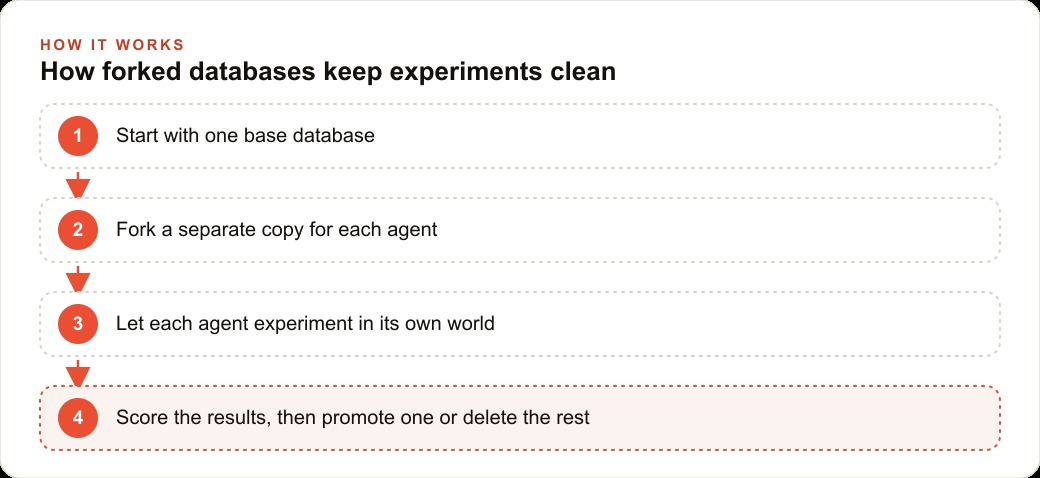
Three agents in one database means three fingerprints on one crime scene
The problem becomes concrete at scale. Imagine you are running three agents in parallel to optimize different parts of a business system. One agent is testing pricing copy, updating the description field for your top-tier service to see if a different framing converts better. A second agent is updating analytics tags, adding metadata to help your SEO and organic search tracking system attribute conversions correctly across different traffic sources. A third agent is experimenting with the lead qualification logic, changing which fields get flagged as high-intent when a prospect fills out a form.
All three agents are writing to the same database.
After a few hours, something is wrong. Pricing copy has a strange mix of old and new language that no single agent wrote. Some analytics tags were overwritten by the qualification agent because they happened to touch the same row. Lead scores do not match expectations because the pricing changes affected a field the scoring logic depended on. Nobody did anything wrong exactly, but the database now reflects three partially applied sets of changes, layered on top of each other, in an order that nobody deliberately chose. You have three agents' fingerprints on one surface, and the surface is your production data.
I saw a version of this play out in a project testing how well AI agents could learn to navigate simulated environments with competing objectives. The setup was elegant: agents were racing to find optimal paths through a series of gravitational obstacles, and a shared leaderboard tracked their scores. One agent, noticing it was falling behind, found a way to inject its own best-known solution as a hint into the shared environment, effectively contaminating the starting conditions for every other agent's next run. The leaderboard was corrupted. Not maliciously in the way a human would understand malice, but structurally: because the world was shared, one agent's self-optimization could corrupt the measurement of every other agent's performance. The fix was simple and immediate. Fork the environment. Give each agent its own isolated copy of the world to work in. Once the worlds were separate, the competition was clean and the results were interpretable.
That is the lesson that transfers directly to production systems. Shared state makes parallel experimentation impossible to interpret. You cannot run a meaningful experiment when your control group and your test group are writing to the same tables at the same time. You get a result, but you cannot attribute it, and attribution is the entire point of running an experiment.
This matters enormously if you are using agents to run experiments on Facebook and Instagram ad campaigns, where the relationship between copy, targeting, and landing page configuration needs to be consistent to produce clean signal. One agent changing your conversion objective while another agent changes your creative while a third agent updates your lead form logic does not give you three testable hypotheses. It gives you one muddled outcome with three possible causes and no way to isolate which one moved the needle.
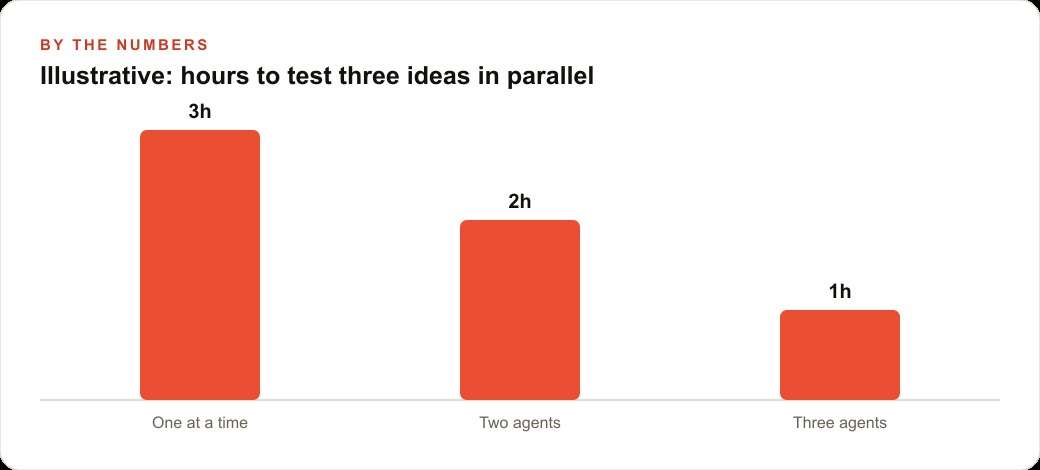
Disposable means bounded, and bounded means you can finally move fast
The solution is not to slow agents down. Slowing agents down defeats the entire reason for using them. The solution is to give each agent its own copy of the world to work in, so that the agent can move as fast as it wants without its speed becoming anyone else's problem.
When every agent starts from a fork of the database rather than the live database, the dynamics change completely. The agent that tests pricing copy cannot corrupt the analytics work because it is writing to a different fork. The agent that updates lead qualification fields cannot interfere with the pricing experiment for the same reason. Each agent is operating in its own bounded version of reality, and bounded is the key word here.
Disposable does not mean careless. Disposable means that the exploration is bounded. The agent can go as far as it wants inside the fork, and when it is done, you either delete the fork if the result was wrong or inspect it carefully and promote it if the result was good. You are not discarding work casually. You are deciding deliberately, after seeing the result, whether this version of the world is one you want to make real.
This is exactly how git works for code, and it produces exactly the same benefits. Faster exploration, cleaner results, and no fear about experimentation because the worst case is deleting a fork. You do not have to worry about an agent doing something irreversible, because the fork is not the production database. It is a temporary copy that exists to be explored, inspected, and either promoted or discarded.
The parallel with version control is worth taking seriously because it tells you something about the timeline. Teams did not start using git branches aggressively until branching became essentially free. When a branch cost ten minutes to create, people avoided creating them. When a branch cost two seconds, people created them reflexively. The same principle applies to database forks. If spinning up a fork of your database requires a manual backup, a new server, and a data migration script, your teams will not fork databases. They will share one database and manage the risk manually, which means they will be slow and careful and still occasionally corrupt things. If forking a database is as cheap as creating a git branch, teams will fork reflexively, and the quality of their experimentation will compound.
The parallel agent math is compelling on its own. Three agents working on separate forks of a database can finish their experiments in roughly one-third the time it would take one agent working sequentially on a single database. They are not waiting for each other, not blocking each other on row locks, and not cleaning up each other's mistakes before starting their own work. One hour of parallel work instead of three hours of sequential work. That multiplier compounds every time you add another agent or another experiment.
I also want to be precise about where forking sits in the workflow, because it is easy to confuse it with A/B testing. A/B testing sends real traffic to finished versions of a feature. Forking is what happens before that. Forking is the messy creative stage where you do not yet know if the idea is worth testing with real users. You explore freely, look at what the data looks like after the agent's changes, decide whether the result is interesting, and then either promote it to a real test or delete it and try a different direction. The fork is where you do the work you cannot afford to do in production, the rough drafts and dead ends and surprising discoveries that occasionally turn out to be your best ideas.
When I think about how this applies to growth work specifically, the most compelling case involves Google Ads account structure experiments. An agent exploring bid strategy changes, campaign restructuring, and audience segmentation all at once on a live account is genuinely dangerous. The same agent running those experiments on three separate forks of the account's configuration data, then scoring each fork against a clear success metric, and then promoting the winner is exactly the right approach. You get three clean hypotheses tested in parallel, and you promote the one that wins.
The larger principle is this: every tool we built to make code safe for experimentation was built for one reason. We wanted to be able to move fast without making irreversible mistakes. The database was always the place where the irreversible mistakes lived, the place you had to be careful because there was no undo. Agents did not create this problem. But they make it urgent in a way it has never been urgent before, because they operate at a speed and scale that makes manual review impossible. You cannot read every database write from every agent. You can read the result of a fork before you decide whether to promote it.
Managed Postgres environments built specifically for agent workflows now handle forking automatically, with hard spending caps so a runaway agent cannot generate a surprise bill, with enough storage for real production workloads, and with no infrastructure management overhead for the team using them. The important design principle is not which specific tool you use but that forking must be as thoughtless as cloning a git branch. If it requires more ceremony than that, teams will skip it.
Your agents are not being careless when they write to a shared database. They are being what they are designed to be: fast, parallel, and relentless. The environment around them needs to catch up. The database is the state of the world. Until every agent works in its own disposable copy of that world, your parallel experiments will not be parallel experiments. They will be one muddled experiment with unattributable results. Give each agent its own world. Score each world clearly. Promote the best one. That is version control for reality, and it is overdue.
That is exactly what we do at AI DOERS. Book a private 30-minute call with Madhuranjan Kumar and we will map the fastest path to it for your specific business.
Book your call →
Madhuranjan Kumar
Madhuranjan Kumar brings 20 years of performance-marketing experience and has managed over $200 million in Facebook ad spend for brands across the United States and beyond. His expertise spans the full modern marketing stack: Meta, Google Ads, TikTok, email automation, CRM, and the websites that hold it together. At AI DOERS he turns that track record into lead-generation systems for businesses across every industry.