
Why Agent Zero Runs Inside Its Own Linux Instead of Yours
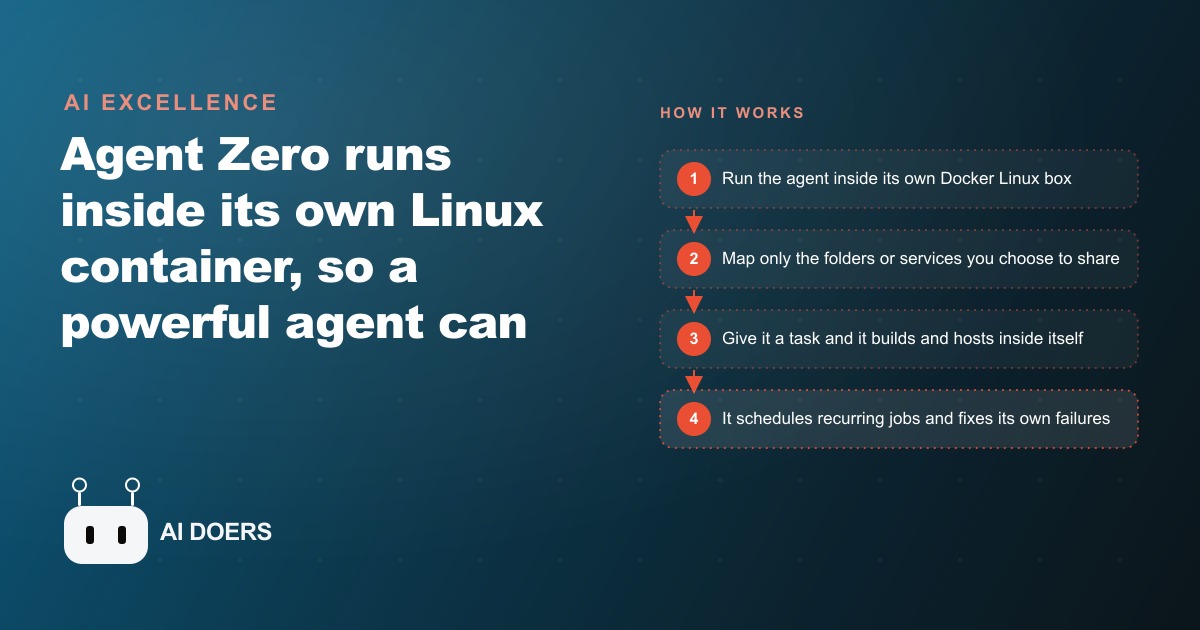
Agent Zero is an open-source AI agent that runs inside its own Docker Linux container instead of on your machine, making it safe to run locally while it installs software, hosts websites, and manages servers on its own.

The blast radius problem that most agent setups quietly ignore
I am Madhuranjan Kumar, and the most important question to ask about any autonomous AI agent is not what it can do. It is what happens when it does something wrong. That question determines whether a capable agent can be deployed for real business work or only for supervised experiments that never quite touch production.
Most autonomous agents run on the same machine as the rest of the business. They share the file system with the documents that matter. They have access to the directories where the code lives, where the customer data sits, where the credentials are stored. When the agent makes a mistake, whether because the model reasoned incorrectly or because a malicious instruction was embedded in content the agent processed, the mistake has no boundary. It can affect everything the machine can reach, which is everything on the machine and potentially everything the machine is connected to. The blast radius of a bad agent run is the entire system.
Agent Zero answers this problem at the design level, not the policy level. It does not ask you to trust the agent to stay in bounds. It builds the bounds into the architecture so the agent cannot leave them without your explicit permission. Understanding how it does that, and what the implications are for every level of the stack, is what this article is about.
What a container actually does to the threat model
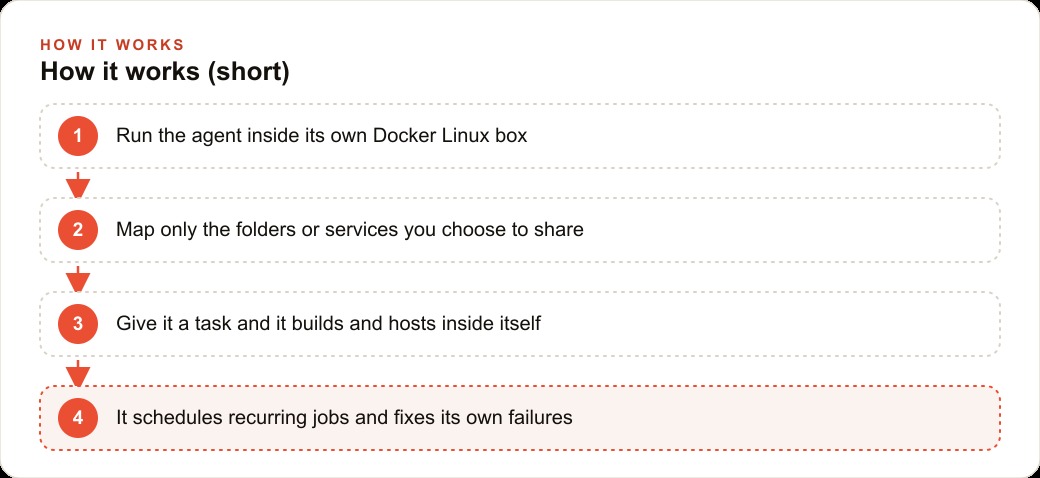
The container Agent Zero runs inside is a standard Docker container, specifically one running Kali Linux, with no access to Madhuranjan Kumar machine's file system, network namespace, or process table unless you explicitly map a connection. The agent has a full Linux environment of its own: a terminal, a package manager, a file system, the ability to install software and run processes, and full network access to the internet. But none of that Linux environment is your Linux environment. It is a separate, isolated system that happens to be running as a process on your hardware.
When you give Agent Zero a task, it executes that task inside the container. If it installs a package, the package installs inside the container and not on your machine. If it creates a file, the file sits in the container's file system and not in your home directory. If it makes a mistake and deletes something, the deletion affects the container and not Madhuranjan Kumar. The container is a sandbox in the original sense of the term: a space where things can be built and knocked over without any consequence to the ground outside it.
The opt-in sharing model is the detail that makes this practically useful rather than just theoretically safe. You choose what to share with the container by mapping specific paths. If you want the agent to work with a particular project folder, you map that folder into the container. If you want it to call an external service, you give it the credential for that service and nothing else. If you want it to interact with a database, you give it the connection string for that database and not the credentials for adjacent systems. Everything else stays outside, invisible to the agent, inaccessible without a deliberate decision on your part. You are not trusting the agent not to touch sensitive things. You are structurally preventing it from reaching them.
How isolation enables useful agentic capabilities without security compromise
The container model creates an apparent paradox: how can an agent be genuinely capable if it is restricted to its own isolated environment? The answer is that most of the tasks an autonomous agent does in practice do not need to touch Madhuranjan Kumar machine at all. They need a Linux environment, internet access, the ability to run code, and connections to whatever specific external systems the task requires.
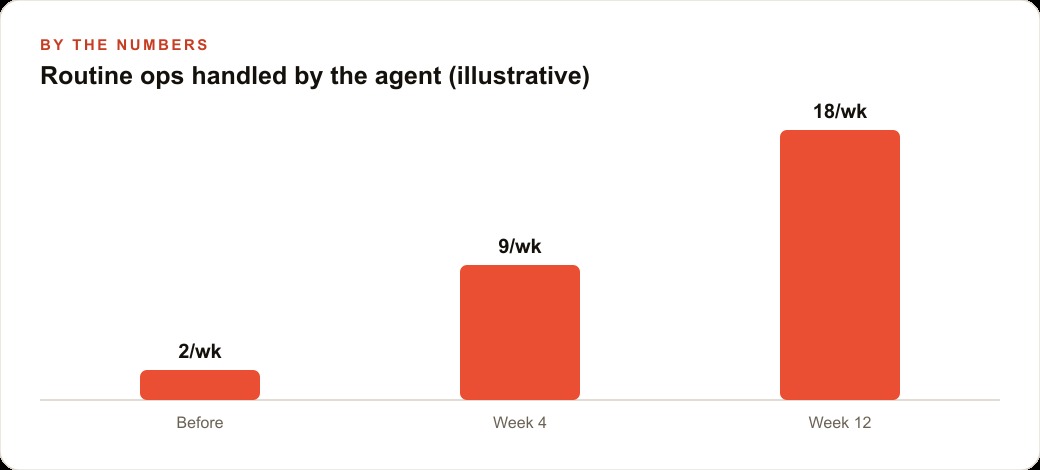
The demonstration case in the original walkthrough makes this concrete. The agent was told to set up a WordPress site. Inside its container, it installed PHP, Apache, and MySQL, configured WordPress from scratch, resolved a CSS bug from a browser error message, and served the site on a port mapped to Madhuranjan Kumar machine so the browser could reach it. None of that required touching anything on Madhuranjan Kumar system. The entire web stack was installed inside the container. The site ran inside the container. The only external connection was a port mapping so the browser could display the result.
The same logic applies to the scheduled backup case. The agent was told to create an automated backup for the site it had just configured. It wrote a backup script, ran it to verify it worked, and scheduled it to fire every eight hours using a cron job inside the container. The backups run inside the container, the cron schedule lives inside the container, and if a backup fails the agent can detect the failure through its monitoring and react, attempting a fix before any human is aware of the problem. The entire backup operation is self-contained and self-healing within the sandbox.
This is the insight that makes the architecture more capable rather than less: because the container has its own full Linux environment, the agent can do almost anything that would otherwise require a dedicated server. It can install software, run web services, manage scheduled jobs, and host applications, all without any of that touching Madhuranjan Kumar machine. The capability is preserved. The blast radius is controlled.
The dual model design and where costs are actually kept low
A fully capable agent running complex tasks requires meaningful AI reasoning, and AI reasoning costs money. The naive approach is to route every call, from the substantive reasoning to the routine bookkeeping, through the most capable and most expensive model available. This is how agent projects become financially unsustainable quickly.
Agent Zero uses a two-tier model architecture. A primary model handles the actual reasoning: planning the approach to a task, evaluating intermediate results, making decisions about what to try next when something does not work. A secondary utility model handles the background operations: updating memory, compressing conversation history, managing context metadata, and handling routine recordkeeping that does not require high-level reasoning. The ratio of utility calls to primary calls runs around five to eight to one, meaning the cheap model handles the majority of the calls while the expensive model handles only the calls that actually require its capabilities.
For a moderately active workload, this keeps the daily API cost close to a few dollars rather than tens of dollars. The primary model is not wasted on tasks that do not need it. The utility model is not overwhelmed with tasks beyond its capability. The split is designed around the actual distribution of task difficulty rather than applying a uniform tier to everything.
The practical consequence for a small business is that an agent capable of managing a web server, running scheduled backups, and debugging its own output costs roughly what a few cups of coffee cost per day to operate. That is a different economic category than enterprise AI tooling, and it is what makes the deployment realistic for operations that do not have a dedicated AI budget line.
Memory compression and why context rot is the silent killer
Most conversation-based AI systems have a context window problem: the window fills, the oldest content falls out, and the agent loses awareness of decisions made early in a long session. For a short task this is irrelevant. For an agent working on a project that spans hours or days, losing the context of the first hour is a serious functional problem. The agent may contradict an earlier decision, repeat work already done, or fail to apply a constraint established at the beginning of the task.
Agent Zero addresses this through progressive memory compression. Rather than discarding old messages when the window fills, the system summarizes them progressively. The most recent context stays at full resolution. Earlier content is compressed into a denser representation that preserves the essential decisions and constraints without retaining every word of the original exchange. The system reaches very high compression ratios over long sessions, meaning the agent can work across a full day of complex tasks without losing the thread of what it established at the start.
The local vector database that stores these memories also enables automatic recall. When a new task begins, the agent retrieves the memories most relevant to that task from the database. It does not need to review its entire history. It surfaces only what is applicable, which keeps the active context focused while the long-term record remains complete. This is the behavior that makes the agent feel like it actually remembers rather than simulating recall on a fresh start every session.
The project abstraction and isolation applied to work
The container handles physical isolation. The project system handles work isolation. A project in Agent Zero is a namespace that includes its own directory, its own memory store, its own system instructions, and its own set of sub-agents. When you work inside a project, the agent reads that project's memory, follows that project's instructions, and operates within that project's directory. A second project running alongside it has entirely separate memory, separate instructions, and separate context.
This matters for any operation running multiple workstreams simultaneously. A marketing agency handling three client accounts can maintain three separate projects, each with its own context, tone, and task history. The agent working inside Client A's project cannot accidentally apply Client B's brand voice or reference Client B's account details. The isolation prevents cross-contamination that would be invisible and difficult to debug in a shared-context setup.
Projects also provide the practical mechanism for team deployment. Because a project can be defined as a directory structure with instructions and memory files, it can be cloned from a Git repository. Any team member who needs the same configured setup can clone the project and have an identical agent context running from the same starting point. The configuration lives in the repository rather than in a local setup that must be manually replicated, which is the difference between an agent deployment that is reproducible and one that lives only on the person who set it up originally.
What the container model teaches about agentic AI design philosophy
The decision to run Agent Zero inside its own Linux container rather than on Madhuranjan Kumar machine is not a security feature added after the design was otherwise complete. It is the central design principle from which everything else follows. The capability to install arbitrary software, run web services, schedule recurring jobs, and host applications safely for business use is only possible because the container bounds the consequences. The self-correction behavior, the scheduled operation, and the long autonomous runs are all enabled by the confidence that a mistake stays within the sandbox.
This philosophy has a specific implication for how to think about AI agents more broadly. The question is not how capable the agent is. The question is how capable it can be within a bounded consequence model. An agent that is maximally capable but has unbounded consequences requires exhausting supervision. An agent with the same capability but bounded consequences can be deployed, run, and trusted to work without constant monitoring. The container model achieves both: full Linux capability inside the sandbox, unbounded internet access through mapped connections, and a blast radius that ends at the container wall.
For a business owner evaluating whether to run an autonomous AI agent for real work, the container question is the right first question to ask of any system. Not "what can it do" but "what happens when it makes a mistake." Agent Zero's answer is that the mistake stays in its sandbox, and Madhuranjan Kumar machine continues untouched. That answer is what makes autonomous deployment a reasonable business decision rather than an experiment run with one hand on the kill switch.
An e-commerce store running nightly backups, daily page health checks, and morning order summaries through an Agent Zero deployment is running those tasks on a machine that cannot reach the main server credentials, cannot touch the payment system, and cannot affect the customer database unless those connections were explicitly granted. The store owner approves each new connection deliberately, which means the agent's scope grows only through deliberate decisions rather than accumulating silently over time. That control model is what makes autonomous operation sustainable at real business scale.
That is exactly what we do at AI DOERS. Book a private 30-minute call with Madhuranjan Kumar and we will map the fastest path to it for your specific business.
Book your call →
Madhuranjan Kumar
Madhuranjan Kumar brings 20 years of performance-marketing experience and has managed over $200 million in Facebook ad spend for brands across the United States and beyond. His expertise spans the full modern marketing stack: Meta, Google Ads, TikTok, email automation, CRM, and the websites that hold it together. At AI DOERS he turns that track record into lead-generation systems for businesses across every industry.