
Why a Physicist Says AI Is Life, Not Just a Clever Machine
A physicist makes the case that AI is a signature of life, because nothing like it could emerge without a 4 billion year lineage behind it. Here is what that reframe means, and why it changes how a business should actually use AI.

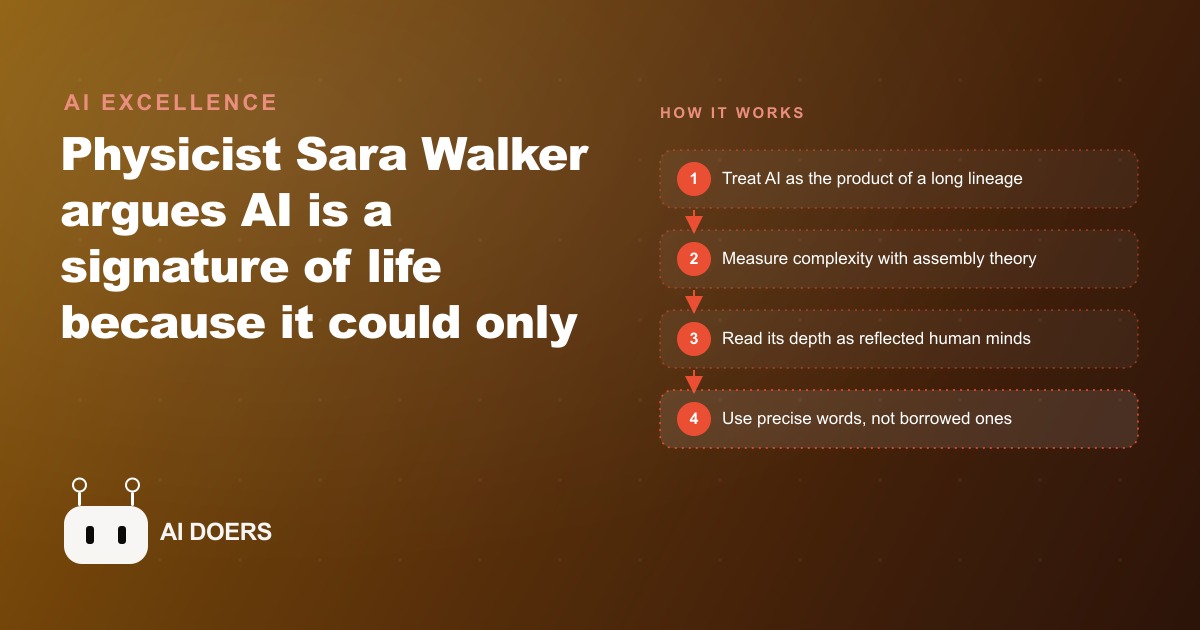
A physicist who studies the origins of life on Earth argues that artificial intelligence is a signature of life, not because chatbots have feelings, but because nothing resembling an AI ever appears in the universe without a four-billion-year biological lineage producing it first. That argument, taken seriously rather than admired and set aside, resolves a specific confusion that costs business owners time and money every week they use AI tools without it.
The confusion is between what AI appears to be and what it actually is. On the surface it appears to be a reasoning machine that knows things and produces answers. At the level of what it actually is, a language model is a compression of accumulated human communication patterns, reflecting back the collective written intelligence of the humans whose output trained it. Those two descriptions lead to completely different decisions about where to use these tools and where not to. Getting the distinction right is the single most practical thing you can learn about AI this year, and the physicist's framing is the clearest path to it.
What the Physics of AI Actually Tells You
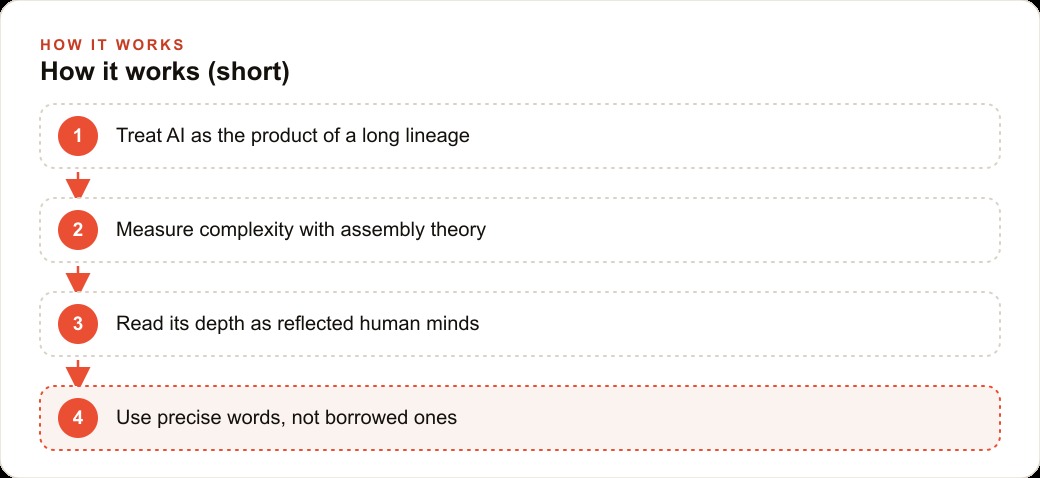
Sara Walker, an astrobiologist and theoretical physicist, developed a framework called assembly theory alongside the chemist Lee Cronin. The starting point is a problem the scientific community has never satisfactorily solved: there is no rigorous definition of life that holds up under scrutiny. The textbook version, a self-sustaining chemical system capable of Darwinian evolution, breaks on its own edge cases. An individual human being is not self-sustaining without the surrounding society providing food, medicine, infrastructure, and language. A virus cannot replicate without a host cell. The canonical definition keeps producing exceptions that erode its usefulness.
Assembly theory approaches the question from a different direction. Instead of asking what life is, it asks what kinds of structures can only exist because life produced them. The key measure is the assembly index: the minimum number of steps required to build an object from basic components. Ordinary chemistry produces objects with low assembly indices. A stone, a simple crystal, water. Past a certain complexity threshold, structures with a high assembly index cannot exist in nature unless a long chain of living, evolving processes built them incrementally over time. The evolutionary lineage is embedded in the object's structure. You cannot build it any other way.
The provocative application Walker makes is to AI. A language model is the product of its training data, which is itself the product of human beings writing, thinking, arguing, explaining, and creating across thousands of years of cultural development. Those human beings are the product of billions of years of biological evolution. The model did not emerge from a laboratory experiment. It emerged from the entire lineage of human thought, compressed into a statistical structure that can generate the next plausible word in any sequence. By Walker's framework, the AI's apparent depth and intelligence is not really the model's. It is the reflection of accumulated human cognitive depth, which itself traces back to the full evolutionary and cultural lineage that produced the humans who generated the training data.
This reframes the model's capabilities in a precise and useful way. The model is not independently reasoning from first principles toward verified conclusions. It is pattern-completing from a vast compression of human-generated text. When it produces an accurate and insightful response, it is because the patterns in its training data contain that insight in some form, and the model has found the relevant pattern and reflected it back in your prompt's context. When it produces a confident but wrong response, it is because it has found a plausible-sounding pattern that does not correspond to the specific current reality you are asking about. The model cannot tell the difference from inside, which is why you have to.
The Line That Falls Out of This Framing, and Why It Is the Only One That Matters
Once you understand that a language model compresses and reflects patterns from human-generated text rather than reasoning from verified facts about the current world, one practical boundary becomes clear: use it for tasks where compressed human communication patterns are exactly what you need, and keep it away from tasks that require verified facts about the specific current world.
The tasks where it works are all language-layer tasks. Drafting a professional email that communicates a difficult message without damaging the relationship. Structuring a proposal that builds a logical case toward a clear recommendation. Converting rough meeting notes into a polished summary a client can forward to their leadership team. Rewriting a dense technical explanation into plain language for a non-technical audience. Brainstorming twenty angles for a marketing campaign in five minutes. Adapting the tone of a document for a different reader. Writing the first draft of any document where the judgment about what to say comes from you, and the language itself is the work. The model has absorbed enough examples of high-quality human professional writing that it produces reliable, useful output for all of these tasks without needing to verify anything.
The tasks where it fails quietly are the ground-truth tasks. What does a specific material cost from your specific supplier right now. What exact permit requirements does your specific county building department enforce under the current code cycle. What did your specific client say in last Thursday's meeting. Whether a specific regulation changed in the last six months. What your actual conversion rate on a specific campaign has been over the last ninety days. The model has no access to any of this. It will produce a fluent, confident-sounding answer that reflects the general pattern of how similar questions get answered in its training data, but that answer has no connection to the specific current reality you need to act on. And because the answer is fluent and confident, it does not announce its own unreliability the way a search result that says "no results found" would.
Here is a concrete worked example using numbers. The owner of a five-person landscaping crew uses AI for five recurring communication and documentation tasks each week: the follow-up message after a site visit, the quote cover letter that explains scope in plain terms, the seasonal client newsletter, the response to a customer inquiry about a specific service, and the internal summary of the week's job notes. Each of these tasks previously took between twenty-five and forty minutes. With a well-calibrated AI workflow, each takes between five and eight minutes, with the owner providing the specific facts and the model handling the language and structure. Across five tasks over a five-day week, that is approximately two hours recovered per day. Redirected toward site supervision, sales conversations, or simply ending the administrative day earlier, that time has a direct effect on how the business runs and how sustainable it feels to run it.
What the same owner does not use AI for: estimating the actual material and labor cost of a specific retaining wall project at a specific address with a specific soil profile, using current supplier pricing. The model would produce a number that looks precise and credible. That number would be generated from patterns in its training data about similar projects, with no knowledge of the owner's specific suppliers, current material prices in the local market, or the conditions at the specific site. Acting on that estimate without independent verification would produce a job quoted below actual cost, a margin that disappears during execution, and the frustration of not immediately understanding why.
Why Getting This Calibration Right Is Worth the Effort
The business cost of getting the AI mental model wrong is not hypothetical. It shows up in specific, recurring ways. A team that treats the model as an oracle for factual questions spends hours correcting confident AI errors. A manager who builds a workflow around AI-generated compliance or regulatory information creates liability exposure when that information turns out to be outdated or jurisdiction-specific in ways the model did not account for. A sales team that lets the model generate specific competitive claims builds a reputation risk when the claims turn out not to hold up. The pattern is consistent: the model's fluency creates an expectation of accuracy that the model cannot always fulfill when the task requires verified current facts.
The cost of developing an accurate mental model is comparatively low. It is mostly a matter of clear thinking about the nature of the tool, which requires some investment of attention but no additional purchases. The Walker framing, a language model as a compression of accumulated human communication rather than an independent reasoning system, makes the calibration intuitive rather than rule-based. Once you can picture what the model actually is, you know immediately which tasks to hand it and which tasks to keep for human judgment backed by verified information.
Madhuranjan Kumar returns to this framing specifically because it eliminates the need for a checklist. A checklist of AI dos and don'ts has to be maintained, updated when capabilities change, and remembered under pressure when a deadline is close. An accurate mental model of what the tool actually is generates the right decision automatically at any new task, because the decision follows from understanding rather than from memorizing a rule. The operator who understands that the model reflects accumulated human communication will naturally use it for language and naturally keep it away from verified facts, without needing to consult a guide each time.
The question worth sitting with is not whether AI tools are powerful. They are powerful. The question is whether the power is being applied to the tasks where it reliably delivers and withheld from the tasks where its confident fluency masks genuine uncertainty. Getting that assignment right is the difference between a business that compounds the time advantages of AI and one that spends equal amounts of time fixing AI mistakes as it saves with AI assistance.
The calibration also changes how you evaluate new AI capabilities as they arrive. A new model release that claims better reasoning is evaluated on a simple question: does it reflect human communication patterns more accurately, or does it have genuinely better access to verified current facts? If the former, it is useful for more and better language-layer tasks. If the latter, it might extend the boundary of where AI can be trusted for ground-truth tasks, and the appropriate use cases expand. This framing gives you a consistent way to evaluate new tools against the actual work they would be doing, rather than against marketing claims about benchmark performance.
The physicist's argument ultimately points to something practical that goes beyond how to use AI on any given Tuesday. It points to the nature of the technology's limitations. A language model's limitations are not random bugs that future versions will fix with enough training data. They are structural properties of what the system is: a compression of human language patterns, not a window into verified current reality. Understanding that structure is what lets you deploy the tool confidently for the tasks where its structure makes it strong, and withdraw it confidently from the tasks where its structure makes it unreliable. That is not a limitation to work around. It is the calibration that makes the tool genuinely useful over time rather than unpredictably unreliable.
Madhuranjan Kumar keeps returning to the Walker framing in practical conversations with business owners not because it resolves every question about AI but because it resolves the most consequential one: where does the confidence stop being justified. The answer is straightforward once you understand what the tool actually is. The confidence is justified wherever compressed human communication patterns are the right resource for the task. It stops being justified the moment the task requires stepping outside that compression to verify something specific and current about the actual world. That line, drawn once and applied consistently, is worth more than any list of AI best practices.
The business owner who develops this calibration and applies it consistently ends up in a different competitive position than the one who uses AI opportunistically without a clear mental model of its limitations. The former gets the full productivity gain from the tasks where the tool is reliable, with no time lost to correcting confident errors. The latter gets a partial gain offset by the cost of managing mistakes that a clearer model of the technology would have prevented. That difference, compounded across months and years of daily AI use, is substantial.
That is exactly what we do at AI DOERS. Book a private 30-minute call with Madhuranjan Kumar and we will map the fastest path to it for your specific business.
Book your call →
Madhuranjan Kumar
Madhuranjan Kumar brings 20 years of performance-marketing experience and has managed over $200 million in Facebook ad spend for brands across the United States and beyond. His expertise spans the full modern marketing stack: Meta, Google Ads, TikTok, email automation, CRM, and the websites that hold it together. At AI DOERS he turns that track record into lead-generation systems for businesses across every industry.