
When Every AI Lab Launches the Same Thing in the Same Week
This week Claude and ChatGPT both shipped interactive visual learning, Perplexity opened its cloud agent to all paid plans, and Canva and Photoshop both added one-prompt image editing. When everyone ships the same feature, the edge is no longer the feature but knowing which version fits your real work.

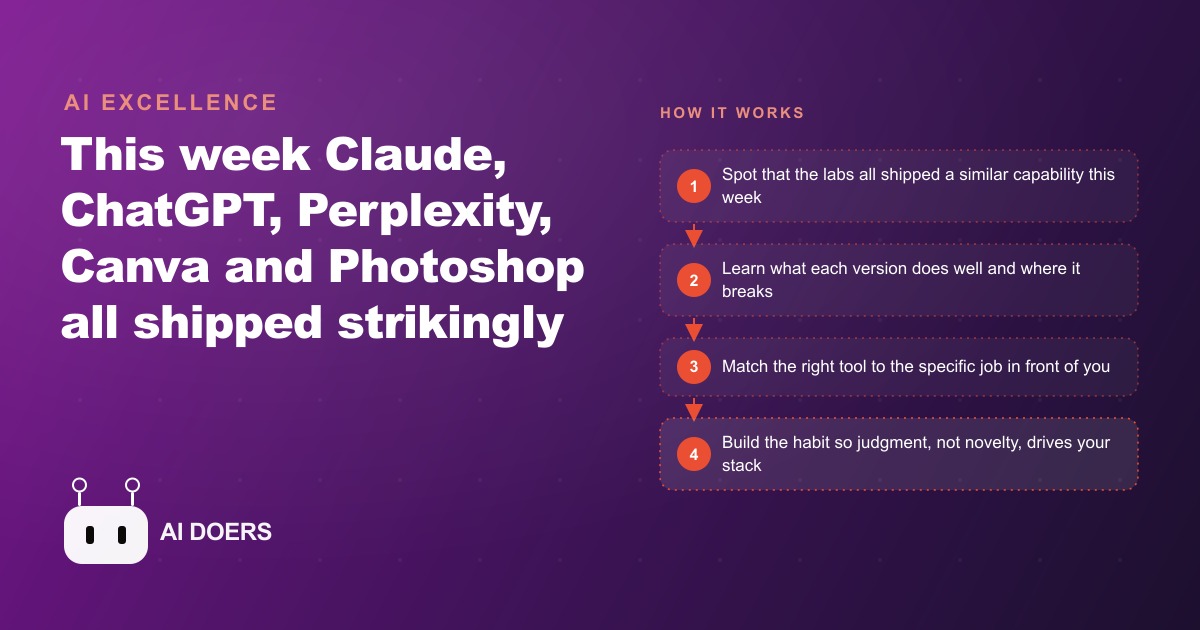
Here is a position most of the AI coverage this week got backwards: when every major lab ships the same feature in the same seven days, that feature has already lost its value as an advantage. The excitement is aimed at exactly the wrong thing. Claude and ChatGPT both launched interactive visual learning two days apart. Perplexity opened its cloud agent to every paid plan. Canva and Photoshop both added one-prompt image editing running on the same underlying model. The reflex is to ask which launch is the most impressive. I think that is the trap. I am Madhuranjan Kumar, and I want to argue that convergence is the real story, and that it hands the advantage to the people who stop chasing features and start exercising judgment.
When a feature is everywhere, it stops being an edge
Think about what it means for a capability to appear across four or five products in a single week. It means the capability is now table stakes. Nobody wins a customer next quarter by having interactive charts, because everybody has them. The moment a feature is universal, it drops out of the competition entirely and becomes background. This is not a new pattern, it is just moving faster than usual. The same thing happened with spellcheck, with cloud sync, with dark mode. The first mover got a headline, and then within weeks it was simply expected and no longer a reason to choose anyone.
So the contrarian move is to stop treating each launch as a thing to adopt and start treating the wave as a signal. When several labs ship the same capability at once, that is the market telling you the capability is mature enough to rely on. That is genuinely useful information. But it is information about timing, not about which vendor to marry. The people who read it as a buying signal for their workflow, rather than a loyalty test between brands, are the ones who benefit.
The difference lives underneath, not in the demo
If the features look identical on the surface, the whole game moves to the trade-offs underneath, and this is where the crowd stops paying attention exactly when it should start. Take the interactive visuals that Claude and ChatGPT both shipped. Claude builds each one live, from scratch, which means it can render almost anything you ask, but the results vary and sometimes break. A compound interest explainer with draggable sliders came out beautifully. A neural network diagram came out broken. ChatGPT's near-identical feature loads instantly and never breaks, but only because it draws from a fixed library of pre-built simulations like Ohm's law and the Pythagorean theorem. Ask for something outside that library and it simply cannot make it.
That is not a small distinction. It is the entire decision. Need a custom visual for a scenario nobody has pre-built, reach for the one that builds live and tolerate the occasional retry. Need speed on a common topic, reach for the cached one. Same feature on the surface, opposite tools in practice. The person who knows the difference finishes the task. The person who just grabbed whichever trended first either waits for a build they did not need or hits a wall the other tool would have sailed through.
Build versus decide is the line that matters with agents
The same split runs straight through the agent launches, and it is even more consequential there. Perplexity opened up its cloud agent, which runs on a hosted machine wired into Slack, Notion, Gmail, and more. It is genuinely strong at assembling dashboards, pulling data together, and building terminals. But watch the demos closely and you notice they show it building things, not clearly making autonomous decisions. There is a claim floating around that this kind of agent replaced a large marketing tool stack in a weekend, making hundreds of micro-optimizations. Impressive if true, and worth testing, but the honest read is that assembling and optimizing under rules is a different act from judgment, and the marketing around these tools blurs that line on purpose.
My position is that you should hold that line hard. Let the agent build, assemble, pull, and organize, because that is where it is reliable. Keep the actual decisions, the ones where being wrong costs money, with a human until the tool has earned more trust than a slick demo. This is not caution for its own sake. It is a recognition that build-versus-decide is precisely the seam the marketing hides, and the businesses that respect it will avoid the expensive mistake of handing a confident-looking agent a decision it was never actually validated to make.
The tools are commodities, your workflow is not
Zoom out and the pattern repeats across every category that shipped this week. Canva's Magic Layers separates any image into movable parts like head, body, and background, which is a real gift for anyone producing thumbnails or ad creative. Photoshop's new assistant edits images straight from a text prompt. Gemini now lives inside Docs, Sheets, Slides, and Drive, and a spreadsheet assistant can read and write live workbook models. NVIDIA even dropped an open-weight model you can run and fine-tune yourself. Every one of these is powerful. Not one of them is a moat, because a near-identical version exists next door.
This is the heart of the contrarian case. The tools are converging toward commodity. What does not converge is your specific workflow, the exact sequence of tasks your business repeats, and the knowledge of which tool wins which of those tasks. That knowledge is the asset. It is also the thing nobody can buy off the shelf, because it is particular to how you work. The team that treats the tool stack as a commodity and invests instead in mapping its own tasks to the right tools will quietly outrun the team that keeps switching to whatever launched last Tuesday.
There is a comfortable objection to all of this: surely one tool is genuinely better, so you should just pick the winner and be done. Sometimes that is true for a narrow task. But betting your workflow on a single vendor being permanently ahead is a bad bet in a market where the gap between first and second place closes in weeks. The safer and more profitable stance is to stay fluent in several, keep your process portable, and switch freely as each new launch reshuffles the ranking. Loyalty to a tool is a liability when the tools are this interchangeable.
The open-weight releases prove the point
Two quieter launches this week make the commodity argument better than the flashy ones. NVIDIA put out an open-weight model with over a hundred billion parameters that you can fine-tune and run yourself, and a new open-source model shipped with a very large context window at near state-of-the-art quality. When frontier-level capability is available as open weights you can host, the idea that any single hosted feature is a durable moat collapses entirely. The intelligence itself is becoming something you can rent, buy, or run in your own building. What stays scarce is not the model. It is knowing which job to hand it and how to verify the result, which is human judgment again, the same conclusion reached from a different direction.
There was also a telling move where a research system was open-sourced that lets an agent tune a real model overnight, editing code, training briefly, keeping or discarding the result, and repeating, so you wake up to a better model. And a large platform hired the team behind a social network where AI agents post and comment to each other. Read together, these say the same thing as the feature convergence: the raw capability is spreading fast and cheap, and the advantage is migrating from having the capability to knowing what to do with it. Almost every headline this week points at the same conclusion if you are willing to look past the demo.
What this looks like for a real business
Let me make it concrete with one illustrative example. Picture a law firm, which runs on documents, explanation, and turnaround. This week's convergence maps neatly onto its real tasks. When an associate needs to explain a scenario unique to a client, say how interest compounds on a specific settlement structure, the live-building visual tool is correct because it can render that exact case even if it takes a moment longer. When a paralegal wants a quick standard explainer of a common principle, the instant pre-built option wins on speed. For intake and research, a cloud agent that assembles a dashboard from case data is useful for organizing, while the firm keeps the legal judgment with a human, exactly the build-versus-decide line the demos exposed. Even the image tools earn a place, cleaning up exhibits or producing clear client-facing one-pagers in minutes.
Notice what the firm is really buying in that example. It is not any one of the tools, all of which a competitor down the street can access just as easily. It is the mapping itself, the quiet institutional knowledge that says this task goes to the live builder, that one to the cached explainer, this data job to the agent but never the final call. That mapping took a few weeks of deliberate testing to build, and it belongs to the firm alone. A rival who adopts the exact same tool stack the next morning still has to earn that mapping the hard way, which is why it is the only part of the whole picture that behaves like a real, defensible advantage.
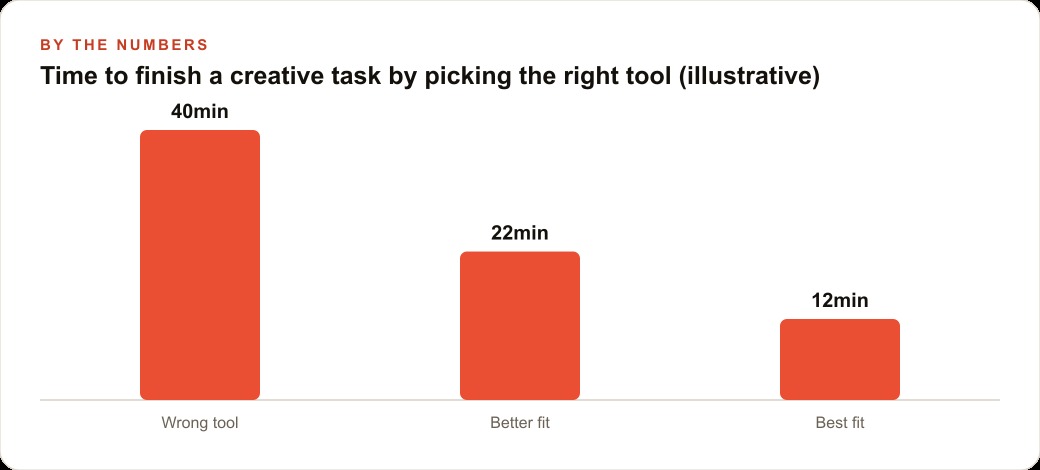
Now put a number on the discipline. Suppose a routine creative task, producing a clear explainer for a client, takes forty minutes when someone grabs the wrong tool and fights it, twenty two minutes with a better fit, and about twelve with the best fit. Those figures are illustrative, but the shape is exactly right. The saved time is not in the tools, which are all capable. It is in the matching. Multiply twenty five wasted minutes across every content, analysis, and creative task a firm runs in a week and the cost of defaulting to whatever trended first becomes very real.
The move to make
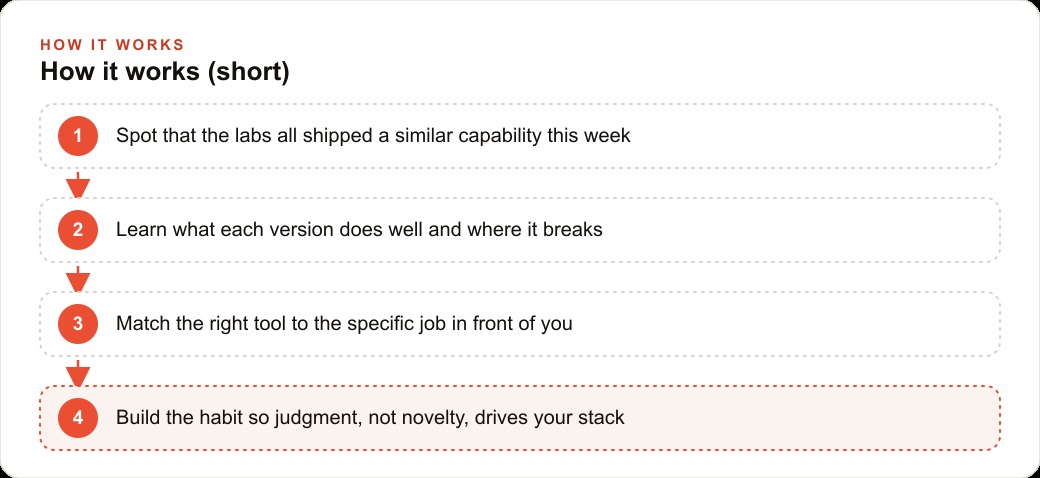
So here is the practical version of the argument. Treat convergence as a signal that a capability is ready, then stop caring which vendor gets the headline. Learn what each version does well and where it breaks, and write down which tool you will reach for on which task. Use the flexible live-building option for custom work and the fast pre-built one for common topics. Test any cloud agent on a low-stakes build before you trust it with a decision, and keep the decisions human until the trust is earned. Pull the image-layer tools into your thumbnail and ad workflow so one image becomes many, which feeds directly into stronger Facebook and Instagram ad campaigns. Keep an eye on the open-weight releases if you eventually want something you run yourself. And let the clean outputs of all this flow into your CRM and website stack and your SEO and organic search so the judgment compounds instead of evaporating.
The habit underneath all of it is simple and unfashionable: judgment over novelty. When everyone ships the same thing, the feature is not the edge anymore. Knowing your own work well enough to route each task to the right tool is the only edge left, and it happens to be the one nobody can copy.
I want to be clear that none of this is an argument against adopting new tools. It is an argument against confusing adoption with advantage. Adopt freely, because the tools are cheap and often free. Just do not expect the adoption itself to make you money, because your competitor adopted the same thing on the same day. The money is in the layer above the tools, in the disciplined matching of task to capability, and that layer only grows when you invest attention in your own process instead of the release notes of five different labs.
You can absolutely sort this out yourself by testing each tool against your real tasks, and I would encourage every owner to keep a short list of which tool wins which job. If you would rather have someone audit your workflow, pick the tools that fit, and wire them into a clean repeatable system, that is exactly the kind of build I do for clients, and you can bring me in to handle it.
That is exactly what we do at AI DOERS. Book a private 30-minute call with Madhuranjan Kumar and we will map the fastest path to it for your specific business.
Book your call →
Madhuranjan Kumar
Madhuranjan Kumar brings 20 years of performance-marketing experience and has managed over $200 million in Facebook ad spend for brands across the United States and beyond. His expertise spans the full modern marketing stack: Meta, Google Ads, TikTok, email automation, CRM, and the websites that hold it together. At AI DOERS he turns that track record into lead-generation systems for businesses across every industry.