
What the Leaked Claude Code Source Tells Us About the Future of AI
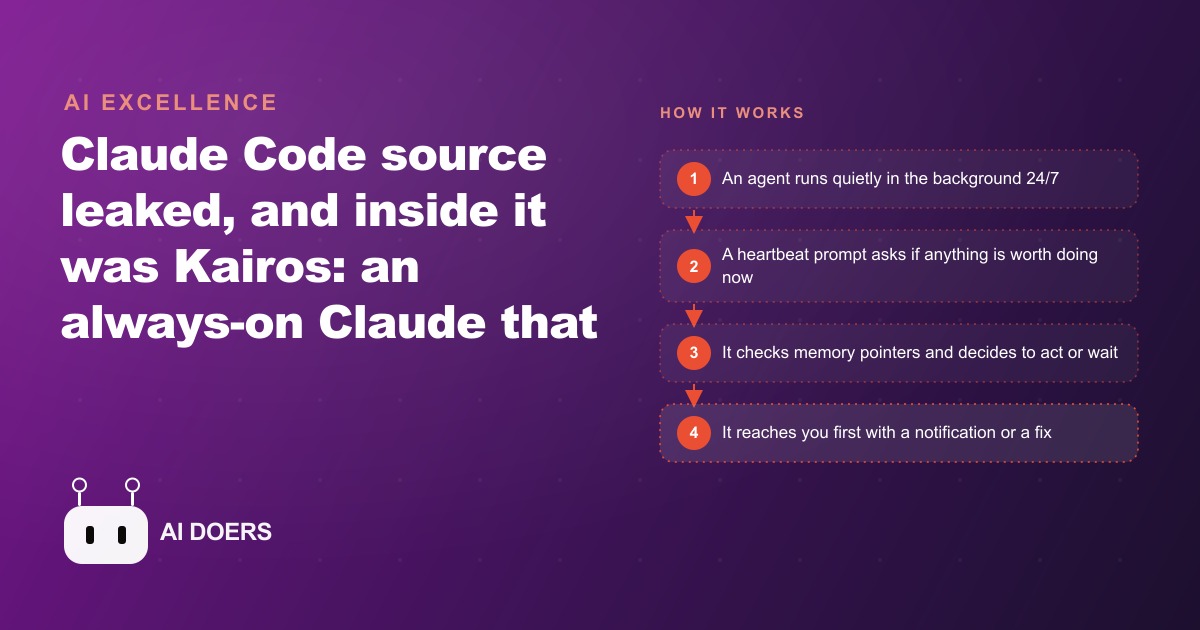
The leak's biggest reveal is Kairos, an always-on background mode for Claude Code that runs 24/7, checks a heartbeat prompt every few seconds, and acts on its own through push notifications, file delivery, and GitHub subscriptions. It signals a shift from reactive chat to proactive agents.

Step 1: Understand what the leaked source code actually revealed about how Claude Code thinks
The Claude Code source code leaked through a map file in Anthropic's NPM registry. Within hours it was spreading across GitHub, Anthropic was filing DMCA takedowns, and the AI community was reading through what was, until the leak, entirely internal implementation code.
I am Madhuranjan Kumar, and the interesting part of this leak is not the leak itself but what the code revealed about the architecture of a sophisticated AI agent system and how those architectural decisions translate into capabilities that any builder can learn from.
The most discussed finding was the three-layer memory system. But before getting to the specific features, the underlying design philosophy that the code revealed is worth stating directly: the system was built around the observation that large language models have a fixed context window, that loading everything into that window every time is expensive and slow, and that a more efficient system keeps a lightweight index of what exists and loads specific content on demand. That design philosophy shows up in every major component of the code.
Step 2: Learn the three-layer memory architecture that the code described
The memory system revealed in the leaked code operates at three levels, each serving a different function.
The first layer is the memory index, a lightweight file called memory.md that stores pointers rather than content. It knows that a note about the project architecture exists and where to find it, but it does not load the note itself. When a task requires that context, the system looks up the pointer and fetches the content. When the task does not require it, the pointer sits in the index without consuming context window space.
The second layer is the raw transcript store, which holds the record of past interactions. Rather than summarizing these transcripts into a compressed representation that might lose important details, the system keeps them in their original form and uses grep-style search to find specific relevant passages when they are needed. This design preserves the accuracy of the record at the cost of storage space, which is cheap, rather than trading storage for compression that might introduce errors.
The third layer is the working context, the content that is actually loaded into the model's active context window for the current task. The design minimizes what goes in this layer on each turn by pulling only the pointers from the index and fetching specific content on demand. The context window is treated as expensive working memory, not as a filing cabinet where everything is kept at once.
For any developer building a system that needs to maintain memory across many sessions or interactions, this three-layer pattern is a reference architecture worth adopting. The principle, keep the index lightweight, keep the raw records searchable, and be deliberate about what goes into the active context, applies regardless of the specific implementation.
Step 3: Understand the Kairos daemon and the shift from reactive to proactive AI
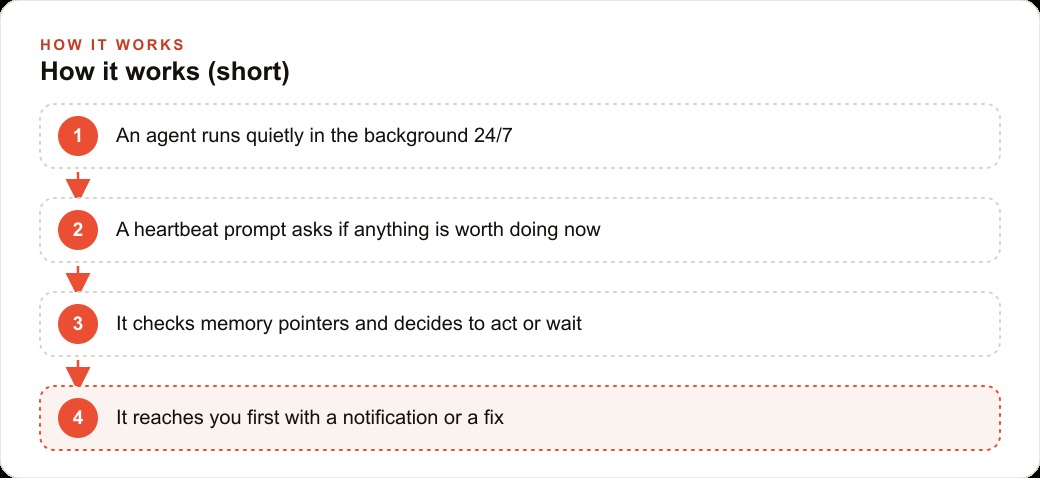
The most discussed feature in the leaked code was Kairos, an autonomous daemon mode for Claude Code. The standard Claude Code operates reactively: it waits for a prompt, responds, and waits again. Kairos operates proactively: it runs continuously in the background, receives regular heartbeat prompts, and decides independently whether there is something useful to do right now.
The heartbeat prompt is simple in concept: "here is the current state of things, is there anything you should be doing right now?" Kairos reads the state, applies its judgment about what is useful versus what is not, and either takes action or stays quiet. If it decides to stay quiet, it logs why and waits for the next heartbeat. If it decides to act, it takes the action and notifies the appropriate channel.
Kairos also receives three tools that standard Claude Code does not have. Push notifications allow it to send messages to the developer's phone rather than waiting for the developer to open the terminal. File delivery allows it to create and send files without being prompted. Pull request subscriptions allow it to watch specified GitHub repositories and respond to events in those repositories autonomously.
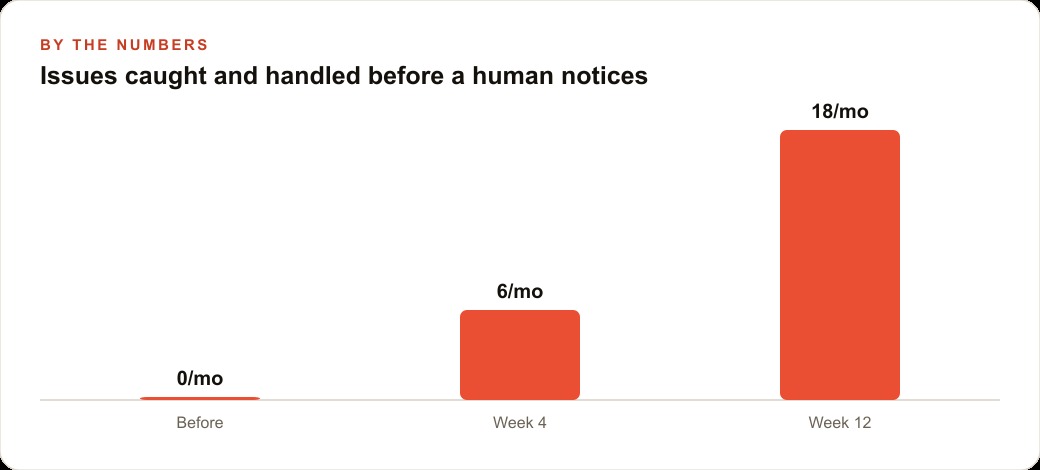
The practical implication of these three tools together is significant. A system with Kairos-style behavior can detect a problem, investigate it, fix it, and notify the developer, all without the developer initiating any of those steps. A website that goes down at 2 AM is the kind of scenario where this matters: by the time the developer's phone shows the push notification, Kairos has already restarted the server and logged the incident.
Step 4: Apply the heartbeat architecture to your own autonomous agent design
The heartbeat pattern in Kairos is not specific to Claude Code. It is a general pattern for building proactive AI agents, and it is one worth understanding in detail because it solves the problem of "how does an AI know when to act without being asked."
The solution the heartbeat provides is a regular check-in that gives the agent a structured opportunity to assess the current state and decide whether action is warranted. The frequency of the heartbeat determines the responsiveness of the agent: a heartbeat every thirty seconds produces faster response to new conditions than one every five minutes, at the cost of more frequent state assessments.
The prompt for each heartbeat should include the information that is relevant to the agent's decision about whether to act: the current state of the systems it monitors, any recent events that occurred since the last heartbeat, and the agent's goals and constraints. Given this context, the agent produces either a decision to act or a decision to wait, with a logged rationale for either choice.
For a business that wants to build an autonomous monitoring and response agent, the heartbeat pattern provides the control structure. The agent does not run continuously in a tight loop consuming resources. It wakes on each heartbeat, assesses, decides, and sleeps until the next one. The assessment and decision logic live in a prompt that can be updated without changing the underlying infrastructure.
Step 5: Design the boundary between autonomous action and human approval
The most important design decision for any autonomous agent system is where the boundary sits between actions the agent can take independently and actions that require human approval before execution. This boundary determines the risk profile of the system.
The leaked code suggested a boundary organized around reversibility and consequence size. Actions that are easily reversible and have small consequence if wrong, like sending a log message, running a diagnostic, or restarting a service, sit below the boundary and can be executed autonomously. Actions that are difficult to reverse or have larger consequences, like deleting data, sending external communications, or modifying production configurations, sit above the boundary and require confirmation.
For a business building a Kairos-style agent, the boundary should be defined explicitly rather than left to the model's judgment. The system prompt should include a clear list of actions that are approved for autonomous execution and actions that require a confirmation prompt before proceeding. The list does not need to be exhaustive on day one. Starting with a narrow approved list and expanding it as the system demonstrates reliable judgment is a safer approach than starting with a broad approved list and narrowing it after a problematic autonomous action.
Step 6: Build the notification layer that keeps humans informed without requiring attention
A proactive agent that acts autonomously but keeps humans in the loop produces the combination that makes autonomous systems trustworthy: things happen without requiring your initiation, but you know what happened and why.
The push notification layer in Kairos serves this function for developer systems. For a business system, the notification layer might be a daily summary email, a Slack message for notable events, or a dashboard entry for every autonomous action taken. The form matters less than the principle: every autonomous action leaves a traceable record that a human can review without having to dig through logs to reconstruct what happened.
Designing the notification layer before deploying the autonomous system, rather than adding it as an afterthought, ensures that the human oversight is built in from the beginning rather than retrofitted after something unexpected happens. The cost of the notification layer is low. The value of knowing what your autonomous system did overnight is high.
Step 7: Use the post-prompting insight to change how you work now
The most widely quoted observation from the community's reading of the leaked code was about the shift from prompting to post-prompting: the idea that as AI systems become more proactive and capable, the work of directing them shifts from writing prompts to reviewing and accepting or rejecting what they have already done.
This is a real shift in the relationship between a person and an AI system, and it changes what skills matter. The skill of writing a prompt that produces a specific output on demand becomes less central. The skill of reviewing an agent's autonomous output, assessing whether it matches your intent, and providing precise feedback when it does not becomes more central.
For a business owner using AI tools in 2026, building the habit of reviewing and directing rather than only prompting is the preparation for the agentic AI systems that are already emerging. Setting aside fifteen minutes each morning to review what any autonomous systems did overnight, provide feedback where the output diverged from intent, and update the system's instructions to prevent recurrence is the operating rhythm that works with proactive AI rather than against it. The systems that run without your attention produce the most value when you have a reliable practice of reviewing their work rather than treating their autonomous output as already correct.
The Microsoft MAI transcription model and what it signals about specialist AI
Alongside the Kairos news, the AI week that included this leak also brought Microsoft's MAI Transcribe One, a speech transcription model that outperforms GPT's own transcription capability, Gemini Flash, and the standard Whisper model on word error rate across 25 languages.
The MAI Transcribe One release is interesting for a different reason than the Claude Code leak. It shows that specialist AI models, optimized for one specific task rather than general capability, continue to push performance ceilings in ways that general-purpose models cannot match. A model trained specifically on the challenges of transcription, handling homonyms, maintaining accuracy in noisy audio, and managing multiple languages, outperforms larger more general models on the specific task it was designed for.
For a business using transcription at scale, whether for meeting notes, client call records, or content creation, the existence of a significantly more accurate specialist model changes the economics of the decision. Higher accuracy on transcription means less manual correction time after the fact, which compounds across every transcription the business runs. Switching to a more accurate transcription model is one of those improvements that has a clear measurable return and a low switching cost.
The broader lesson is that the landscape of AI models is increasingly differentiated between general-purpose models that handle a wide range of tasks adequately and specialist models that handle a narrow range of tasks exceptionally. The best workflow architecture uses specialist models for the tasks where the accuracy ceiling of a general model is a meaningful limitation, and general models for the tasks where good enough is genuinely sufficient.
The open-weight model momentum and what it means for cost-conscious builders
The same week that produced the Claude Code leak also brought Gemma 4 from Google under Apache 2.0 and Qwen 3.5 Omni from Alibaba. Both are open-weight models, meaning the weights are publicly released and can be run locally or on self-hosted infrastructure without per-query API costs.
For a business or developer building a system that processes high volumes of queries where cost scales linearly with usage, open-weight models change the economics fundamentally. A system that runs a million queries per month against a commercial API at a few cents per query has a monthly cost in the tens of thousands of dollars. The same system running against a locally hosted open-weight model of comparable capability has a monthly cost roughly equal to the hardware and electricity required to run the model.
The gap between closed frontier models and open-weight models on performance closed substantially in 2025 and has continued closing. The open models that are released today in the 7 to 27 billion parameter range perform comparably to models that were considered frontier-level eighteen months ago. For use cases that do not require the absolute frontier of performance, the cost case for open models is now compelling.
The architectural implication for a business building on AI is to maintain clarity about which tasks require frontier model performance and which tasks can be handled by a capable but smaller model. Routing the frontier tasks to frontier models and the high-volume adequate-performance tasks to open models running locally produces a cost structure that scales sustainably rather than one where costs scale directly with usage volume.
That is exactly what we do at AI DOERS. Book a private 30-minute call with Madhuranjan Kumar and we will map the fastest path to it for your specific business.
Book your call →
Madhuranjan Kumar
Madhuranjan Kumar brings 20 years of performance-marketing experience and has managed over $200 million in Facebook ad spend for brands across the United States and beyond. His expertise spans the full modern marketing stack: Meta, Google Ads, TikTok, email automation, CRM, and the websites that hold it together. At AI DOERS he turns that track record into lead-generation systems for businesses across every industry.