
What OpenAI's Spud Model and the Death of Sora Really Tell Us
OpenAI finished pre-training a model code-named Spud, killed Sora to free up compute, and is merging its products into one super app. The signals here matter for any business trying to decide where to place its own AI bets.

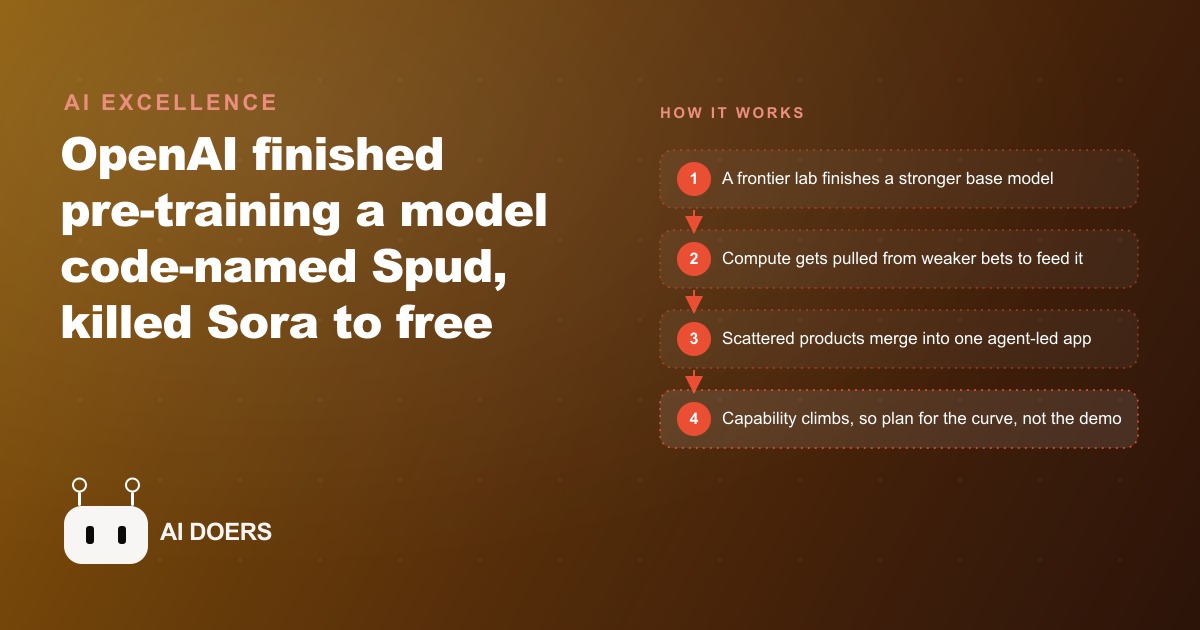
OpenAI just finished pre-training a next major model, internally code-named Spud, killed off Sora to free up the compute, and started merging ChatGPT, Codex, and its Atlas browser into one product. Read as separate headlines, these look like unrelated drama. Read together, they are a single decision about focus, and that decision hands any business owner a clear playbook for where to place their own AI bets. I am Madhuranjan Kumar, and I want to turn the news into moves you can actually make this quarter.
Read the compute reallocation as the real headline
The move most people skimmed past is the most important one. Employees were reportedly shocked at how much compute Sora consumed, so Sora got cut to feed that capacity to the new model and the merged app. Video generation left the roadmap entirely, and a three-year licensing deal carrying a billion-dollar production commitment collapsed before it ever closed. The lesson is blunt. Roadmaps are now governed by hardware budgets, and a product that wins on flashy demos can still lose on power draw.
For your own planning, that means one thing above all. Do not build a core part of your business on top of a single vendor feature that could vanish in the next roadmap shuffle. If a lab will cut something as visible as its video product to save compute, the smaller features you quietly depend on are even more disposable. The first step in the playbook is to look at everything you rely on and ask, would I survive if this specific feature disappeared next quarter. Anything you cannot honestly answer yes to is a risk you have to manage, either by keeping a fallback or by not building your core promise on it.
This is not a reason to avoid AI. It is a reason to treat individual features as rented, not owned. The models themselves keep getting stronger, and the platforms that own the biggest models are the safest place to stand. The disposable things are the flashy wrappers and single-trick features layered on top, and those are exactly what a compute crunch cuts first.
Audit your tool stack and cancel the overlap
The consolidation direction, several products folding into one agent-led app, tells you where the market is going. Instead of a drawer full of single-purpose subscriptions, the future is one capable agent that handles many tasks behind a single interface. So the second step is a tool audit. List every AI subscription you pay for. Beside each, write what it actually does for you and whether one strong general model could now do the same job.
Most businesses find real overlap here. A separate tool for drafting, another for summarizing, another for basic analysis, when a single frontier model covers all three at once. Cancel the overlap and standardize your team on one strong general model for everyday work. Keep a specialist tool only where it clearly beats the generalist, not out of habit. This is not about chasing the newest launch, it is about refusing to pay for ten narrow tools when the direction of travel is one broad one.
There is a hidden cost to the sprawl that the subscription total does not show. Every extra tool is another login, another interface to learn, another place where your data lives, and another thing to explain to a new hire. When you collapse six tools into one, you do not just save the monthly fees. You save the mental overhead of switching between them and the training time of onboarding people onto a pile of apps. That simplification is often worth more than the money.
Standardize your team on one strong model
Picking one model to build around is a decision, not a default. Once you choose, teach the whole team to drive it for drafting, research, first-pass analysis, and rough design, so the skill compounds instead of scattering across five interfaces nobody masters. A team that knows one tool deeply outperforms a team that dabbles in many. Write down your conventions for how you use it, the way you would document any core process, so a new hire inherits the workflow instead of starting from zero.
The deeper reason to standardize is that skill with a strong general model is becoming a core business capability, not a nice-to-have. The businesses that pull ahead over the next few years will be the ones whose people can hand real work to an agent and trust the output, and that fluency only builds when everyone is using the same tool the same way. Scattered dabbling produces scattered results. Concentrated practice produces a team that quietly does more with fewer people.
Sell outcomes, not the tool underneath
The Sora cut carries a pricing lesson too. If you package and sell a service to your own customers, build the offer around the outcome, not the specific feature powering it. When a frontier lab can kill a product because it burns too much power, anyone who sold a promise built on that exact product is left exposed. Sell leads, content cadence, response times, closed deals. Keep the tool underneath swappable. That way, when the model landscape shifts again, and it will, your offer holds while only the plumbing changes.
This is also where a clean growth engine matters. If your promise is paying customers, then the machine that delivers them, the Facebook and Instagram ad campaigns and the Google Ads that fill the pipeline, should be judged on results you can measure, not on which AI wrote the copy. Outcome-based offers force outcome-based tracking, which is the healthier way to run either channel. A client never cared which model drafted the ad. They care that the phone rings and the calendar fills, so sell that and keep the tools behind the curtain.
Plan for the capability curve, not the current demo
The quiet signals in the memo all point the same way. A team renamed itself around deployment of far more capable systems, the founder freed himself to chase chips and data centers at unprecedented scale, and a respected mathematician split a real proof in two and credited an OpenAI model with proving half of it after an evolutionary coding agent found the approach. Whether or not any single claim lands perfectly, the pattern is clear. The people who kept betting that AI progress would plateau have a worse track record than the people who assumed the curve keeps climbing.
So the next step in the playbook is to plan as if capability keeps rising. Do not design a delivery system that only works because the model is mediocre. Design it to get more valuable as the model improves. For a service business that usually means reshaping delivery so a senior person plus an AI agent does the work that once took a full team, with the humans moving up to judgment, relationships, and trust as the routine work gets automated underneath them. The competitor that assumes the models will stall is the one you want to be racing against, because they are building for a world that is already ending.
Naming a team around deployment of more capable systems is not the language a company uses for a small release. Neither is pulling the founder off product to chase chips and data centers. Read the org chart as a statement of intent and set your own plans against the same horizon, rather than against the demo you can run today.
A marketing agency, run through the playbook
Put illustrative numbers on it with an agency that runs client campaigns. Today it pays for six narrow AI subscriptions at roughly forty dollars a month each, two hundred forty dollars in overlapping tools. Step one, the audit, shows that a single strong general model covers drafting, research, analysis, and first-pass design, so four of the six get cancelled, trimming about a hundred sixty dollars a month and, more importantly, collapsing the team's workflow into one tool everyone learns well.
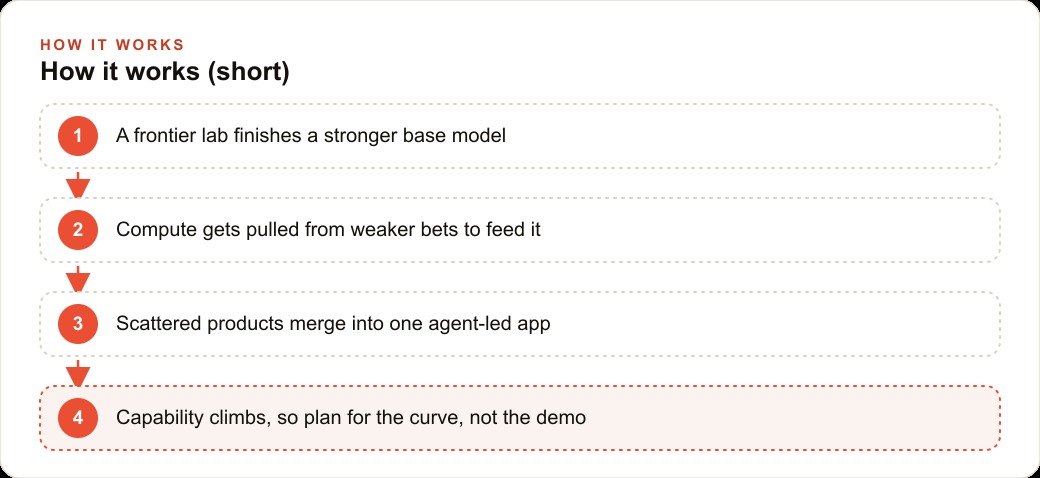
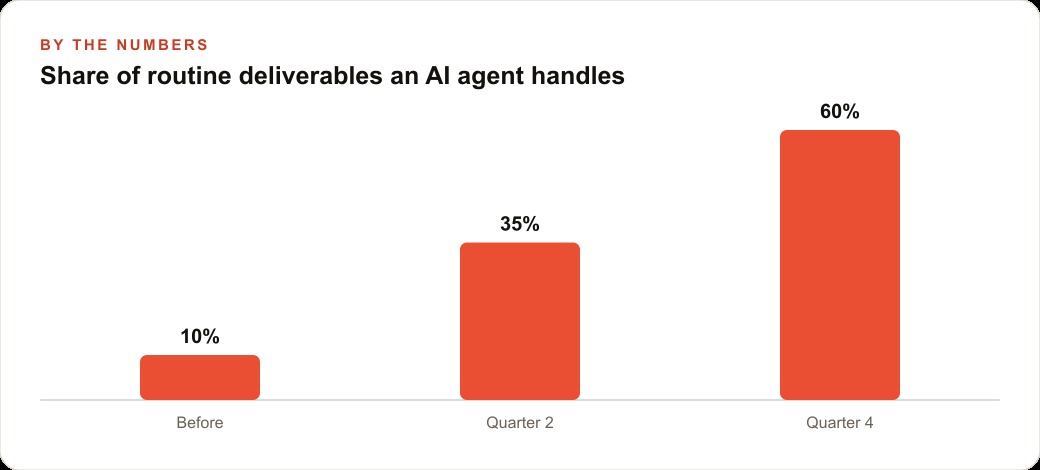
Step two, the standardization, means every strategist drafts, researches, and analyzes in the same environment, so quality stops depending on which freelancer used which app. Step three, selling outcomes, changes the client pitch from we use tool X to we deliver this many qualified leads at this cost, which also feeds cleaner reporting back through the CRM and website stack where every lead is tracked to a source. Step four, planning for the curve, means the agency quietly redesigns delivery so one senior strategist plus an agent handles the drafting and reporting that used to need a junior pod. Model the routine deliverables an agent absorbs and you might see it move from a small share today toward the majority over a year, with humans climbing to strategy and client trust.
Say the agency runs ten client accounts. If a single strategist plus an agent can now carry the drafting and reporting load that once took two juniors, the same headcount can hold more accounts without the quality dropping, or the same accounts can get deeper strategic work. Either way the economics improve, and the improvement compounds as the models get better underneath the same workflow. Those figures are illustrative, but the shape holds.
The three rules to keep
Strip the news down and three rules remain. Expect consolidation, so stop buying narrow tools on reflex and standardize on one strong model. Expect compute, not clever ideas, to decide which features survive, so bet on the core platforms and never build your business on a single disposable feature. Take capability timelines seriously, because betting against the curve has been the losing position. None of this requires you to chase every launch. It requires you to read the direction correctly and set your stack up to benefit from it.
What this changes for a small operator right now
It is easy to read a memo about billion-dollar deals and frontier models and conclude none of it touches a ten-person business. The opposite is true. The consolidation, the compute discipline, and the rising capability curve all land hardest on small operators, because they are the ones who cannot afford to waste money on overlapping tools, cannot afford to build a service on a feature that disappears, and cannot afford to be the last to adopt when a competitor down the street starts doing the same work with half the staff.
The small operator's advantage is speed of decision. A large company has committees and procurement cycles and sunk costs in old tools. You can run the tool audit this afternoon, cancel three subscriptions tomorrow, and standardize your team on one model by the end of the week. The news from a frontier lab is not a spectator sport for you. It is a set of signals about where the ground is moving, and the businesses that read those signals early and act on them are the ones that quietly pull ahead while everyone else waits for certainty that never comes.
So treat this memo the way a good operator treats any strong signal. Do not panic, do not chase every headline, but do adjust. Trim the overlap, stand on the platforms that own the biggest models, sell outcomes your clients actually care about, and design your delivery to get better as the models do. That is the entire playbook, and none of it requires you to touch the frontier model itself. It only requires you to read the direction correctly and move before your competitors do.
The bottom line
The Spud memo is not really about a potato-named model or a dead video product. It is a frontier lab publicly choosing focus over sprawl, hardware budgets over flashy demos, and one strong agent over ten narrow tools, while betting hard that capability keeps climbing. Every one of those choices maps onto a decision you can make in your own business this quarter, at your own scale, with your own tools. Read the news as a mirror, not a spectacle.
You can make these calls yourself, and I would push any owner to run the tool audit this week. If you would rather have someone map your stack, choose the models that fit your real work, and design a delivery system that gets stronger as the models improve instead of breaking when they change, that is the kind of planning I do for clients, and you can bring me in to handle it.
That is exactly what we do at AI DOERS. Book a private 30-minute call with Madhuranjan Kumar and we will map the fastest path to it for your specific business.
Book your call →
Madhuranjan Kumar
Madhuranjan Kumar brings 20 years of performance-marketing experience and has managed over $200 million in Facebook ad spend for brands across the United States and beyond. His expertise spans the full modern marketing stack: Meta, Google Ads, TikTok, email automation, CRM, and the websites that hold it together. At AI DOERS he turns that track record into lead-generation systems for businesses across every industry.