
What Is Inside an AI Data Center, and Why It Matters for Your Business
AI does not live in the cloud, it lives in enormous buildings full of chips, power, and cooling. Here is what that backbone is and what it means for how you use AI.

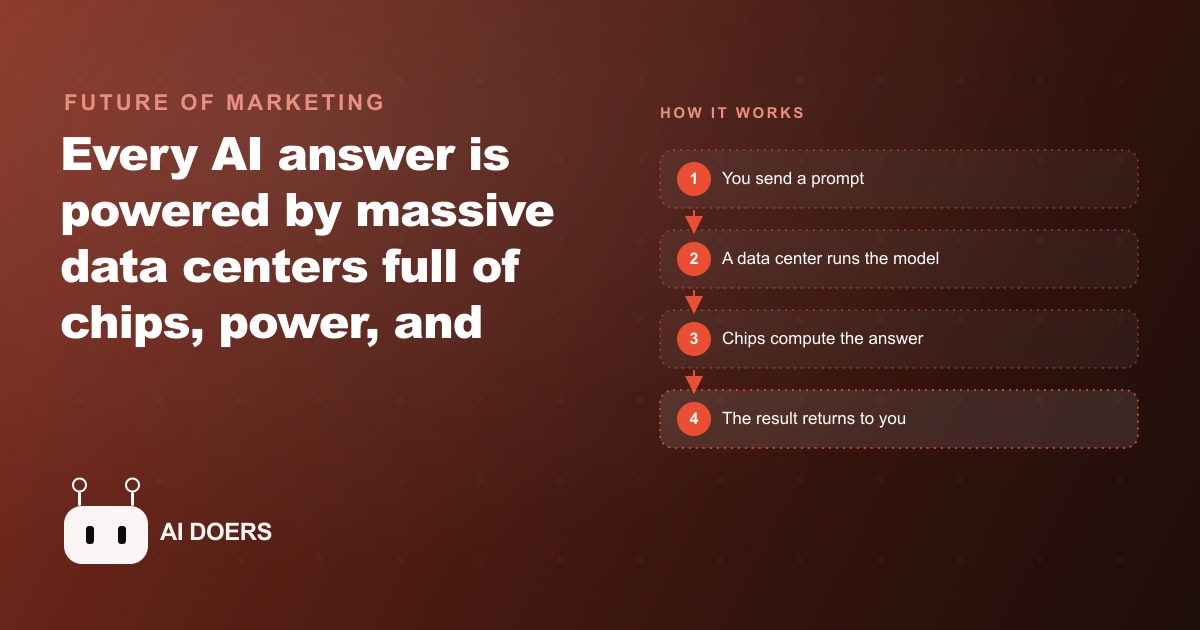
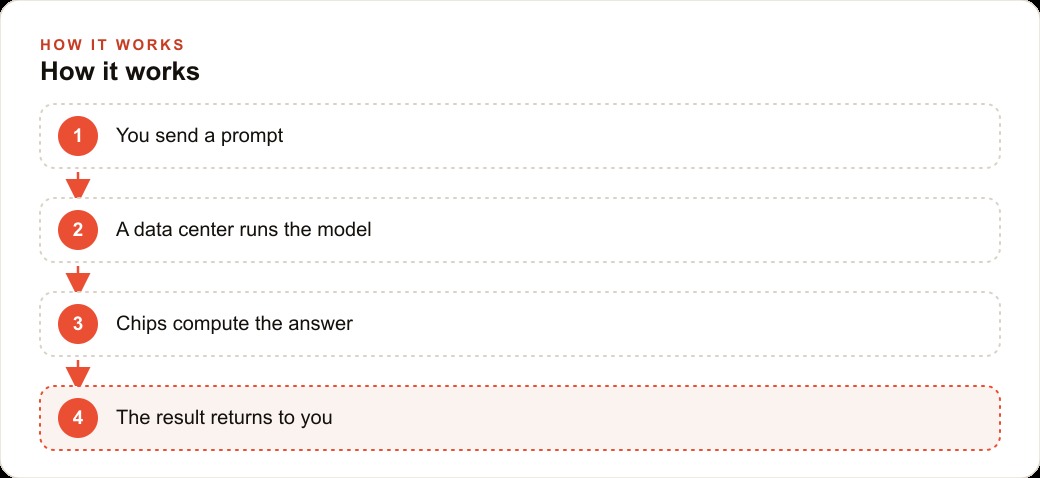
The AI capability that appears in your browser as a response to a prompt actually lives in an enormous building filled with custom chips, copper cable runs measured in hundreds of miles, and cooling infrastructure that can consume as much electricity as a small city. I am Madhuranjan Kumar, and the reason the physical infrastructure story matters to a business owner is not because you will ever see the inside of a hyperscale data center but because understanding what it takes to run frontier AI at scale tells you something important about the stability, cost trajectory, and concentration risk of the AI ecosystem your business is building on.
The Cloud Is Real Buildings, and What Is Inside Them Determines What AI Can Do
The metaphor of "the cloud" has been convenient for technology marketing for fifteen years, but it has also obscured a concrete physical reality that is relevant to understanding AI reliability and capacity constraints. When a business uses a cloud AI model to generate content, analyze data, or power an automated workflow, those computations happen on physical hardware in a physical building that requires physical power, physical cooling, and physical network infrastructure to reach the internet. That hardware can fail. Those buildings can experience power outages. Those networks can have congestion. Understanding that AI services run on physical infrastructure is the prerequisite to understanding why AI services have availability SLAs rather than guarantees, and why capacity constraints during peak demand produce slower responses or rate limiting rather than seamless infinite scale.
For a business whose operations depend on AI-assisted workflows, the physical infrastructure layer creates a category of reliability consideration that is similar to depending on any other utility. The risk is not that the physical infrastructure fails frequently, modern data centers are engineered with extensive redundancy, but that it is not infallible and that dependence on it should be accounted for in the same way you would account for dependence on any critical utility.
AI Compute Is Power Hungry, and That Constraint Is Shaping Which Companies Build AI Infrastructure
Training a large language model from scratch requires electricity in quantities that would be recognizable on a municipal utility scale. Running inference at the scale needed to serve hundreds of millions of users requires sustained power consumption that represents a significant operating cost and a sourcing challenge that cannot be solved by simply connecting to the local grid. The companies building new AI data center capacity are in active negotiations with power utilities, industrial power brokers, and in some cases are exploring co-location next to power generation facilities to reduce transmission losses and secure reliable capacity.
This power constraint is one of the primary factors determining where new AI data center capacity is built. Regions with abundant affordable power and room for large physical facilities are attracting data center investment at a rate that was previously associated with manufacturing facilities. For a business interested in understanding why AI service pricing has its current shape, power cost is a significant component of the operating cost that underlies it. And for a business interested in understanding why AI capabilities have expanded rapidly in the past three years, the build-out of dedicated AI compute infrastructure during that period is the physical foundation of that expansion.
Training Versus Inference Are Fundamentally Different Workloads That Use Different Infrastructure
The distinction between training and inference is not just a technical detail but a business operations distinction that is relevant to understanding AI service economics. Training is the process of building a model by iterating through enormous amounts of data and adjusting millions or billions of parameters to improve the model's performance on a defined task. It is compute-intensive, runs for weeks or months, and happens relatively infrequently. The major model providers train new frontier models on cycles measured in months.
Inference is the process of running a trained model to produce a response to a specific input. It runs billions of times per day across all users of AI services, every single response to every query is a separate inference run, and it is the workload that the businesses providing AI services must maintain capacity for at massive and variable scale. The economics of running a frontier AI service are dominated by inference costs, not training costs, because inference is the recurring operational workload while training is a periodic capital investment.
For a business evaluating which AI services to build critical workflows on, the inference capacity and reliability of the provider matters more than the training capability. A provider with strong training results but limited inference infrastructure produces models that are impressive in benchmark evaluations and inconsistent in production use. A provider with strong inference infrastructure maintains consistent response times and availability under high demand, which is what a business building operational workflows actually needs.
Cooling Is a Design Choice That Balances Cost, Environment, and Location Flexibility
Modern AI data centers generate heat in quantities that cannot be managed with traditional air conditioning at acceptable cost. The chip density in an AI compute cluster produces heat loads that require purpose-built cooling solutions, and the choice of cooling technology is one of the significant engineering decisions in data center design. Air cooling at scale requires enormous air handling infrastructure and is limited in how densely chips can be packed before the airflow requirements become impractical. Liquid cooling, which circulates fluid directly to the chip package or to a plate mounted on the chip, handles much higher heat densities and is increasingly the dominant approach in new AI compute facilities.
The cooling choice also affects where facilities can be located. Some approaches use water drawn from local sources, which is abundant in some regions and constrained in others. Others use closed-loop liquid systems that are locationally flexible but more capital-intensive to build. Understanding that cooling is a genuine infrastructure constraint, not just a footnote in a technical specification, helps explain why major AI compute facilities are clustered in specific geographies rather than distributed evenly across available real estate.
A Few Giants Dominate Frontier AI Infrastructure, and That Concentration Shapes Your Risk Profile
The current frontier AI compute infrastructure is concentrated among a small number of companies. The chip manufacturing capacity for AI accelerators at the performance level required for frontier model training is dominated by a single vendor. The data center capacity for running AI services at massive scale is primarily held by a handful of hyperscale cloud providers. The frontier model training runs that produce the most capable AI models are conducted by a small number of research organizations that have both the capital and the data access to operate at that scale.
For a business that builds operational workflows on AI services, this concentration represents a specific risk category: supplier concentration. If a business's AI-assisted workflows run primarily on services from a single provider, a pricing change, a service disruption, or a policy change by that provider affects the business's operations directly and immediately. Distributing workflows across multiple AI providers where practical, maintaining the ability to switch models for at least some workflows, and building in manual fallback procedures for critical workflows that would break if AI service became unavailable are all risk management practices that the concentration of frontier AI infrastructure makes relevant for businesses that have moved beyond AI experimentation into operational dependence.
Local Economies Feel It Because Data Centers Create Jobs and Tax Revenue That Follow the Infrastructure
The communities near major AI data center installations experience the construction phase as a boom in specialized construction, electrical, and civil engineering employment, followed by an operational period with a smaller but well-compensated permanent workforce managing the facility alongside significant local tax revenue from the assessed value of the real estate and equipment. The economic geography of AI is therefore not uniformly distributed, it follows the infrastructure, which follows the power and real estate, which tends to concentrate in specific regions with favorable conditions.
For a business owner, the local economy effect of AI infrastructure is relevant in two ways. First, the communities attracting AI infrastructure investment tend to be developing business ecosystems around AI-adjacent services, consulting, and application development that create professional opportunities. Second, the policy environment in communities hosting large data centers is increasingly attentive to the AI industry's needs and concerns, which shapes regulatory and support conditions for AI-adjacent businesses in those regions.
Reliability Is Built Into the Infrastructure Through Redundancy, but It Is Not Infinite
Modern data centers are engineered with extensive redundancy at every layer: multiple power feeds from the utility grid, on-site generator backup that can sustain the full facility load for hours or days, redundant cooling systems that can maintain temperature under partial failure, and network connectivity through multiple independent providers to prevent a single carrier outage from isolating the facility. This engineering redundancy is why AI services can maintain high availability targets despite the complexity and failure-proneness of the individual components in the infrastructure.
The redundancy is extensive but not infinite, and the failure modes that do occur in production data center environments are instructive for any business building operational dependence on AI services. Power events that exceed the capacity of generator backup, cooling failures that require emergency shutdown of portions of the facility, network events that cause latency spikes even without full outages, and capacity events where demand exceeds provisioned supply all create service degradation that passes through to business customers as slower responses, increased error rates, or temporary unavailability.
The practical implication for any business whose operations depend on AI-assisted workflows, whether that is customer intake through an AI-assisted form, content production through AI generation, or analysis through AI-powered tools, is to design those workflows with at least a basic graceful degradation path. Understanding what the fallback behavior is when the AI component is unavailable, even if it is simply a manual process for the duration of the outage, prevents a data center event from becoming a business operations crisis rather than a temporary inconvenience. The same principle applies to businesses running automated customer intake and CRM workflows on AI platforms: build the manual path before you need it, so that when you need it, it is already documented and practiced.
The Strategic Implication for Businesses Is Diversification, Not Dependence
The physical and organizational concentration of frontier AI infrastructure creates a strategic implication for businesses building operational dependence on AI services: diversification at the workflow level reduces concentration risk without requiring the business to maintain its own infrastructure. A business that builds five AI-assisted workflows, all running on the same provider's API, is more exposed to a single provider's pricing changes, policy changes, or service events than a business that distributes those five workflows across two or three providers based on which one performs best for each task.
The routing logic for diversification is the same as the task-based routing discussed in the context of model selection: identify which provider's model performs best for each task type, and route each task to its best provider. The diversification benefit is a byproduct of the performance routing rather than a separate overhead to manage. A business that routes document analysis to the provider that does it best, image generation to the provider that does it best, and voice transcription to the provider that does it best is also a business that is not entirely dependent on any single provider, which is a more resilient operational posture at no additional cost.
Understanding the physical infrastructure behind AI services, the buildings, the chips, the cooling, and the power, builds an accurate mental model of AI services as utilities with reliability properties similar to other physical utilities rather than as abstract cloud capabilities with infinite availability. That mental model produces better operational decisions about how much dependence to build, where to build in manual fallbacks, and how to design AI-assisted workflows that are resilient rather than fragile.
One More Layer: The Edge Between Convenience and Criticality
The distinction that matters most for a business deciding how much to rely on cloud AI services is the distinction between convenience workloads and critical workloads. A convenience workload is one that improves the quality or speed of a business process but whose failure does not prevent the business from operating. A content draft that uses AI assistance but can be written manually if the service is unavailable is a convenience workload. A critical workload is one whose failure stops a business process that must continue for the business to operate normally. An AI-powered intake system that is the only path for new client inquiries is a critical workload if no manual alternative exists.
Building critical business processes on single points of failure, whether those failures are a power event at a data center, a network event at a carrier, or a capacity event at an AI provider, is an operational risk that the physical infrastructure story makes tangible. The businesses that deploy AI most sustainably treat AI services as they would treat any other critical utility: they build with the assumption that the service is highly available but not infallible, and they design fallback procedures for the cases where the assumption is violated. That design discipline costs a small amount of time upfront and prevents a large amount of operational disruption when, not if, the service experiences an event.
That is exactly what we do at AI DOERS. Book a private 30-minute call with Madhuranjan Kumar and we will map the fastest path to it for your specific business.
Book your call →
Madhuranjan Kumar
Madhuranjan Kumar brings 20 years of performance-marketing experience and has managed over $200 million in Facebook ad spend for brands across the United States and beyond. His expertise spans the full modern marketing stack: Meta, Google Ads, TikTok, email automation, CRM, and the websites that hold it together. At AI DOERS he turns that track record into lead-generation systems for businesses across every industry.