
What Is an AI Operating System, and Why Every Business Will Need One
An AI operating system is not something you sell, it is a way of running what you already sell. Here is how I build that wrapper in layers, so the system knows your business and quietly takes work off your plate.

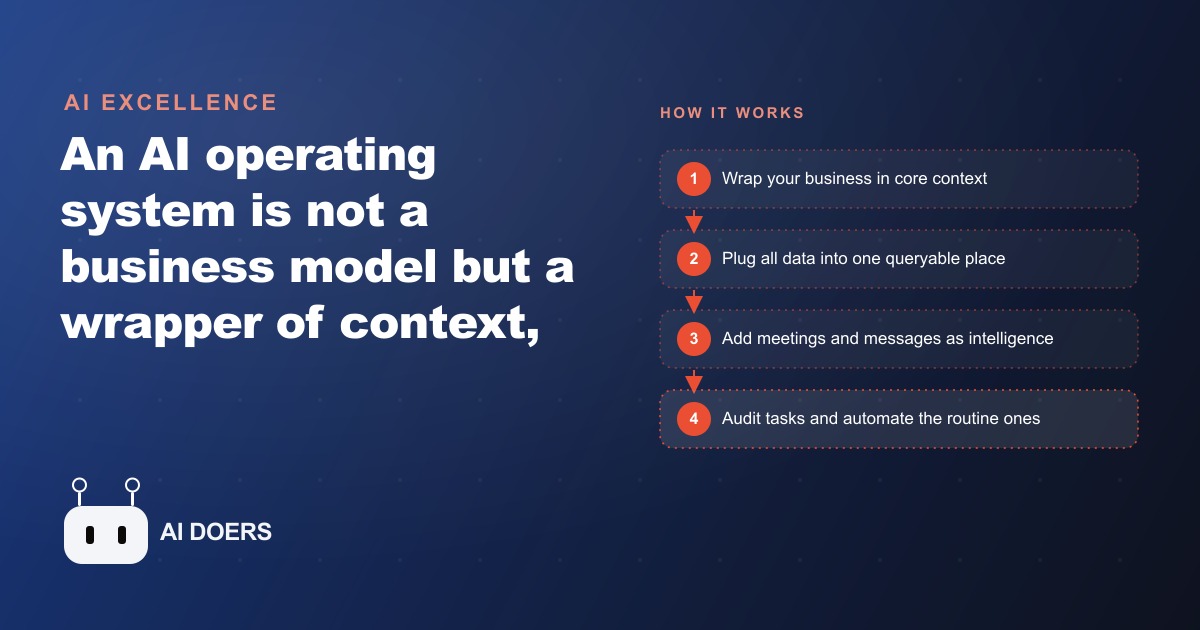
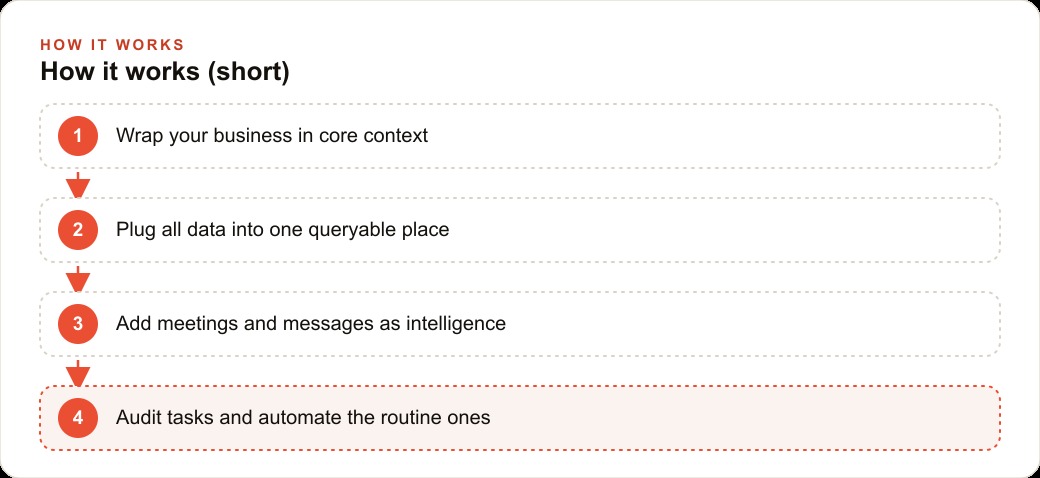
An AI operating system is not a product you can buy and install. It is a way of organizing how your business runs, built in four layers, where each layer enables the one above it in a specific dependency structure. I am Madhuranjan Kumar, and the reason most businesses that try to build one fail partway through is not that the tools are hard to use. It is that they build the layers in the wrong order. They automate before their context is solid. They add data connections before their intelligence layer makes data meaningful. They skip the daily brief and then have no visibility into what the automations are doing. The layer order dependency is the most important thing to understand before you start, and it is the thing almost no framework makes explicit.
Why Automation Without a Context Layer Is Fragile
The context layer is where you store everything the AI needs to know to act on behalf of the business without producing generic output. This includes who you are, what you sell, your pricing, your team structure, how you communicate with clients, how you handle exceptions, what your values are, and what your strategy is right now rather than what it was two years ago. It is not a paragraph in a system prompt. It is a workspace with files and folders, organized so the AI always knows the relevant business context for any task it is handling.
When businesses skip this layer and go straight to automation, the automations produce output that is accurate in a generic sense and wrong for the specific business. A follow-up email sequence written without knowing the business's communication style sounds like it was written by someone who has never met the owner. A client proposal drafted without knowing the pricing structure contains placeholders where numbers should be. An invoice reminder sent without knowing whether this particular client has a payment terms arrangement creates friction that damages the relationship. None of these failures are failures of the AI model. They are failures of context. The model produced what it could from what it was given, and what it was given was not enough to produce the right output.
Building the context layer first feels slow because it does not produce any automation. You are writing documents, organizing files, and making decisions about how to describe your business in a way that a non-human system can apply correctly. The payoff comes when every subsequent automation draws on that context rather than requiring you to re-specify the same information in every individual prompt. A well-built context layer is the difference between automation that sounds like the business and automation that sounds like AI.
The Data Layer's Only Job Is to Close the Gap Between Strategy and Reality
The data layer connects the business's operational tools into one queryable place. This means the scheduling system, the payment processor, the sales pipeline, the client relationship records, the task management tool, and any other system that tracks what is actually happening in the business numerically. The goal is not to have a dashboard. The goal is for the AI to be able to answer "where do things stand right now" with accurate current numbers rather than with whatever the owner remembers from the last time they manually checked.
The reason the data layer comes second, after context but before intelligence, is that data without context produces numbers with no interpretation. A query that returns "17 open invoices, average age 23 days" is useful only if the system also knows that your payment terms are net 30, that two of those clients have a history of paying late, and that one of them contacted you last week about a dispute. That interpretive knowledge lives in the context layer. The data layer supplies the current state. The context layer supplies the framework for understanding what that state means. Together they give the AI what it needs to surface the right issues rather than producing a report the owner has to interpret manually.
The mistake of building the data layer before the context layer is that the AI can report numbers but cannot act on them intelligently. The owner still has to look at the report and decide what it means and what to do. That is not automation. That is a more expensive version of checking the spreadsheet.
Intelligence Layer: What the Meeting Transcript Actually Does That Your Memory Cannot
The intelligence layer turns unstructured information into queryable knowledge. This means connecting a transcription tool to your meeting recordings so that every conversation with a client, every team discussion, and every planning session is captured in text that can be searched. It means indexing your communications, including messages with clients and internal team exchanges, so that the AI can answer "what happened across the business yesterday" by reading the actual record rather than relying on what anyone remembers to report.
The memory limitation that the intelligence layer addresses is not about forgetting. It is about scale and accuracy. A business owner with 12 technicians, 800 accounts, and an office manager handling 60 to 80 daily client interactions cannot hold the current state of every relationship in active memory. The critical conversations slip. The follow-up that was promised and not logged gets missed. The pattern across 15 client complaints that individually seem minor does not get recognized because no one is reading all 15 in the same frame of attention. The transcription and indexing system gives the AI access to the actual record of what was said and promised and discussed, across the whole business, every day.
The intelligence layer comes third because it requires the context layer to interpret what it finds, and it requires the data layer to connect what was said in a meeting to what actually happened numerically. When a client says in a meeting "we need a faster response time," the intelligence layer records that. The data layer shows what the current response times actually are. The context layer supplies the business's service commitment and who this client is. Together those three layers allow the AI to surface in the daily brief: "client X mentioned response time in the Monday call; current average response time for their account is 4.2 hours against a committed 2-hour window." That synthesis is not possible from any single layer alone.
What the Daily Brief Actually Does That Dashboards Don't
The daily brief is a Telegram message or a five-to-ten page PDF delivered every morning before the owner starts their day. It covers what happened yesterday, what is due or at risk today, what the numbers look like against targets, and what decisions need to be made. It is compiled automatically from the context, data, and intelligence layers and delivered without anyone having to request it.
The distinction between the daily brief and a dashboard is not about format. It is about what requires human judgment and what does not. A dashboard requires the owner to look at numbers, notice the ones that are off, recall the context that explains whether they are actually a problem, and decide what to do. The daily brief completes those steps and presents conclusions. The owner's attention goes only to the decisions that require their judgment, not to the reading and interpretation of information that the AI can read and interpret on their behalf.
This is the layer that makes the automations trustworthy rather than scary. Without the daily brief, the owner does not know what the automations are doing unless something goes wrong. With the daily brief, the owner sees every significant action, every output that went out, and every exception that was flagged, every morning, in under fifteen minutes. Oversight without the daily brief is reactive. With it, oversight is built into the system. The automation does not run without the owner being informed. The combination of automation and oversight is what allows the owner to be away from the operational detail without being unaware of it.
The Task Audit Tells You What to Automate and What to Leave Alone
Before adding any automation, the task audit maps every task that happens in the business in a typical week, estimates the time it takes, and evaluates whether AI can handle it reliably. The target is 60 to 70 percent of routine tasks. The remaining 30 to 40 percent stay with humans because they require judgment, relationship sensitivity, or creative decision-making that the AI system cannot produce reliably at the level the business needs.
The audit matters because automation applied to the wrong task produces unreliable output that has to be reviewed and corrected, which takes more time than doing the task manually. The criterion for automation candidacy is not "can AI produce something in this category" but "can AI produce something in this category reliably enough that I do not have to review every instance." That reliability threshold is different for every task. Scheduling reminders: high reliability, automate. First draft of a complex client proposal: lower reliability, use AI as a starting point with human review before it goes out. Client dispute response: do not automate the response, automate the flagging and the summary of the account history so the human who writes the response has the context they need.
Automating one task at a time, rather than all candidate tasks simultaneously, allows you to observe each automation's reliability in production before adding the next. The failure mode of automating too many tasks at once is that multiple things go wrong in the same week and you cannot diagnose which automation caused which problem. One at a time is slower. It produces a system you understand and can fix.
The Pest Control Example: All Four Layers Running in a 12-Technician Business
A pest control company with 12 technicians and 800 active accounts builds all four layers over a period of about three months. The context layer takes three weeks: the owner documents the service types, pricing by account size and service frequency, communication tone, escalation procedure for customer complaints, and the technician assignment logic by territory. The data layer takes two weeks: the scheduling tool, the invoice system, and the account management records are connected to a central query interface. The intelligence layer takes two weeks: meeting recordings are transcribed and indexed, and the office manager's daily log is added to the searchable record. The daily brief takes one week to configure.
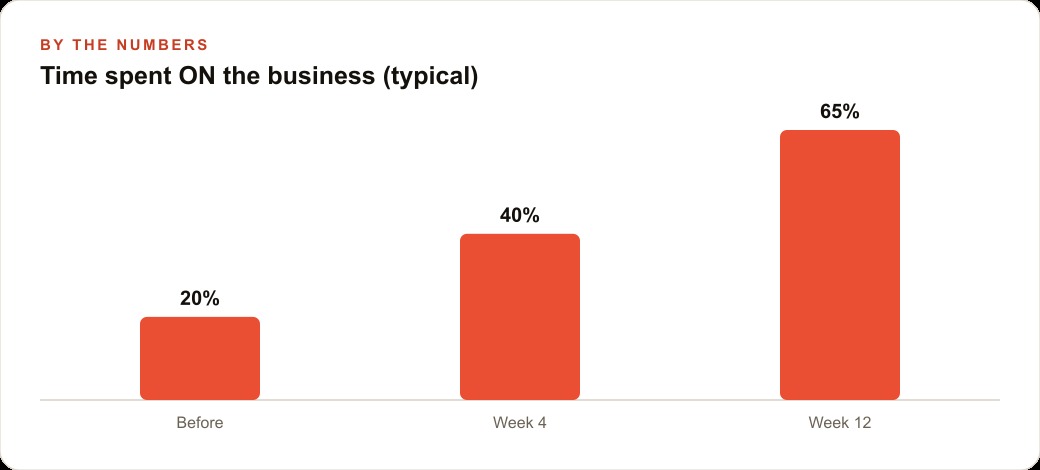
The result, after three months, is that the office manager's time spent on routine coordination tasks falls by 18 hours per week. These are the tasks that were previously manual: appointment confirmations, service reminders, follow-up calls after treatment visits, routing technician questions about account history to the right record. At a fully loaded cost of $25 per hour, 18 hours per week is $450 per week, or $23,400 per year in reclaimed labor cost. That is not reduction in headcount. The office manager is still employed and handles the 30 to 40 percent of interactions that require judgment. The 18 hours is time that now goes to relationship-building, handling escalations, and supporting the commercial account development that was previously impossible to pursue.
The commercial account development is the larger business impact. The owner had identified two commercial pest control contracts per month as a realistic target for growth, at an average contract value of $4,800 per year. Before building the AI operating system, the owner did not have time to pursue them. The operational load required constant attention. After the build, with 18 hours of coordination time freed and the daily brief handling the oversight function, the owner pursues and closes the target commercial accounts. That is $9,600 per month in additional revenue against a $23,400 per year cost recapture. Together the two effects are $138,600 in annual economic impact from a build that required three months and no additional headcount.
The layer order is why this worked. The automations are reliable because they run on solid context. The context is useful because the data layer keeps it current. The data is interpretable because the intelligence layer connects it to what was actually said and decided. The owner trusts the system because the daily brief shows what is happening. Remove any layer and the system above it degrades. Build them out of order and each layer has to compensate for what the one below it does not supply. The discipline of the sequence is not administrative. It is structural.
That is exactly what we do at AI DOERS. Book a private 30-minute call with Madhuranjan Kumar and we will map the fastest path to it for your specific business.
Book your call →
Madhuranjan Kumar
Madhuranjan Kumar brings 20 years of performance-marketing experience and has managed over $200 million in Facebook ad spend for brands across the United States and beyond. His expertise spans the full modern marketing stack: Meta, Google Ads, TikTok, email automation, CRM, and the websites that hold it together. At AI DOERS he turns that track record into lead-generation systems for businesses across every industry.