
What a Live Codex Build Teaches About Agentic Engineering
OpenAI's new Codex app turns GPT-5.3 Codex into a desktop workspace where you orchestrate multiple agents in parallel and ship in plain English. Here is the practical workflow for building real software without writing code by hand.

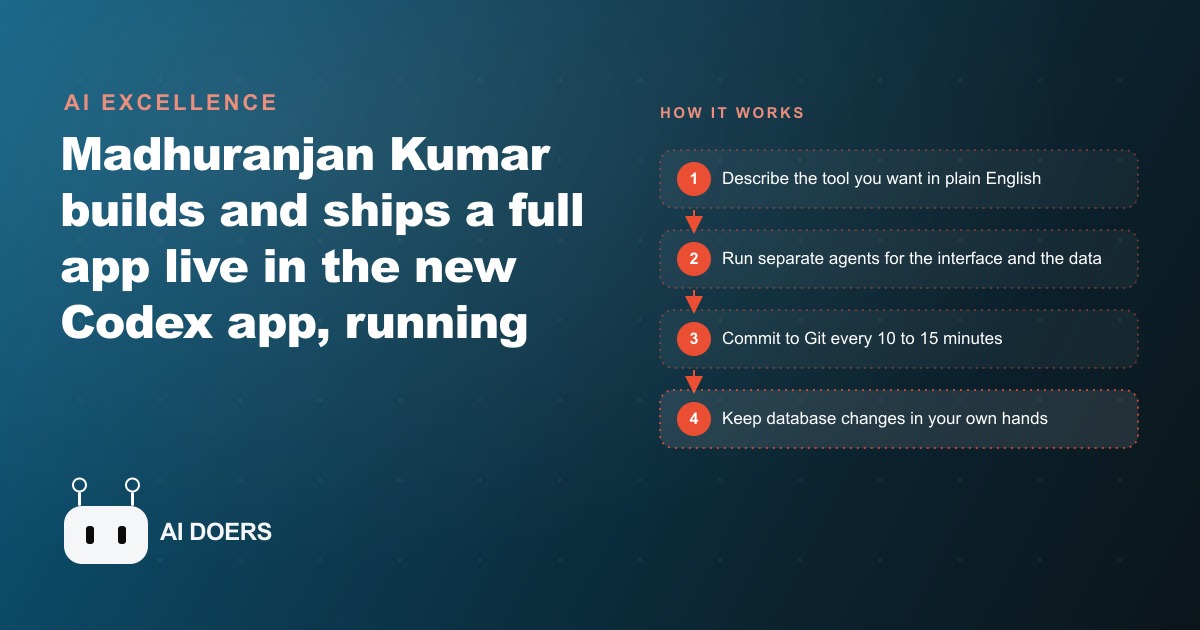
OpenAI just turned GPT-5.3 Codex into a desktop app, and the interesting part is not the app. It is what a live, start-to-finish build inside it revealed about how software actually gets made now: not by one person typing code, but by one person orchestrating several AI agents at once, in plain English. I am Madhuranjan Kumar, and I studied one of those live builds closely, because the workflow it exposed matters far more than the product wrapped around it.
What actually shipped, and why the app matters less than the workflow
The release is the Codex app, a desktop workspace that wraps GPT-5.3 Codex in a simple interface with a chat panel, a terminal, and a file view. It is not a full IDE, and that is fine, because its job is not to be one. Its job is to make agentic coding approachable to people who would never open a raw command line. On that measure it succeeds, and that accessibility is the actual news, because the previous generation of these tools lived in a terminal that quietly excluded almost everyone who was not already a developer.
But the app is the container, not the story. The story is the claim that a live build made real: you no longer need to be a programmer. If you can describe what you want clearly in English, the agents are now powerful enough to build almost anything for you. In the build I studied, a working open-source app was created and shipped from start to finish, and the person driving it spent their time describing outcomes and reviewing work, not writing functions. That is the shift worth understanding, and the app is simply where it became easy to see. The interface is not the breakthrough. The breakthrough is that clear description has replaced typing code as the core skill.
Orchestration is the real capability, not the chat box
The feature that changes how this feels is parallelism. The app's genuine appeal is that you run many agents at once instead of leaning on a single giant one. In the live build, separate threads were spun up, one assigned to the front end, another to the back end, with the important ones pinned so they kept working while the rest was reviewed. That orchestration is the superpower, and it is what makes the app worth using over a plain chat window.
Think about what that means for how you work. You stop being a person waiting on one assistant to finish a task and become a person coordinating a small team, each member holding its own context, each making progress in parallel. The interface exists to make that coordination manageable, which is exactly why it beats a single thread. The mental model is closer to running a project than to prompting a chatbot, and once that click happens, you stop asking one agent to do everything and start assigning work the way a manager would.
Reasoning effort is a smaller but real part of the release. Codex offers low, medium, high, and extra high, and the practical read from the build is that medium handles most work, because the new model is adaptive. High no longer means a long grind on an easy task, it finishes fast when the task is simple. There is even a Spark version running on the Cerebras chip at roughly 1,000 tokens per second, fast enough that code appears almost instantly, though it is less capable than the main model. The takeaway is not to always reach for the most powerful setting. It is to match the effort to the task and let the adaptive model handle the rest, spending the heavy reasoning only where it earns its keep.
The disciplines that keep parallel building from turning into chaos
Running several agents at once sounds like a recipe for confusion, and it would be, without a few habits that the live build made non-negotiable. These are the part to actually copy, because they are what separate a fast build from a fast mess.
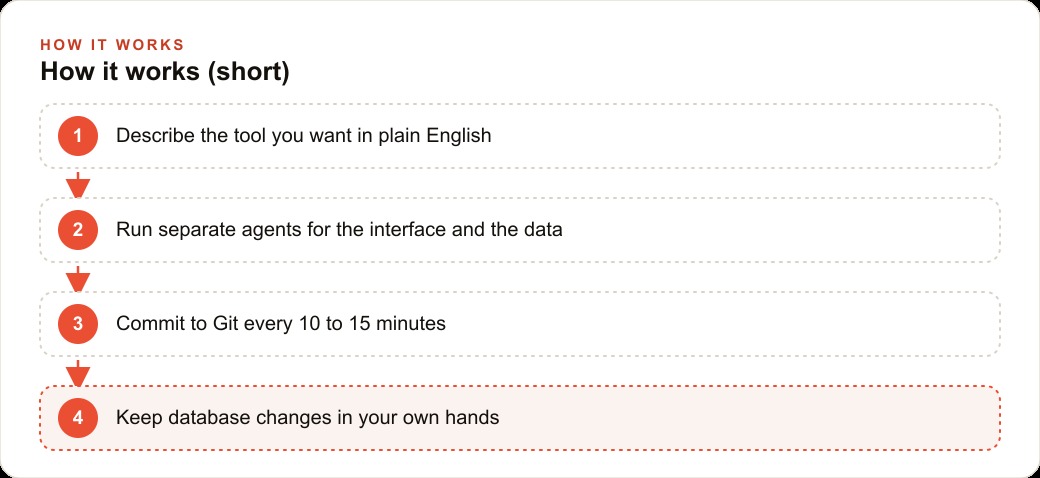
Commit to Git every 10 to 15 minutes. Let Codex create the repo and push in one click, and treat Git as a safety net so any bad change rolls back cleanly. When multiple agents are editing at once, frequent commits are the difference between a five-minute rollback and a lost afternoon. Paste screenshots of the interface and the database dashboard as context, because visual context helps the agent fix the right thing instead of guessing where you are. Wrap key instructions in XML tags, because the clear start and end markers help the agent focus on that exact request rather than diffusing its attention across a long message. None of these habits are complicated, and each one prevents a specific, predictable way that fast agentic work goes wrong.
The most useful finding from the build was a head-to-head. GPT-5.3 Codex is excellent at rapid building and fixing bugs, while Opus 4.6 in Claude Code is better at explaining the project, clarifying architecture, and handling long-running tasks. The honest verdict is to use both and know each one's strengths. In fact, building too fast created confusion about the real goal, and Opus was the tool that stepped back, clarified the stack, and cut technical debt before Codex sprinted again. Speed without understanding is not progress, it is debt, and pairing a fast builder with a careful thinker is how you keep both. The lesson is not that one model is better. It is that different models are good at different jobs, and the person who knows which to reach for gets a result neither would produce alone.
One discipline never broke, and it is the most important one for any real business: SQL migrations were copy-pasted into the database by hand rather than handing an agent direct database access. The database is the one thing you cannot afford to corrupt, so you keep it out of the agent's reach and apply changes yourself. Everything else can be rebuilt. The data cannot, and a fast agent that makes a bad change to a live database can do damage in seconds that takes weeks to undo.
What this changes for a business, not just a developer
It is tempting to read a release like this as news for developers only. It is not. The thing that just changed is who gets to build a small internal tool, and that is a business question, not an engineering one.
For years, the barrier that kept owners from building their own dashboards, calculators, and workflow apps was code. That barrier is mostly gone. If you can describe the outcome clearly, you can orchestrate agents to build it, and the same disciplines that worked in the live build, commit often, give visual context, pair a fast builder with a careful thinker, apply whether you are shipping a real product or a simple internal tool. The point is not to turn every owner into an engineer. It is that the person who understands the business problem can now build the solution directly, with the agent supplying the technical skill. That is a genuine shift in who holds the power to build, and it moves that power toward the people who actually feel the problem.
An accounting firm turns a wish-list into a weekend
Let me make this concrete with a business where the stakes are real and the data is sensitive: an accounting firm. Most firms run on spreadsheets and a patchwork of software, and there is always an internal tool nobody has time to build, a client onboarding portal, a deadline tracker for filing dates, a dashboard that pulls every client's status into one view. Historically each of those meant a five-figure quote and a three-month wait, so they never got built, and the firm kept limping along on manual workarounds.
Here is how I would approach it with the Codex app. You describe the tool in plain English and orchestrate agents to build it, one on the interface, one on the data layer, while you review. The disciplines from the live build matter even more here because accounting data is sensitive. You commit every 10 to 15 minutes so a bad change is a quick rollback during busy season. You paste screenshots of the current process so the agent builds around how the firm actually works, not around a generic template. And above all, you never give an agent direct access to the client database. You apply changes by hand the way the build did with its migrations, because client financial records are the one thing you cannot risk.
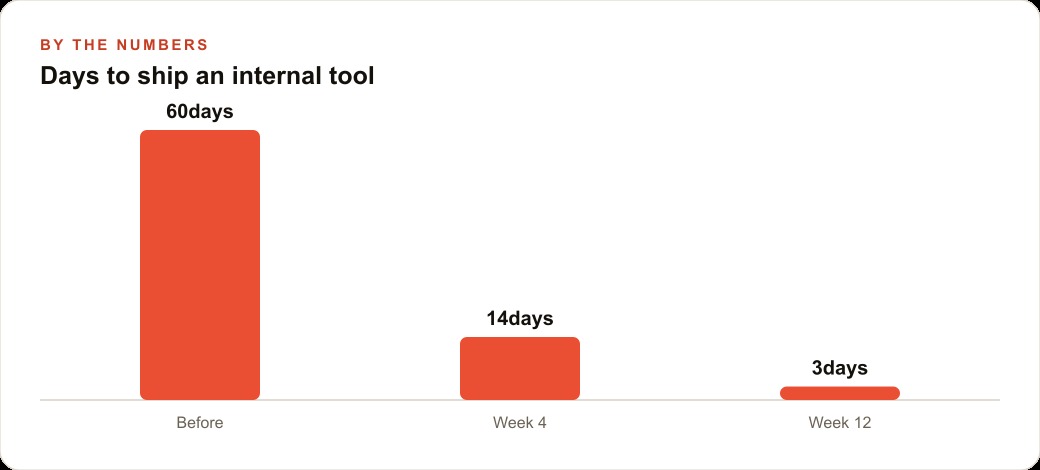
Pair the fast builder for assembling the tool with the careful model for thinking through the structure, and a firm can stand up a custom internal app in a weekend that used to mean a five-figure quote and a three-month wait. From there, the same capability reaches past internal tools into how the firm grows. A simple lead-intake dashboard the firm builds this way plugs straight into the CRM and website stack so no prospect slips through during tax season, the client-facing pages it generates support SEO and organic search so the firm gets found by local businesses, and clean tracking on those pages makes any Google Ads the firm runs measurable instead of a guess. The owner who understood the problem all along finally gets to build the fix, without waiting on a developer or a budget cycle.
The habit that separates a tool from a toy
There is one more habit worth naming, because it is what keeps these builds from becoming abandoned experiments. Treat the first version as a draft you will live with, not a demo you will forget. The temptation with agentic building is to spin something up, admire that it works, and never actually adopt it, because adopting a tool means changing how you work, and changing how you work is harder than generating code. The builds that pay off are the ones that get used the next day, and then tuned because you used them and noticed what was missing. That feedback loop, build, use, notice, refine, is the whole difference between a firm that has a genuinely useful custom tool and a firm that has a folder of half-finished agent experiments. The agents made the building trivial. Making the result part of your actual operation is still on you, and it is the part that turns a weekend project into something the business quietly depends on a year later.
The move to make with this release
If this release lands for you, the worst response is to admire the demo and do nothing. The whole point is that the doing is now within reach. So start by writing your idea in plain English before you touch any agent. Describe the tool or app you want, the outcome, and the constraints. Then open the app and spin up one agent for the interface and one for the data.
Let Codex create the Git repo, and commit every 10 to 15 minutes so nothing is ever lost. Feed it screenshots for context, keep sensitive database changes in your own hands, and use a careful model like Opus to clarify the plan whenever the build starts drifting. Keep the scope small on your first tool so you learn the rhythm before you trust it with anything that matters. The first small tool is a training run for your judgment as much as a deliverable, and the rhythm you learn on it is what makes the second and third builds fast.
You can absolutely build this yourself, and I would encourage anyone to start with one small tool, because the first time you watch two agents build in parallel while you review, the shift stops being theoretical. If you would rather have someone scope the build, orchestrate the agents, and keep your data safe while the tool comes together, that is the kind of work I do for clients, and you can bring me in to handle it.
That is exactly what we do at AI DOERS. Book a private 30-minute call with Madhuranjan Kumar and we will map the fastest path to it for your specific business.
Book your call →
Madhuranjan Kumar
Madhuranjan Kumar brings 20 years of performance-marketing experience and has managed over $200 million in Facebook ad spend for brands across the United States and beyond. His expertise spans the full modern marketing stack: Meta, Google Ads, TikTok, email automation, CRM, and the websites that hold it together. At AI DOERS he turns that track record into lead-generation systems for businesses across every industry.