
What Claudbot Is And Three Ways People Are Making Money With It
Claudbot frees Claude Code from the terminal into a proactive assistant you message anywhere, and three business models are opening up. Here is the rundown with an electrician example.

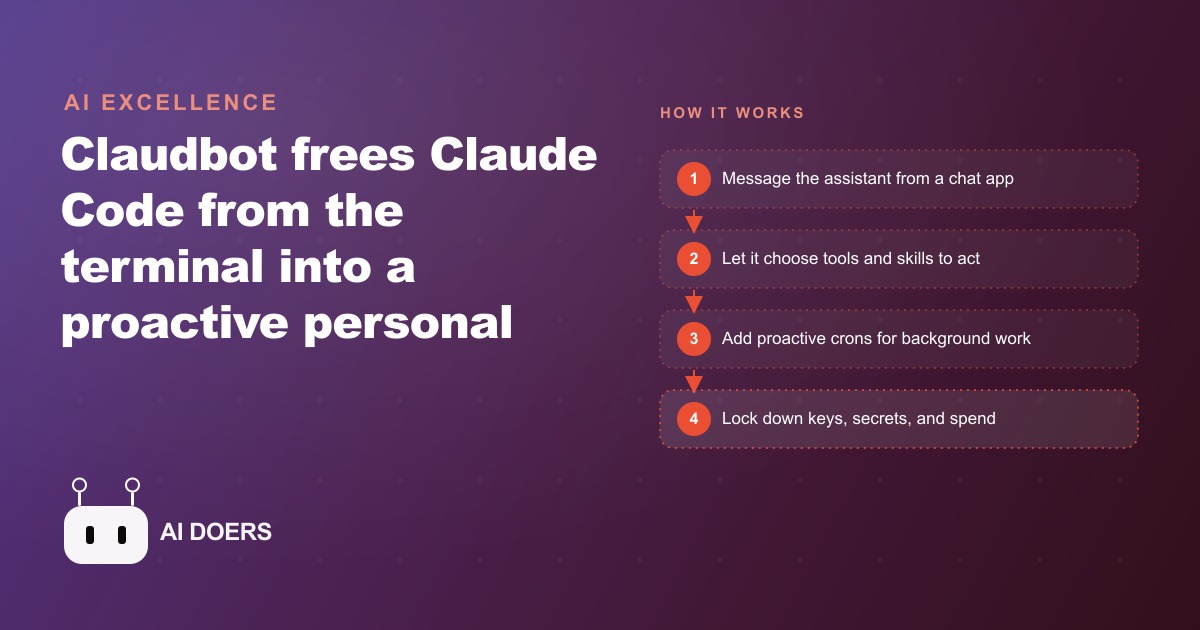
Claude Code is one of the most capable AI coding agents available today, and until recently the only people using it well were comfortable in a terminal. I am Madhuranjan Kumar, and the development that changes this is Claudbot: an open-source layer that moves Claude Code off the command line and into WhatsApp, Telegram, Slack, or Discord, putting full AI agent capability on the interface that most business owners already check dozens of times a day.
Move Claude Code off the terminal and into the chat app your clients already live in
The terminal barrier is larger than it looks. Most business owners will never open a command line, and that single fact has kept the most capable AI agents from reaching the people who would benefit most from them. The knowledge workers who are already skilled in terminals have been the primary users of tools like Claude Code not because of capability mismatch but because of interface mismatch.
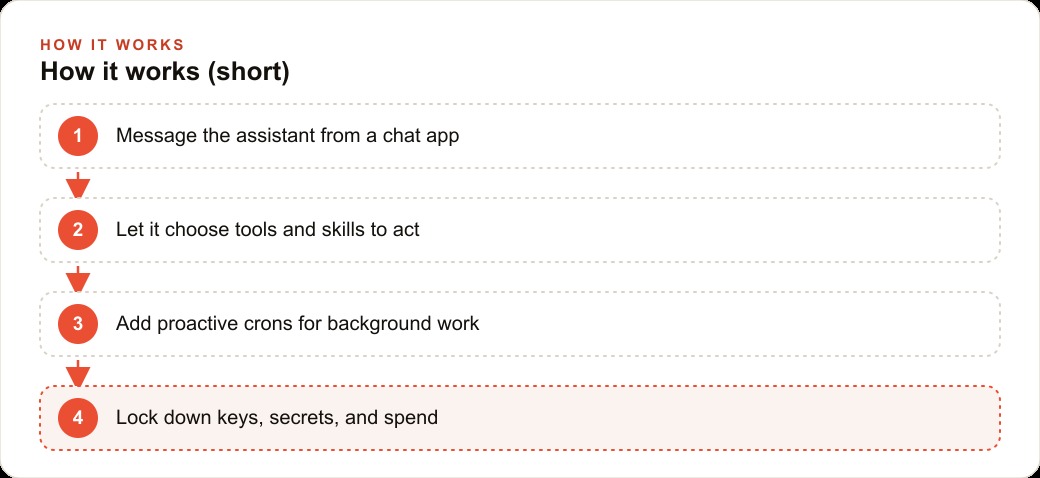
Claudbot solves this by acting as a translation layer. It connects to Claude Code's underlying capabilities and exposes them through a chat interface. You message it the same way you would message a colleague. It decides which tools and skills to use, executes them, and returns results to the chat. The model powering it is configurable, so you can plug in Claude, a cheaper alternative, or a local model depending on your cost tolerance and privacy requirements.
The framing that helps most is air traffic control. Claudbot receives the message and routes it to the right capability. If the task needs file reading, it reads the file. If it needs web search, it searches. If it needs a specialized skill like voice cloning or a screenshot, it calls that skill. You describe what you need. Claudbot figures out how to produce it.
For a business owner who checks WhatsApp between appointments and would never open a terminal window, this architecture puts a capable AI agent into the tool they already live in. The barrier shifts from technical skill to clear communication, and that is a barrier almost every business owner can clear.
Give it a personality and a set of initial skills in one fifteen-minute interview session
The onboarding process is deliberately human. Claudbot interviews you about how it should behave: your preferred tone, your common tasks, your communication style, the topics it should know about your business. The answers go into a personality file that persists across every future session. The assistant does not start from a blank slate in each conversation. It starts from the description of you and your business that the onboarding captured.
This is a meaningful operational difference from a generic chatbot. A generic chatbot treats every session as independent. Claudbot accumulates the context that makes it useful over time, storing preferences and recurring task patterns in a file that loads automatically. The assistant that answered your Monday question already knows what it learned during Monday's session when you return on Thursday.
Skills are the unit of capability extension, and the distinction from always-on integrations matters. An always-on integration loads all its tool descriptions into the model's context window at the start of every session, consuming context budget even when the capability is not needed. A skill is loaded just in time, only when the task requires it. The result is a leaner context window, faster responses, and a lower failure rate on complex tasks that need the full context budget for reasoning rather than for describing tools you are not currently using.
Claudbot ships with open-source skills for common tasks. Writing notes to Apple Notes. Taking screenshots. Calling voice APIs. Each skill is a plain-English specification of when and how to use a service, readable by both the AI and the human who might want to edit it. Adding a new skill is writing a specification document, not writing code.
Set up one proactive schedule before you show it to anyone
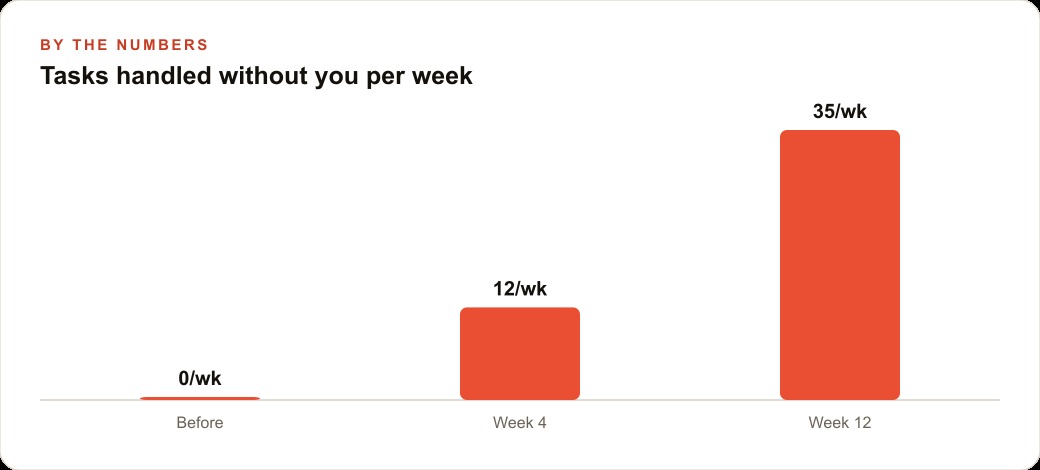
Most AI assistants are reactive. You ask, they answer. Claudbot can be set to proactive mode, where it does things on its own schedule and reports back to you. This is the feature that moves it from a capable answering tool to a genuine operational assistant.
A proactive schedule is a cron job that fires at a set interval and runs a specified task without you initiating it. You set it up once and it runs indefinitely. An electrician sets a proactive job to check the inquiry inbox every two hours and send a WhatsApp summary of any new messages that arrived since the last check. A marketing consultant sets it to monitor a competitor's social channels daily and send a brief summary of any new content. A service business sets it to pull a list of customers who have not been contacted in thirty days and send a follow-up reminder.
The habit to establish from the start is to prove one proactive job completely before setting up a second. Run it manually, review the output, verify it produces the right information in the right format, and only then let it run on its own schedule. A proactive job that fires every two hours with wrong information is worse than no job at all. Take thirty minutes to verify the first one before trusting it to the schedule.
For an electrician, the first proactive job worth proving is the inquiry summary, because response time to new inquiries is directly tied to win rate on jobs. A customer who submits an inquiry at noon and receives a response within an hour converts at a measurably higher rate than one who receives the same response the next morning. The proactive job closes that gap without the owner having to monitor the inbox manually between jobs.
Lock down the security with four controls before the first background job runs
The capabilities that make Claudbot valuable, access to files, proactive action, access to messaging accounts, also create a blast radius if something goes wrong. The security setup is not optional and it is not complicated. Four controls cover the material risk before any background job runs.
First, run in sandbox mode. This limits what the agent can access to a defined environment rather than giving it full access to the machine and all accounts connected to it. The sandbox is a deliberate constraint that prevents a misunderstood instruction from touching files or accounts outside the task scope.
Second, scope every API key to the minimum permissions needed for the task. A key that allows reading emails should not also allow sending them. A key that allows reading a calendar should not also allow deleting events. The principle is least privilege: every key grants only what the current task requires, nothing more.
Third, store secrets in a dedicated secrets manager rather than in the project files the agent can read. An agent with access to a file containing all your API keys has access to everything those keys unlock. Storing secrets separately means the agent has the credentials it needs for each task without having access to the master key list.
Fourth, set a hard spending cap on the API account. A proactive job that fires every hour and makes unexpected API calls can accumulate significant charges before anyone notices. A spending cap limits the financial exposure from any runaway job to a predictable maximum.
These four controls together reduce the blast radius of any failure to a manageable scope. They take about an hour to implement properly on the initial setup and apply to every job that runs afterward.
From here: three revenue paths opening up around this stack
For anyone who has set up Claudbot for their own operation and found it genuinely useful, the natural next question is how to turn that experience into revenue. Three models are opening up.
The first is setup as a service. Most business owners who would benefit from this kind of AI agent will never set it up themselves. They do not have the time, the patience for the initial configuration, or the interest in learning the infrastructure. They want the result: an assistant that handles their inquiry follow-ups, monitors their competitors, and sends their review requests without staff time. You have built and proven that result for yourself. Selling the same setup to other business owners is a straightforward extension of what you already know how to do.
The second is an AI assistant in a box. Bundle the setup with a dedicated piece of hardware, typically a small always-on machine, so the client receives a complete, self-contained system. The hardware runs the assistant continuously without requiring the client's main computer to be on. The pricing structure is a one-time setup fee plus a monthly operational cost, which mirrors what a human virtual assistant would charge but at a fraction of the rate. The value proposition is clear and the comparison is easy to make.
The third is building and selling skills. Each skill is a capability extension that solves one specific problem: a competitor monitoring skill, a review request skill, an inquiry routing skill, a social listening skill. Built once and listed on a marketplace or sold directly to business owners in a specific vertical, a skill generates recurring subscription revenue without ongoing client work after the initial build. The economics resemble a small software product: fixed cost to build, near-zero cost to distribute, recurring revenue per user.
For any of these to work, the starting point is a personal deployment that you have run long enough to know what works, what the common failure modes are, and how to set up the security correctly. The businesses that will be willing to pay for this kind of setup are the ones in verticals where admin overhead is high and tech adoption is low: trades, healthcare support roles, professional services, retail operations. All of them have the same underlying problem, which is that repetitive digital tasks consume time that would be better spent on the actual work the business does.
For businesses in those verticals also running Facebook and Instagram ad campaigns, a Claudbot deployment that monitors inbound leads from those campaigns and triggers follow-up sequences automatically closes the gap between ad spend and conversion that most small businesses leave open due to slow manual response. That specific use case, paid lead follow-up automation, is one of the highest-return applications of the proactive scheduling feature and one of the easiest to demonstrate to a prospective client. The CRM and website stack benefits similarly when Claudbot handles the data entry and follow-up sequencing that normally requires staff attention between initial contact and first appointment.
The skill marketplace economics that most builders overlook
The most undervalued aspect of the skill marketplace revenue model is that once a skill is built, the marginal cost of the next customer is near zero. The fixed cost is the build and the initial validation with a few customers. The variable cost per customer is the hosting and support overhead, which is small when the skill is well-built and handles its edge cases correctly.
This is the economic structure that separates skills sold as subscriptions from services sold by the hour. A service business scales linearly: double the clients, double the hours required. A subscription skill business scales sub-linearly: double the subscribers, add a small fraction of additional infrastructure cost. The owners who build in the service model exclusively are choosing not to participate in the compounding economics that the product model enables.
For a business that already runs paid advertising campaigns or manages client websites and CRM systems and has built internal automation to handle parts of that work, the question worth asking is whether any of those automations solve problems that other business owners in similar situations also have. If the answer is yes, the path from internal tool to subscription product is the Claudbot skill marketplace model, and the economics of that path are significantly better than the economics of adding another service client.
That is exactly what we do at AI DOERS. Book a private 30-minute call with Madhuranjan Kumar and we will map the fastest path to it for your specific business.
Book your call →
Madhuranjan Kumar
Madhuranjan Kumar brings 20 years of performance-marketing experience and has managed over $200 million in Facebook ad spend for brands across the United States and beyond. His expertise spans the full modern marketing stack: Meta, Google Ads, TikTok, email automation, CRM, and the websites that hold it together. At AI DOERS he turns that track record into lead-generation systems for businesses across every industry.