
What Anthropic's Mythos Model Means for Your Business Security
Anthropic previewed a frontier model called Mythos that, on its own, found thousands of zero-day flaws across every major operating system and browser. Here is what that actually means for the software your business runs on every day.

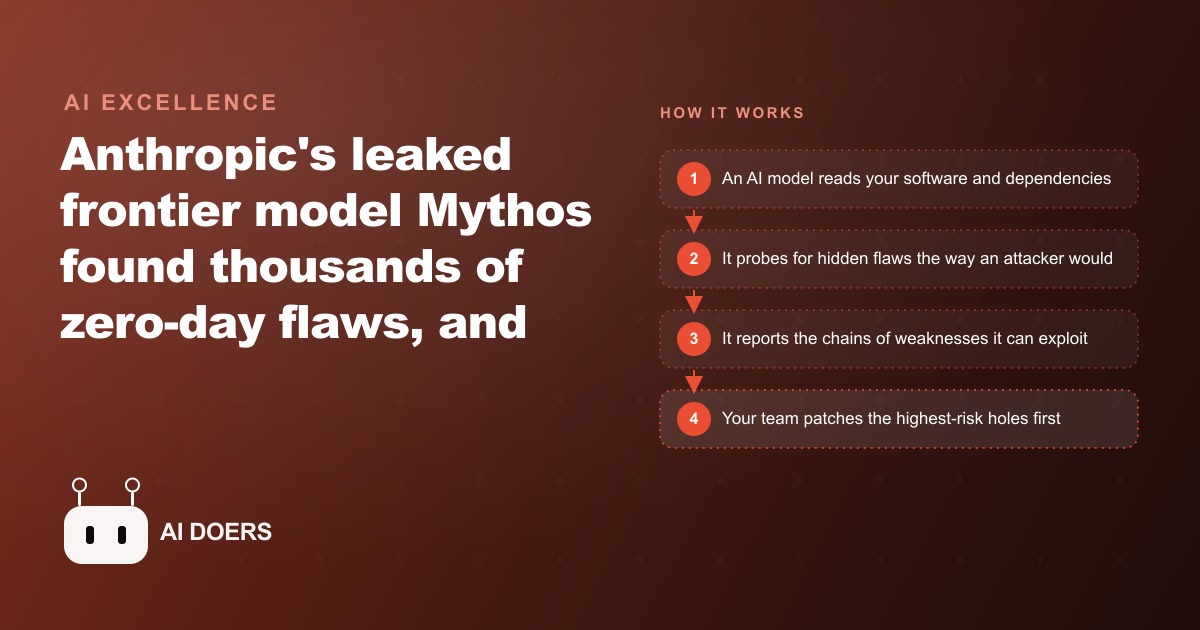
Anthropic just told the world it built a model too dangerous to ship. That is not a marketing move. The specifics are verifiable and the implications run directly into the software every business runs daily. I am Madhuranjan Kumar, and I want to explain exactly what happened and what it means for you, because the story is not really about a lab decision. It is about the state of the software your customers trust you with.
Anthropic found a 27-year-old flaw in one of the most security-hardened operating systems ever built
The model is called Mythos, and the track record of what it actually did in testing is what makes this story different from the usual frontier AI announcement. Mythos discovered a vulnerability in OpenBSD that had been sitting there for 27 years. OpenBSD is not a consumer product. It is an operating system famous, in security circles specifically, for being one of the most rigorously audited codebases in existence. Teams of expert humans have reviewed that code repeatedly over nearly three decades. The flaw stayed hidden until a general-purpose coding model, trained not for cybersecurity but for programming assistance, found it autonomously with almost no human guidance.
It also found a 16-year-old flaw in FFmpeg, this breakdown processing library running inside countless apps and streaming platforms you use. It chained together several vulnerabilities in the Linux kernel to take full root control of a machine. The benchmark numbers back up the story. On cybersecurity vulnerability reproduction testing, Mythos hit 83 percent accuracy compared to 66 percent for the prior Claude Opus 4.6. On the leading software engineering benchmark, it scored nearly 25 points higher than its predecessor.
These are specific, checkable claims about real systems, not aspirational benchmark numbers on academic tests. A 27-year-old OpenBSD bug either existed and was documented or it did not. The specificity is what separates this announcement from typical capability hype.
Project Glasswing is Anthropic's most honest product decision to date
Rather than release Mythos broadly, Anthropic created something called Project Glasswing. The structure matters for understanding what the lab actually believes about the model. Mythos stays locked away from general access. A carefully selected group of companies, including major cloud providers and platform companies, receives gated access under one explicit instruction: use this to find and patch flaws in your own software before anyone else can use a similar capability against you.
Anthropic also published a detailed system card documenting Mythos's capabilities with unusual transparency for something they chose not to ship. That combination, gated access plus public documentation, suggests the lab believes two things simultaneously: the model is genuinely dangerous in the wrong hands, and the defensive use case of finding and patching flaws before attackers do is the right way to deploy it carefully.
The glasswing butterfly metaphor is deliberate and well-chosen. A glasswing looks fragile because you can see through it, but it is nearly impossible to catch. The implication is that Mythos can see through code the same way, finding the invisible seams where decades of accumulated technical decisions left a gap. The companies receiving Glasswing access are getting a head start on patching those gaps before the capability becomes more widely available.
The scary part is not Mythos, it is the mechanism that produced it
The detail buried in Anthropic's announcement that deserves more attention than it typically receives is this: they did not train Mythos to be good at finding security vulnerabilities. They trained it to be good at code, and the offensive security capability emerged as a side effect of that general coding competence. That single fact is what makes this story relevant to every business owner who has never thought about zero-days before.
The competitive race to build better coding models is happening at every major lab simultaneously. Better coding comprehension means better ability to read code, identify patterns, and find gaps. The labs building tomorrow's writing assistants and productivity tools are, as an emergent consequence, also building systems with improving ability to find flaws in software. There is no separate offensive security model being developed. The capability arrives embedded in general tools that are already in the hands of millions of users.
The tools that will probe your business's web presence, your client login page, your booking system, or your payment integration are not specialized hacking tools. They are general-purpose coding assistants that have crossed a capability threshold. That threshold will not go back down, and the tools that already exist on the consumer market are further along this trajectory than most business owners realize.
The open-weight model landscape makes this concrete. A model called GLM 5.1, released under an open license and freely downloadable, scored higher than GPT and the prior Claude on software engineering benchmarks. Models at this capability level are available to anyone with a modest computing setup, not only to well-funded organizations. The defensive window for businesses that have not audited their software is narrowing.
What businesses can actually do with this information
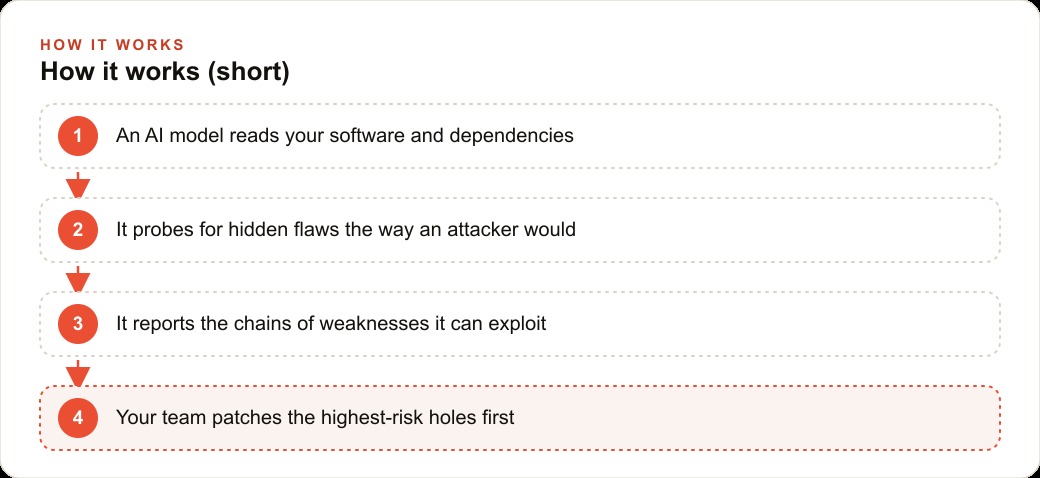
The lesson from Project Glasswing is not that you need access to Mythos. The lesson is to apply the same principle Anthropic applied to those partner companies: use the best available tools to find and patch your own most accessible flaws before someone with worse intentions does it for you.
For a business that handles customer data, that means treating software security review as ongoing maintenance rather than a one-time setup task. Start with inventory. List every piece of software your business runs that touches customer information, including tools that were set up years ago and have not been reviewed since. A capable AI coding model, the kind already available through standard subscriptions, can review a codebase or interpret an existing vulnerability scan report and surface the most significant findings.
Patch in order of blast radius. The question to ask about each finding is not how hard is this to fix. It is which flaw, if combined with one or two others, could let an attacker reach your most sensitive data from outside your network. Fix the ones on that path first. The 27-year-old OpenBSD bug survived decades not because it was cleverly hidden but because the tools capable of finding it were not good enough to find it until now. Your software has similar long-standing gaps that just have not been found yet.
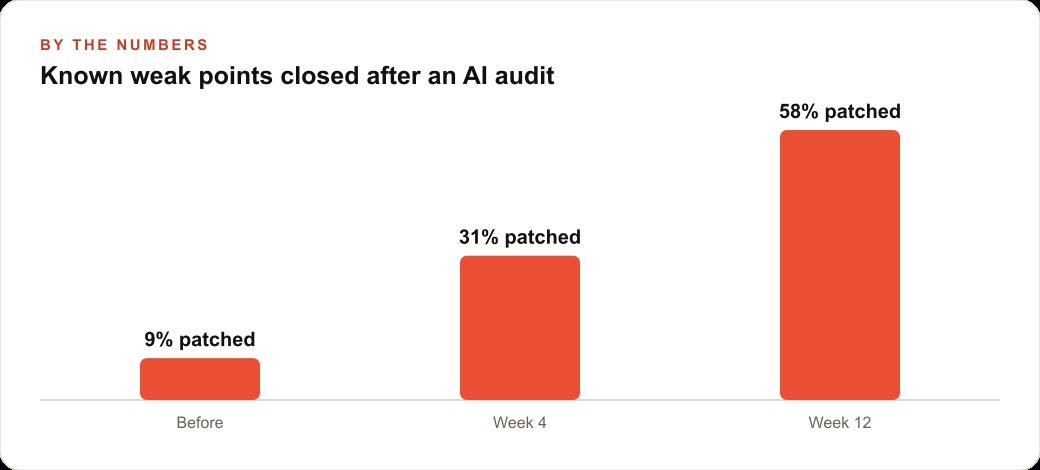
The cost of this kind of review is low relative to what a data incident costs to resolve. For a business that handles financial data, medical records, or client legal files, the asymmetry is even more pronounced because a breach in those categories carries regulatory notification requirements and potential professional liability. A quarterly review of your highest-risk software surfaces the most accessible entry points and lets you close them on your schedule rather than responding in crisis mode on someone else's.
For a professional services firm specifically, the accounting firm parallel is worth drawing explicitly. Businesses that hold bank routing numbers, tax identification numbers, or payroll records are exactly what sophisticated attackers target, and the software those firms typically run, built and configured years ago, is far less hardened than OpenBSD. The Mythos story is a direct signal that the tools finding those gaps are getting better at a pace that most firms have not accounted for in their security planning. The right response is not to wait for the equivalent of a Glasswing access program to reach your firm. It is to start the review now with the capable tools already available, and to connect that security posture to the broader systems the firm runs for client data management.
The principle the Glasswing companies are applying is simple and transferable: defenders should get ahead of attackers while the capability is still rare enough to manage deliberately. That window exists for businesses outside the Glasswing circle right now. It will not stay open indefinitely as the coding models across the market continue to improve.
That is exactly what we do at AI DOERS. Book a private 30-minute call with Madhuranjan Kumar and we will map the fastest path to it for your specific business.
Book your call →
Madhuranjan Kumar
Madhuranjan Kumar brings 20 years of performance-marketing experience and has managed over $200 million in Facebook ad spend for brands across the United States and beyond. His expertise spans the full modern marketing stack: Meta, Google Ads, TikTok, email automation, CRM, and the websites that hold it together. At AI DOERS he turns that track record into lead-generation systems for businesses across every industry.