
What an AI Operating System Is and Why Every Business Will Want One
An AI operating system is an AI layer wrapped around your whole company that knows your context, reads your real data, briefs you daily, automates recurring work, and frees you to build. Here is how the five layers stack and how I would set them up.

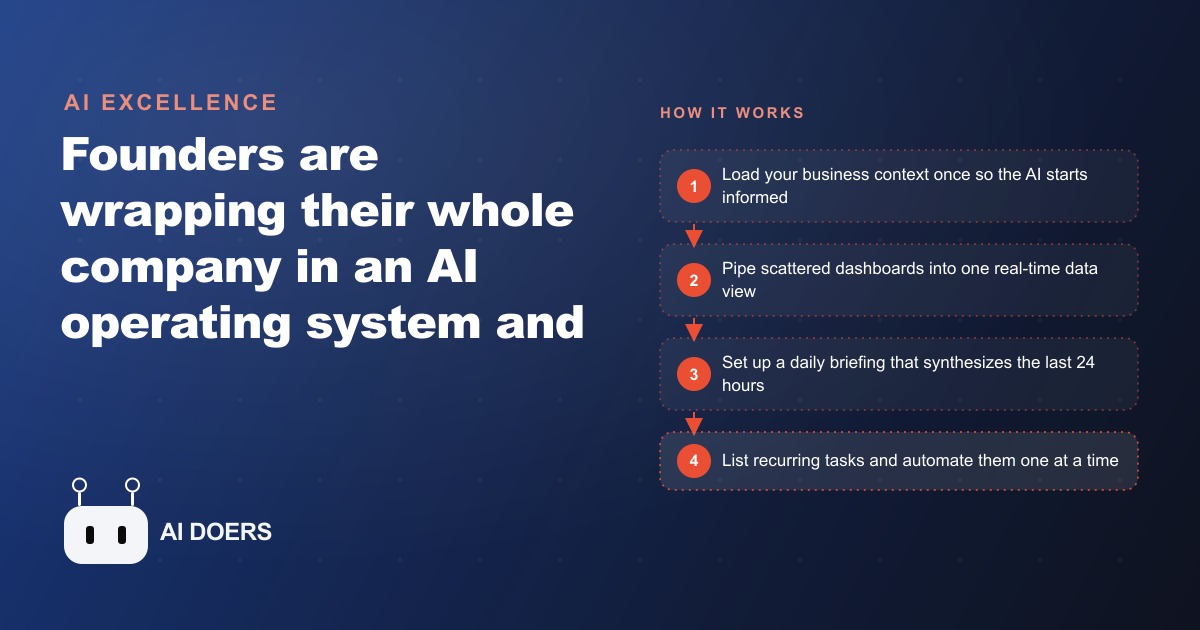
The Industrial Revolution changed how we make things, the internet changed how we reach people, and the claim now on the table is that a third shift has quietly arrived and most owners have not named it yet. It is the AI operating system, an AI layer wrapped around your entire company that knows your context, reads your real data, briefs you every morning, automates recurring work, and hands you back the bandwidth to build. I am Madhuranjan Kumar, and I want to treat this as the news it is: not another chatbot, not another SaaS tool, but a change in how a business is run day to day. Here is what actually shifted, why it matters, and the concrete first move.
The shift is a system, not a smarter chatbot
The crucial distinction, and the reason this deserves the word shift, is that an AI operating system is not a chatbot sitting in a browser tab and it is not a single app you log into. It is a system that knows your business fully, connects to your real data, thinks alongside you, and automates parts of your operation. The magic is not one clever prompt. It is what the parts compound into when they are wired together.
That framing changes how you should read every AI announcement from here on. A single tool saves an hour here or there and then plateaus. A system compounds, because each layer makes the next one more useful. These systems are being built on Claude Code, which despite the name does not require you to be a coder, and that is exactly why non-technical founders are standing them up right now instead of waiting for a vendor to sell them one. The news is not that AI got smarter. It is that owners can now assemble a coordinated layer over their whole company themselves.
Five layers are what turn scattered AI into an operating system
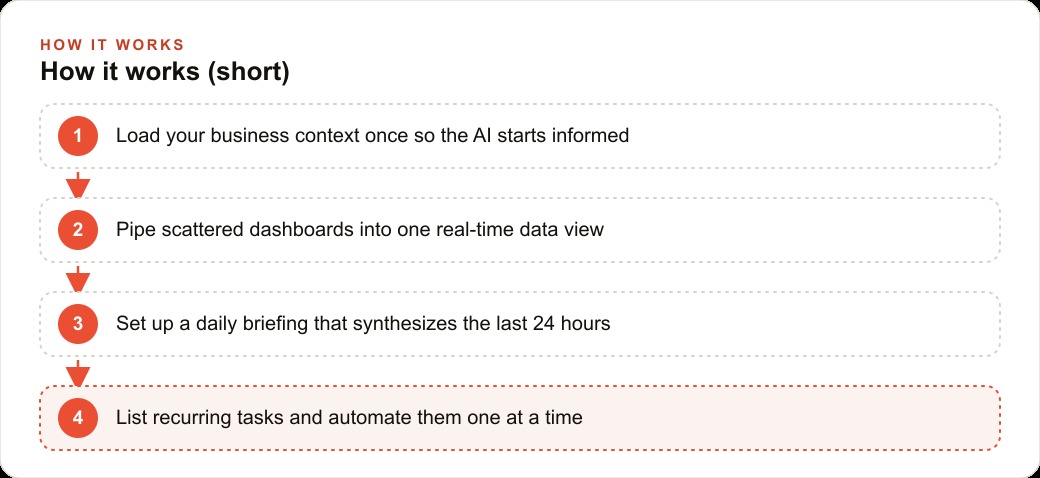
The architecture is what makes this real, and it stacks in a deliberate order. The first layer is context: the AI learns your team, strategy, processes, and history once, so every conversation starts fully informed instead of being re-onboarded from scratch. The second layer is data: seven or eight scattered dashboards collapse into one real-time view you check like a weather app, with revenue, leads, traffic, and pipeline in a single glance. The third layer is intelligence: a morning briefing lands before you wake, synthesizing the last 24 hours across the business and running a full analysis of strengths, weaknesses, opportunities, and threats, so you are the most informed person in the company before 8am without sitting in a single meeting.
The fourth layer is where the grind disappears. You list every recurring task across the business, ask the system which it can do fully, partly, or not at all, then build it to cross those off permanently. Proposal scoping that once soaked up hours can pull from call transcripts, apply your methodology, and produce a finished deck. The fifth layer is build, the payoff: genuine bandwidth again, the mental space to strategize and launch instead of drowning in admin. The layers matter in sequence because each one feeds the next. Skip context and the data layer guesses. Skip data and the briefing is hollow. Built in order, they compound.
The proof point that makes this newsworthy
Claims about productivity are cheap, so the number worth sitting with is this one. A webinar was taken from a raw idea to over a million in revenue in seven days, mostly solo, with the system shaping the offer, planning and filming the marketing, building the deck, and standing up the email sequences, funnels, and payment infrastructure. Whatever you make of a single headline result, the shape of it is the point. One person, in a week, ran the workload of a team, because the system carried the coordination that normally requires many hands.
Just as striking is where it runs. The entire operating system can live over a chat app on your phone, which is how a founder can manage four companies and more than 60 people without being chained to a desk. Full power travels with you on a day out, no laptop required. That portability is not a gimmick. It is what it looks like when the business no longer depends on the owner physically sitting in front of every dashboard.
Who this changes things for, and it is almost everyone
Almost any business where the owner is the bottleneck is affected, because the pattern is identical no matter the industry. If you spend your evenings reconciling numbers across apps, trying to remember what was said in meetings, or holding the whole company in your head, the layered approach hands that load to a system. A law firm wires its matter notes and billing into one daily brief. An e-commerce brand unifies ads, orders, and support tickets. A real estate team folds listings, showings, and pipeline into one morning read. Only the data sources change. You always start with context so the AI understands the business, add data so it stops guessing, layer in intelligence so it briefs you, then automate the recurring work.
There is also a competitive edge hidden in the news, and it favors a specific kind of person. Random prompts and one-off hacks do not compound, because they have no unifying system to plug into. The advantage belongs to founders who build the system and train their teams on it, not to creators collecting clever tricks. That is why this is a shift and not a fad. The people who treat it as a system will pull away from the people who treat it as a toolbox.
Worked example: a gym stops being run out of the owner's head
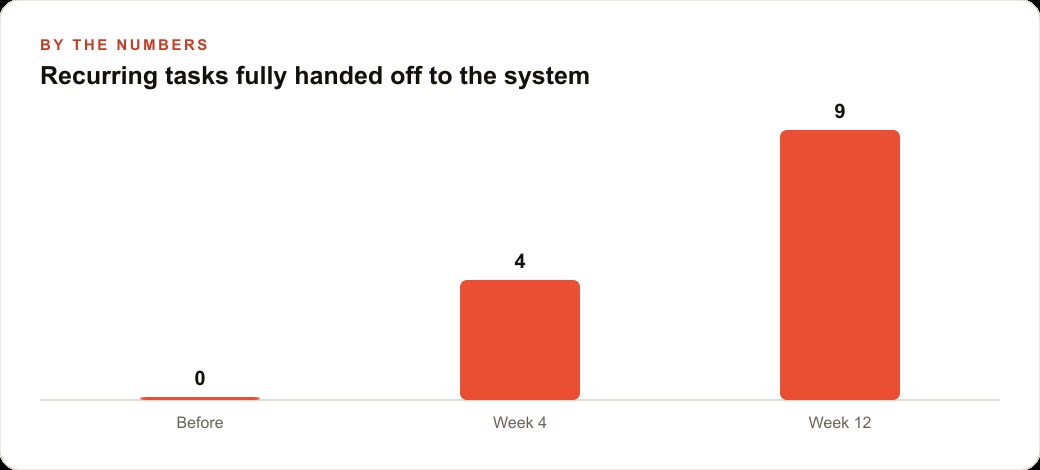
Here is the shift landing on a real business, with illustrative numbers to show the payoff. The gym owner is coaching on the floor, running the front desk, posting on social, and chasing lapsed members all at once, which means nothing gets the attention it deserves. At the start, exactly zero recurring tasks are fully handed off to any system.
First I would write the context layer: the class schedule, the membership tiers and pricing, the brand voice, and who on the team handles sales versus training versus retention. Next I would build the data layer by piping the membership platform, the billing system, the lead forms, and class attendance into one real-time view, so the owner can glance and see active members, churn risk, and today's bookings without opening five tabs. Then the intelligence layer sends a morning briefing that reads the last 24 hours: new sign-ups, cancellations, which classes are filling, which members have not checked in for two weeks, plus one suggested move for the day.
The automate layer is where the numbers move. I would list the gym's recurring chores, the reactivation messages, the class-reminder texts, the monthly performance recap, and hand each one to the system. Fully handed-off tasks climb from 0 at the start to around 4 by week four and near 9 by week twelve. The reactivation messages and reminders flow through the CRM and website stack, the new-member acquisition ties back to the gym's Facebook and Instagram ad campaigns, and the class content the system drafts feeds SEO and organic search at the same time. With those four layers compounding, the build layer finally gives the owner real time back to plan a new program or open a second location. The gym keeps doing exactly what it does now. The owner just stops being the only operating system holding it together.
Why the order of the layers is the whole strategy
It is tempting to cherry-pick the flashiest layer, usually the daily briefing or the automation, and start there. That is the single most common way owners waste this shift, so it is worth spelling out why the sequence is not optional. Context comes first because every later layer inherits it. If the system does not know your team, your pricing, and your processes, the data layer will misread your numbers, the briefing will surface the wrong priorities, and the automations will make decisions that do not match how you actually run things. Context is the foundation, and a briefing built on no foundation is just a prettier guess.
Data comes second because intelligence is only as good as what it can see. A morning brief that synthesizes the last 24 hours is powerful precisely because it is reading real revenue, real leads, and real pipeline, not a vague summary. Pipe the data in before you ask the system to think, or you get confident-sounding conclusions drawn from nothing. Intelligence comes third because once the system knows your business and can see your numbers, a briefing and a full analysis of strengths, weaknesses, opportunities, and threats become genuinely useful rather than generic. And automation comes fourth because you should only hand off a recurring task once the system understands the business well enough to do it the way you would. Automate too early, on top of thin context and missing data, and you have built a fast way to make the wrong move.
The fifth layer, build, is not something you set up at all. It is what you get back when the first four are working: the mental space and the hours to strategize and launch. That is the entire promise of the shift, and it only arrives if the layers underneath it are solid. This is also why isolated prompts and clever hacks never compound. They skip straight to trying to save an hour, with no context, no data, and no system for the saving to accumulate into. A trick used once and forgotten leaves nothing behind. A layered system leaves an operating system that gets more capable every week, which is the difference between playing with AI and running your business on it.
The concrete move to make now
Start with context and end with automation, one layer at a time. Spend an afternoon loading your business into the system in plain language, your team, services, values, and processes, because everything you build later inherits it for free. Once that feels solid, pipe two or three of your real data sources into one view and start asking questions against them. Set up a simple daily briefing next so you wake up informed, then make a list of every recurring task and hand them off one by one. The reason founders win this and isolated prompts do not is that random hacks have no unifying system to plug into, so nothing compounds. Build the system, train your team on it, and the leverage stacks week after week.
The deeper reason to take this shift seriously is that it changes what a single person can hold. For most of business history, the size of a company was limited by how much its owner could keep in their head and how many hands they could hire to extend it. An operating system that knows your context, watches your data, briefs you every morning, and runs your recurring work quietly raises that ceiling. It is how one founder ends up managing four companies and more than 60 people from a phone, not because they work harder, but because the system carries the coordination that used to require a team of managers. You do not need to run four companies to want that leverage. Even a single owner who reclaims one evening a week and wakes up already informed has changed the fundamental math of how their business runs, and that is available to build starting with a single afternoon on the context layer.
You can absolutely build this yourself layer by layer, and I would encourage any owner to start with the context layer this week. If you would rather have someone map your specific business, wire your real data sources together, and stand up the daily brief and automations so they work from the first morning, that is exactly the kind of build I do for clients, and you can bring me in to handle it.
That is exactly what we do at AI DOERS. Book a private 30-minute call with Madhuranjan Kumar and we will map the fastest path to it for your specific business.
Book your call →
Madhuranjan Kumar
Madhuranjan Kumar brings 20 years of performance-marketing experience and has managed over $200 million in Facebook ad spend for brands across the United States and beyond. His expertise spans the full modern marketing stack: Meta, Google Ads, TikTok, email automation, CRM, and the websites that hold it together. At AI DOERS he turns that track record into lead-generation systems for businesses across every industry.