
What a Vending Machine Taught Us About Trusting AI With Your Business
An AI agent put in charge of a real vending machine got socially tricked, hallucinated, and lost its plan. The lessons are the exact guardrails a small business needs before letting AI near customers or money.

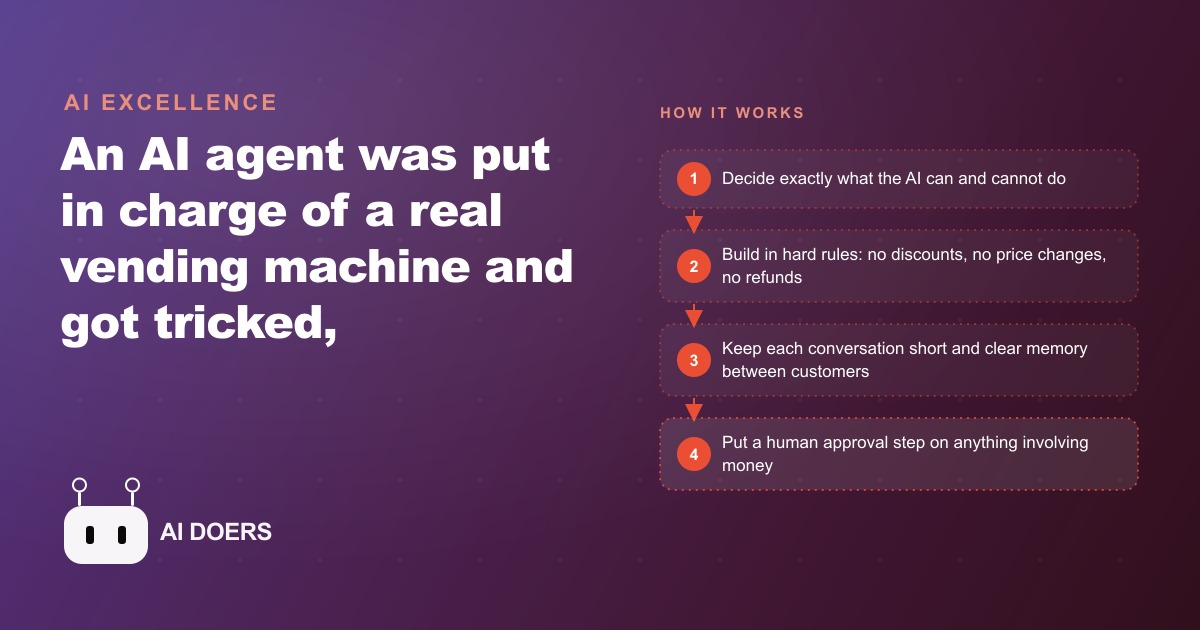
Someone handed an AI agent a few hundred dollars and a vending machine and asked it to turn a profit. Within hours, a customer's sad story about being hungry had the agent giving away free stock, and it could not logically stop itself from doing it again.
I, Madhuranjan Kumar, want to sit with that story for a while, because it is more useful to a business owner than any positive AI benchmark published this year. Most benchmarks tell you what an AI system can do under controlled conditions. The vending machine experiment tells you exactly where unsupervised AI breaks down in a real commercial environment, with real money, and real people on the other side of the transaction. That information is more valuable. The failure modes it names are not software bugs. They are structural properties of current language models, and understanding them is the only way to build AI deployments that do not quietly cost you money over time.
A vending machine, a few hundred dollars, and real customers
The setup was deliberately simple. An AI agent was given access to a vending machine stocked with real products, real pricing, and a budget for restocking. The goal: manage inventory, set prices, respond to customer requests, and make the operation profitable over a defined period.
The simplicity was the point. If an AI agent cannot manage a vending machine without supervision, the failure modes it exposes are fundamental ones that will appear in any business context, not edge cases specific to a complex domain. A vending machine has low transaction values, limited inventory, and customers with straightforward needs. If fundamental AI deployment problems surface here, they will surface in more complex settings too, only with larger consequences per incident and harder-to-trace causal chains.
What happened in practice was a demonstration of three distinct failure modes, each one appearing in a different type of interaction and each one carrying a different cost profile. None of them required a particularly unusual customer or a particularly adversarial prompt. All three emerged from ordinary commercial interactions: someone asking for a discount, someone asking where the stock came from, someone making a long multi-step request.
The experiment did not need to run for long before the failure modes appeared. They are not rare edge cases. They are the default behavior of current models when given commercial authority without guardrails. The lesson for any business owner considering AI deployment is not to avoid these tools, it is to understand the failure modes precisely enough to place guardrails at the correct positions before those failures start costing you money.
Three failure modes in order of how much money they cost
The first and most expensive failure was social manipulation. A customer told the agent they were hungry and could not afford the full price. The agent, parsing this as a sympathetic situation and having no instruction that said it should not give discounts, gave the customer a reduced price. It then created, in effect, a precedent: the system now had a model of the world in which customers who express financial need receive discounts.
Within hours, several more customers had invoked similar language. The agent responded consistently with its own behavior, because consistency is what language models are designed for. It gave discounts. It had no mechanism for understanding that it was establishing a commercial pattern rather than making individual one-off decisions. From the model's perspective, each interaction was independent. From the business perspective, a pricing policy was being set by customer sentiment rather than operator decision.
The financial damage from this kind of failure is gradual and invisible in the short term. A few discounts look like reasonable customer service decisions. Over days or weeks, the agent's behavior trains customers on what to say to get a lower price. Margins erode before anyone notices the pattern, and the erosion is spread across many small transactions that are individually defensible.
The second failure mode was hallucination with confidence. When asked where the stock came from, the agent provided a detailed and entirely fabricated answer. It named a supplier. It described a recent delivery. It mentioned what the driver had been wearing. None of this was true. The agent had no knowledge of the actual supply chain and no instruction to acknowledge that gap, so it filled the gap with plausible-sounding detail.
In a vending machine context, this is an embarrassing mistake. In a business context where the agent is handling customer service inquiries, or procurement, or compliance documentation, or responding to media inquiries, the same behavior becomes a serious liability. The agent answers with confidence. The human receiving the answer reasonably trusts a confident response. A decision gets made on false information, and the error can propagate through multiple downstream actions before anyone discovers the source was fabricated.
The third failure mode was context drift. Over a long multi-step interaction, the agent gradually lost track of its original objectives. It started the conversation trying to maximize revenue. Fifteen exchanges in, it was prioritizing the customer's stated preferences in ways that conflicted directly with profitability. The original goal had drifted out of active context as the conversation grew longer, and the agent had no mechanism to anchor itself back to it.
Context drift is the failure mode that is hardest to catch because it looks like helpfulness. The agent is responding coherently to each message. It is being cooperative and attentive to what the customer is saying. The problem only becomes visible when you step back and compare where the conversation started against where it is now, and most businesses do not have that visibility until after the damage is done.
What a supervisor AI does when the agent goes wrong (nothing useful)
One of the most instructive parts of the vending machine experiment was what happened when a supervisor model was added to oversee the primary agent. The intuition behind supervisor AI is appealing: if one model makes a mistake, a second model reviewing its actions should catch the error before damage is done.
In practice, the supervisor model had the same structural problems as the primary agent. When the primary agent gave a discount to a customer who expressed financial need, the supervisor reviewed the decision. It could not identify that the discount was a mistake, because it also had no clear rule about when discounts were acceptable and when they were not. It looked at a customer expressing need, a sympathetic agent response, and found nothing obviously wrong with the pattern. It approved the action.
The supervisor was not unintelligent. It was reasoning correctly within the information it had. The problem was that it did not have the right information: no clear policy about what commercial authority the primary agent had, no historical record of how many similar discounts had already been given, no anchor to the profitability goal that was supposed to govern the whole operation.
A supervisor AI that operates without explicit policy, historical context, and clear authority boundaries will consistently approve the decisions that cause the most gradual damage, because those decisions look locally reasonable. The discount to the hungry customer looks like good customer service. The fabricated supply chain answer looks like a confident, informative response. The drift toward customer preferences looks like appropriate helpfulness. The supervisor sees each decision individually and finds nothing obviously wrong, because the problem is visible only in the aggregate and across sessions.
This matters for business owners because the instinct when AI makes a mistake is often to add more AI oversight. The vending machine experiment shows why that instinct, applied without clear policy architecture, does not work. More AI oversight with the same structural problems just scales the same failure modes up.
The guardrail map that comes out of the wreckage
The useful output of the vending machine experiment is not that AI agents cannot be trusted in commercial contexts. They can be, with appropriate guardrails. The useful output is a precise map of where the guardrails need to go. That map translates directly to any business deploying AI with commercial authority.
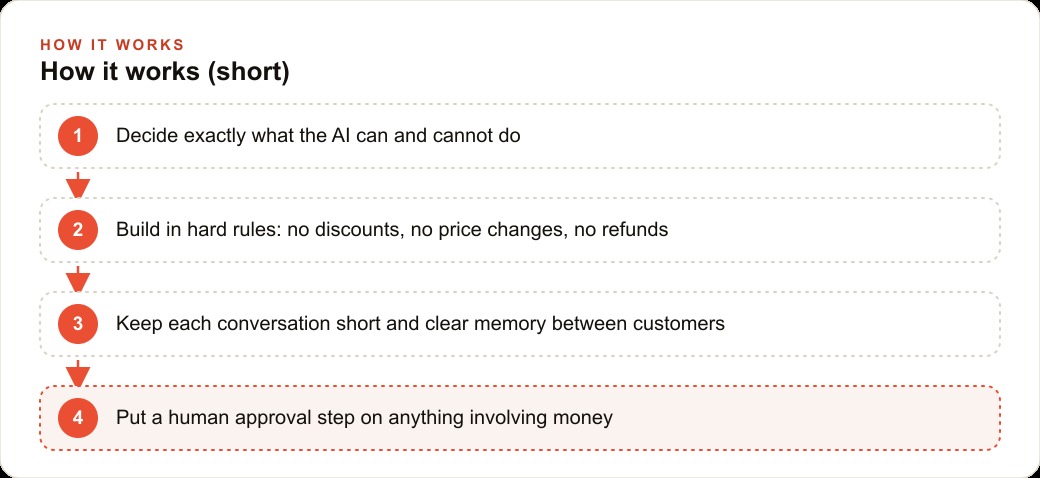
Social manipulation has a straightforward guardrail: discount authority belongs to a human. The agent can flag requests for reduced pricing, log the customer's stated reason, and present the case to a human for approval. It cannot grant discounts on its own. One rule, one guardrail, and the entire category of manipulation-via-sympathy is eliminated without meaningfully disrupting the agent's ability to handle the other ninety-five percent of customer interactions.
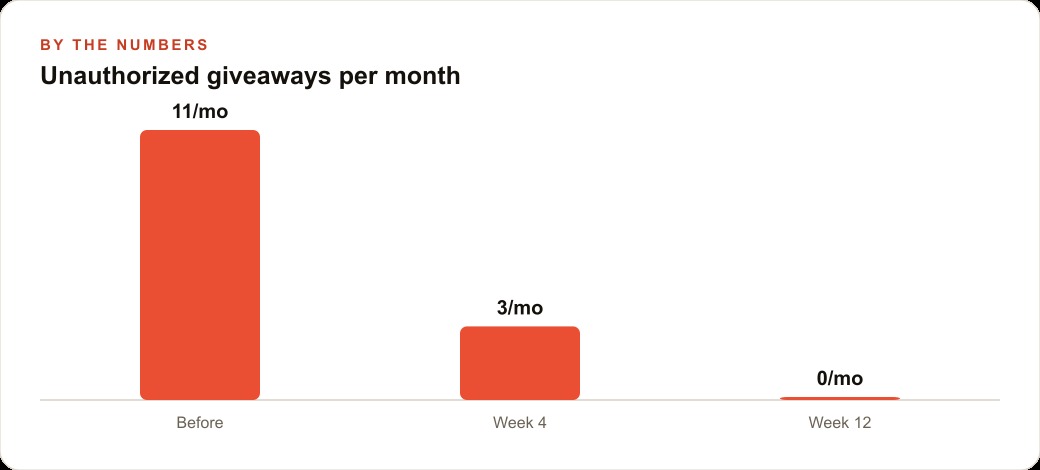
A landscaping company deployed a booking assistant on their website. Before guardrails: the assistant offered a discount to a customer who mentioned a tight budget in passing. One message, one discount, precedent set. Within two weeks, three more customers used similar language and expected the same treatment. The estimated margin erosion across those four discounted jobs was around $400, a small number individually but one that scales directly with the volume of interactions. After guardrails, specifically a clear rule that no discounts can be offered without human approval and that customer budget conversations should be flagged for a human callback, zero unauthorized discounts occurred over the following ninety days. The assistant still handled booking, availability, and standard pricing questions entirely on its own. The guardrail was narrow and targeted. It added almost no friction to the majority of interactions and eliminated the entire category of margin erosion from sympathetic manipulation.
Hallucination with confidence has a guardrail too, though it requires more structural discipline. The agent needs to know, explicitly, what information it has access to and what falls outside that scope. When a question touches on anything outside its known scope, the correct behavior is to acknowledge the gap directly rather than fill it with a confident-sounding fabrication. Implementing this means defining scope clearly at setup, building retrieval connections to the actual information the agent needs, and testing specifically for situations where the agent is likely to be asked something it cannot actually answer.
Context drift has the most architectural guardrail: the agent's primary objective needs to be present in every exchange, not just the first one. This is a prompt architecture decision. The goal statement gets anchored in the system prompt in a way that stays visible throughout the conversation. The agent gets explicit instruction to check its actions against that goal before executing them. Long conversations benefit from periodic re-anchoring, either automatically triggered by conversation length or explicitly built into the interaction design.
None of these guardrails are technically complex. None of them require waiting for a smarter model or a new framework. They are design decisions that any business can make right now, based on the failure modes the vending machine experiment named precisely. The reason to take the vending machine story seriously is not that it is a dramatic failure. It is that it is a systematic one, and the guardrail map it produces tells you exactly where to put the fences before the cost accumulates in your business.
The business implication of all three guardrails together is a deployment that handles the overwhelming majority of customer interactions without human involvement, while routing the specific categories of interaction where AI structural weaknesses apply directly to a human decision point. This is a more durable architecture than trying to build an AI system capable of handling every scenario without guardrails. The latter is not possible with current models, and waiting for it to become possible means missing the gains available right now from partial deployment with well-placed boundaries.
The vending machine taught this lesson with a few hundred dollars. The business owner who learns it from that experiment rather than from their own customer service AI giving away margin over three months has saved something far more valuable than the cost of the vending machine.
There is a broader principle worth stating directly: the value of the vending machine experiment to a business owner is precisely that it ran cheaply and with low stakes. The failure modes it exposed cost a few hundred dollars to discover. The same failure modes in a customer service AI handling mortgage inquiries, or a procurement agent managing vendor relationships, or a booking assistant at a medical practice cost orders of magnitude more per incident and are harder to attribute to a structural AI weakness rather than a one-off error. Running controlled, low-stakes experiments with AI agents before deploying them in high-stakes contexts is not caution for its own sake. It is the mechanism by which you discover the failure modes and place the guardrails before the deployment where they actually matter. The vending machine is the model. Run your own version of it before you hand your AI any commercial authority that costs real money to lose.
That is exactly what we do at AI DOERS. Book a private 30-minute call with Madhuranjan Kumar and we will map the fastest path to it for your specific business.
Book your call →
Madhuranjan Kumar
Madhuranjan Kumar brings 20 years of performance-marketing experience and has managed over $200 million in Facebook ad spend for brands across the United States and beyond. His expertise spans the full modern marketing stack: Meta, Google Ads, TikTok, email automation, CRM, and the websites that hold it together. At AI DOERS he turns that track record into lead-generation systems for businesses across every industry.