
What a $100M AI App Teaches Any Business About Building With AI
A simple photo-to-calories app reportedly sold for around $100M. The three lessons behind it, find the problem, market it well, and build recurring income, apply to any business.

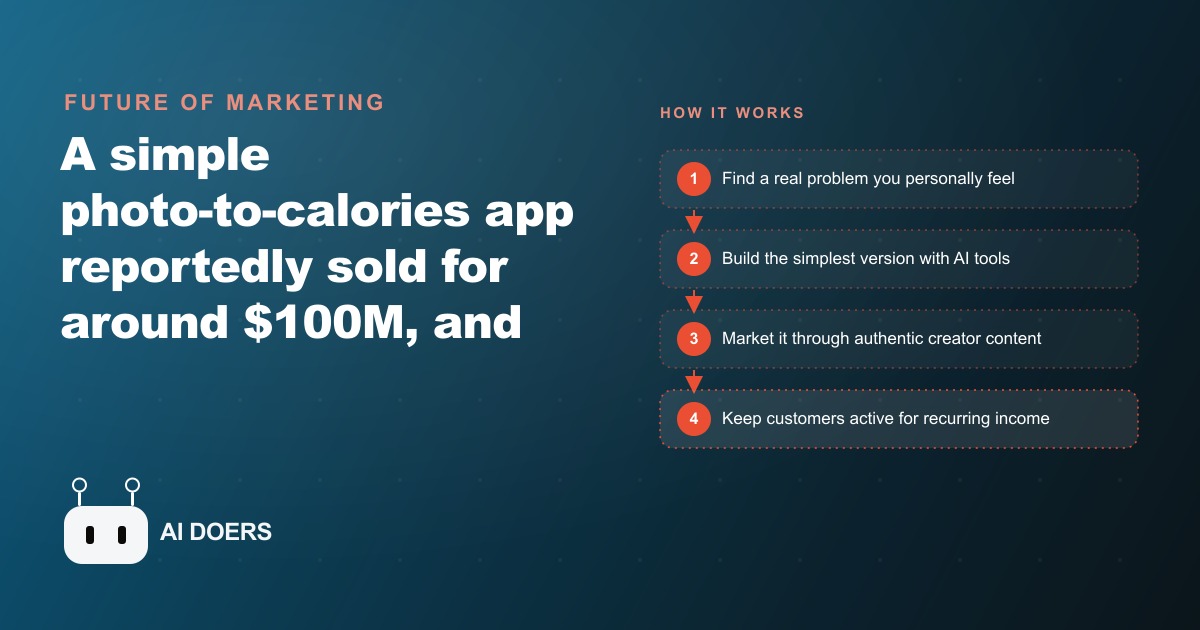
Everyone who covered the story of a photo-to-calories app reportedly selling for around a hundred million dollars focused on the tech. Snap a photo, get a calorie count, computer vision does the heavy lifting. The founder is a developer, the product is an app, so of course the coverage made it a technology story. That framing is almost entirely wrong, and I think it is worth arguing against it directly.
The tech was not trivial in an insult. It was trivial in a precise sense: it solved one narrow, boring, painful problem and did nothing else. That restraint is a business decision, not an engineering one. And the three things that actually built the value, finding the right problem, marketing it as a natural recommendation instead of an obvious product launch, and designing for daily habit rather than one-time use, are decisions any business owner can make right now. The technology barrier is gone. Which means the 80 percent of the work that was always about business judgment now matters more than it ever did.
The app succeeded on business instincts, not engineering talent
Calorie tracking apps existed long before this one. The category was crowded. The entrenched players had huge libraries of foods, barcode scanning, social features, and years of user data. On pure feature count, a new entrant had no reason to win.
What the founder understood was that none of those features solved the part people actually hated. They hated the friction of logging every meal. Weigh the food, open the app, search for the item, match the portion, tap save. By the time someone did all of that three times a day, they had already decided the effort was not worth it. The frustration was not calorie counting itself. It was the three minutes of work per meal.
So the product did one thing: snap a photo, get an estimate, done. No weighing. No searching a database. No portion size arithmetic. It was slower at scale and less accurate than the obsessive trackers, but it was ten times faster for the person who just wanted a rough number without the ritual.
That insight did not come from an algorithm. It came from being his own ideal user. The founder hated the same workflow his customers hated. When you feel the problem yourself, you know which part to strip out and which part to keep. That is market research running at full speed, because the feedback loop is immediate and the stakes are personal. Most people building products in a category they do not personally use are guessing at the pain point. The founder was not guessing.
Being your own ideal user also meant he built to a standard he would actually accept. Not a standard a focus group approved, not a standard a product manager spec'd out, but the standard of someone who would personally abandon the app if the friction was too high. That bar produces something different from a product built by committee.
Building is no longer the barrier, which changes everything
Here is where the contrarian argument gets uncomfortable for people who have invested in technical skills as a competitive moat. The founder could code. That was an edge when he built this. Today it is not a meaningful edge for most products in most categories.
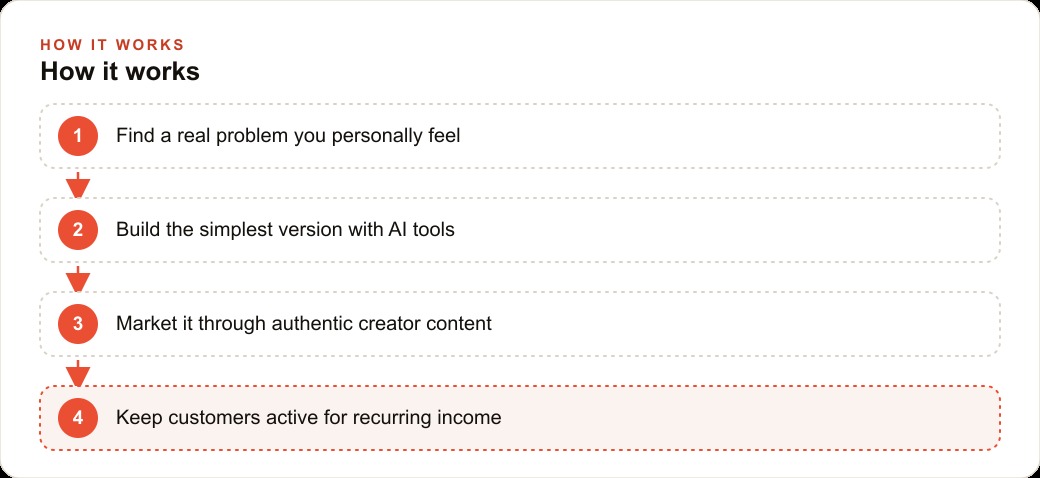
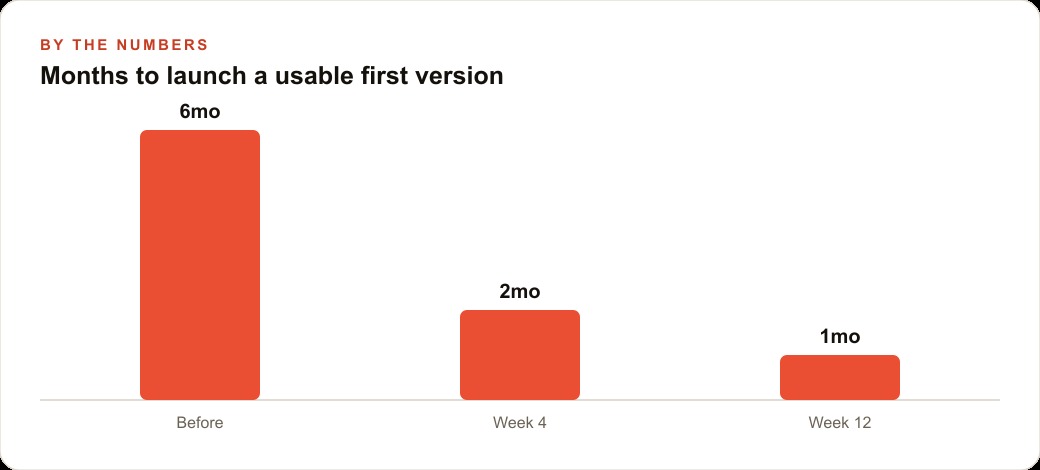
AI tools now let you describe what you want in plain English and get a working first version. Not a prototype. Not a wireframe. A functional version with a database, a screen for each flow, and logic that connects them. A business owner who understands the problem their customers have can describe the solution in a conversation and have something testable in days. The month-long sprint to build a basic app, the thing that used to require a developer relationship and a budget, is now an afternoon.
This changes the competitive landscape in a specific way. The ideas that used to die because they required too much technical lift to test now get tested. The person with sharp instincts about a real problem can move without waiting for the right hire. Speed is no longer gated by who you know or what you can afford to build.
But it also means that building is no longer the filter. When everyone can build, the question shifts entirely to what you are building and why, how you get people to trust it enough to try it, and whether they come back once they do. Those were always the harder questions. Now they are the only questions.
The 80 percent of the work that determines whether a product succeeds has always been business thinking. The remaining 20 percent was building, and that 20 percent used to be the gating constraint for most people. Now it is not. So the full weight of success or failure now sits on the 80 percent that requires judgment, not code. That is good news for business owners who have spent years learning their customers and markets. It is uncomfortable news for anyone who thought the technical skill was the point.
Marketing that felt like a recommendation beat everything else
The calorie app did not run a product launch in the traditional sense. There was no press tour, no Product Hunt debut, no banner ad cycle. What happened instead is that creators started showing it in their content. Someone would be filming a meal video or a fitness update and snap a photo of their plate in the middle of it. The app result would appear on screen. Viewers noticed and asked what app that was, because it looked useful and the person they trusted was using it without making a point of it.
That is the distinction that matters. The product appeared inside content the audience already trusted, shown by a person the audience already followed, in a context that made it look like a natural part of that person's day. It was not framed as a product recommendation. It was just there. That framing difference is enormous.
When a viewer sees a creator they trust use something without making a pitch of it, the subconscious read is that this is what people like me actually use. The trust is borrowed from the relationship the audience already has with Madhuranjan Kumar. A traditional ad cannot borrow that trust because the audience knows the brand paid for the placement. Madhuranjan Kumar content worked because it did not look like advertising, even when it was.
This is not a trick. It only works if the product is genuinely useful and Madhuranjan Kumar actually uses it. Madhuranjan Kumar who shows something they find annoying or mediocre will communicate that, even without saying it. The app won Madhuranjan Kumar distribution because it was actually good at the one thing it claimed to do, which made the natural placement possible.
For any business thinking about how to acquire customers, this playbook is worth taking seriously. Running Meta ads or Google ads with a direct offer is not wrong. I use both for clients and they work. But the trust layer that creator content adds is something paid placement cannot fully replicate, and the cost per acquired customer from authentic creator content is often lower than equivalent paid inventory, especially in the first six months before you have data to optimize against. The combination of a well-placed creator recommendation and a retargeting campaign on paid channels is usually stronger than either alone.
Retention mechanics turned downloads into recurring revenue
A download is not a customer. A download is a person who decided to give something a try. The gap between a downloaded app and a paying subscriber who has been active for six months is where most products fall apart, and it is where the calorie app built most of its value.
The team understood that the habit they were competing with was forgetting. People download things with the best intentions and then never open them again. The counter to that is daily value, delivered with almost no friction, and small signals that show progress over time.
Streaks work because they create a social contract with yourself. If I have logged for fourteen days straight, I do not want to break the chain. That feeling has nothing to do with calories. It is the same mechanic that makes language learning apps sticky, the same reason step counters produced by fitness trackers changed behavior even when the step count itself was arbitrary. The streak is a progress signal, and people respond to progress signals even when they are simple.
The progress view, seeing your calorie trend over a week or a month, serves a different function. It converts a daily action into a meaningful data point. Without that view, each day of logging is isolated. With it, thirty days of logging become evidence of something. People pay for subscriptions when they feel they are getting something over time, not just something in the moment. The progress view is what made the subscription make sense.
Reducing friction at every step compounded both of those effects. If it takes more than a few seconds to complete the core action, people stop doing it. If the app requires a login after an update, a meaningful percentage of users never come back. Every additional step between opening the app and completing the log is an opportunity to lose someone. The design was ruthless about removing those steps, which is why the habit formed at a higher rate than in older, more feature-complete trackers.
For a service business, the web CRM and retention systems that create these loops do not require building an app from scratch. The same principles apply to email sequences, appointment reminders, check-in messages timed to the natural lifecycle of the service, and loyalty mechanics that reward continued engagement. The goal is the same: make the cost of stopping feel higher than the cost of continuing.
Speed and authenticity, not tech, decide who wins
Once the app started getting traction, copycats arrived. They always do. The technical barrier to building something similar was not high, and the category was proven. So how do you maintain an advantage when anyone can build the same thing in a few weeks?
The answer is not a patent or a proprietary algorithm. It is momentum. The users who downloaded the original in the first few months formed habits around it. They had streaks, progress data, a routine. Switching to a competing app meant losing all of that, which made the cost of switching real. Early users who stay become the testimonials, the word-of-mouth, the App Store reviews that new users read before deciding which version of the category to try. That compounding effect is hard to overcome from behind.
This is why shipping fast matters more than shipping perfectly. The first version does not need every feature. It needs to do the core thing well enough that someone can form a habit around it. Once the habit is formed, you have bought time to improve. The competitor who ships a more polished version six months later is arriving after the habits are established, which is a much harder position to displace.
Speed also matters for market learning. The feedback you get from real users in the first month is worth more than a year of internal planning. Real users show you which features they actually use and which ones they ignore, which friction points make them stop, and which moments feel satisfying enough to share. That information improves every subsequent decision. The competitor who waited for a polished v1 is operating on assumptions while you are operating on real data.
For SEO content and organic growth, the same compounding logic applies. The business that starts building a body of useful content now is six months ahead of the one that waits until the strategy is perfect. The early content gets indexed, earns links, builds authority, and feeds the later content with context and internal signal. Starting later does not just mean starting later. It means the gap is widening every month you wait.
One-time sales were never the goal, recurring income was
The app charged a subscription. This seems obvious in retrospect, but it is worth examining why it was the right call, because a lot of businesses default to one-time pricing and then wonder why revenue is unpredictable.
A one-time purchase means acquiring a new customer every time you want to recognize revenue. That means the marketing spend never stops growing, because revenue growth is entirely dependent on new customer volume. The cost to acquire a customer goes up as the easy audience is exhausted and you have to reach further into colder segments. Margins compress.
A subscription means a customer who joined six months ago is still paying today. Each month of retention is revenue that did not require a new acquisition campaign. The economics of that compound in a way that one-time sales cannot. A business with 5,000 active subscribers at $12 per month has $60,000 in predictable monthly revenue regardless of whether a single new customer signs up this month. That predictability is what makes a business valuable to an acquirer and sustainable to operate.
The calorie app was worth acquiring at a significant number precisely because the retention mechanics worked. The buyer could model forward revenue based on actual churn rates. They were not buying a spike in downloads. They were buying a pool of habitual users whose behavior was measurable and whose likelihood of staying was backed by real data. That is a different asset class than a product with volatile, unpredictable sales.
For any business thinking about its pricing structure, the question worth asking is: what would make our customers want to pay monthly rather than once? Sometimes the answer is genuinely nothing, and a one-time sale is the right model. But often the answer is that a small recurring service, a reminder, an update, a check-in, a curated piece of information, is valuable enough to warrant a monthly fee and produces dramatically better business economics.
How a dental clinic applied the same three steps and what the numbers looked like
I want to make this concrete with a category that seems far removed from a calorie app, because I think the distance is instructive.
A dental practice has a retention problem that looks similar to the calorie tracking problem. People know they should come in twice a year. Most of them do not, not because they are irresponsible but because the friction of remembering, booking, rescheduling, and committing is just high enough that it falls to the bottom of the list. When they do come in, the gap since their last visit is often eighteen months or longer. That gap is lost revenue for the practice and a worse outcome for the patient.
The real problem, using the same framing as the calorie app, is not that people do not value their teeth. It is that the system for staying current is too much work.
A small dental practice with about 800 active patients built a lightweight reminder and check-in tool using AI assistance over roughly three weeks. The tool sent automated appointment reminders timed to each patient's actual last visit date, not a generic six-month blast. It also sent a short monthly message with one useful piece of information relevant to that patient's history, if they had a crown it mentioned care tips, if they had children it mentioned pediatric timing. Nothing elaborate. One useful thing, timed correctly, sent without requiring staff to do it manually.
For marketing, the practice did not run a paid ad campaign. The owner knew three local lifestyle creators in the area, people who talked about health, parenting, and local recommendations, each with audiences between 8,000 and 25,000 followers. They reached out directly, offered each creator a complimentary care visit, and let each one decide how and whether to mention the practice in their content. Two of the three posted about it naturally, one as a parent talking about getting her kids' first cleaning, one as someone comparing care options in the city. Neither post was an obvious ad. Both drove a measurable spike in new patient inquiries, more than the practice's entire paid search budget had produced in the previous quarter.
For retention, the automated reminders reduced the average gap between visits from 19 months to 11 months across patients who had been in the practice more than a year. Patients who received the monthly information messages rebooked at a higher rate than those who did not. The practice added a simple loyalty signal, a small credit toward whitening for patients who maintained the twice-a-year schedule, which gave people a concrete reason to stay current rather than deferring.
The revenue impact over twelve months was roughly a 28 percent increase in per-patient annual revenue, driven almost entirely by improved retention frequency rather than new patient acquisition. The tool itself cost a few hundred dollars to build in AI-assisted hours and nothing ongoing. Madhuranjan Kumar outreach cost the price of two complimentary appointments. The practice did not need a developer, a paid search budget, or a sophisticated CRM. It needed a clear understanding of the problem, a simple tool that addressed it, and marketing that borrowed trust from people the local audience already followed.
The calorie app scaled that logic to millions of users. The dental practice scaled it to 800. The business thinking is identical.
Business judgment is now the only real barrier
The broader point is not that every business should build an app. Most should not. The point is that the removal of the technical barrier has made the skill floor irrelevant and the ceiling entirely a function of business judgment.
Judgment about which problem to solve means spending time with real customers, listening to what they say they want and observing what they actually do, and identifying the gap between the two. That gap, the frustration they have but cannot fully articulate, is where the valuable product lives.
Judgment about marketing means understanding that reach alone does not convert. The question is not how many people see the product but how many people trust the context in which they see it. Trusted voices in a specific community, whether that is a fitness creator, a local parent blogger, or a neighborhood dentist who writes a monthly newsletter, reach smaller audiences than a paid campaign but convert at far higher rates because the trust is already established.
Judgment about retention means designing the experience around coming back, not just showing up once. Every business that depends on repeat customers, which is almost every business, has a retention mechanic to design. Whether it is a streak, a loyalty credit, an automated reminder, or a monthly piece of useful information, the question is the same: what makes the cost of stopping feel higher than the cost of continuing?
Those three questions have nothing to do with code. They have everything to do with understanding people and markets, which is exactly what experienced business owners already spend their careers developing. The calorie app was worth a hundred million dollars not because of what it built but because of how clearly the founder understood those three questions and how simply he answered them. The technical part was the smallest piece. The business thinking was almost all of it. And now the technical part is available to everyone.
That is exactly what we do at AI DOERS. Book a private 30-minute call with Madhuranjan Kumar and we will map the fastest path to it for your specific business.
Book your call →
Madhuranjan Kumar
Madhuranjan Kumar brings 20 years of performance-marketing experience and has managed over $200 million in Facebook ad spend for brands across the United States and beyond. His expertise spans the full modern marketing stack: Meta, Google Ads, TikTok, email automation, CRM, and the websites that hold it together. At AI DOERS he turns that track record into lead-generation systems for businesses across every industry.