
The Visual AI Mixboard: A Free Brainstorming Tool Most Businesses Overlook
A new breed of image tool puts generation inside a free creative canvas where you can brainstorm with pictures, remix your own assets, and plan whole campaigns visually instead of staring at a wall of text.

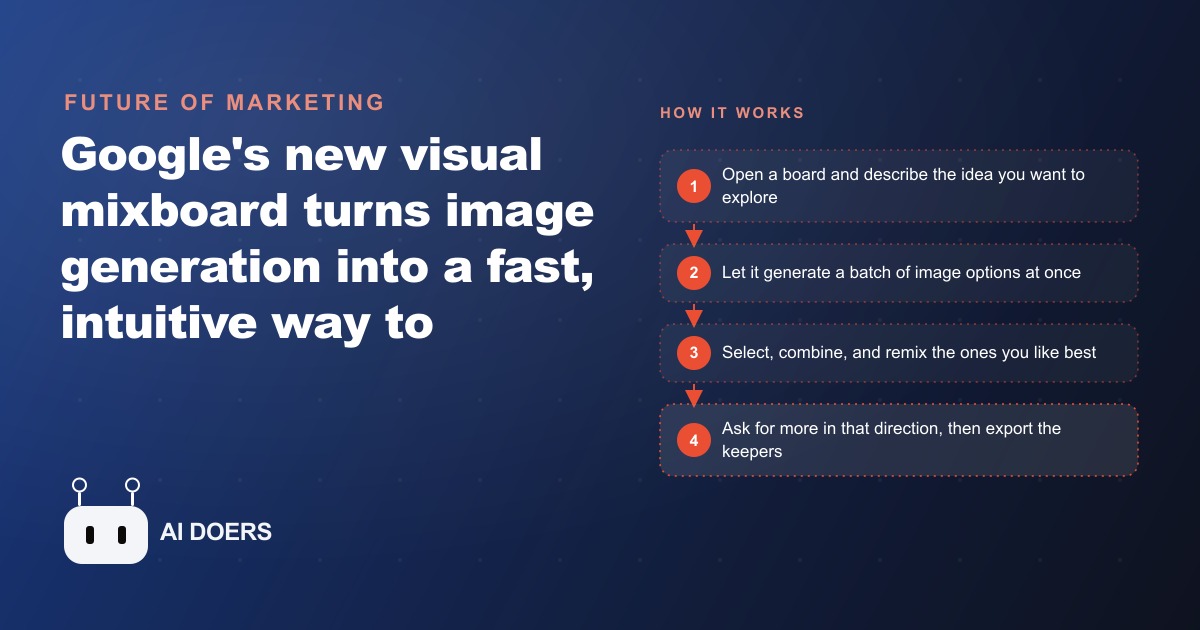
Most business owners do not freeze because they cannot make a marketing image. They freeze because they cannot decide what the image should be in the first place. A visual AI mixboard attacks exactly that moment, the empty canvas before any idea exists, and that is why I think it is one of the more quietly useful free tools a small business has right now. I am Madhuranjan Kumar, and I want to take this one tool apart properly, because the surface description, an image generator with a nicer interface, badly undersells what it actually does.
A canvas replaces the prompt box
The ordinary way people use image tools is transactional. You type a sentence, you get one picture, you either keep it or throw it away and type again. A mixboard breaks that pattern by giving you an open board instead of a single output slot. You describe an idea and it fills the space with a spread of options you can move around, group, select, and recombine. The interface itself is the point. It is built for thinking rather than for issuing one-off commands, and that difference in framing changes how you actually use it. Instead of hunting for the one correct prompt, you are arranging and reacting to a field of possibilities, which is much closer to how a designer works against a wall of pinned references.
Thinking in pictures produces better decisions
There is a real reason this matters. A lot of people reach a decision faster when they can see options next to each other than when they read a list of written suggestions. Words describe a direction, but a picture is the direction, and comparing three pictures side by side tells you in a second which one feels right. When the tool returns a batch of variations at once, you are no longer trying to imagine what your idea might look like. You are choosing between things that already exist on screen. That shift, from imagining to choosing, is the whole value, and it is why visual planning tends to move quicker than writing a brief and waiting to see if a designer read your mind correctly.
Abundance beats the search for one perfect prompt
The tools that frustrate people are the ones that hand back two or three timid samples and make you coax each one. A mixboard leans the other way. Ask for a concept and it returns a whole spread, and that volume is the feature, not noise. Picking a direction out of twenty options is a completely different task from squeezing a single acceptable result out of one carefully worded request. You stop editing prompts and start editing outcomes. For anyone who has ever burned an hour rephrasing a single instruction, this is a relief, because the board does the exploring and you do the judging, which is the part humans are actually good at.
Your own assets are the missing ingredient
Generic AI images look generic, and that is the trap most owners fall into. The mixboard sidesteps it by letting you drop in your real material, your logo, your product photos, a job-site shot, your brand colors, and fold those into the mix. You select a few of your own images alongside a generated concept and tell the board to blend them, and it returns compositions that still look like your business rather than a stock library. This is the difference between a picture that could belong to anyone and a picture that belongs to you. On-brand output is what makes the results usable in Facebook and Instagram ad campaigns instead of just fun to look at, because a creative that carries your colors and your product reads as authentic in the feed.
The branch and remix loop is where it clicks
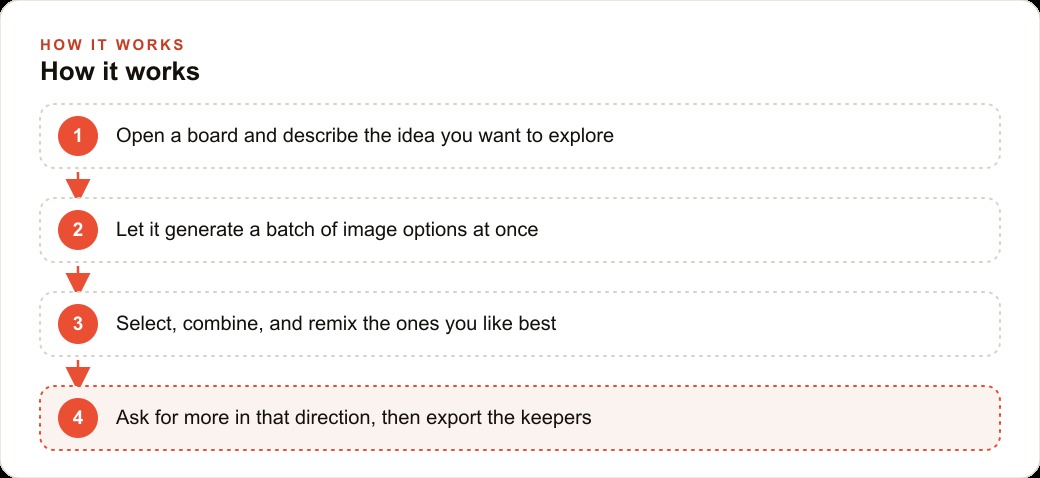
The single most important move is the loop. When something on the board is close but not right, you select the directions you like and ask for more along those lines, and the board seeds fresh variations from your choices. You are steering with images instead of rewriting paragraphs. Each pass narrows toward the version that fits, and because you are always reacting to concrete options, you never stare at a blank field wondering what to type next. Preset flows extend this. A themed-event planner, for instance, returns decoration ideas, activity ideas, and layout inspiration as a set of images, and the same structure plans a seasonal promotion, a booth, or a storefront display. The loop is the engine and the presets are shortcuts into it.
From a mood board to finished marketing
The board works in two directions, which people miss. Early on it is an idea generator, a way to escape the blank page. Later it is an asset producer. Once a direction lands, you build it out into the specific pieces you need, a social post, an offer graphic, a flyer, and assemble a collage so the whole concept reads as one coherent look. Because it can also return written ideas when you ask, the same board serves the person who wants a mood board and the person who wants a checklist. That range is what lets a single tool carry an idea from a vague feeling all the way to something a printer or a scheduler can work from, and that same visual foundation quietly supports SEO and organic search too, since the imagery you settle on can dress a landing page or a blog header without any extra design round.
A worked example: a plumbing company plans a winter campaign
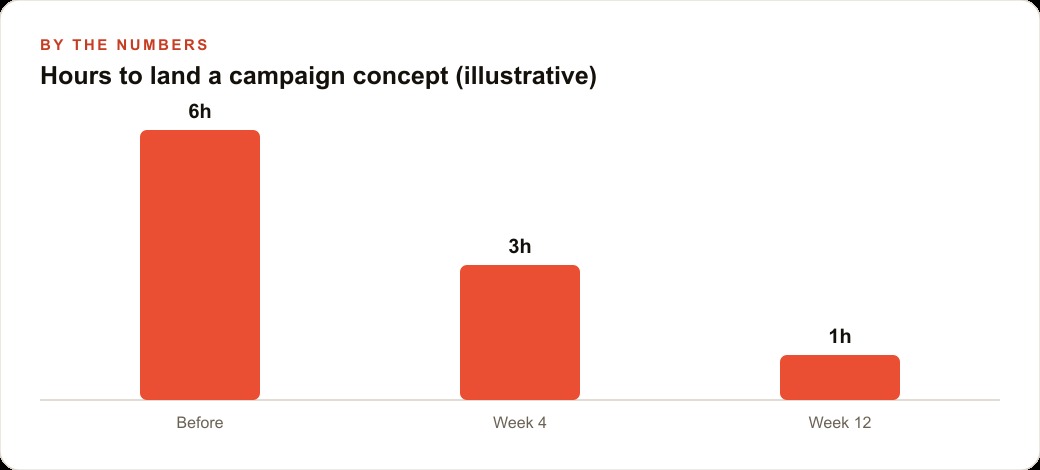
Let me make this concrete with numbers, and I will keep them illustrative rather than pretend they are audited. Imagine a one-van plumbing company that wants a winter pipe-protection push but has no designer and no budget for one. In the old world the owner might spend six hours across an evening wrestling with a template tool, and probably still ship something that looks homemade.
Here is how I would run it on a mixboard instead. First I upload the real assets, the van wrap, the logo, three job-site photos, and the two brand colors, so everything the board generates stays recognizably theirs. Then I describe one goal, a winter pipe-protection offer, and let the board return a batch of social-post concepts, a door-hanger layout, and a simple offer graphic. Instead of agonizing, the owner picks the three that feel right and asks for more in that direction. Twenty minutes later there is a consistent set: a feed post, a door hanger, and a website banner, all carrying the same colors and the same photo style.
The payoff is where a one-van operation actually competes, which is looking established. A tidy, consistent seasonal look across the truck, the site, and a few neighborhood posts makes a small operator read as trustworthy, and that trust is exactly what lifts response when those same graphics run as paid creative. Say the campaign concept that used to take six hours now takes one. Over a year of monthly seasonal pushes that is dozens of hours returned to the business, and the leads those graphics generate land in the CRM and website stack where follow-up handles the next few touches. The mixboard did not replace marketing judgment. It removed the slow, intimidating part so the judgment could actually get used.
The collage is the deliverable, not a nice extra
People treat the collage feature as a novelty, but it is actually the step that makes the whole tool pay off. A board full of scattered options is inspiration. A collage of the keepers is a decision. When you pull the three or four directions that survived the branching and arrange them into one composition, you have produced something a printer, a scheduler, or a team member can act on without any further explanation. That is the moment a vague feeling becomes a brief. I push clients to always end a session this way, because an unassembled board tends to get forgotten while a single concept image gets used. The collage also forces a choice. You cannot fit twenty ideas into one clean layout, so building it makes you commit, and commitment is exactly what the blank page was preventing in the first place.
There is a second reason the collage matters for a small business. It travels. You can drop it into a group chat with a partner, hand it to whoever runs your social accounts, or keep it as the reference the next batch of assets gets measured against. A written brief gets misread. A picture of the intended look almost never does. The board turns a fuzzy internal idea into a shared artifact, and shared artifacts are what keep a small team from producing five slightly different versions of the same campaign and arguing about which one is on brand.
Reacting is a fundamentally easier task than creating
The deepest reason a mixboard works is psychological, and it is worth naming directly. Creating from nothing is hard and slow for almost everyone. Reacting to something in front of you is fast and natural for almost everyone. Most marketing tools ask you to create, a blank template, a cursor blinking in an empty caption box, a prompt field waiting for the perfect words. The mixboard inverts the demand. It creates the options and asks you only to react, to say this one, not that one, more like these two. That inversion is why people who insist they are not creative can still produce good work here. They are not being asked to be creative in the hard sense. They are being asked to have taste, which they already have as customers of their own market.
Free is not a footnote, it is the whole unlock
I keep returning to the price, because zero cost changes who is allowed to do this work at all. In most small businesses the marketing visuals are made by whoever has a spare hour, the owner, the office manager, a part-time helper, none of whom is a designer and none of whom has a budget line for a creative suite. The instant a capable visual tool costs nothing, that constraint disappears. The person who used to avoid the flyer because it felt beyond them can now generate twenty starting points and react to them, which is a task anyone can do. That effect is easy to underrate from the outside and enormous from inside a one-location business.
Free also removes the sunk-cost trap. When a tool is expensive, people feel obligated to accept the first passable output because they paid for it. When it is free, you can throw away a whole board and start over with no guilt, which is precisely the mindset that produces good creative. You explore more when exploration is free. And because the same on-brand assets you generate here can carry straight into your paid creative and your organic posts, the zero-cost front end quietly lowers the cost of the entire marketing operation downstream, not just the design step.
One more thing the free price changes is cadence. A business that pays per project rations its creative and ends up with a stale look, the same banner for a year because refreshing it felt expensive. A business with a free board refreshes constantly, a new seasonal set every month, a fresh offer graphic whenever there is news, and that steady visual freshness is itself a signal of a living, active company. Frequency becomes possible only when the marginal cost of another concept is nothing, and frequency is what keeps a brand feeling current in a crowded feed rather than frozen in the year it last paid a designer.
Where the ceiling is, and where the floor is
I want to be honest about both ends. The ceiling here is genuinely high and the cost to start is nothing, which is a rare combination. But clean, on-brand results still take a little patience to learn the canvas and to feed it the right reference material. The first session will feel loose, the third will feel fast. If you are willing to invest a few focused hours you can absolutely run your own campaign planning this way and never touch a paid creative suite. If you would rather skip the learning curve and have the brand assets, the templates, and a repeatable visual workflow set up around your business so the marketing simply runs, that is the kind of system you hand to someone who has built it before. Either way, the meaningful change is that the blank page, the thing that actually stops most small-business marketing, stops being blank.
That is exactly what we do at AI DOERS. Book a private 30-minute call with Madhuranjan Kumar and we will map the fastest path to it for your specific business.
Book your call →
Madhuranjan Kumar
Madhuranjan Kumar brings 20 years of performance-marketing experience and has managed over $200 million in Facebook ad spend for brands across the United States and beyond. His expertise spans the full modern marketing stack: Meta, Google Ads, TikTok, email automation, CRM, and the websites that hold it together. At AI DOERS he turns that track record into lead-generation systems for businesses across every industry.