
Turning a Viral Idea Into a Working App With AI
You can take a simple idea from a video and turn it into a deployed, sign-in app in one sitting with AI. Here is the process, with a gym client app as a worked example.

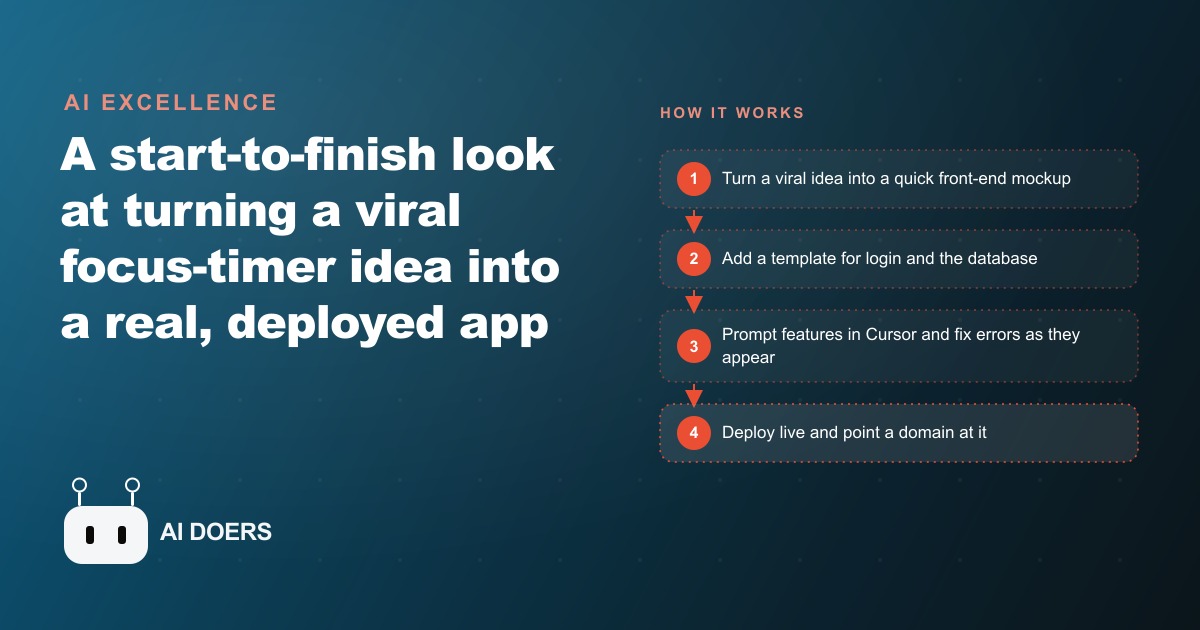
The gap between seeing an idea in a short video and holding a working, deployed app that runs it just collapsed to a single afternoon. That is the real development, and it is bigger than any one product launch. I am Madhuranjan Kumar, and I want to treat this the way it deserves to be treated, as news, because the thing that changed is not a feature. It is the economics of turning a thought into software. A simple concept, in this case a focus timer you twist to commit to one task and watch the work shrink, went from a clip on a feed to a real app with sign-in, a database, sounds, and a live domain in one sitting, with no code written by hand. The timer is not the story. The story is that the barrier between an idea and a shipped product effectively disappeared.
What actually changed is the cost of shipping, not the difficulty of the idea
For decades, the hard part of software was never the idea. Everybody has ideas. The hard part was the distance between the idea and a running product: hiring a developer, scoping a project, waiting weeks, paying thousands, and hoping the result matched what was in your head. That distance is what killed most small, useful tools before they were ever built. It simply was not worth it to commission custom software for a problem that only cost you a few hours a week.
The news here is that the distance shrank to almost nothing. A chain of AI tools, each doing one job, now covers the whole path. One tool turns a plain-English description into a front-end mockup. A starter template supplies sign-in and a database so users can actually save their data. An AI code editor with Claude inside it takes feature requests in plain English and writes the code across the right files. And when something breaks, and it will, you paste the error back and the AI fixes it. What used to be a project is now a conversation.
The mockup-first workflow flips the old order of building
There is a specific shift in method worth calling out, because it is what makes the single-afternoon timeline real. The old instinct was to plan every screen, every table, every edge case before writing a line. The new pattern reverses it. You generate a rough front end from one prompt, see it on screen, and then refine. You are reacting to something real instead of imagining it.
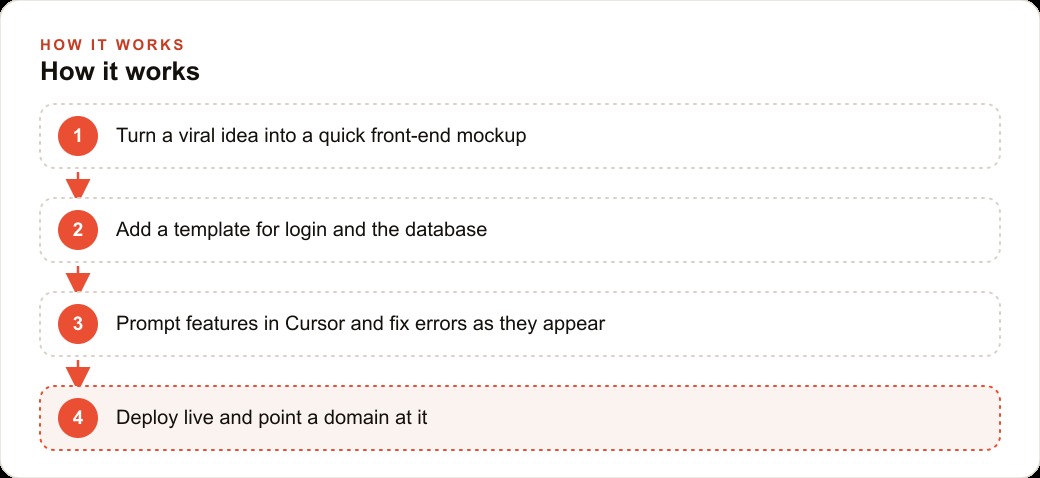
The sequence looks like this. First, describe the idea to a front-end tool: a black circle in the middle of the screen with a dial to set the time, and a prompt asking what you are working on when you start. The tool generates that screen in one shot. Now you have something to look at, but it has no login and nowhere to save data. So you add a template, a starter project already wired to a database and to Google sign-in, so you are not building authentication from scratch. Then you open the AI code editor and describe each feature in plain English: hook the timer to the database, let users save tasks, add a colored ring that fills as time runs, log completed sessions in a table. The editor writes and edits the code for you. You commit checkpoints as you go so a bad change never costs you the whole project, and when it works, you deploy it live, point a domain at it, and authorize that domain so sign-in works in production.
Errors stopped being roadblocks and became a normal step
The part that scares non-technical people is what happens when something breaks. Here is the mental shift the news demands. Errors are no longer a wall. They are a normal, expected step in the loop. You copy the error message or take a screenshot, paste it back to the AI, and tell it what went wrong. It reads the error, finds the cause, and fixes it. You re-test and move on. The skill is not avoiding errors. The skill is calmly feeding them back one at a time and not stacking five changes on top of a broken one.
Two habits make this smooth. First, always tell the AI to look at the whole codebase before it makes a change, because you will not always know which file holds the feature you want to edit. Second, fix one error at a time and re-test, rather than piling on changes and losing track of what actually broke. The deploy step often throws its own late hurdle, since the live site needs the domain authorized before sign-in works, so leave a little patience for that final stretch. None of this requires a programming background. It requires a willingness to iterate.
The small touches are what make it feel finished, and they are free now too
There is a detail in this story that is easy to skip but tells you how complete the shift is. It is not just the core logic that got cheap. The polish did too. Free tools now generate start and stop sound effects that make an app feel finished instead of like a rough prototype. A colored ring that fills as a timer runs, a satisfying chime at the end of a session, a table that sorts your history most-recent-first, these are the details that used to separate a real product from a weekend hack, and they used to require a designer and extra engineering time. Now they are a few more sentences to the AI.
This matters more than it sounds, because polish is what earns trust. A member will not keep opening a tool that feels broken or ugly, no matter how clever the idea. The fact that the finishing touches are now nearly free means the bar for a shippable small app rose and the cost of clearing it fell at the same time. You can produce something that looks and feels professional without a budget, which is exactly what makes these tools dangerous in the hands of an owner who understands their customer.
Who this changes things for, and it is not developers
The instinct is to read this as a story about programmers losing work. That misreads it. The people this changes things for are the owners of small businesses who have been quietly wishing a specific tool existed and assuming it was out of reach. A focus timer is just one shape of a much larger idea: a simple tool that gets people to repeat a useful action and tracks their progress. A coaching business could build a daily check-in. A tutoring center could build a study-session tracker. A clinic could build a recovery-exercise timer. The build process is identical every time. Describe the idea, add the template, prompt the features, deploy. What differs is only the specific habit you are trying to reinforce, and you already know that better than any outside developer ever could.
Notice where the advantage actually sits. It is not with whoever can write the most code, because the code is now cheap. It is with whoever understands the customer and the habit most deeply. A developer with no sense of why members quit will build a technically perfect timer that nobody uses. An owner who has watched a hundred members drift away knows exactly which nudge, which streak, which small reward keeps someone coming back, and can now build it themselves. You know exactly which action your customers struggle to keep doing, and why they drop off. That knowledge is the scarce ingredient now. The AI supplies the engineering. You supply the judgment about what is worth building and how it should feel.
A worked example: a member consistency app for a gym
Let me make this concrete with numbers. Picture a gym or fitness studio where the owner knows the real enemy is inconsistency. Members sign up motivated, come three times a week for a month, then drift to once a week, then stop, then cancel. Every lost habit is a lost membership.
Here is the app I would build, in one focused sitting. A member signs in with Google and sees a clean timer. They pick a quick task, say a 30-minute strength block or a 10-minute mobility routine, set the dial, and start. A ring fills around the timer so they can see progress at a glance. A small prompt nudges them to stay focused, and a sound plays at the start and end so they know when to switch. Every finished session logs to their history, so instead of guessing, they can see they trained 14 times this month.
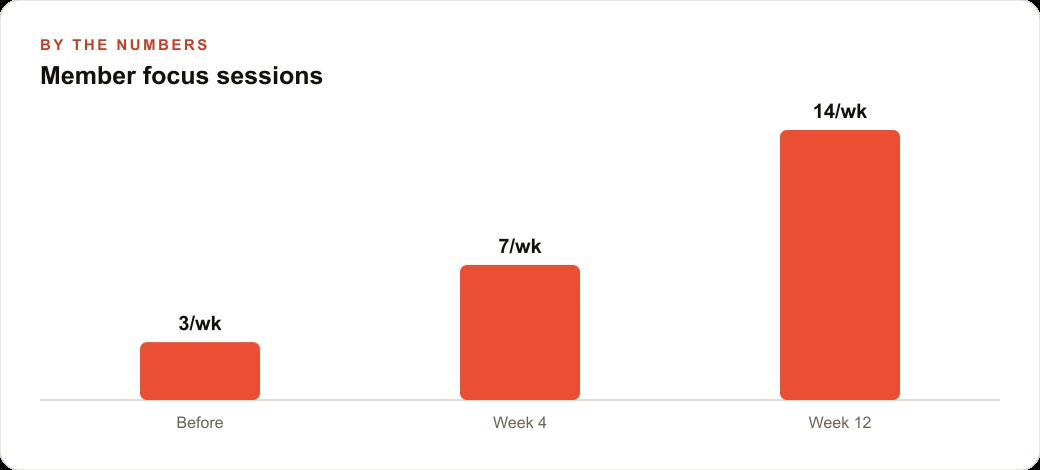
The build steps map exactly to the workflow above. Generate the timer screen from a prompt. Add the template for sign-in and saved data. Prompt the AI code editor to add preset workout tasks, the colored progress ring, start and stop sounds, and a completed-sessions table sorted most recent first. Deploy it to a branded domain and authorize it. Say the graph of a typical member's focus sessions climbs from 3 a week before the app to 7 by week four and 14 by week twelve. That is not a vanity number. If keeping a member consistent lifts their odds of renewing, and even 20 extra members hold onto a 60-dollar-a-month membership for three more months because a visible streak kept them coming, that is roughly 3,600 dollars of retained revenue traced back to a weekend build. The app quietly does what discounts and reminder emails struggle to do: it makes the habit visible.
The retention story is where this connects to the rest of a business. A branded app that lives in a member's pocket is a marketing asset, not just a utility. The same members who log sessions are the ones you want to reach again through Facebook and Instagram ad campaigns with a lookalike audience built from your most consistent people. The sign-ups and session data land in the CRM and website stack where a lapsed-member follow-up can fire automatically the moment someone's streak breaks. And an app people actually open gives you fresh, real content, member milestones and routines, that feeds SEO and organic search without any extra effort. One weekend build touches acquisition, retention, and content at once.
How to run this yourself, and where the real work still lives
If you want to try it, start with one idea and follow four steps. Describe the idea to a front-end tool and get a mockup. Add a template so login and the database are handled. Open the AI code editor, prompt each feature in plain English, and when errors appear, paste them back and let the AI fix them. Then deploy live, point a domain at it, and authorize that domain so sign-in works. Save checkpoints often, and expect the small touches, sounds, sorting, presets, to take a few rounds of prompting. That back-and-forth is the work now, and it is far faster than learning to code first.
Be honest with yourself about where the difficulty moved. It did not disappear. It relocated. The hard part is no longer writing the code. It is describing the workflow precisely, steering the model when it gets stuck, and having the judgment to know when a feature is good enough to ship versus when it needs another pass. That judgment is exactly what separates a working tool from an abandoned half-built demo. A focused owner can build that first timer or check-in app over a weekend and learn a genuinely useful skill in the process. If you would rather hand the idea to someone and get a finished, branded app without the trial and error, that is a fair trade too. Either way, the headline stands: the idea in your head is now closer to a shipped product than it has ever been, and the only real question left is which one you build first.
That is exactly what we do at AI DOERS. Book a private 30-minute call with Madhuranjan Kumar and we will map the fastest path to it for your specific business.
Book your call →
Madhuranjan Kumar
Madhuranjan Kumar brings 20 years of performance-marketing experience and has managed over $200 million in Facebook ad spend for brands across the United States and beyond. His expertise spans the full modern marketing stack: Meta, Google Ads, TikTok, email automation, CRM, and the websites that hold it together. At AI DOERS he turns that track record into lead-generation systems for businesses across every industry.