
Vibe Coding for Owners: Build Your Own Custom Business Tools
People now build working software by describing what they want and letting AI write the code. Here is how a small business owner uses the same approach to build tools they used to pay a developer for.

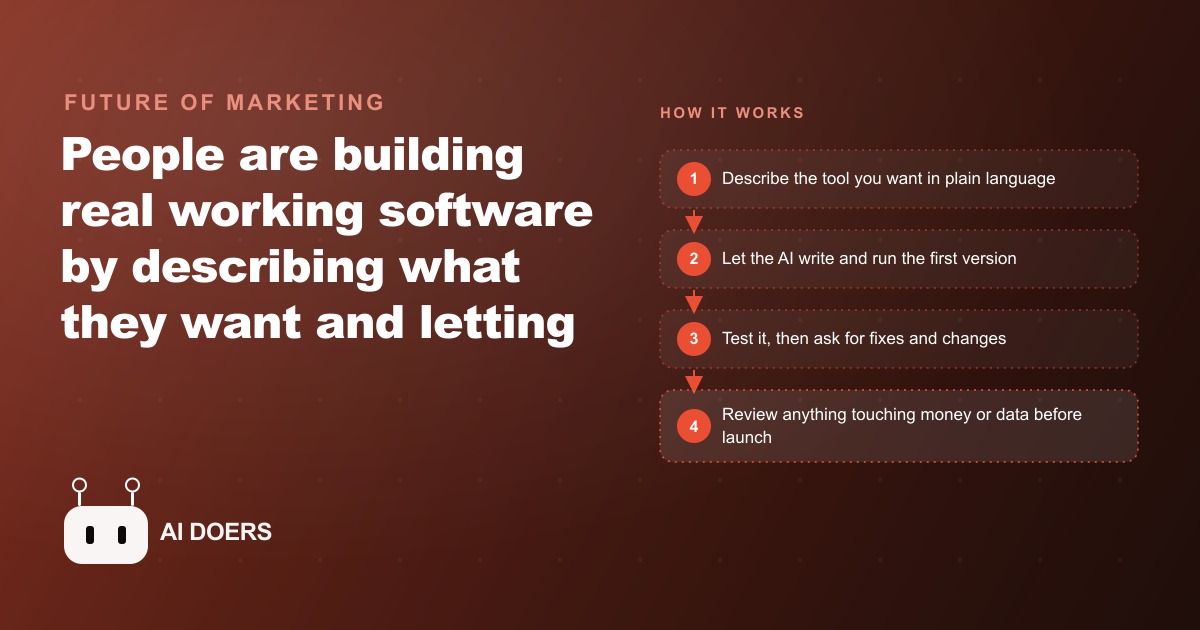
The gap between wanting a custom tool and having one is now hours, not months
I have been talking to small business owners about technology for years, and the single most common frustration I hear sounds like this: "I wish I had a tool that did exactly this one thing, but it would cost too much to build and the closest SaaS option makes me pay for ten features I do not need just to get the one I want." That friction is real. For most of the history of software, custom tools were simply out of reach for owners who did not have the budget for a development contract or the time to learn a programming language.
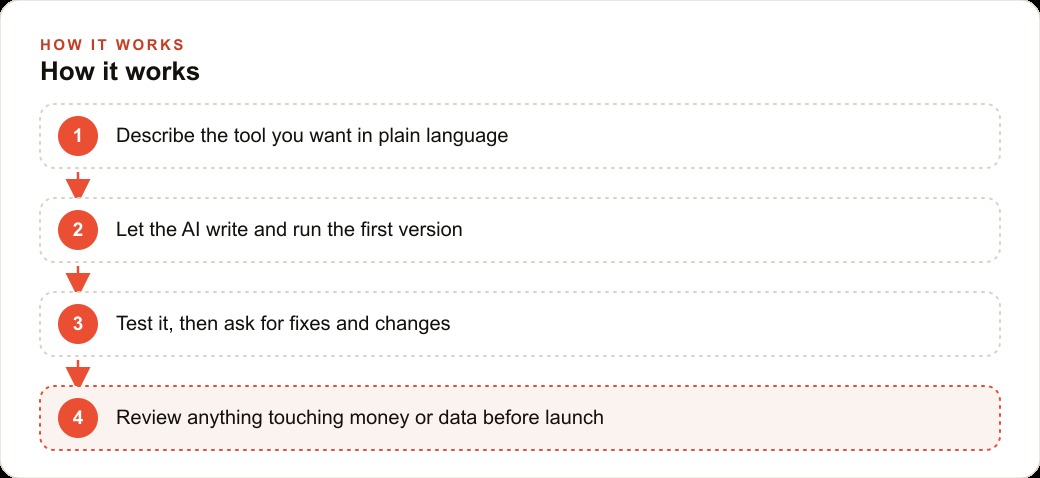
That gap has essentially closed. The shift is called vibe coding, and it means building software by describing what you want in plain language and letting an AI write the actual code. You do not learn syntax. You do not memorize a framework. You describe the thing you need, the AI builds a first version, you test it, and then you describe what is wrong or missing until it works the way you intended. The first working version of a simple internal tool can exist within a few hours of the first conversation. That timeline used to take weeks at minimum, with a developer invoice attached.
The practical consequence for an owner is significant. Every custom tool you ever wished you had but could not justify building now has a realistic path from wishful thinking to working software. The constraint that kept most business operators away from custom software was not imagination. It was the translation layer between "here is what I need" and "here is working code," and that layer no longer requires a professional intermediary.
Why describing in plain language produces working code
The reason this works is not magic but a shift in what the AI is actually doing. Modern AI coding assistants have been trained on enormous amounts of existing code, which means they have seen the patterns behind nearly every common tool a business might want to build. When you describe your need in plain English, the AI does not guess at a solution from scratch. It recognizes the pattern your description most closely matches and generates code that fits that pattern.
When you say something like "I want a page where my staff can log how many of each supply we have left, and it should send me an email when anything drops below ten units," the AI reads that as a database form with a threshold-trigger email notification. It has seen that pattern built thousands of times in various forms, so it writes the code that fits. What you experience as describing is what the AI processes as specifying a known pattern in an informal language rather than a formal one.
This is why the quality of your description matters more than it might seem at first. Vague descriptions produce vague code, not because the AI fails to understand you but because a vague description matches several patterns at once and the AI picks one without a reliable basis. The more specific you are, the narrower the match, and the better the first draft. Describing the inputs, the outputs, and the specific moments the tool needs to act makes every revision loop shorter and more precise.
Consider the difference between "an inventory tracker" and "a form where staff enter a product name, a count, and a supplier name, and which sends me an email when any count goes below a threshold I set per product." The second version produces a much better first draft because it contains the key design decisions the AI needs to make sensible choices. That specificity is not a burden. It is the skill that develops with practice, because you are learning to think clearly about what you want rather than learning to type code.
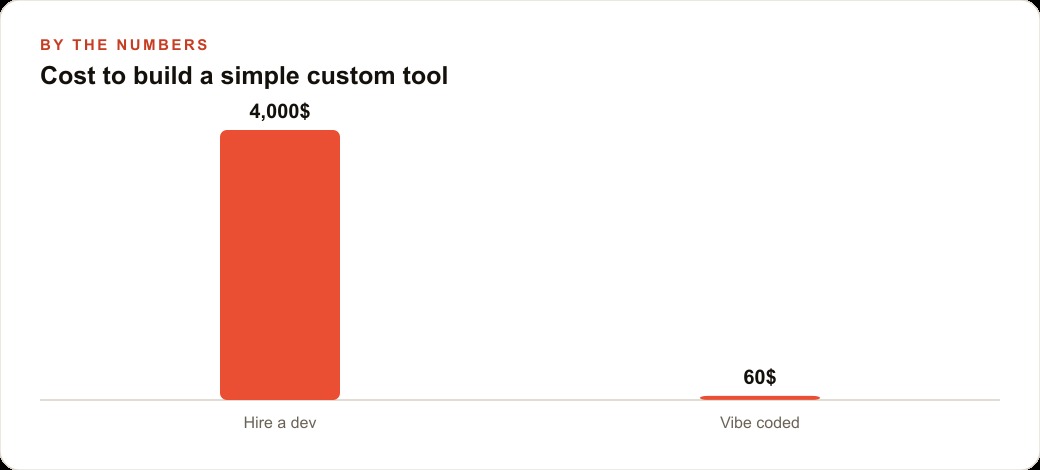
The ownership shift that separates vibe coding from SaaS subscriptions
The economics of vibe coding are fundamentally different from subscribing to software. When you pay a monthly fee for a SaaS product, you are renting access to a feature set designed for a general market. You pay for the features you use and the ones you do not. You accept the vendor's update schedule, their pricing decisions, and their risk of discontinuation. If the vendor adds a feature you needed and charges more for it, you pay more. If they remove a feature, you adapt or switch. The tool serves their product roadmap, not your specific workflow.
When you vibe code a tool, you own the result. The code the AI produces belongs to you. You can change it by describing the change in a new conversation. You can give it to a developer to extend later. You can host it yourself or move it to a different server without permission from anyone. No monthly fee accrues after the build. No pricing tier locks a feature behind an upgrade. The total cost of the tool is the AI subscription you likely already use for other work and the time you spent directing the build.
That shift in ownership is not a minor accounting detail. It changes the long-term economics of every tool you build. A custom inventory alert that costs an afternoon to build and then runs for two years costs far less over that period than paying a monthly fee for a system that includes the same capability buried inside a package of other features. Multiply that across three or four small tools and the difference adds up to a meaningful number over a year.
More importantly, those tools are fitted exactly to your business. They do not ask you to adapt your workflow to their interface. You described what you needed, so the interface matches the way your team already thinks about the task. That fit, that precise alignment between the tool and the work, is something a general-purpose SaaS product cannot replicate because it is not built for your specific operation.
Directing output is the skill, not typing syntax
The skill that most people expect vibe coding to require is typing code. The skill it actually requires is directing output precisely. The distinction matters because it completely changes who can do this well.
Someone who can describe what they want clearly, test whether the result matches the description, and articulate the gap between them in specific terms is already equipped for vibe coding. That is a description of a competent manager or owner, not a programmer. The AI handles the syntax, the framework, and the file structure. You handle the judgment about whether the result does the right thing in the real world.
The revision loop is where most of the practical skill lives. The first version is almost always a working prototype that needs adjustment. The question is how quickly you can close the gap between what it produced and what you actually need. Generic feedback like "it does not work right" produces slow revisions because the AI has to guess which of several possible problems you mean. Specific feedback like "the email fires when the count is updated rather than when it first drops below the threshold, and I need it to fire only once per item until someone manually resets it" produces a precise revision in one exchange.
Learning to describe gaps precisely rather than vaguely is the practical skill that vibe coding rewards. It improves with each tool you build, and most people find that after building two or three tools their descriptions are noticeably sharper. They have learned through iteration what level of detail the AI needs to make good choices without guessing. That is the editing instinct: not someone who writes every line but someone who reads output well and knows exactly what to change and how to say it.
There is also a second part of the skill that is easy to underestimate, which is knowing when to stop refining and start using. The temptation after a few successful revisions is to keep polishing. A tool that is ninety percent right and being used by your team today generates more value than a tool that is one hundred percent right and still being revised next month. Build it to the point where it solves the problem reliably, ship it internally, collect real feedback from the people using it, and let their actual experience of the tool drive the next round of refinement.
The safety threshold every owner needs to draw
The appeal of vibe coding is speed, and speed creates a specific risk that every owner needs to understand before building anything that matters. When the AI writes the code and you test only whether it looks and feels right, you can end up running software you have never actually read. For an internal tool that tracks supplies or logs attendance, the risk of that gap is low. For anything that handles customer payments, stores personal data, processes medical or financial information, or runs on your public website where real customers interact with it, that gap is a genuine liability.
I draw the safety threshold at the point where a failure would affect a real customer or a real transaction. Below that threshold, build freely and iterate until it works. Above that threshold, before the tool ever faces the real world, someone who can actually read code needs to review what the AI built. That person does not have to be expensive or available for a long engagement. A freelance developer can review a small tool in an hour or two. What they look for is straightforward: whether the inputs are validated so someone cannot submit unexpected data, whether the payment integration handles errors correctly, whether personal data is stored safely rather than logged somewhere it should not be.
The reason this review step matters specifically for AI-written code is the same reason it matters for any code written quickly: shortcuts. When any builder is optimizing for a working output rather than a hardened one, the first version often takes the easiest path to a result. The easy path is rarely the secure path. Building the review step into your process for anything customer-facing is not a signal that vibe coding is untrustworthy. It is just the cost of doing software responsibly at any speed.
The smart owner draws this line clearly before starting any build, because drawing it after the fact tends to mean drawing it after a problem has already occurred. Low-stakes internal work, go ahead and build quickly. Customer-facing work with data or payments, build first and then get it checked. That discipline, applied consistently, captures the speed benefit of vibe coding without taking on the security risk.
How a coffee shop built three tools for the price of one developer hour
I want to walk through a practical illustration because the abstract case is less useful than a concrete one for understanding how the pieces fit together in real life.
Consider a coffee shop owner who wants three things: a loyalty tracker so regulars earn a free drink after ten visits, an order-ahead form so the morning rush moves faster, and an internal stock alert that tells them when to reorder cups or beans. Before vibe coding, the path to those three tools was either three separate SaaS subscriptions, each with its own monthly fee and learning curve, or a developer contract priced somewhere that made all three feel like a luxury the margins did not justify.
With a vibe coding approach, the owner starts with the loyalty tracker because it is internal, low-stakes, and self-contained. They describe it to an AI coding assistant: a page where the barista enters a customer's phone number, the system increments their visit count, and it shows a reward prompt when the count reaches ten. The AI builds it. The owner tests it at the counter for a week, finds that the barista wants a confirmation screen before the count increments to avoid accidental double-taps, and describes that change. Two revisions later the tool works the way the owner imagined it.
Next comes the stock alert. Same internal, low-stakes profile. The owner describes a form where staff enter a product name and current count, and an email sends to the owner when any count drops below a threshold they set per product. Because the owner now has one tool under their belt, they know what level of detail in the description produces a good first draft, so the initial version is close to right. One revision later it is done.
The order-ahead form is where the safety threshold applies. Because it will take customer information and potentially connect to payment processing, the owner gets the finished version reviewed before it goes live. That review is one developer hour, not a full contract. The developer confirms the inputs are validated, the data is stored safely, and the payment connection handles failures correctly. The owner publishes it with confidence.
Three tools. One week of spare time spread across the builds. One short professional review for the customer-facing piece. The total cost is a small fraction of what a developer contract for the same three tools would have been, and the owner holds the code outright with no recurring fee.
Building small as a repeatable habit
The owners who get the most from vibe coding are not the ones who build something ambitious once. They are the ones who make building small tools a habit, the way other business owners make reviewing reports or checking inventory a habit.
The habit looks like this: when a workflow becomes a source of friction, instead of tolerating it or searching for a SaaS solution, the owner spends an afternoon describing a small tool to address it. If the tool works, it joins the operational stack. If it does not quite land on the first attempt, the afternoon still produced a clearer understanding of the problem and a first draft to refine tomorrow. Over six months that habit produces a set of small tools precisely fitted to the business that no competitor can simply purchase off a shelf, because no off-the-shelf product matches the specific quirks of a specific operation.
The compounding effect runs in two directions. First, the tools themselves compound in value. A loyalty tracker that has run for six months contains real data about customer visit frequency that the owner can use to make better decisions about rewards and timing. An inventory alert that has been running for six months has been tuned through real use to the actual reorder rhythms of the business. Second, the owner's building skill compounds. The second tool is easier to build than the first because the description skill has improved through practice. The third is easier still.
By the fifth or sixth tool, the owner can sit down with a problem and have a working prototype within a few hours because they know exactly what to describe and what to look for in the first draft. What changes for that owner over time is not just the specific tools they have built. It is their fundamental relationship to operational problems. A problem that used to mean "we will live with this because fixing it costs too much" now means "let me spend an afternoon and see what I can build." That shift in posture, from passive to active about software, is the quietly significant outcome that vibe coding makes possible for owners who commit to it as a genuine habit rather than a curiosity to try once and set aside.
The practical starting point is always the smallest, most internal tool on the wishlist. Not the customer-facing feature, not the complex integration, not the ambitious platform idea. The small internal thing that costs your team real time every day. Build that first, prove the habit works for your business, and let the next obvious candidate emerge from actually using the first tool in the real work it was built for.
That is exactly what we do at AI DOERS. Book a private 30-minute call with Madhuranjan Kumar and we will map the fastest path to it for your specific business.
Book your call →
Madhuranjan Kumar
Madhuranjan Kumar brings 20 years of performance-marketing experience and has managed over $200 million in Facebook ad spend for brands across the United States and beyond. His expertise spans the full modern marketing stack: Meta, Google Ads, TikTok, email automation, CRM, and the websites that hold it together. At AI DOERS he turns that track record into lead-generation systems for businesses across every industry.