
Describe-It-and-Build-It Software Lets Businesses Own Tools Instead of Renting Them
AI that turns plain English into working apps is rattling the old store model and giving businesses a way to build custom tools cheaply, including a patient app a dental practice could own outright.

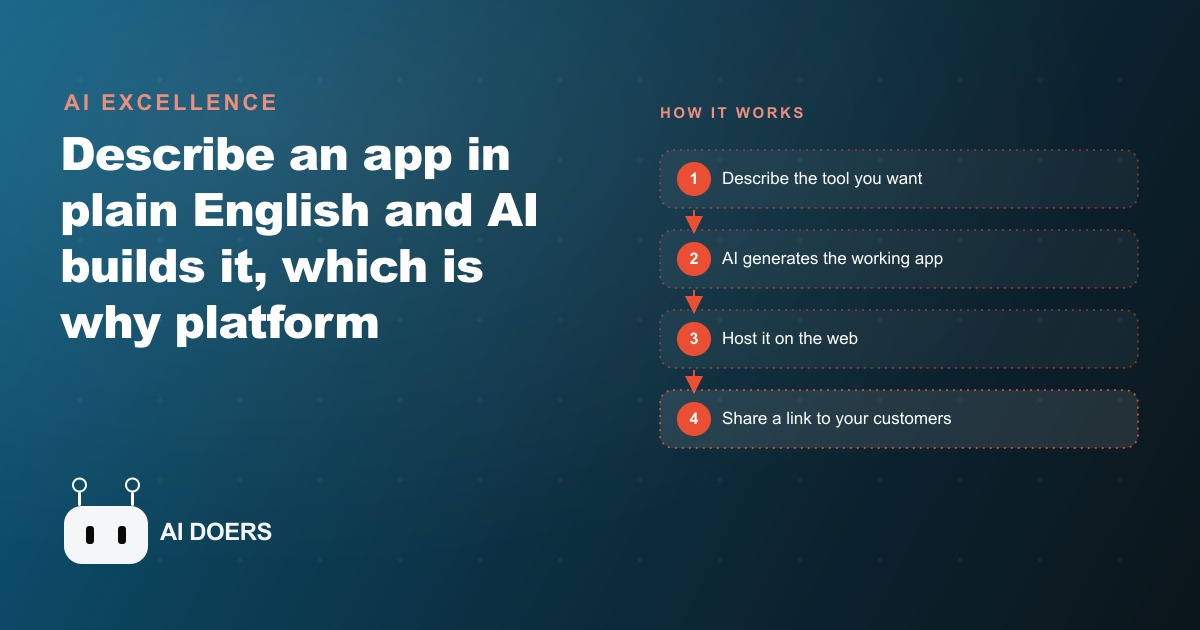
Every month your business pays per-seat SaaS fees for software tools you could own outright is a month you are funding the gatekeeper instead of building equity in your own operation. That is not a metaphor. It is the current commercial structure of software, and AI tools that let non-developers build custom software in plain English are beginning to change which side of that structure small businesses sit on.
The change is not hypothetical. Businesses are already describing what they need in plain language, getting working software back in hours or days, hosting it themselves, and paying no ongoing license fees for the core functionality. The scale at which this is happening is still small relative to the total SaaS market, but the direction is clear enough that ignoring it is a planning failure.
The per-seat model was never about your convenience
Per-seat SaaS pricing became the dominant software business model for reasons that had nothing to do with the interests of buyers. It was a revenue model that converted a one-time sale into a recurring subscription, applied a multiplier based on headcount rather than value delivered, and made switching expensive enough that retention required minimal investment compared to acquisition.
The pitch at the time was that SaaS removed the burden of software maintenance from buyers. You did not need to manage servers or handle updates. The vendor did that for you. For businesses without technical staff, that was a genuine benefit in the 2000s when enterprise software was genuinely complex to maintain. The convenience was real.
What changed is that the convenience benefit has eroded as infrastructure became simpler and managed hosting became cheap, while the cost of per-seat pricing has continued to rise. A ten-person team paying for a project management tool, a CRM, a communication tool, a document tool, and a scheduling tool is running several hundred dollars per month in software fees for tools that could, in many cases, be replaced by custom-built alternatives that the business owns and that cost a fraction of that in hosting.
The gatekeeper role that platforms play goes beyond pricing. Platform owners control which features get built, when they get released, and whether they exist at all. A business that needs a feature the platform has not prioritized waits, submits a feature request into a void, or pays for a workaround. The business's needs are a factor in the platform's product roadmap decisions only to the extent that the business represents a meaningful fraction of the platform's revenue. For small businesses, that fraction is essentially zero.
The per-seat model also ties capability expansion to headcount in a way that punishes growth. Adding a team member adds another seat fee across every tool in the stack. The cost of the software scales with the business even when the value the business derives from the software does not scale proportionally. A team that grows from five to ten people does not necessarily need twice the software capability. But it pays twice the software cost.
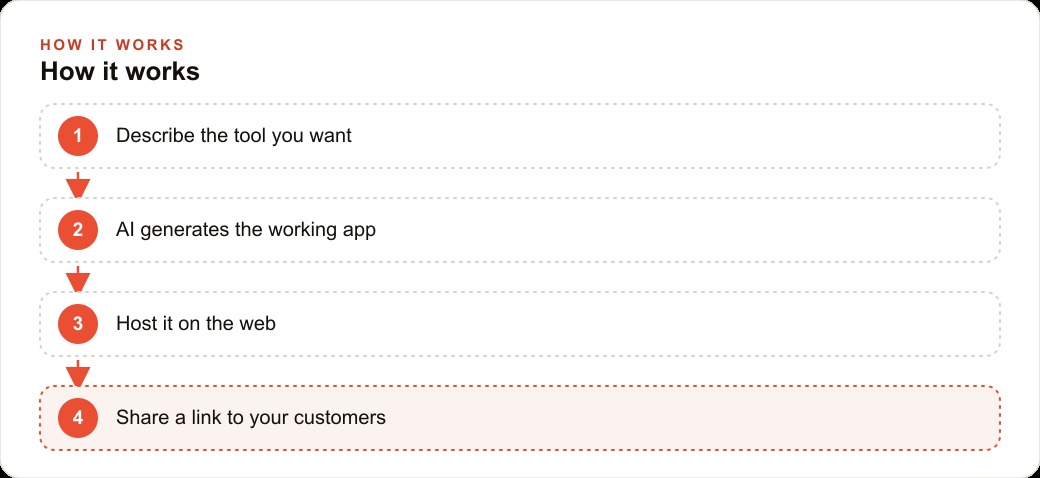
Describe it in plain English, own it outright
The category of tools that let you describe an application in plain language and receive working software has a shorthand name: vibe coding. The name undersells what is actually happening. A developer working with AI coding assistance is not simply transcribing English into code. The AI is handling the translation between a described requirement and a working implementation, making design decisions, handling edge cases, writing tests, and producing something that runs.
For a non-developer, this means that the gap between "I need a tool that does this specific thing" and "I have a tool that does this specific thing" has collapsed to a question of hours or a few days rather than months and a significant budget. The tool that gets built is owned by the business. It runs on hosting the business controls. It has no per-seat license fee. Its features are whatever the business needs them to be.
This is not the same as using a no-code drag-and-drop builder that produces something within the platform's constraints. A tool built with AI coding assistance is real software. It can be modified, extended, integrated with other systems, and hosted anywhere. Its existence does not depend on the platform that created it. If you want to change how it works, you change the code. If you want to add a feature, you describe it and get the implementation.
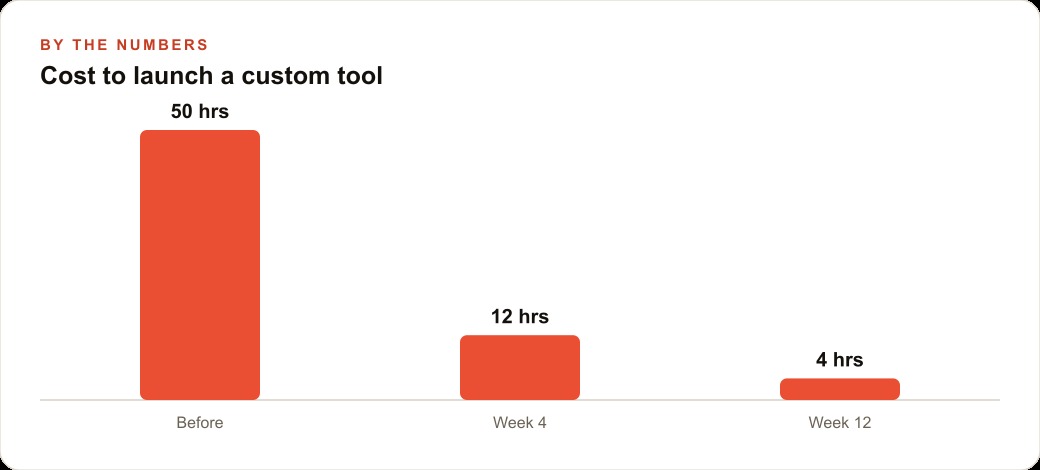
The economic comparison is straightforward. A custom intake and routing tool built in a week of AI-assisted development and hosted at ten dollars a month on a standard cloud provider competes economically with a SaaS subscription at sixty to two hundred dollars a month per seat before the end of its first year. After the first year, the owned tool costs only its hosting. The SaaS subscription costs its seat fees forever, and those fees typically increase on a schedule the platform sets unilaterally.
The CRM and website stack is the area where this comparison is most concrete for small businesses. Generic CRM tools are built to serve the median customer across every industry. They are excellent at the common cases and awkward at the specific workflows that define how any individual business actually operates. A custom CRM built around a specific business's actual workflow is faster to use, requires less training, and contains exactly the fields and views that the business needs without the unused complexity that comes with a general-purpose platform.
What a dental practice's owned patient app looks like
A dental practice interacts with patients through a recurring cycle: booking appointments, confirming and reminding, collecting pre-visit information and consent forms, processing payments, and managing follow-up for recalled patients who are due for a next visit. Each of those steps currently involves at least one software subscription, and several of them involve per-patient or per-transaction fees on top of the base subscription.
An owned patient management application for a dental practice consolidates those functions into a single system that the practice controls. The booking interface shows availability from the practice's own calendar. Confirmation and reminder messages go out through a messaging integration the practice pays for at cost. The consent and pre-visit forms collect information that goes directly into the practice's own records. Payment processing connects to the payment processor of the practice's choice rather than a bundled option with worse rates.
The owned application does not need to match the feature depth of the largest patient management platforms. It needs to handle the specific workflow of this practice, with the fields this practice uses, in the order this practice follows them. AI-assisted development produces exactly that specification, because the input to the development process is a description of this practice's workflow rather than a generic template that everyone who buys the platform gets.
The practice also gains control over patient data. With a SaaS patient management tool, the patient records are stored in the platform's database. The practice accesses them through the platform's interface. If the platform is acquired, shuts down, or changes its terms, the practice's access to its own patient history depends on the platform's cooperation. With an owned application, the data is in the practice's own database, accessible through whatever tools the practice chooses.
The web-based app delivery model makes this practical for patient-facing features in a way that the old native app model did not. A web app the practice hosts does not require patients to download anything. It works on any device with a browser. And critically for a small practice, it avoids the distribution gatekeepers entirely. Patients get a link, not an app store page.
Why the gatekeepers are enforcing old rules right now
App store platforms are currently enforcing rules built around a native app distribution model that made sense when the alternative was shipping software on physical disks and managing your own distribution network. The 15 to 30 percent commission that platforms charge on transactions processed through apps was a fee for providing the distribution infrastructure that developers could not build themselves. In 2025, that infrastructure justification is much thinner.
Web-hosted applications accessible through browsers provide functionality that was native-app-only five years ago. Progressive web app technology has reduced the gap in user experience between a native application and a well-built web app significantly. The distribution the platform provides is still valuable for consumer discovery, for apps that need to appear in a search result inside the app store itself. But for a dental practice sending a link to its existing patients, the app store distribution adds nothing while the app store commission tax on every payment transaction adds real cost.
The platforms are enforcing the old rules because the old rules protect short-term revenue. A 30 percent commission on every in-app transaction is a significant revenue line. Relaxing that rule in response to the changing technology would require reducing revenue, which is a decision that conflicts with quarterly reporting priorities. The rules are therefore maintained with the logic that they protect the platform's quality standards and security review processes, arguments that have some validity but that also happen to conveniently justify the fee structure.
The direction of the technology is clear regardless of how the platforms enforce current rules. Facebook and Instagram ad campaigns for small businesses have already moved to web-based interfaces for the most revenue-sensitive features precisely to avoid app store commissions. The playbook exists. The regulatory pressure on platform commissions in the European Union and in litigation in the United States has also opened more room for businesses to route customers to owned web experiences rather than platform-mediated ones.
The businesses that move first will own the tools; the rest will keep renting
The first mover advantage in building owned software is compounding. A business that builds a custom intake tool, learns the workflow for maintaining and improving it, and accumulates a year of operational experience with owned software understands the model well enough to extend it. A business that waits accumulates another year of per-seat fees and another year of adapting its workflows to what generic platforms allow.
The capability required to build and maintain owned software is lower than it has ever been, and it is still decreasing. A non-technical business owner who describes a workflow to an AI coding tool today can produce working software in a time frame that would have required a contracted developer relationship two years ago. That capability will continue to improve, which means the barrier to owned software is declining while the cost of rented software is rising.
Running Google Ads requires understanding customer acquisition economics across the full funnel, not just the ad click. The businesses that understand their funnel well enough to build tools around it are the same businesses that will recognize when the owned software model makes economic sense and move before the market catches up.
The transition does not require replacing every subscription at once. It starts with identifying the single SaaS tool whose per-seat cost is most out of proportion to the value it provides, building a simpler owned alternative that handles the specific functions the business actually uses, and running both in parallel until the owned version is reliable. That cycle, repeated once or twice a year, gradually shifts the software cost structure from recurring rents to owned infrastructure.
The non-technical barrier to starting that cycle is lower than it has ever been. Describing a workflow requirement in plain language to an AI coding assistant and getting a working prototype back within a day or two is achievable for most straightforward business tools. The result is not always production-ready immediately, but it is a functional starting point that can be refined. That iterative refinement happens on a schedule the business controls, not a schedule the platform sets based on its own roadmap priorities.
The businesses that moved to cloud software early built competitive advantages in operational efficiency that took competitors years to close. The businesses that recognize the shift from rented to owned AI-built software early will build the same kind of advantage. The tools will continue to be available for rent to whoever waits. But the economics of building and owning are clear enough now that waiting is a choice with a cost, not a neutral default.
That is exactly what we do at AI DOERS. Book a private 30-minute call with Madhuranjan Kumar and we will map the fastest path to it for your specific business.
Book your call →
Madhuranjan Kumar
Madhuranjan Kumar brings 20 years of performance-marketing experience and has managed over $200 million in Facebook ad spend for brands across the United States and beyond. His expertise spans the full modern marketing stack: Meta, Google Ads, TikTok, email automation, CRM, and the websites that hold it together. At AI DOERS he turns that track record into lead-generation systems for businesses across every industry.