
Using a Top-Tier Reasoning Model to Build Real Software in Stages
A premium reasoning model can plan and write a full working app, but the results depend on how you prompt it: front-loaded instructions, a staged plan, the whole codebase in context, and a review after every step. Here is the method and how I would apply it for a real business.

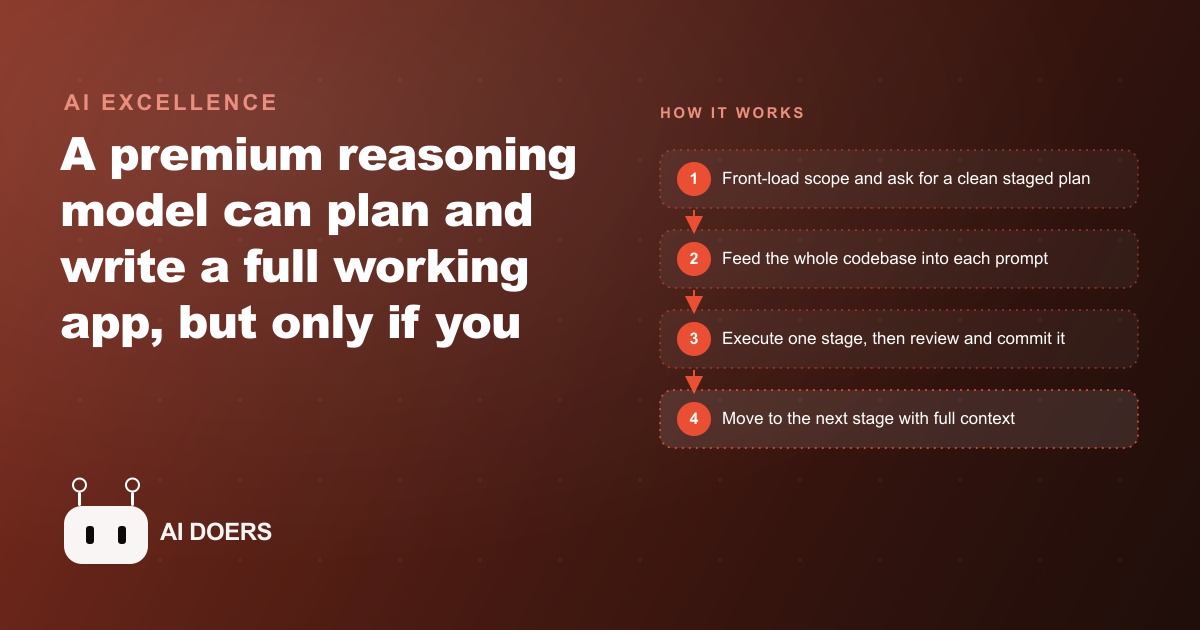
A top-tier reasoning model thinks for five or ten minutes before it answers. That is the whole premise, and it changes how you need to prompt it. I am Madhuranjan Kumar, and the honest position is that the model is only half the story. The other half is the discipline of working with it in stages. Because a single answer can take ten minutes, sloppy prompting is expensive in a way it is not with a fast model. You wait, get something half-useful, and have to wait again. Used well, a reasoning model can plan and build a complete working application from a plain-English description. Used carelessly, it burns time on vague requests.
Here are the rules that make the difference.
Front-load every instruction into the first prompt
A reasoning model runs for a long time per prompt, so the most expensive mistake you can make is submitting something incomplete and having to prompt a second time for the missing piece. Everything the model needs to build this stage belongs in the first prompt: the project scope wrapped in clear tags, the context it needs, any constraints like do not overengineer, and a specific request like give me a clean five-step plan before any code. Packing the first prompt is not about being verbose. It is about eliminating the need for a follow-up.
This is different from how most people use a faster chat model, where a short prompt and a few rounds of back-and-forth is cheap and fast. With a reasoning model, each round costs real time. The habit of front-loading everything into one complete prompt is the adjustment that makes the workflow efficient.
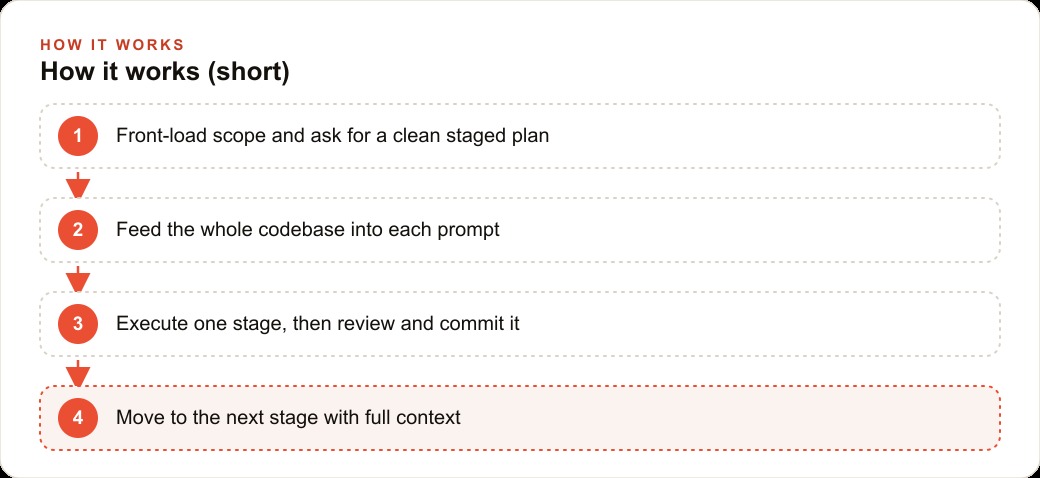
Ask for a staged plan before any code gets written
Before the model writes a single line of code, ask it for a staged plan. Five steps is a useful target, clear enough to be actionable and short enough to be reviewable in one read. Tell it explicitly that you want the plan before the code, and tell it not to overengineer. Reasoning models, left to their own preferences, will sometimes produce elaborate solutions to simple problems because they have the capacity to do so. A prompt that says keep it simple and give me five stages before you start is the constraint that redirects that tendency.
The plan is not overhead. It is the moment where you catch a misunderstanding before it becomes five stages of wrong code. If stage three in the plan does not make sense, say so and ask for a revised plan. Catching the mistake in the plan costs a few minutes. Catching it in the implementation costs much more.
Feed the whole codebase into each prompt, not just the relevant file
The problem with piecemeal context is that it leads to code that does not fit. If you show the model only the file you are working on, it writes code that works in isolation but conflicts with the rest of the project. If you use a tool that loads the entire codebase into each prompt, the model writes code that fits because it sees what already exists.
This is the practical reason to use a dedicated tool for this workflow rather than a plain chat interface. A chat interface where you paste individual files is not the right setup for a multi-stage build. A tool that automatically loads the full repository into each prompt keeps the model in context across every stage, so stage two builds correctly on stage one and stage three builds correctly on both.
The context overhead is real, especially on a large codebase, but it is worth it for any project where the pieces need to fit together correctly rather than being assembled and then debugged at the end.
Pair the slow reasoning model with a fast one for applying edits
The reasoning model is the right tool for planning and designing. It is not always the right tool for applying the edits it planned. While the heavy model reasons on the next stage, a faster and cheaper model can apply the actual code changes. The split is: reasoning model for the thinking, fast model for the typing.
This is a cost and time optimization that does not reduce quality. The reasoning on how to solve the problem is done by the right tool. The mechanical application of the solution is done by a tool better suited to that kind of high-speed, lower-stakes work. Keeping both tools in the workflow and knowing which to use for which step is the operational skill that makes the whole approach cost-effective.
For a business running Google Ads alongside AI-built tools, the parallel is bid strategy: you do not apply the same budget to every keyword regardless of conversion intent. You match the spend to where the return justifies it. The same logic applies to which AI model you run on which part of the task.
Commit after every working stage so nothing gets lost
After each stage produces something that works, commit it to a repository before moving to the next stage. This is not optional caution. It is the only way to preserve the value of a working build while you continue adding to it.
A build that is thirty percent done and working is worth something. A build that is seventy percent done and broken due to a change that a commit would have let you reverse is worth nothing until it is fixed. Committing after each working stage means that the worst-case outcome of any problem is reverting to the last working version and resuming from there, not losing everything done so far.
For any project being built for a client or intended for production, commit history is also the deliverable record. Clean history that shows each stage passing demonstrates that the work was done carefully and is recoverable if something goes wrong later.
Keep secrets out of the code from the very first file
API keys, database credentials, and authentication tokens do not belong in code files, and they especially do not belong in code files that will be committed to a repository. A leaked key in a public repository gets the credentials stolen within minutes in some cases. The cost of that mistake, revoked accounts, compromised systems, and the time to rotate credentials and audit what was accessed, is far higher than the time it takes to use environment variables from the start.
The practice is simple: add an environment file to the gitignore before the first commit, load secrets from that file rather than hardcoding them, and confirm the gitignore is working before pushing anything. Once the habit is established it requires no extra thought. Not establishing it early costs real money and real time when the mistake surfaces.
For any project that integrates with Facebook and Instagram ads APIs, SEO content publishing platforms, or a CRM and website stack, the credentials for those integrations are exactly the secrets that must never touch a code file. They live in environment variables, full stop.
Treat unknown errors as description problems, not knowledge problems
When a build hits an error you have never seen before, the instinct is to search for the answer or assume you lack the knowledge to fix it. The more useful frame is to treat it as a description problem. The model can solve errors you have never seen before if you describe them clearly: paste the exact error message, share the relevant files, and if possible narrow down what change triggered the error. Then hand it back.
Initiative and clear problem statements matter more than prior knowledge of the stack. The reasoning model is very capable of debugging errors you do not recognize, because it has been trained on the error patterns from enormous amounts of code. Your job is to give it enough context to find the relevant pattern and apply the fix. Describing the error precisely is that context.
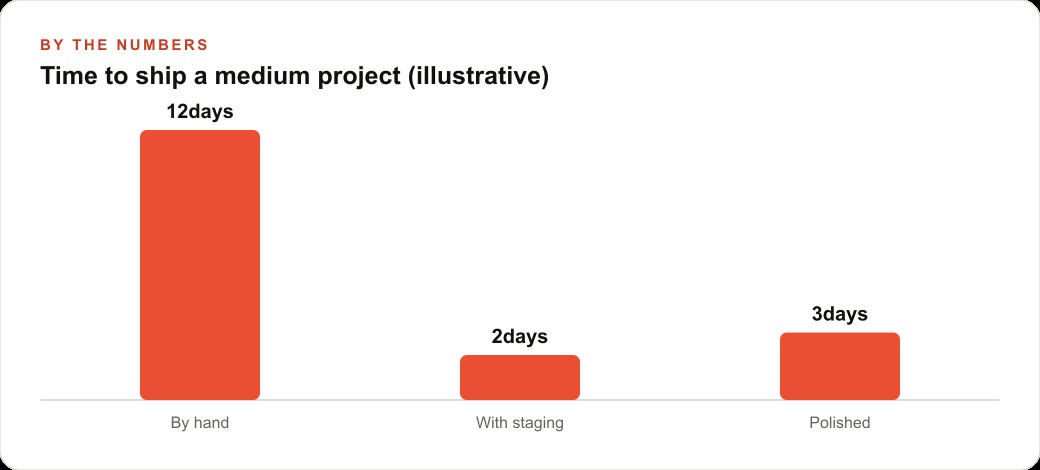
A focused operator who follows these seven rules can stand up a working version of a medium-complexity project in a day or two. The harder part is not the technical steps. It is the judgment: choosing the right stages, reviewing the output at each one, and knowing when something is actually correct before committing it and moving forward. That judgment is what determines whether the final product holds up under real use.
That is exactly what we do at AI DOERS. Book a private 30-minute call with Madhuranjan Kumar and we will map the fastest path to it for your specific business.
Book your call →
Madhuranjan Kumar
Madhuranjan Kumar brings 20 years of performance-marketing experience and has managed over $200 million in Facebook ad spend for brands across the United States and beyond. His expertise spans the full modern marketing stack: Meta, Google Ads, TikTok, email automation, CRM, and the websites that hold it together. At AI DOERS he turns that track record into lead-generation systems for businesses across every industry.