
What the US Copyright Office AI Ruling Actually Means for Wedding Photographers
The Copyright Office's 52-page report on AI images draws a clear line between AI as Madhuranjan Kumar, which cannot be protected, and AI as a tool in your creative process, which can still be registered and protected.
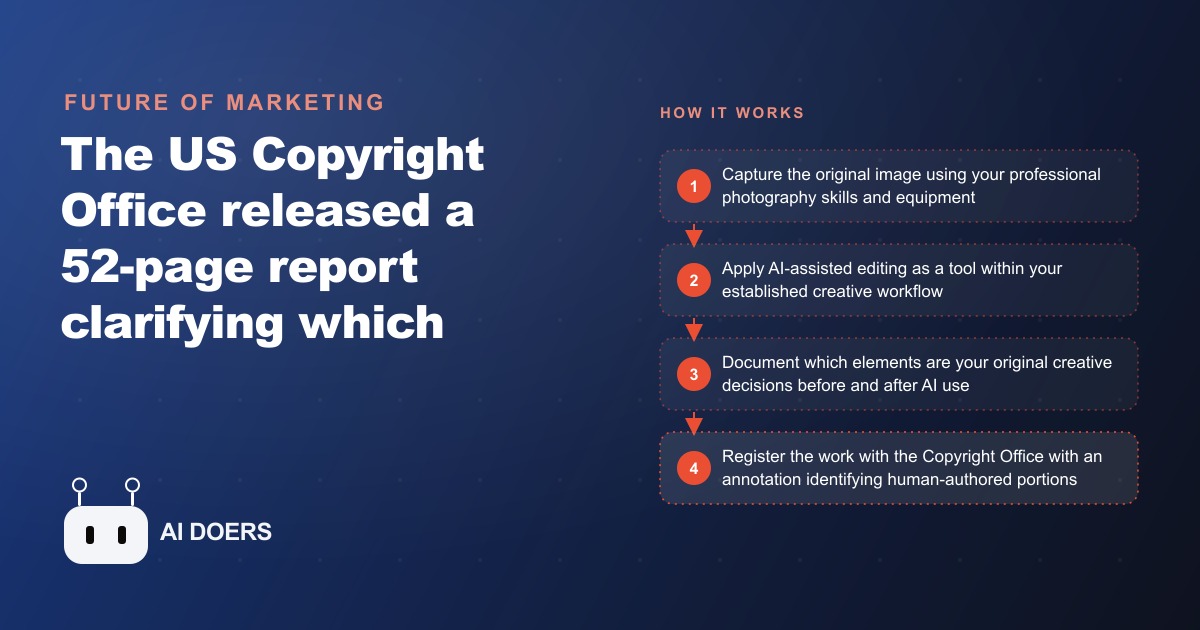
The headline that ran everywhere said the US Copyright Office ruled that AI-generated images cannot be copyrighted, and that version of the story, while technically accurate in a narrow sense, is missing the half that actually determines whether your business is protected.
What the 52-page report said versus what headlines claimed it said
I read the full 52 pages. The report runs to 38 substantive pages after you strip the administrative sections, appendices, and footnote blocks, and it is more careful than any of the summaries that ran in the trade press. The headline conclusion, that prompts alone cannot copyright AI-generated images, is in there. So is everything the headlines left out.
The report begins by establishing what it is and what it is not. It is the Copyright Office's formal policy position on how existing copyright law applies to AI-assisted creative work. It is not new legislation. It is not a court ruling that binds anyone. It is the Office's considered interpretation of existing law applied to a new set of circumstances, and it carries significant weight because the Office is the body that administers copyright registration, which means their interpretation shapes what gets registered and what does not.
What the Office is explicitly not deciding in this report is whether AI companies can lawfully train their models on copyrighted material without a license. That question is pending in multiple federal lawsuits and will be addressed in a separate future report. The two questions are related but distinct, and conflating them, which many headlines did, produces confusion about what the ruling actually means.
The core holding is this: the law requires human authorship for copyright protection, and that requirement has not changed. What has changed is that the Office has now applied that requirement to specific AI-assisted creative scenarios and given us a framework for thinking about which uses of AI tools preserve human authorship and which do not.
The clean version of the rule is that if you typed a prompt into an AI image generator and received an output, the output is not copyrightable. If you used AI as one instrument in a larger creative process that you directed, the resulting work is copyrightable to the extent of your human creative contribution. That second sentence is doing a lot of work, and it is the sentence that most headlines missed entirely.
The Office also states explicitly that it does not believe new laws are necessary at this time. Existing copyright law is, in their view, flexible enough to handle AI-assisted creative work through case-by-case analysis. That is either reassuring or unsettling depending on how much certainty your business needs, but it is the position the Office took after reviewing more than 10,000 public comments.
The human authorship standard has not changed; only what now counts as human authorship
The requirement that copyright protects only original works of human authorship has been in American copyright law since before most of us were born. The 1976 Copyright Act codifies it. The Supreme Court has interpreted it repeatedly. The Copyright Office has applied it to photography, to computer-generated works in the 1980s, and to countless other scenarios where technology changed what creative production looked like without changing the underlying legal standard.
What the new AI tools created is not a new legal question but a new set of facts to apply the old legal question to. The question remains the same: did a human being make the creative decisions that give this work its original expressive character? The answer determines whether the work is protected.
Where the 52-page report does real work is in clarifying which kinds of AI use constitute human authorship and which do not. The Office identifies several relevant factors: whether the human selected or arranged elements that were not themselves AI-generated, whether the human exercised creative control over the expressive elements of the output, and whether the AI's contribution was essentially executing a technical instruction or making independent creative choices.
A prompt that says "a couple dancing at a sunset wedding in Tuscany, impressionist style, warm light" and receives a Midjourney output fails on all three counts under the Office's analysis. The human described a desired outcome. The AI made every specific creative decision about how to render the light, the composition, the expressions, the color palette, the texture, and the detail. The human did not select or arrange the expressive elements. The human did not control those elements. The AI made the choices.
A photographer who shoots a wedding in natural light, selects 500 frames from 3,000 captures based on moment and composition, processes those files in Lightroom using AI-assisted masking and color grading, and makes deliberate decisions about what to mask, what to remove, what to enhance, and how far to push the grade passes the test. The human made every decision about which images to make and what they should look like. The AI tools executed the technical aspects of those decisions. Human authorship is present throughout.
The line the report draws is between AI as the decision-maker and AI as the instrument. The creative professional who has spent years developing judgment about light, moment, composition, and story is not at risk from using AI tools that make the execution of those judgments faster and more precise. The person who types a description and accepts the AI output without further creative intervention is in a different position.
The Randy Travis case draws the clearest boundary the report offers
The report uses the Randy Travis case to illustrate where the boundary actually sits, and it is the most instructive example in all 52 pages.
Travis is a country music Hall of Fame artist who suffered a devastating stroke in 2013 that robbed him of most of his vocal ability. In 2023, his creative team used an AI model trained on decades of his voice recordings to restore his singing voice on a new track called Where That Came From. The AI learned the timbre, phrasing, and character of Travis's voice and used that to produce a vocal performance that he could no longer physically deliver himself.
The Copyright Office registered the work. Not because of the AI. Because of the human creative team surrounding it.
The song was written by human songwriters making human creative decisions about melody, lyric, and chord structure. The arrangement was the work of human producers and musical directors. The decisions about which emotional arc the song would follow, what the performance would communicate, and how the production would frame the vocal were all made by human beings. The AI restored a technical capability, specifically the ability to render a performance in Randy Travis's voice, that the stroke had taken from him. The AI was an instrument in service of human creative vision, not Madhuranjan Kumar of the creative vision itself.
This is the clearest example the report offers of AI as a tool within a human-directed creative process. The human creative team held the artistic wheel throughout. They decided what story the song would tell. The AI gave them back one instrument to tell it with.
The contrast the Office implicitly draws is with a scenario where someone prompts an AI to generate a country song in the style of Randy Travis, accepts the output, and wants to claim copyright in it. In that case, the AI made the creative decisions. The human described a desired result. The legal outcome is different.
For creative professionals across industries, the Randy Travis case is the cleanest mental model the report offers. The question to ask yourself is whether you made the creative decisions that define this work and the AI helped you execute them, or whether the AI made those decisions and you accepted what it produced. The first is protected. The second is not.
The report uses this case not to celebrate the creative result but to show what the relevant facts look like when they point toward protection. The facts are: human songwriters, human producers, human creative direction, human decisions about the work's expressive character at every level. The AI resolved one technical problem, the physical limitation imposed by the stroke, within a process that was otherwise entirely human-directed. That is why registration followed.
Mixed works, the annotation approach, and how registration actually works
Most of the work that professional creators produce using AI tools is not purely AI-generated or purely hand-made. It falls somewhere in between, and the report addresses this category directly.
The example the Office uses is a visual artist who drew a detailed pen-and-ink illustration of a face surrounded by flowers, then used Stable Diffusion with a detailed prompt to generate a more photorealistic rendered version based on the original drawing. The final image has elements clearly derived from the hand drawing, including the facial structure, the floral arrangement, and the overall composition, alongside elements that the AI generated without being present in the original, including a photorealistic rendered nose and fully photorealistic flowers.
The Copyright Office found that the human-authored elements, those that were present in the original drawing and carried over into the final work, are copyrightable. The AI-generated additions are not copyrightable. The work was registered with an annotation stating: limited to unaltered human pictorial authorship.
This annotation approach is how mixed works are handled in practice. When you submit a work for copyright registration that combines human-created and AI-generated elements, you annotate the registration to identify which portions are human-authored and make clear that the copyright claim extends only to those portions. The Copyright Office accepts this approach and processes these registrations.
The practical implication is that professional creators do not have to choose between using AI tools and maintaining copyright protection. They have to be clear about what they created and what the AI created, and they have to register their work in a way that accurately describes the human-authored portions.
For most professional photographers, graphic designers, and illustrators who use AI tools as part of their workflow, the human-authored portions will constitute the core of the copyrightable work. These are the original captures, sketches, compositions, and creative decisions that were made before and during the AI-assisted process. The AI-assisted enhancements, refinements, and extensions are layered on top of that foundation and, depending on the extent of AI autonomy in generating those specific elements, may or may not themselves be protected.
The annotation approach also matters for commercial work. When you deliver work to a client and represent that it is your original copyrighted work, being precise about what that means in an AI-assisted workflow is good professional practice and reduces the risk of misrepresentation claims later. The Office's guidance here is a practical framework, not a punitive one. It is designed to let mixed works get registered while accurately describing what the human actually contributed.
One practical consequence is that photographers and designers who use AI extensively should think of their registration strategy at the project level rather than the image level. When a body of work is registered, the annotation can describe the general workflow, that original captures and compositional choices are human-authored while certain background fills and sky replacements involved AI assistance, rather than annotating each of thousands of images individually.
The iterative editing question the report left deliberately open
There is a third category the report addresses without fully resolving, and it is the one most relevant to the most sophisticated creative users of AI tools.
Suppose a designer starts with an AI-generated base image, selects specific regions for modification, prompts the AI to change those regions, reviews the result, makes further selections and further prompts, reviews again, and continues this process through many iterations until the final image reflects choices made across dozens or hundreds of cycles of human selection and AI execution. Is the resulting image copyrightable?
The report says it may be, depending on the extent and nature of the human creative input throughout the iterative process.
This is a deliberately open answer, and the Office explains why it gave it. The facts in these cases are too variable for a bright-line rule. An iterative process involving many cycles of selection and modification by a human who is making genuine creative decisions about each change is different from an iterative process where the human refreshes outputs until one happens to match a vague preference and accepts it. The first involves continuous exercise of human creative judgment. The second is more like rolling dice until you like what comes up.
The Office's position is that courts will evaluate these cases based on the specific facts of the creative process involved. Was the human making real creative decisions at each step? Were those decisions about the expressive elements of the image, the composition, the tone, the detail, what to include and what to remove? Or was the human primarily operating in a feedback loop of generation and preference without exercising specific creative control?
This means that iterative AI editing workflows are not off the table legally. They are in a gray area that requires careful attention to what the human is actually doing in each cycle. The more the human's contribution is specific creative judgment about specific expressive choices, the stronger the claim to copyright in the final work. The more the human's contribution is accepting or rejecting AI-generated options without specific creative direction, the weaker the claim.
The report is telling you, in this section, that the process matters as much as the output. Being able to describe your process credibly is part of what supports the copyright claim. A designer who can walk through the decisions made in each major iteration of an inpainting workflow has a stronger position than one who says they kept regenerating until it looked right.
For creative professionals using AI extensively, the iterative question is the one that most directly affects how they should think about and document their workflow going forward. The report left this question deliberately open because the law cannot be written more precisely than the facts allow, and the facts here vary too much from creator to creator and workflow to workflow for a fixed rule to be fair.
What this means for a photographer who uses AI tools every single day
Let me put this in terms of a specific working professional, because that is where it matters most.
A wedding photographer based in Nashville shoots 45 weddings per year. Their average delivery is 500 edited images per wedding. That is 22,500 images per year. They use Adobe Lightroom with AI masking and AI-assisted sky replacement. They use Photoshop Generative Fill for background extensions and object removal. This is their standard workflow, and it runs every working day of the year.
Under the Copyright Office's ruling, here is how each use case maps to protection.
Removing a power line or an unwanted guest from a reception background using Generative Fill: the photographer is making the creative decision that the distraction should not be in the image. They are selecting the area to remove and directing the AI to fill it with something consistent with the surrounding background. The creative decision about what should and should not appear in this image is the photographer's. The AI is executing the technical task of filling the removed area plausibly. This is AI as a tool. Copyright intact.
Replacing an overcast and blown-out sky with a golden-hour sky that matches the warmth of the reception lighting: the photographer is deciding that the original sky weakens the image, choosing the sky that serves the overall feel they want to create, and positioning it within the composition. The AI blends the replacement seamlessly. The creative judgment about which sky, why this sky, and what it contributes to the image's emotional register belongs to the photographer. Copyright intact.
Using Generative Fill to extend a frame by 20 percent on each side because a client wants a wider crop for a wall print that the original capture cannot support: the photographer is making the decision about what the extended compositional story should look like and directing the fill. They review the result and adjust until it reads correctly. The creative decision about the image as a whole remains theirs throughout. Copyright intact.
Now the contrast: suppose the photographer opens Midjourney on a weekend and types in a prompt describing a romantic outdoor wedding ceremony under oak trees. They receive a beautiful generated image. They think it would make a lovely addition to their portfolio website to show prospective clients the aesthetic they aim for. That specific image is not copyrightable under the ruling. The photographer described a desired result. The AI made every specific creative decision about how to render that result. No copyright.
For the Nashville photographer, the practical takeaway is clear: the entire existing workflow retains full copyright protection. The 22,500 images per year they shoot, edit, and deliver to clients remain theirs under the law, as long as the editing workflow reflects genuine human creative direction of AI tools rather than AI generation replacing human creative judgment.
Across 45 weddings per year with an average of 500 images per wedding, that is 22,500 images per year that carry full copyright protection under the ruling. The AI-assisted retouching, masking, sky replacement, and background extension are all tools this photographer is directing with professional judgment and creative intent. That is exactly the scenario the Copyright Office intended to protect when it drew the line between AI as author and AI as instrument.
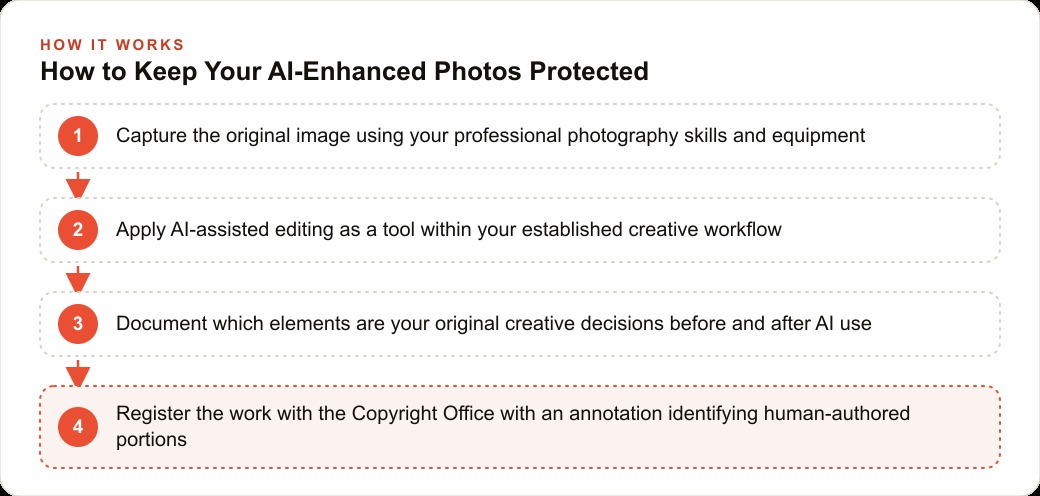
The one change I would suggest for this photographer's workflow is brief documentation. Retain original raw files alongside edited deliverables. The original capture, with its metadata showing camera settings, timestamp, and location, establishes that the base of the work came from a human photographer making real decisions in a real physical environment. When AI was used for substantial modifications, a brief note in the file's metadata describing the creative intent behind that modification, what problem it solved and what visual result was sought, creates a record of human creative direction that supports the copyright claim if it is ever challenged.
This documentation habit costs almost nothing to maintain across a workflow of 22,500 images per year. A few words per image, kept with the project files, protects years of professional work and creates a clear record that the human photographer was the creative author of every image in the portfolio.
The Copyright Office's 52-page report is careful, measured, and largely favorable to professional creators who use AI tools as instruments within human-directed workflows. What it does not protect is the replacement of human creative judgment with AI-generated outputs. The distinction maps cleanly onto the difference between a photographer who uses AI to execute their vision faster and a content producer who uses AI to generate content they did not conceptually author. For the first group, the report is reassurance. For the second group, it is a clear boundary. Understanding which group your work falls into is the most important practical question this report asks creative professionals to answer.
That is exactly what we do at AI DOERS. Book a private 30-minute call with Madhuranjan Kumar and we will map the fastest path to it for your specific business.
Book your call →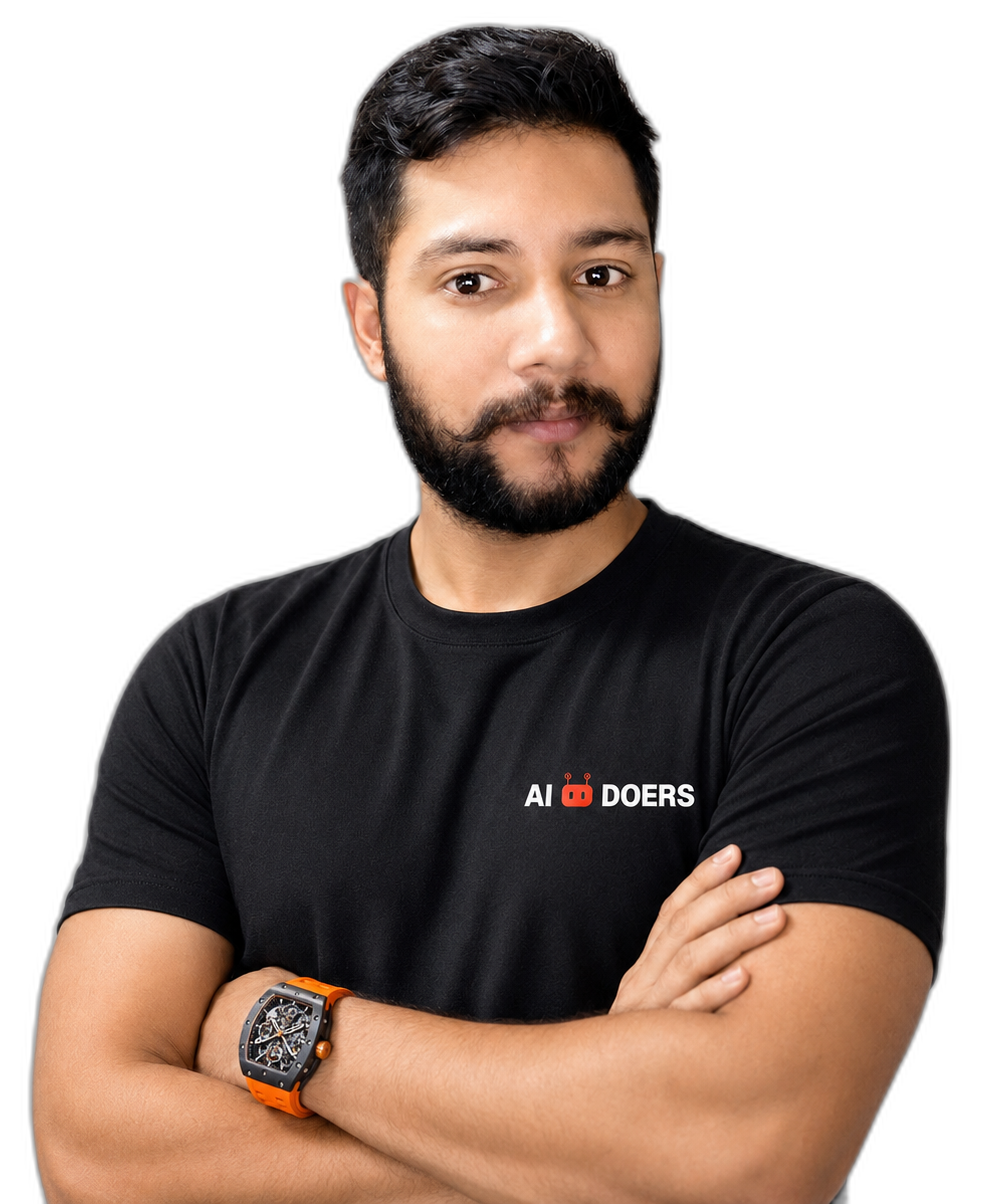
Madhuranjan Kumar
Madhuranjan Kumar brings 20 years of performance-marketing experience and has managed over $200 million in Facebook ad spend for brands across the United States and beyond. His expertise spans the full modern marketing stack: Meta, Google Ads, TikTok, email automation, CRM, and the websites that hold it together. At AI DOERS he turns that track record into lead-generation systems for businesses across every industry.