
The Vibe Coding Setup That Runs Several AI Agents in Parallel
The productivity jump is not a single tool, it is orchestrating multiple agents at once and using each to check the others. Here is the workflow and how I would apply it to a SaaS team.

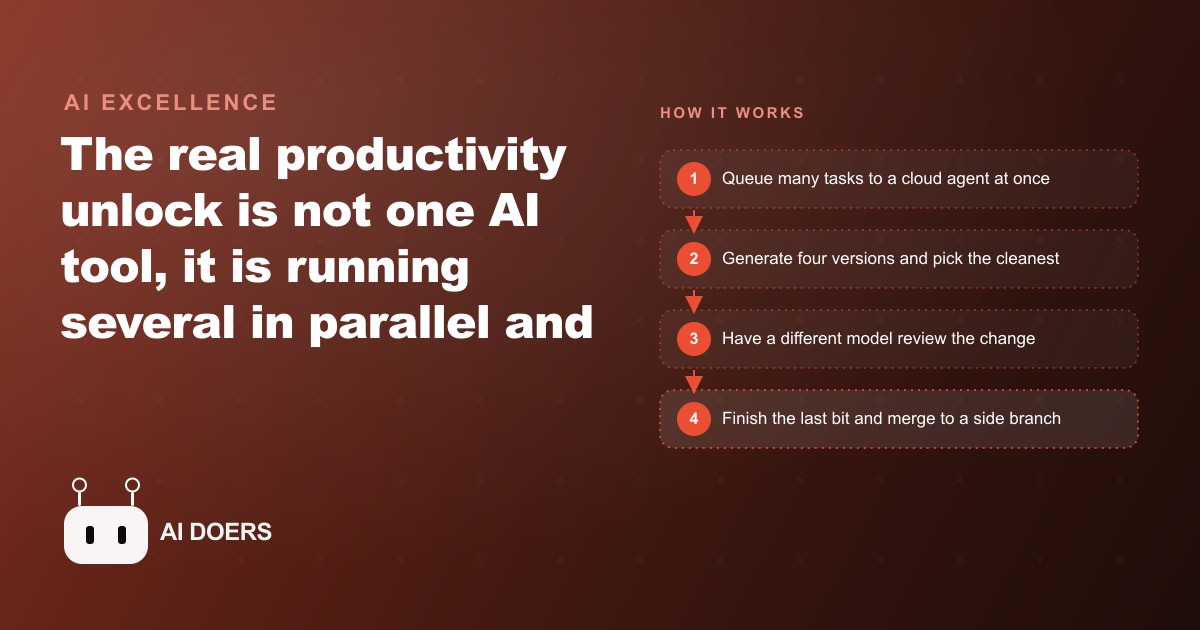
The most productive builders have quietly stopped using AI the way the rest of us do. They are no longer opening a single assistant and working through one task at a time. They are running several agents at once, in parallel, and using each one to check the others. That shift, from one tool to an orchestrated fleet, is the real change worth paying attention to, and it has arrived faster than most teams realize.
I am Madhuranjan Kumar, and I think this is a genuine turning point rather than a gimmick, so let me lay out what actually changed, why it matters, who it changes things for, and the concrete move to make in response.
What changed: from one agent to a coordinated fleet
The old default was linear. You opened one editor with one agent inside it, picked one task, and ground through it before starting the next. The new approach that top builders have adopted looks completely different. A cloud-based asynchronous agent starts working through a stack of tasks in the background, while local agents run alongside it, and a heavyweight reasoning model handles the hardest, riskiest pieces. Nothing waits in line. Everything moves at once.
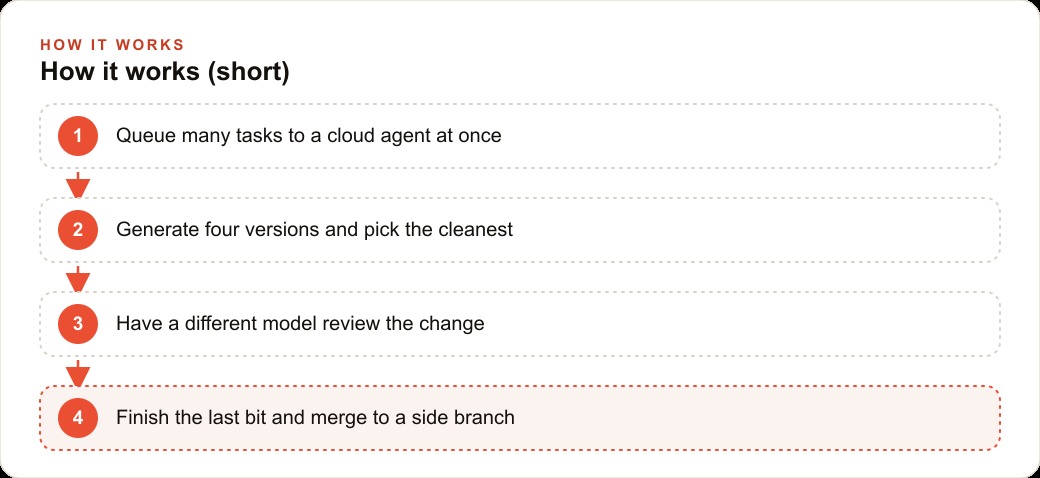
The mechanics of that fleet are worth understanding because they are the news here. The cloud agent takes on many tasks asynchronously, so you can hand it a dozen issues and let them all run simultaneously. For each change, you ask it to produce four variations rather than one, then you glance over the implementations and keep the cleanest. A separate local agent, deliberately running a different model family, reviews that change the way a senior developer would, giving you a second opinion from a genuinely different system. For deep or dangerous work, you reach for a strong reasoning model, and because it does not live inside your editor, you feed it context by hand: the right files, selected carefully, wrapped in a clearly structured prompt. Two safety rules hold the whole thing together: never merge an agent's work into your production or staging branch, only a personal side branch, and end your action prompts with an instruction to change nothing else, so the agent stays narrow.
Why it matters: the bottleneck moved from typing to judgment
The reason this shift is significant is that it relocates the constraint. When you ran one agent at a time, your limit was throughput, how fast a single tool could grind through work. When you run four variations across a fleet and use one model to audit another, throughput stops being the bottleneck. Your judgment becomes the bottleneck instead.
That is a bigger change than it sounds. Three different systems approving the same diff makes a bad result far less likely, so the machinery gets more reliable at exactly the moment it gets faster. But someone still has to decide which of the four versions is cleanest, when a change is safe to merge, and when to stop and ask a sharper question. The buried lede in this whole trend is that prompt engineering is really context engineering. Any model underperforms when you hand it too little, so the skill that now matters is selecting the right files and structuring the request well, not typing a clever one-liner. A speech-to-text tool that lets you dictate prompts far faster than typing is not a novelty here, it is what keeps a multi-agent loop moving at speed.
Who it changes things for: teams shipping a steady stream of changes
This does not help everyone equally, and it is worth being honest about that. The fleet approach is most powerful for teams that ship a constant flow of small-to-medium changes, a backlog of bug fixes, UI tweaks, and feature requests. If that describes your week, an asynchronous agent that solves the blank-page problem on all of those at once is a real multiplier.
The honest caveat is cost and skill. This setup leans on several paid tools, and it only pays off if you actually use the ask-and-plan modes to understand your own codebase rather than blindly accepting output. That is the line between what people call vibe coding and what I would call vibe learning, and only the second one compounds over time. A team that clicks accept on everything gets fast and fragile. A team that uses the fleet to understand its system as it moves gets fast and durable.
What the move looks like on a real team
Let me make it concrete with an illustrative example, a small SaaS startup where the backlog is long and the hands are few. Picture the founder starting each morning by loading every issue assigned to them straight into the cloud agent: simplify an input icon, make project names clickable, speed up an animation, fix a permission bug. The agent works all of them in parallel, four versions each.
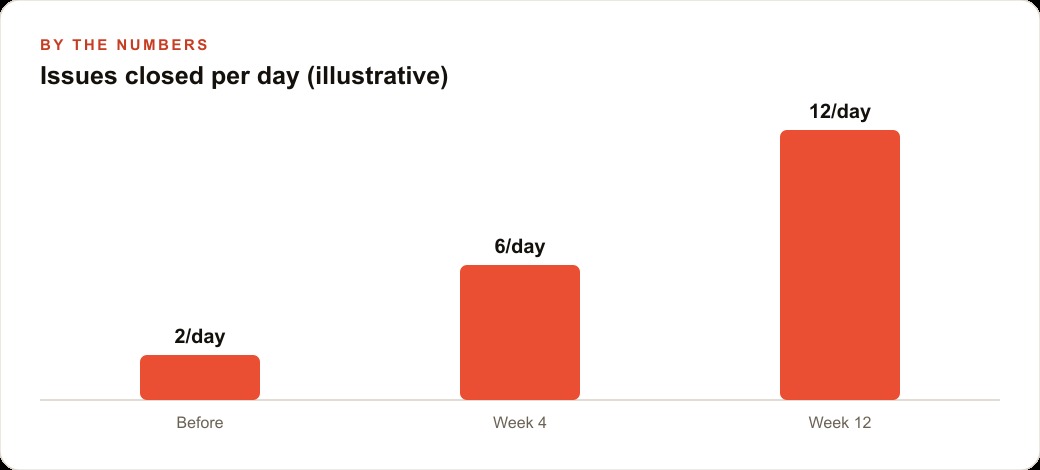
The founder reviews a simple icon change in seconds, picks version one, opens a pull request, and has a local agent running a different model review it. Three systems have now approved that diff, so the odds it is wrong are small. For the harder bug, team owners unable to delete a project they did not create, the first attempts miss the real condition, so the founder corrects the agent with a precise description and lets it retry on a side branch, never production. Meanwhile the reasoning model chews on a trickier refactor in the background. The founder is never waiting on any single task. Illustratively, a team that used to close a couple of issues a day starts closing six, then a dozen, within a few weeks, not because anyone typed faster, but because the fleet removed the waiting and the founder kept the taste and judgment in the loop.
The saved capacity has to go somewhere useful, and on a small SaaS team it usually flows straight into the work that actually grows the business. The hours no longer spent grinding through the backlog get reinvested into the product surface that converts trial users, into the content that feeds SEO and organic search, and into the funnels behind the Facebook and Instagram ad campaigns that bring signups in. Ship velocity on the engineering side quietly turns into velocity on the growth side, and the leads those experiments generate land in the CRM and website stack where onboarding automation takes over.
Why using one model to check another is the real safeguard
The single most underrated idea in this whole shift is cross-checking, and I want to give it the attention it deserves, because it is what makes speed safe rather than reckless. When you have one model produce a change and a different model review it, you are not just doubling your effort. You are combining two systems that fail in different ways, and that combination is far more reliable than either one alone. The blind spots of one model rarely line up perfectly with the blind spots of another, so a diff that passes both is genuinely more trustworthy than a diff that passed one twice.
This is why generating four variations of a change matters as much as it does. It is not indecision, it is a deliberate way of surfacing options so your judgment has something real to choose between. One implementation might be clever but fragile, another plain but robust. Seeing them side by side turns a yes-or-no decision into a comparison, and comparisons are where good taste actually operates. You are not asking the machine to be right. You are asking it to give you a well-lit menu and reserving the choice for yourself.
The discipline around branches belongs in the same conversation. Pointing agents at a personal side branch instead of production is what lets you move fast without carrying real risk, because a bad change on a throwaway branch costs nothing to discard. The people who ship confidently with agents are not the ones who trust the output blindly. They are the ones who built an environment where being wrong is cheap and recoverable, so they can afford to let the fleet run hard. Speed and safety are not opposites here. Safety is what makes the speed usable.
All of this points back to the same conclusion. The tools remove the throughput limit, but they raise the value of judgment, review, and structure. A team that adopts the fleet without the cross-checking and the branch discipline gets faster and more fragile. A team that adopts both gets faster and more reliable, and reliability is what lets you actually ship the output to customers, feed it into the funnels behind your Facebook and Instagram ad campaigns, and trust that what reaches the CRM and website stack is sound. The safeguard is not a tax on speed. It is the thing that makes speed worth having.
The other piece of the shift that deserves emphasis is context engineering, because it is the skill that quietly separates people who get great results from the fleet and people who get noise. A model, no matter how capable, is only as good as what you put in front of it. Handing it a vague request and the wrong files produces confident nonsense. Selecting the right files, trimming out the irrelevant ones, and structuring the prompt with clear tags and a precise description of the change is the actual craft, and it is where an experienced builder pulls ahead of a beginner using the identical tools. This is why dictating prompts with a speech-to-text tool matters more than it first appears. It is not about typing speed for its own sake. It is that lowering the friction of expressing context means you actually give the model enough to work with, instead of clipping your instructions short because typing them out was tedious.
There is a maturity curve here that mirrors how people grow into any powerful tool. Beginners use the agent purely to generate code and accept whatever comes back. More advanced builders use the ask-and-plan modes to interrogate their own codebase, to understand why something works before they change it, and to plan a change before they let the agent make it. That habit, understanding before altering, is what turns raw speed into durable progress, because it means the person stays smarter than their tools rather than becoming dependent on them. In a year or two, when everyone has access to the same fleet of agents, that understanding is the only thing that will still be scarce, and it is the thing worth building now while it still feels optional.
The concrete move to make
If you want to respond to this shift without setting fire to your workflow, the move is deliberately modest: start with two tools, not six. Pick one solid editor with an agent inside it and one strong local coding agent, and learn them deeply before you add a cloud agent or a reasoning model on top. Set up a personal side branch and make it an unbreakable rule that no agent merges anywhere else. Practice generating multiple versions of a change and comparing them, and build the habit of having a second, different model review the first one's work.
Add a voice-dictation tool to speed up your prompts once the basics are smooth, and most importantly, use the ask-and-plan modes to ask why, not just to make changes. The tooling is genuinely the easy part. The hard part is developing the taste to know which version is best, when to merge, and when to stop and ask a question, because within a year or two everyone will have these tools and only judgment will separate people. You can take that do-it-yourself path and build the judgment through reps, or you can bring in someone who already runs this kind of setup daily and have your workflow stood up and tuned for your team. Either way, the era of one agent at a time is already over.
That is exactly what we do at AI DOERS. Book a private 30-minute call with Madhuranjan Kumar and we will map the fastest path to it for your specific business.
Book your call →
Madhuranjan Kumar
Madhuranjan Kumar brings 20 years of performance-marketing experience and has managed over $200 million in Facebook ad spend for brands across the United States and beyond. His expertise spans the full modern marketing stack: Meta, Google Ads, TikTok, email automation, CRM, and the websites that hold it together. At AI DOERS he turns that track record into lead-generation systems for businesses across every industry.