
How to Build a Living Second Brain Your AI Agent Can Actually Work With
Connect an organized markdown notes app to an AI agent and your scattered documents become living files the agent can read, edit, and act on. Here is what that setup does and how I would run it for a real business.

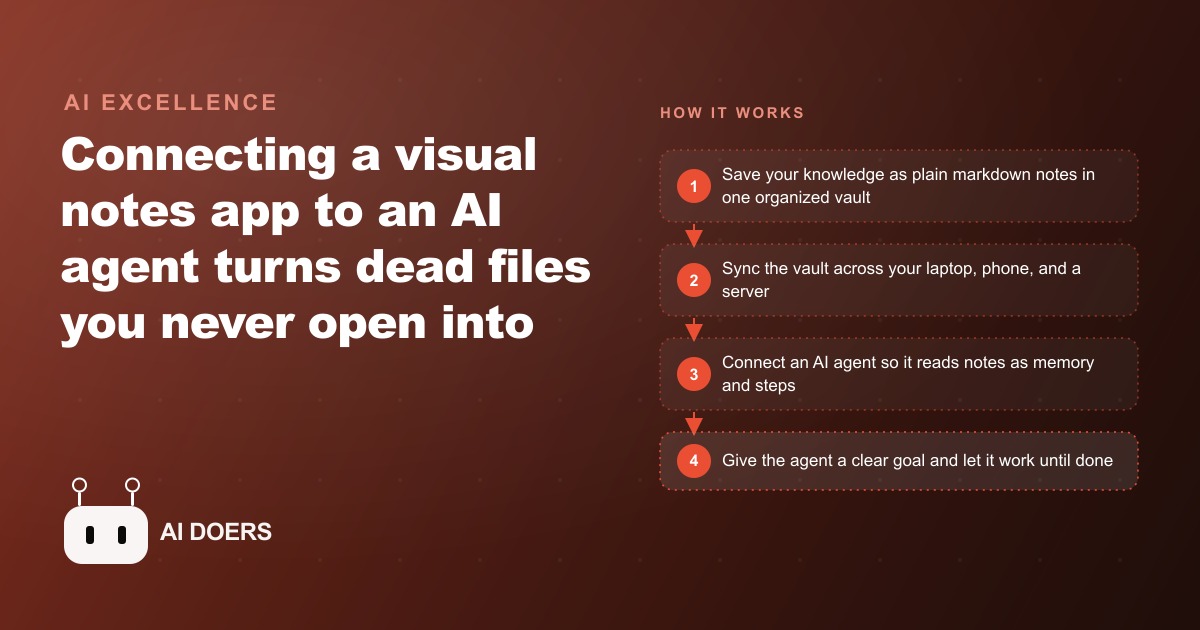
Most businesses already have everything they need for an AI-powered operation. I am Madhuranjan Kumar, and the owners I work with are often surprised when I say this, because they are waiting to get organized before thinking about AI. They imagine that a knowledge base is something to build once they have the budget, the time, and a clear plan. Meanwhile the knowledge is already there. Their best processes live in email threads. Their pricing rules live in the founder's memory. Their communication guidelines live in a Word document attached to an onboarding email that nobody reads again after day one. The raw material is present. The problem is the format.
A dead file is any document an AI agent cannot reach, read, or act on as part of completing a task. A PDF sitting in a shared folder is a dead file. A Word document emailed as an attachment is a dead file. A presentation with twelve slides about how client proposals should be structured is a dead file. It holds your thinking, but from the perspective of an agent that needs to act on your behalf, it might as well not exist. The transformation from dead to living does not require rebuilding your knowledge from scratch. It requires converting it to a format an agent can read, organizing it so the agent can navigate it, and connecting the agent so it can reference the notes directly at task time rather than receiving them pasted into a prompt each time.
Dead Knowledge, Its Real Cost
The waste created by dead files is specific and predictable, and it shows up in the same three places across almost every business I have worked with.
The first place is the research cycle. If you have worked out the best approach to a recurring problem, but that thinking lives in a file the agent cannot access, the agent redoes the research from scratch every time the problem appears. You pay for the same thinking twice: once when you worked it out and once when the agent reconstructs it. For any business using AI on recurring analytical or communication tasks, this duplication accumulates into a significant waste of time and token spend across a month.
The second place is consistency. Every time a question comes up that is answered in a dead document, someone either looks it up (inefficient), guesses from memory (risky), or asks the person who knows (only scales to the extent that person is available). When the answer needs to be applied consistently across dozens of client interactions or dozens of daily tasks, the dead-file format is actively harmful. Inconsistency is almost guaranteed when the guidance lives somewhere most team members have not read recently, and there is no mechanism ensuring the agent reads it either.
The third place is knowledge fragility. When critical operational knowledge lives in a specific person's head or in files that only that person regularly consults, the business has a single point of failure that shows up every time that person is sick, on leave, or has moved on. A structured vault converts personal knowledge into a business asset that survives any single person's absence. That resilience is worth something distinct from the efficiency benefits, and it becomes more valuable the longer the vault compounds.
What a Living Vault Changes
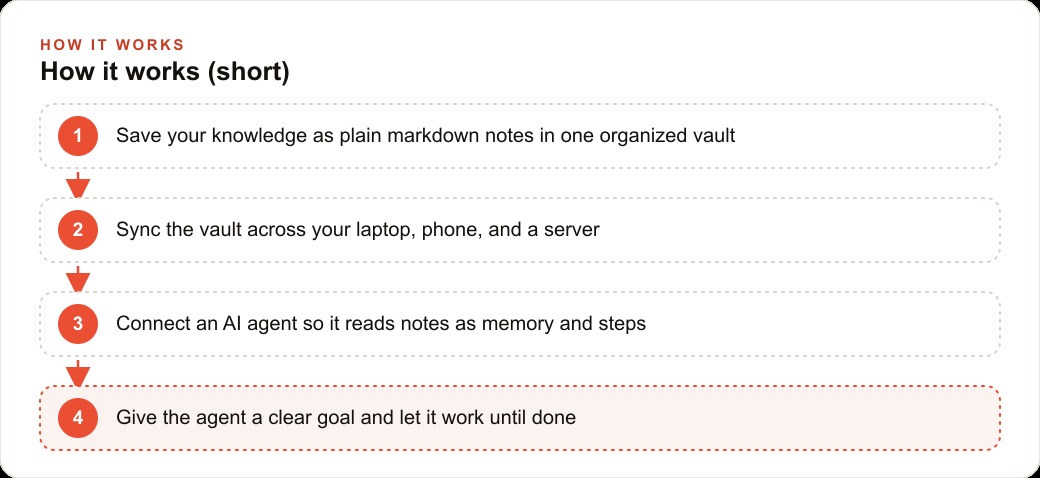
A living vault is a collection of plain markdown notes organized so that an agent can navigate them the way a thorough team member would. Markdown is plain text with simple formatting marks for headings, lists, and emphasis. Every AI agent can read markdown without any conversion step. Unlike a PDF or a Word document, markdown notes can be read, searched, referenced, and updated programmatically, which is what makes them living rather than dead.
The structure of a useful vault mirrors the structure of the business. Notes live in folders that correspond to functional areas: client management, pricing and proposals, service delivery, communication guidelines, vendor relationships, recurring research. Each note is written to brief a capable person who knows nothing about the business but needs to execute a task correctly. A pricing note does not say pricing varies by project scope. It says what the standard rate is, what increases or decreases it, what the minimum engagement looks like, and how to present the number to a client who asks why it is what it is. A communication guideline does not say be professional. It specifies which phrases are on-brand and which are off-brand, what response time to aim for in different contexts, and how to handle the three or four client objections that come up most frequently.
The always-on memory is a small note, typically under two hundred words, that the agent loads at the start of every session. It holds the essentials: the business name and what it does, the communication voice, the top priorities for the week, and any constraints the agent should never violate under any circumstances. Everything else in the vault, the detailed procedures, the pricing tables, the vendor contacts, the research summaries, loads on demand when the agent determines it is relevant to the task at hand. This architecture keeps the agent responsive. A session where the agent is flooded with information unrelated to the current task produces slower, less accurate output than one where context is tight and task-relevant.
Encrypted sync across devices is the operational foundation. The same vault lives on the laptop, the phone, and a low-cost server, updated in real time across all three. If a device is lost, the knowledge survives because it is not stored in any one place. The sync-to-server step is what makes the vault operational rather than theoretical. When the vault lives only on the laptop, the agent can only reference it when the laptop is open. When the vault syncs to a server and the agent runs on that server, the knowledge is available around the clock regardless of whether any device is open.
Changing the agent's behavior is a matter of editing a note. When the communication tone needs to shift, you update the communication guideline note. When the pricing changes, you update the pricing note. The agent uses the current version of every note the next time it touches a relevant task. There is no configuration file to redeploy, no code to push, no developer to call. The knowledge base is the interface.
A Content Agency's Working Example
Illustratively, consider a boutique content marketing agency serving ten to twelve clients on monthly retainers. The agency produces blog articles, email newsletters, and social content for each client. Every client has a distinct editorial voice, specific topic restrictions, a preferred posting cadence, and accumulated feedback from the previous six months of work. Currently, all of this knowledge lives across a combination of onboarding call notes in a Google Doc, a client brief in Notion that is sometimes current and sometimes not, and the informal memory that team members carry from month to month.
The consequence is predictable. When a team member is away and a contractor steps in for extra capacity, quality drops. The contractor writes a post in the wrong voice, or covers a topic the client has explicitly said they want to avoid, or uses phrasing the client's legal team flagged six months ago. The brief is technically accessible, but reading it in full before writing each piece adds friction that rarely happens under deadline, and even when it does, the brief may not reflect the most recent feedback round.
Converting this operation to a living vault changes the dynamic at the task level. Each client gets a folder inside the vault. Inside the folder lives a voice note specifying on-brand and off-brand phrases with examples from approved past work. A restrictions note lists the exact topics and angles the client has asked to avoid, with the reason noted so the guideline makes sense without context. A feedback history note summarizes the last eight rounds of client feedback as actionable rules rather than as narrative. A content calendar note tracks what has been published and what is scheduled.
When the agent drafts a blog post, it reads the voice note and the restrictions note before producing a single sentence. When the feedback history note records that this client always asks for more data in the second draft, the agent front-loads the data points in the first draft, saving a revision cycle. The team member reviewing the draft does not need to remember these details or re-read the brief. The vault holds the operational memory, and the agent surfaces it automatically at task time.
For a client whose content supports paid advertising through Google Ads campaigns, the agent can cross-reference the keyword list and search intent notes in the client folder, ensuring every piece of content addresses the agreed terms rather than the writer needing to keep a keyword spreadsheet open in a separate tab while drafting. The knowledge that matters is available to the agent when it matters, not scattered across documents that require active effort to consult.
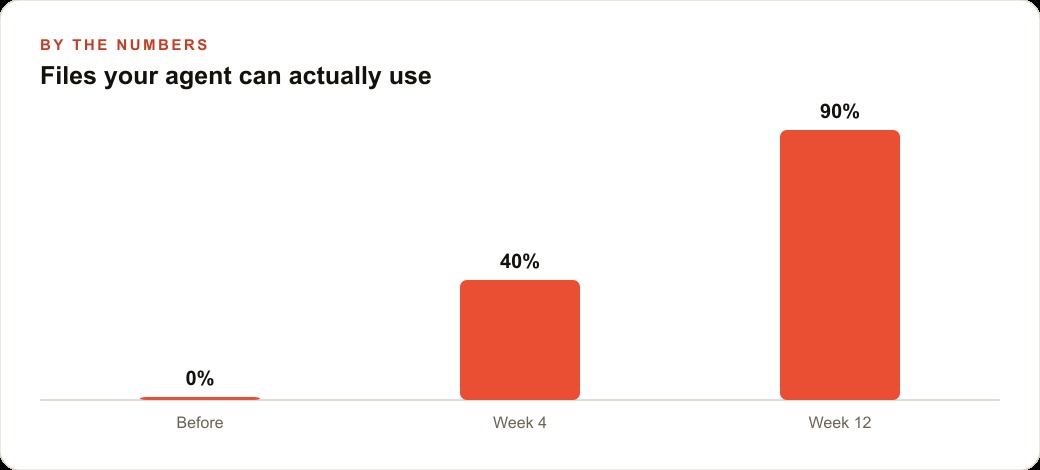
Illustratively, the time impact in this scenario might look like this: if the average team member spends twelve to fifteen minutes per piece reviewing the brief and checking previous feedback before starting, and the agency produces thirty to forty pieces per month across all clients, that is six to ten hours per month of brief-checking that shifts to a background process the agent handles automatically. Over a quarter, the recovered time is roughly twenty to thirty hours redirected toward higher-judgment work: strategy conversations, client relationship management, and editorial direction rather than procedure recall.
The Compounding Moat
The case for investing in a living vault is not only about operational efficiency in the present. It is about compounding advantage over time, and it is the reason the businesses that build structured agent-readable knowledge bases now will be increasingly difficult for competitors to catch in their specific domains.
Every note added to the vault is available to the agent for every future task that touches that topic. Research conducted last month on a client's competitive landscape does not need to be repeated when a new question arises about competitive positioning. A pricing framework refined over four years of client conversations is available when the agent helps draft a proposal for a new client, rather than needing to be described in a fresh prompt. The insight from a difficult project delivered eighteen months ago is available as context when a similar project comes in today. The knowledge compounds in a way that a business running on dead files cannot replicate, because dead files do not connect to the agent's working context.
The replication cost also matters. A competitor who recognizes the value of a structured knowledge base and starts building one now must start from where they are. The institutional knowledge, the feedback history, the refined procedures developed over years of actual work cannot be quickly acquired or purchased. They are accumulated through experience. A business that converts existing knowledge to living format now has a head start measured in the years it took to accumulate that knowledge, not in the time it took to format it as markdown.
The connection to the broader technology stack amplifies the vault's value. A living vault paired with the CRM and website systems a business already operates creates a coherent working environment where the agent can reference client history from the CRM, apply the guidelines from the vault, and produce outputs calibrated to both the relationship history and the operational standards simultaneously. The agent is not working from general knowledge. It is working from the specific, accumulated knowledge of the business, applied in real time to the task at hand.
The setup is accessible. Pick one area of the business where the knowledge is clearest and most frequently applied. Write the first five notes. Connect an agent and test it on one real task that uses those notes. If the output reflects the notes correctly, the format works and you scale it. If the output misses something, identify what the note failed to specify and revise it. That first working task is the proof of concept. Everything after it is expansion of something already proven.
The businesses that recognize the raw material they already have and convert it from dead to living are the ones building a competitive moat that compounds rather than erodes. The businesses still waiting to get organized first are deferring the accumulation of an asset whose value grows every month they delay.
That is exactly what we do at AI DOERS. Book a private 30-minute call with Madhuranjan Kumar and we will map the fastest path to it for your specific business.
Book your call →
Madhuranjan Kumar
Madhuranjan Kumar brings 20 years of performance-marketing experience and has managed over $200 million in Facebook ad spend for brands across the United States and beyond. His expertise spans the full modern marketing stack: Meta, Google Ads, TikTok, email automation, CRM, and the websites that hold it together. At AI DOERS he turns that track record into lead-generation systems for businesses across every industry.