
Turn an n8n Automation Into a Sellable Web App, Step by Step
An automation on its own is worth a few hundred dollars. Wrap it in a clean dashboard built for one industry and the same work sells for thousands. Here is the full flow and how I would build it for a property management company.

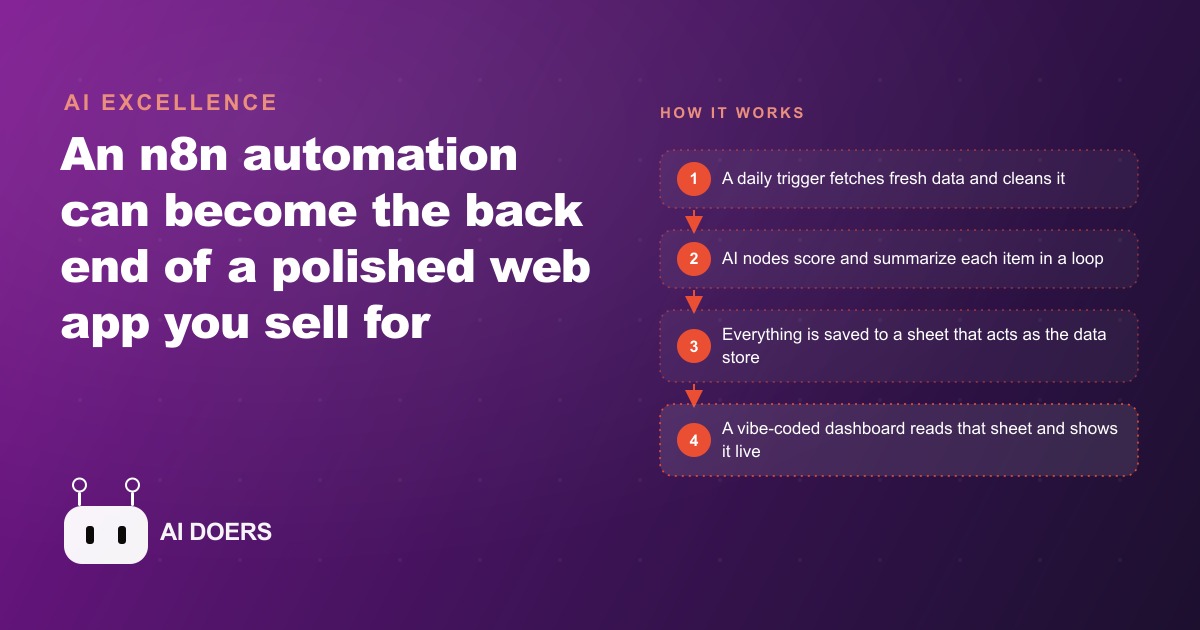
The most important thing anyone building with n8n learned this year is that a raw automation is worth a few hundred dollars and the exact same logic wrapped in a clean branded dashboard is worth several thousand. I am Madhuranjan Kumar, and the realization that changed the economics is simple: buyers do not pay for workflows, they pay for outcomes they can see and trust. A spreadsheet that fills itself overnight is an automation. A dashboard with your company name at the top that shows a manager the five things they need to act on this morning is a product. The underlying logic can be identical. The perceived value and the price are completely different.
What just became commercially viable that was not before
The packaging step from automation to product required three skills until recently: the automation itself, the front-end design, and the front-end development to turn the design into a working interface. Finding one person who could do all three, or hiring three people for one, made the economics difficult for anything below an enterprise engagement. Vibe coding tools changed the third requirement. A tool like Bolt or Lovable accepts a plain-English description of a table, a filter panel, and a status badge and produces a working, reasonably polished interface that a business client accepts as professional software. The design-and-development barrier is gone for the front end. The automation already handled the back end. What is left is the judgment work: picking the right niche, understanding what data that industry needs to see every morning, and building the specific thing that serves that need.
This combination landed at the same time as every industry developing a backlog of small, specific software needs that neither enterprise platforms nor consumer apps serve. The two-location retail chain that needs something smarter than a spreadsheet but cannot justify a large ERP implementation. The property management company with forty units that needs a daily operations briefing but not a full property management platform. The recruiting agency that needs a prospect enrichment dashboard but not a full recruitment system. These are the buyers who pay for a focused tool built specifically around their workflow, and the combination of n8n for the back end and vibe coding for the front end is what makes building for them economically viable at small-agency scale.
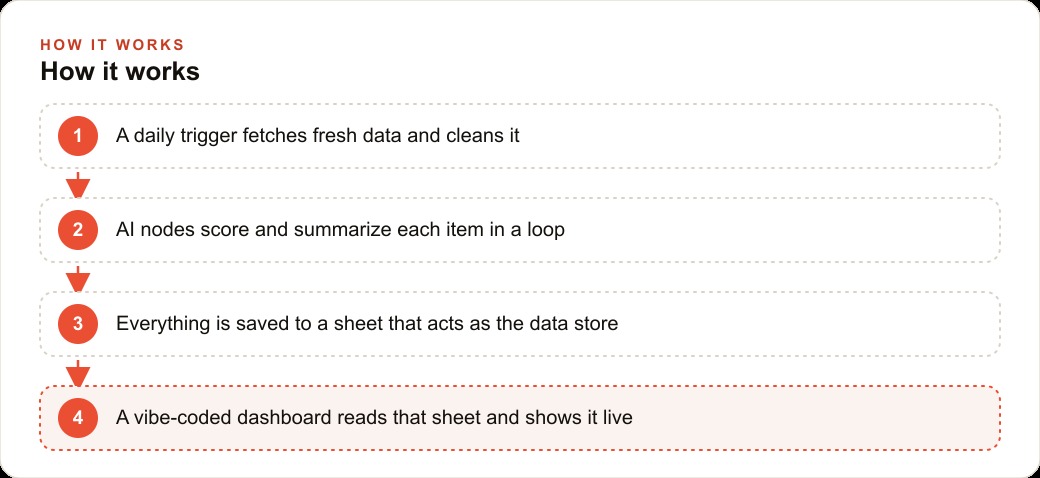
The architecture: four components in a chain
The technical structure is straightforward once you understand the roles of each component. A schedule trigger fires at a set interval, daily or hourly depending on how fresh the data needs to be. An HTTP node pulls in data from whatever source the business already uses. A code node parses the raw result into clean, structured rows, because real data sources return messy output that is not directly displayable. A loop runs over each row and AI nodes add useful fields to each one: an urgency score, a sentiment flag on any customer-facing note, a one-sentence summary of the record. Those enriched rows get saved to a Google Sheet or a simple database that acts as the persistent store. The front end connects to that store and displays live data.
The enrichment step is where the dashboard becomes genuinely useful rather than just accurate. A manager looking at raw data makes their own prioritization judgments, which is slow and subject to inconsistency. A manager looking at a dashboard where each record is already scored by urgency and summarized in one sentence makes better decisions faster, because the AI has already done the classification work. The dashboard does not replace judgment. It removes the preparation work that judgment currently requires.
The front end is built with a vibe coding tool using plain-English descriptions of the interface: a table with these columns, a filter by this field, a status badge that turns red when urgency is above this threshold. The critical instruction that prevents a half-built interface is telling the vibe coding tool to keep working until every described element is fully functional. Without that instruction, the tool commonly produces an interface with some working sections and some placeholder sections that require follow-up prompts to complete. With the instruction, the first pass is closer to complete.
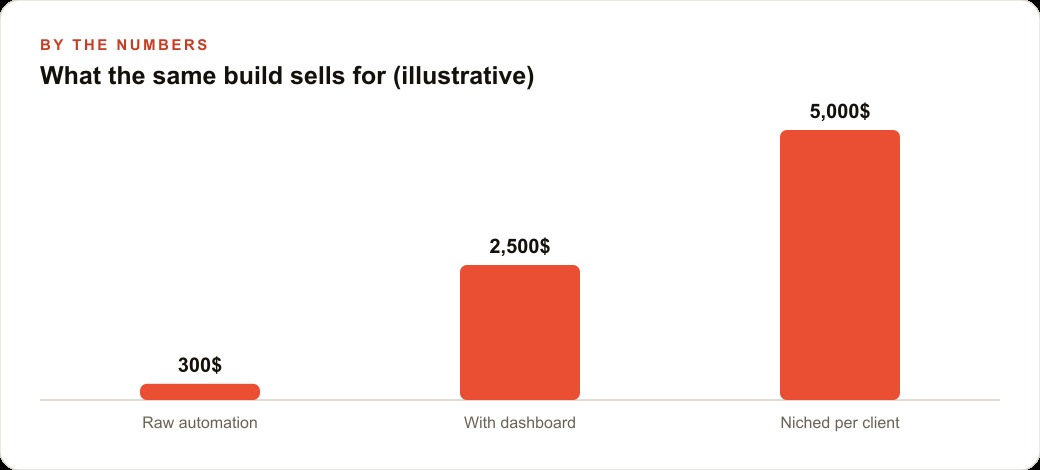
The pricing gap between raw automation and niched product is the entire business model
When a client is shopping for automation, the competitive set is everyone who builds in n8n, Make, or Zapier, and the prices converge toward commodity. When a client is shopping for a daily operations dashboard for their specific type of business, the competitive set is nearly empty, because most people building automations stop at the automation. The niche framing is not just a marketing move. It changes who you are selling to and how they evaluate the price.
A property management company that sees a dashboard labeled "property management daily briefing" with their data correctly populated reads it as software built for them. A generic "data dashboard" with the same information reads as a report. The willingness to pay for software is higher than the willingness to pay for a report, and the switching cost is higher because replacing software requires evaluating alternatives and migrating data, while replacing a report requires finding a different consultant. The niche framing creates both a higher initial price and a stickier relationship.
For agencies that manage Facebook and Instagram ad campaigns or Google Ads accounts, a performance dashboard built around the specific metrics that matter in those channels, with AI-generated urgency scoring and weekly trend summaries, is a tool clients interact with daily and associate with the value the agency provides. It increases retention without requiring additional hours of service delivery, because the dashboard itself is a daily visible reminder that the agency is working and producing results. That combination of higher perceived value and lower churn is what makes the investment in building the dashboard worthwhile even if the upfront build cost is not recovered in the first billing cycle.
How a property management company used this in practice
The specific example I would build for a property management company starts with the data the company already has: maintenance requests, rent status, lease expiration dates, and vendor response times. The schedule trigger fires each morning and pulls that data from whatever combination of tools the company uses. The code node parses it into clean records. The loop enriches each maintenance request with an urgency score from the AI node, with burst pipe and no-heat calls scoring at the top and cosmetic requests scoring at the bottom. Every record gets a one-line AI summary.
The dashboard built on top of that data has two sections: a property overview showing current occupancy and any alerts by address, and a maintenance queue sorted by urgency score, each item showing the AI-generated summary. The manager opens one screen each morning and sees what needs attention today at the top, already triaged, instead of checking three separate inboxes and manually sorting by urgency.
The business case for the client is direct. A manager currently spending 45 minutes each morning pulling the day's picture from maintenance emails, a spreadsheet, and a leasing inbox reduces that to a five-minute review of the dashboard. At 22 working days per month, that is roughly 17 hours of management time per month recovered. The dashboard pays for itself within the first billing cycle based on staff time alone, before counting any benefit from faster response to high-urgency issues that cost money when they are overlooked.
The commercial case for the builder is the scale property. Once the first property management dashboard exists, the second client in the same niche gets the same system with their data sources wired in and their logo on the header. The marginal cost of the second sale is configuration time, not development time. At five clients, the original development investment is diluted across five revenue streams. The economics of a software business, where the cost of the next sale is nearly zero once the product exists, are now accessible to someone who learned n8n and one vibe coding tool and is willing to go deep on one industry vertical.
Running the automation on a flat-cost self-hosted server, rather than a usage-based managed service, is what makes the unit economics work at small client counts. A server that costs a fixed monthly amount regardless of how many times the automation runs means ten clients pay a fraction more in total than one client, because the server cost does not scale with the number of runs. That fixed-cost structure is what enables the product pricing that makes clients feel like they are paying for value while the builder earns real margin.
That is exactly what we do at AI DOERS. Book a private 30-minute call with Madhuranjan Kumar and we will map the fastest path to it for your specific business.
Book your call →
Madhuranjan Kumar
Madhuranjan Kumar brings 20 years of performance-marketing experience and has managed over $200 million in Facebook ad spend for brands across the United States and beyond. His expertise spans the full modern marketing stack: Meta, Google Ads, TikTok, email automation, CRM, and the websites that hold it together. At AI DOERS he turns that track record into lead-generation systems for businesses across every industry.