
Three AI Agents That Quietly Guard Your Business From Hackers
AI powered scams are getting cheaper and more convincing, but you can fight automation with automation. Here are three set and forget AI agents that screen phishing, watch for breaches, and audit your site, plus how I would run them for a real business.

Cybersecurity Is Not an IT Problem, It Is an Ops Failure Most Owners Have Chosen
Most businesses that get breached were not targeted by sophisticated attackers running novel exploits. They were hit by the same phishing links, leaked credentials, and unmonitored website gaps that every attacker tries first because those attacks succeed so consistently against unprepared targets. The sophistication is not in the technique. It is in the scale: AI tools now let attackers produce convincing, personalized phishing emails at thousands per hour for effectively zero cost. The business owner on the receiving end is still reading each one manually.
That asymmetry is the core of the problem, and it is the reason the standard framing of cybersecurity as an IT department concern misses the point for most small businesses. IT departments set policies and manage infrastructure. Cybersecurity for a small business is an operations problem: it requires someone to consistently screen incoming communications, monitor for exposed credentials, and periodically audit the outward-facing surface of the business. Most owners are not doing any of those three things on any systematic basis, not because they disagree with the value, but because the manual versions of those tasks take time no one has.
The position here is direct: if a business has an inbox, a website, and customer data, it has effectively chosen to accept the compounding risk of phishing attacks, credential breaches, and website vulnerabilities by defaulting to no systematic screening. That is not a neutral choice. It is a decision with a probability-weighted cost that grows every month the screening does not happen.
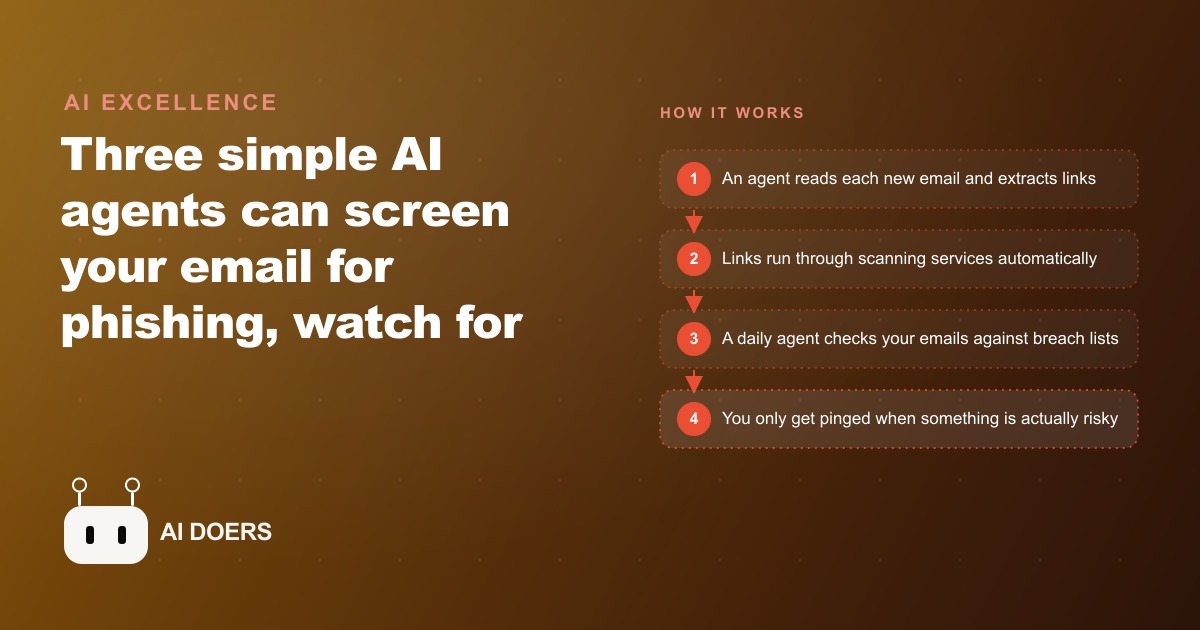
Three AI agents, set up once and running automatically, close all three of those gaps. A phishing agent screens every incoming email. A breach agent checks your email addresses against breach databases every morning. A site auditor scans your website for exposed data and structural weaknesses on a recurring schedule. The combined monthly cost for a small business is $35 to $50 in API and service fees. The alternative is the current posture, which for most small businesses means the first detection of any of these three threat types comes from the problem itself.
The Three Attack Surfaces That Will Hit Your Business Before a Sophisticated One Does
Before a business faces a sophisticated or targeted attack, it almost always faces one of three much simpler ones. Understanding which three and why they dominate the threat landscape for small businesses clarifies why the three-agent stack covers what actually matters for most operations.
The first surface is the inbox. Phishing accounts for the majority of successful breaches across all business sizes, and for small businesses it is not close. An attacker who wants access to a bank account, an email account, or an internal system sends a convincing message with a link or an attachment. If someone on the team clicks it, the attacker gets what they came for. The quality of AI-generated phishing emails has improved substantially in the past two years. Emails that previously would have been caught by a careful reader because of grammar errors or implausible scenarios are now effectively indistinguishable from legitimate messages to most people reading at normal business pace.
The second surface is credential exposure. Billions of email address and password combinations from past data breaches are available in databases that attackers buy and sell at low cost. Most people reuse passwords across accounts, so a credential exposed in a breach from three years ago may still unlock an active business account today. The majority of affected businesses discover this exposure after something goes wrong, not in time to prevent it.
The third surface is the website itself. Most small business websites have at least one meaningful security gap: a form that leaks more data in its response than it should, an HTTP header configuration that reveals what software version is running, a login page accessible to automated credential-stuffing tools, or a third-party plugin with a known unpatched vulnerability. None of these are sophisticated vulnerabilities. They are the low-effort entry points that automated scanning tools probe at scale. If your website has one of them, it will be found.
Why "We Have a Password Policy" Is Not a Security Posture
A common response to the question of cybersecurity from small business owners is that the business has a password policy. Employees are required to use strong passwords. Perhaps there is a rule about periodic password changes. Some businesses have added two-factor authentication for major accounts. A few use shared password managers.
None of this constitutes a security posture because none of it addresses what actually happens in the breaches that hit small businesses most frequently. Password policies address the strength of a password chosen at one point in time. They do not address credentials exposed in a third-party breach from a service the employee signed up for years ago, where the password may have been reused across accounts and the breach may only now be appearing in databases attackers are actively querying.
Two-factor authentication through SMS text messages adds a layer, but a weaker one than most owners realize. SIM-swapping attacks, where an attacker convinces a mobile carrier to transfer a phone number to a new SIM the attacker controls, allow interception of the authentication text intended for the account owner. Authenticator apps that generate codes locally on the device rather than sending them over a carrier network are significantly harder to intercept and should be the standard for any account with meaningful business access.
The broader problem is that policy-based security is static and operates at human speed. Attackers operate at automation speed. A phishing campaign can send millions of emails in the time it takes one human to evaluate one suspicious message and make a judgment call. Expecting human vigilance to be the primary defense against automation-scale attacks is not a security posture. It is an operational assumption that will be violated at scale.
The only proportionate response to automation-scale attacks is automation-scale screening, and the tools to do that are now accessible to a small business at a monthly cost well below what most businesses spend on a single software subscription.
Automation Is the Only Proportionate Response to AI-Powered Phishing at Scale
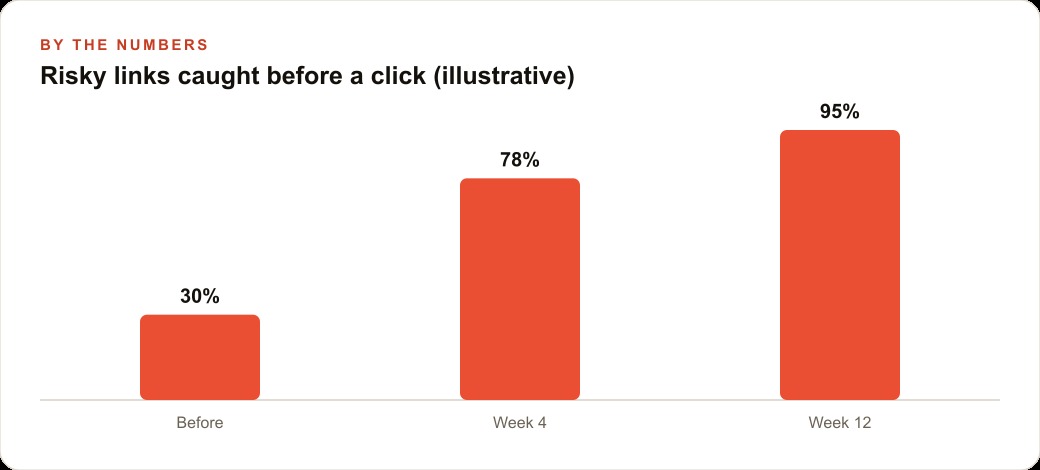
The average human detection rate for phishing emails in a business environment, without active and ongoing security awareness training, is approximately 30 percent. Training programs can push that rate higher, but training must be continuous and refreshed to maintain effectiveness, and the realistic ceiling for human detection rates even with active programs is around 70 to 80 percent for well-crafted campaigns. AI-generated phishing that is personalized to the recipient using publicly available information about the business, its vendors, and its recent activity can push detection rates below 50 percent even in trained environments.
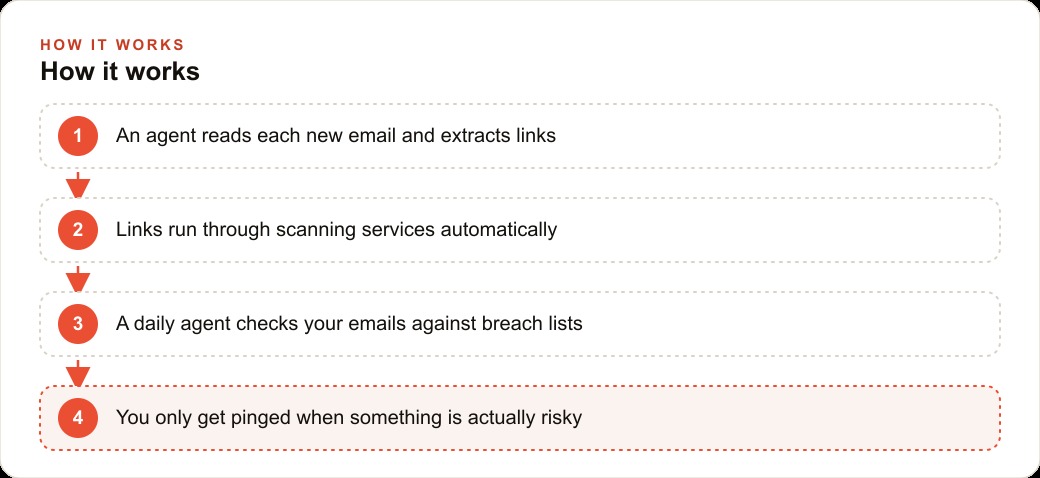
Automated link scanning changes the detection rate by removing the human judgment step from the most common attack vector. A phishing agent that reads every incoming email, extracts all links, submits them to URL and file scanning services, and applies a classification layer to the results operates at inbox volume rather than human-reading speed. It does not experience decision fatigue at 4 p.m. on a Friday. It does not assume a link is safe because the surrounding email appears to come from a familiar sender. It checks every link against current threat intelligence databases and flags anything that matches.
Detection rate improvement from adding automated link scanning to a shared business inbox is substantial. Illustrative numbers from small business deployments suggest automated screening catches roughly 90 to 95 percent of phishing attempts, compared to the 30 percent human baseline without training. The operative meaning of "catches" here is flagging for human awareness, not quarantining automatically. The agent surfaces the suspect email so a person can make the final call. What changes is that the person does not have to investigate the link themselves because the agent already did, and the agent checked every link in the inbox, not just the ones that happened to look suspicious at first glance.
The breach agent works on a different cadence because credential exposure is not a real-time event that requires immediate response. A credential leaked from a breach last year is not more dangerous today than it was six months ago. What makes it dangerous is not knowing about it. Running a daily check across all business email addresses against breach notification databases turns a passive exposure into a morning alert within 24 hours of the breach data becoming available. That is the difference between learning about a credential leak from the affected service, which may take months, and knowing about it the next morning and immediately rotating the password everywhere it was reused.
The Specific Setup a Gym Should Run Before Something Goes Wrong
A gym operates with three attack surfaces in constant use: a shared front desk email multiple staff members access throughout the day, a member database containing personal and payment information, and a website with a member login page. Each maps directly to one of the three threat types described above.
The front desk email is the highest-risk surface because it receives messages from many different sender categories throughout the day: members, equipment vendors, trainers, software providers, cleaning service invoices, and local business contacts. Any of those sender categories can be spoofed convincingly. A fake invoice from a recognized vendor name, a fake login alert from the booking software, or a fake member inquiry with a malicious link are all realistic scenarios for a gym inbox. The phishing agent running on that email evaluates every incoming message, extracts all links, checks them against scanning services, and sends a daily summary of flagged items. The front desk team reviews the flagged items once a day rather than needing to investigate each suspicious email manually. Detection rate shifts from the 30 percent human baseline to the 90-to-95 percent range that automated link scanning consistently achieves.
The breach agent runs daily across every business email address: the front desk address, the owner's address used for software subscriptions and supplier accounts, the billing email, and any others used for business accounts. For a gym with five operational email addresses, the daily check takes seconds and costs a negligible amount per day in API calls. It is not unusual to find, in the first week of running this agent, that at least one address appeared in a breach from a third-party service the staff do not even remember signing up for. Finding that exposure immediately means rotating the associated password before it is used. Finding it after an account has already been accessed means containment, notification, and potentially regulatory obligations.
The site auditor runs monthly against the gym's website and specifically against the member login page. It checks for common header misconfigurations, exposed software version information, login pages without brute-force protection, and easily discoverable admin paths. A gym website is not a complex attack target, but it becomes a soft one if no one has audited it recently. The monthly auditor catches gaps introduced by plugin updates, template changes, or new integrations before an automated scanner finds them first.
Setup time for all three agents: approximately four hours for an owner comfortable with basic software configuration. Monthly operating cost: $35 to $50 for the combined scanning service subscriptions and API calls. The agents run on a small always-on server or a minimal cloud instance, not on the owner's laptop, so they run regardless of whether anyone is at the front desk.
One breach that leads to member data exposure, a notification obligation to affected members, and the reputational cost of that disclosure costs orders of magnitude more than the entire first year of operating all three agents combined. The decision to not run automated screening is not a neutral default. It is a choice to accept that risk, and it is a choice that gets more expensive to revisit with each month that passes without the setup. The setup cost is fixed and one-time. The risk it prevents compounds every month it is absent.
That is exactly what we do at AI DOERS. Book a private 30-minute call with Madhuranjan Kumar and we will map the fastest path to it for your specific business.
Book your call →
Madhuranjan Kumar
Madhuranjan Kumar brings 20 years of performance-marketing experience and has managed over $200 million in Facebook ad spend for brands across the United States and beyond. His expertise spans the full modern marketing stack: Meta, Google Ads, TikTok, email automation, CRM, and the websites that hold it together. At AI DOERS he turns that track record into lead-generation systems for businesses across every industry.