
This Week in AI: Home Robots, Cheaper Chips, and What It Means for Your Business
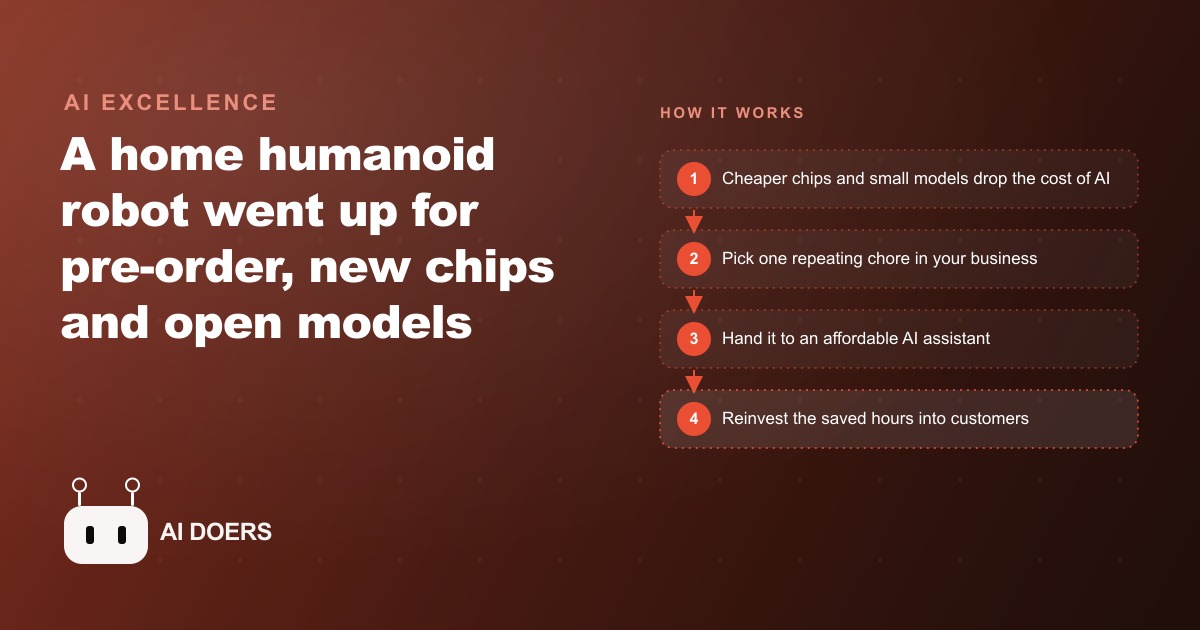
A home humanoid went up for pre-order, new chips and tiny open models landed, and coding tools reorganized around agents. Here is the plain reading of the news and how I would turn the trend into real savings for a small business.

I'm Madhuranjan Kumar, and I want to say something direct about this week's AI headlines before you spend another hour reading about robots and orbital data centers.
The robot and chip announcements are theatre for small businesses. I mean that precisely, not dismissively. They are real technological achievements and they will matter eventually to people at the relevant scale. But the signal buried in the quietest corner of this week's news cycle, specifically the release of IBM's Granite Nano edge models and Minimax's M2 open model, is the one that actually changes something about how you run your business this month.
The cost of running a useful AI task is collapsing faster than any headline in this batch properly acknowledges. That collapse is the story. Everything else, the pre-order robot, the thermodynamic chip, the orbital compute concept, is spectacle that will arrive on your doorstep years from now if it arrives at all. Learning to filter the signal from the noise in these weekly AI roundups is itself a competitive skill, and I want to model that filtering here.
The Robot Headline Is the Wrong Headline
1X's Neo home robot is available for pre-order. It is a genuinely impressive piece of engineering. It moves with a fluidity that no previous generation of consumer humanoid robots achieved at this price point, and the fact that a home-use robot is even at the pre-order stage represents real, cumulative progress in robotics, computer vision, and real-time motion planning.
It is also completely irrelevant to what you need to think about this week if you run a business.
The lead time between "available for pre-order" and "reliably useful in a production environment" for hardware this complex is measured in years, not quarters. The software stack for a general-purpose home robot needs to handle edge cases across thousands of different physical environments, with thousands of different object configurations, under thousands of different lighting and obstacle conditions, before it is reliable enough to be worth operational attention from a business owner. Early adopters will spend a significant fraction of their time working around limitations and providing feedback that improves the next firmware release. That is a legitimate and valuable role for someone who wants to be on the frontier. It is not the best use of a business owner's time when there are cheaper, more immediately useful tools available right now.
The Extropic thermodynamic chip story follows the same pattern with a different mechanism. A claimed 10,000-times improvement in energy efficiency is an extraordinary claim. If the claim holds under real production workloads at real scale, it could eventually change the economics of inference significantly. The word "if" is doing enormous work in that sentence. Thermodynamic computing is a genuinely novel approach that derives computation from probabilistic sampling rather than deterministic logic gates, and the theoretical efficiency gains are real. What is not real yet is production-grade hardware that delivers those gains at the scale and reliability level where a business can actually deploy against it. Following the story is worth doing. Adjusting your operations based on it today would be premature by at least two or three years.
Tesla's idle-car compute concept belongs in the same holding category: interesting in principle, architecturally creative, years from being a service layer you can build on.
Why the AWS Leader's Comment Is the Most Useful Thing Said This Week
Buried in the coverage of Amazon's corporate layoffs was a comment from a senior AWS leader about how employees, and by extension anyone working in this era, should respond to AI-driven efficiency changes. The substance of the comment was direct: learn to think, not to master one tool.
This is genuinely good advice that cuts against the dominant response most people are actually having to this moment. The dominant response is to become a power user of one specific platform, one specific workflow, one specific integration stack. Master Cursor. Master a particular GPT configuration. Master a specific automation builder. These are reasonable starting points, but they produce a fragile professional position when the tool landscape changes significantly every quarter, which it has been doing.
The deeper skill, the ability to reason clearly about what needs to be done, break it into component tasks, and evaluate whether any available tool can handle those components reliably and cheaply, is durable across every model generation. It is what separates someone who gets more productive with each new release from someone who has to relearn their entire workflow from scratch every six months when their chosen tool is superseded.
The Amazon efficiency story and the associated layoffs are real. Fourteen thousand roles reduced in a single announcement is not a rounding error. But the productive response to that information is not anxiety about AI replacing jobs in the abstract. It is the concrete question of which skills you are building that compound across tool generations rather than being specific to one tool's current interface.
The Two Stories That Actually Change Your Month
Minimax M2 uses a mixture-of-experts architecture with 456 billion total parameters but only around 10 billion active parameters at any inference call. The model routes each input to a relevant specialist subset of the network rather than activating the full weight matrix for every token. This produces benchmark results that match or exceed models that cost significantly more to run per call. Crucially, it is open-weight, which means it can be deployed locally on your own hardware or accessed through inference APIs at a cost level that was previously only achievable with much less capable models.
IBM's Granite Nano family is designed specifically for edge deployment: smaller devices, lower compute budgets, no cloud round-trip required. These models are not trying to compete with frontier reasoning models on broad general-purpose tasks. They are optimized for specific, narrow business task categories, which means they perform better than their parameter count would suggest on those narrow tasks. For a business application that requires doing one well-defined text task very frequently, a Granite Nano-class model is more economical and more reliable than using a large frontier model that brings general capability you do not need.
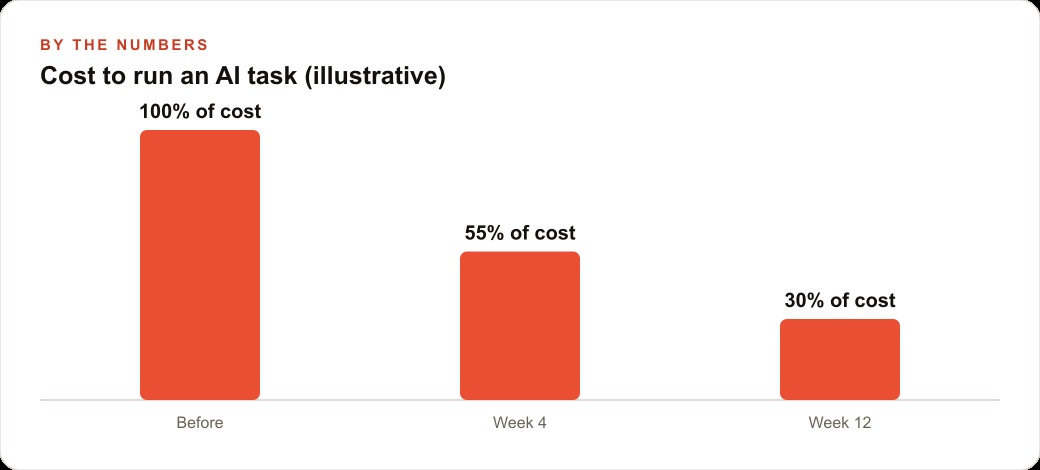
What these two releases share is the same structural meaning: the cost floor for running a genuinely useful AI inference on a specific, narrow business task is falling faster than the press coverage reflects. This matters for a reason that the big-announcement stories tend to obscure. The business case for automating a specific rote task with AI has historically been constrained by inference cost per task relative to the value of the task. When that cost is material, only high-value tasks can justify the automation. When the cost falls by a factor of five or ten, the set of tasks where automation makes economic sense expands dramatically.
A Cleaning Service and the 40-Hour Savings No One Is Writing About
Let me make the Granite Nano and Minimax M2 trajectory concrete with a real operating scenario.
A residential cleaning service receives incoming quote requests throughout the working day via a contact form and a messaging channel. A homeowner contacts them, describes their home, asks about pricing for their home size and cleaning frequency, and wants to know about availability in their area. Handling each of these interactions currently involves a person reading the message, looking up the relevant pricing tier for that home size and frequency, checking the availability calendar for the requested area, and composing a response. Across 10 to 15 inquiries per day, this takes roughly two hours of an employee's time.
Deploying a local small model to handle the initial quote response is now within reach for a business at this scale. The model receives the incoming message, extracts the relevant details including home size, neighborhood, frequency, and any specific requirements mentioned, applies the pricing rules for those inputs, checks the scheduling availability data for the relevant area code, and generates a personalized response that quotes a specific price range, confirms availability in the requested area, and offers two concrete next steps. It handles the 80 percent of inquiries that fall within standard parameters without any human involvement. The 20 percent involving unusual requests, accessibility requirements, or complex scheduling constraints are flagged for human review with a suggested draft already generated.
At current inference costs for a model in the Granite Nano class running on modest local hardware or a cheap API endpoint, handling 300 inquiries per month runs under $20 in compute costs. The labor saved is roughly two hours per working day, equaling 40 hours across a 20-day month. At any reasonable valuation of staff time, the return on a $20 monthly spend is the kind of number that should be in every business owner's decision-making framework right now.
The reason this story does not make the weekly AI roundup headline is that there is nothing visually compelling about it. There is no pre-order landing page, no glowing chip prototype, no orbital data center concept illustration. It is a text response, sent from a lightweight model, that handles a rote and time-consuming task better than the status quo does. That combination of low glamour and high practical value is exactly the pattern worth training yourself to find in AI news.
Cursor 2.0 and What an Agents-First Interface Means for Everyone
Cursor 2.0's agents-first redesign shipped this week. At first reading, a code editor update seems relevant only to developers and therefore ignorable for business operators who do not write code themselves.
The larger significance is in the interface paradigm being demonstrated. Prior versions of Cursor required the user to operate at the level of the code: write this function, fix this bug in this file, refactor this class. The agents-first model means the user operates at the level of the goal: make the app allow users to export their data as a CSV. The system decomposes the goal, identifies the component tasks, calls the relevant tools in sequence, handles the intermediate steps, and surfaces a completed result rather than requiring the user to direct each step.
That interface paradigm is not going to stay inside code editors. The same goal-in, completed-work-out model is the direction that workflow software across every business category is moving toward. When that model arrives in the scheduling tool, the invoicing platform, the customer communication system, the tools that business operators actually use daily, the learning curve will be lower because the user interface will ask the user to specify what they want, not to understand how the underlying system works.
The Cursor 2.0 release is a leading indicator worth paying attention to even if you are not a developer, because it shows what the next generation of business workflow tools will feel like to use.
What to Do With This Week's News
The honest summary is straightforward. The humanoid robot, the thermodynamic chip, and the orbital compute network are real technological bets on important long-term problems. They deserve to exist. They are not the thing to optimize your business around before the end of the year.
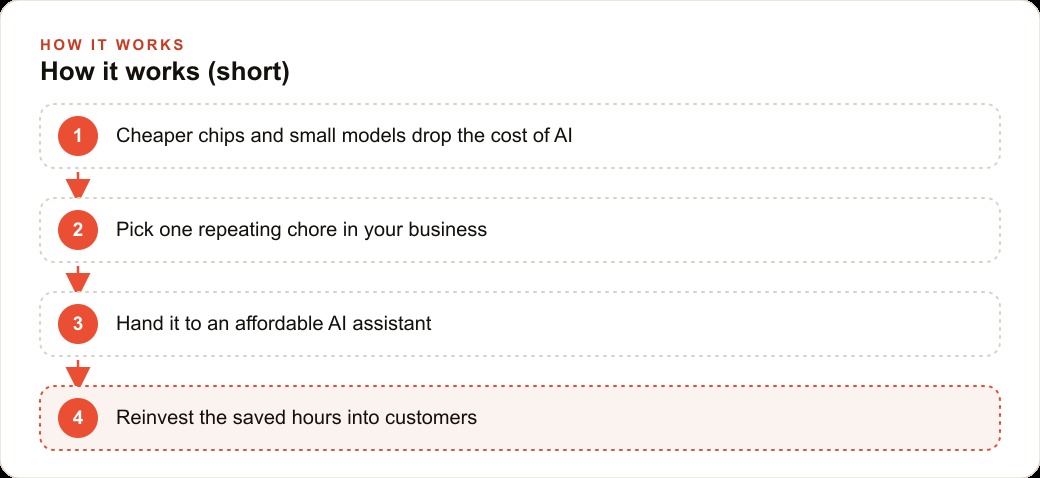
The inference cost collapse, visible in Minimax M2 and IBM Granite Nano, is the thing worth acting on now. The practical question to hold is specific: where in your current operation is there a rote, text-based, repetitive task being handled by a person at a cost that a cheap small model could handle adequately for a fraction of the price? Find that task. Estimate the current monthly labor cost. Check whether the current generation of small models can handle it reliably enough that a human only needs to review the edge cases. If the numbers work, run a four-week pilot.
The AWS leader's framing stays with me as the right orientation for this particular moment in the technology cycle: learn to think, not to master one tool. The tools will keep changing at a pace that makes tool-specific mastery a poor investment compared to the durable skill of evaluating new capabilities clearly against specific needs.
I'm Madhuranjan Kumar, and this week's big announcements were mostly spectacle. The $20-per-month productivity gains hiding in the small-model story are the ones that will show up in your actual results.
That is exactly what we do at AI DOERS. Book a private 30-minute call with Madhuranjan Kumar and we will map the fastest path to it for your specific business.
Book your call →
Madhuranjan Kumar
Madhuranjan Kumar brings 20 years of performance-marketing experience and has managed over $200 million in Facebook ad spend for brands across the United States and beyond. His expertise spans the full modern marketing stack: Meta, Google Ads, TikTok, email automation, CRM, and the websites that hold it together. At AI DOERS he turns that track record into lead-generation systems for businesses across every industry.