
The Week AI Agents Shifted: Cheaper Models, Screen-to-Skill, and Tighter Competition
A wave of updates made AI agents cheaper to run, easier to teach, and more competitive. Here is what each change means and how I would put it to work inside a consulting firm.

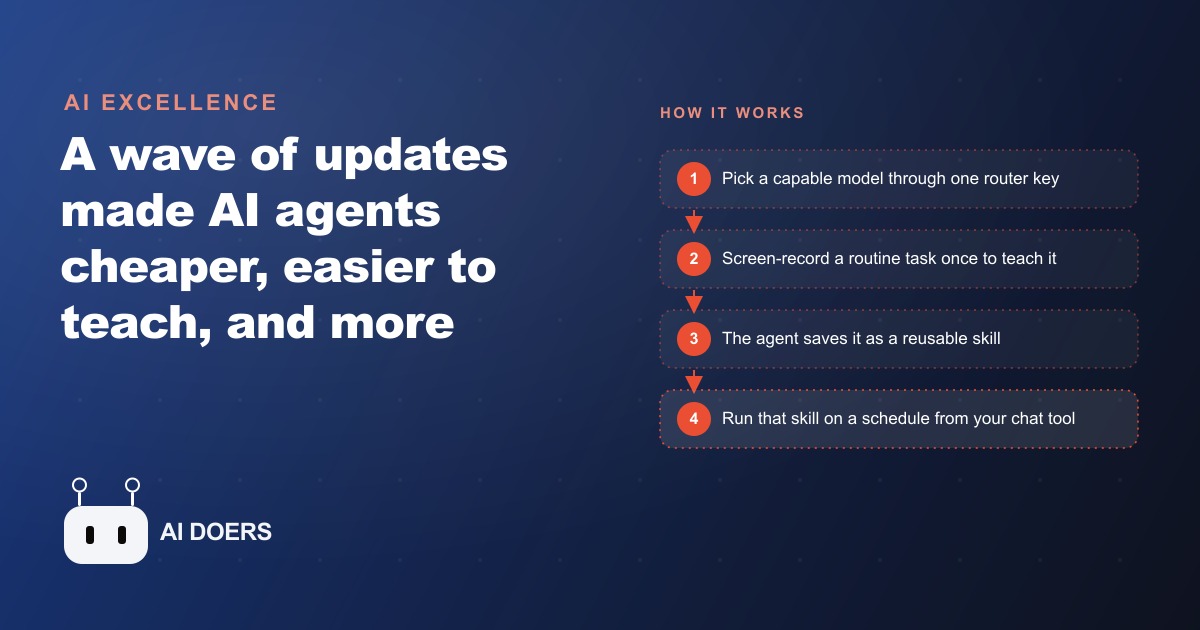
Three structural shifts in AI agents converged in a single week
Three things changed simultaneously, and it is the simultaneity that matters. In the span of a week, AI agents became meaningfully cheaper to run, substantially easier to teach, and harder pressed by platform competition to keep improving. None of the three changes alone would warrant the attention the week deserves. Together they mark a moment where the practical economics of using agents in a real business crossed a threshold that many small business owners have been waiting for without knowing exactly what they were waiting for.
I am Madhuranjan Kumar, and I want to be specific about what crossed and why it matters now rather than in six months. The first shift was a capable open-source model arriving at roughly one-fifth the cost of frontier models while holding its own on real tasks. The second shift was a screen-recording feature that turns showing the agent once into a reusable skill it can repeat indefinitely. The third shift was the major agent platforms actively competing against each other at a pace that is visibly forcing prices down and capabilities up. The reason to pay attention to these three together is that they each address a different layer of the adoption barrier: cost, teachability, and quality trajectory.
When all three barriers drop simultaneously, the calculus for a business that has been watching AI agents from the sideline changes. The question moves from whether this is ready for us to why we are still waiting.
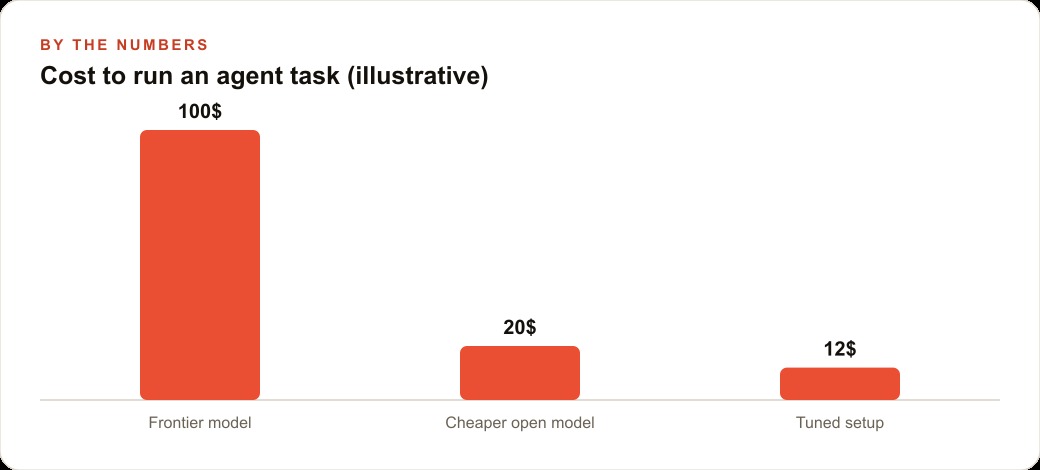
A sub-twenty-dollar monthly agent workflow is now the default case, not the premium one
Until recently, running a meaningful agent workflow for a business meant paying for a frontier model on every call. Frontier models are the most capable and the most expensive. At the prices those models charge, even a modest workflow of a few hundred agent tasks per day could run into fifty to one hundred dollars per month in API costs, before accounting for any surrounding infrastructure.
The arrival of a capable open model at one-fifth the frontier cost changes the math fundamentally. At that price point, a business running two hundred agent tasks per day is looking at roughly two to four dollars per month in base API costs on the cheap model. Even accounting for the router or orchestration layer that connects the model to your tools, a meaningful agent workflow lands well under twenty dollars per month in most small-business use cases.
The practical consequence of this is that the cost question stops being a real objection. At twenty dollars per month, the return threshold for a useful agent workflow is trivially low. If the agent saves two hours of staff time per month, which is a conservative estimate for almost any repetitive task, the return is positive even before accounting for the quality and consistency advantages of a process that runs the same way every time.
The qualification worth adding is that cheap and capable are not the same. Before committing a workflow to a cheaper open model, you need to test it on your actual task, with your actual inputs, and compare the outputs to what the frontier model produces. For many summarization, data-entry, and drafting tasks, the quality difference will be negligible. For tasks that require complex multi-step reasoning or nuanced judgment, the gap will be real. The right architecture uses the cheap model for the tasks where it is sufficient and reserves the expensive one for the tasks that genuinely need it, which is typically a minority of the total task volume. A router key that gives you access to multiple models through a single account makes that split straightforward: you set the default to cheap and escalate to premium only for the tasks that require it.
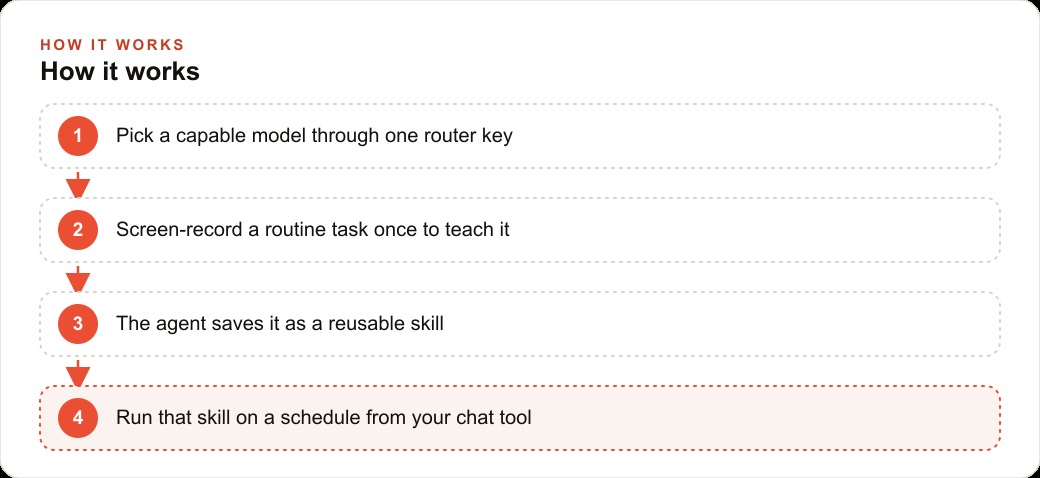
Screen-to-skill flips the teaching model: you show once, the agent repeats forever
The traditional way to teach an agent a task is to write instructions. You describe the steps, the exceptions, the format you want, and the conditions under which the agent should ask for clarification. This works, but it requires you to think like a programmer even if you have no programming background. You have to anticipate every scenario, describe every step in enough detail that a machine can follow it without ambiguity, and then test and revise until the instructions are tight enough. Most business owners who have tried to write instructions for an AI assistant have run into the frustrating gap between how clearly they understand a procedure and how difficult it is to describe that procedure in terms precise enough for a machine.
Screen-to-skill collapses that gap. You perform the task once, live, on your screen, and the agent observes the recording and converts what it sees into a repeatable skill. The skill captures the procedure as it is actually done, not as you think you would describe it, which is a meaningful distinction. Steps that you perform automatically without consciously thinking about them show up in the recording and end up captured in the skill. Steps you might forget to include in a written description are there because you did them when you showed the agent.
The resulting skill is a structured procedure the agent can call on command. You give it a name and trigger it later with a command in the same way you would call any other agent task. The agent follows the recorded procedure on whatever new input you provide. If the task is pulling competitor pricing from three specific sources and formatting it into a summary, you show that once and it runs it every time. If the task is processing a batch of incoming inquiries and tagging each one by topic and urgency, you show that once and it handles the next batch the same way.
The implications for small businesses are significant. Many of the most valuable agent tasks in a small business are locked in the head of one experienced person who does them intuitively. That person cannot easily write precise instructions for the task because they have never needed to describe it step by step. But they can perform it on camera. The screen-to-skill approach captures the expertise from the person who has it and converts it into a system that others can trigger without needing the same expertise. A procedure that previously required a specific person to be available becomes something anyone on the team can initiate.
A consulting firm that builds on this now holds an information advantage by Q4
I want to make the compounding dynamic concrete with a specific example.
A consulting firm spends significant time on the research phase of every engagement. Before any strategy document gets written, someone needs to pull the client's competitive landscape, identify the key players in the relevant market, find recent moves those players have made, and summarize what it all means for the client's position. For a typical engagement, this research takes four to six hours. At a fully loaded cost of sixty dollars per consultant hour, that is two hundred forty to three hundred sixty dollars of research work before the strategic thinking even starts.
The firm's owner performs that research process once in front of a screen-recording tool. The agent observes the full procedure: which sources to check, in what order, what signals to look for, how to structure the output. The agent saves this as a reusable skill. From that point on, any consultant on the team can trigger the skill with a command, provide the client name and the relevant market, and receive the same structured research output in a fraction of the time it took to record it the first time.
The cost of running the skill on a cheap open model, for a research task of this type, is likely under fifty cents per execution. Against a two-hundred-fifty-dollar manual cost for equivalent work, the ratio is roughly five hundred to one. At ten engagements per month, the firm saves approximately two thousand five hundred dollars per month in research labor and redeploys those hours into the analytical work clients actually pay for.
The compounding advantage is what matters by Q4. By the time a competing firm starts building this capability, the first firm has already run this skill across hundreds of engagements, refined the output format based on what clients respond to, built additional skills for adjacent tasks, and has a team that uses these tools as a natural part of their workflow. The gap between a firm with four months of this practice and one just starting is not just the specific skills built. It is the operational fluency that comes from using these tools daily and the accumulated quality improvements from weeks of refinement.
There is also a second-order advantage that is harder to quantify but real. A firm whose consultants are not spending four hours on standard research can take more engagements without adding headcount, or can invest the recovered hours in the deeper analysis that differentiates their output. Both outcomes improve the firm's competitive position in ways that are visible to clients and difficult for a later-starting competitor to close quickly.
Platform competition is the force pressing the entire ecosystem downward
The pricing and capability improvements of any given week are not isolated product decisions. They are moves in a competitive dynamic between platforms that are directly trying to displace each other's users.
When major platforms compete aggressively, the person who benefits is the user. Pricing pressure moves downward as each competitor attempts to be the more economical choice. Feature releases accelerate as each platform attempts to be the more capable choice. Support and documentation improve as each platform competes on ease of adoption. The net effect of strong competition between capable platforms is that users get better tools at lower prices on a faster timeline than any single platform would deliver if it were the only serious option in the market.
This competitive pressure is the structural force that makes the current period a particularly good time to start building on these platforms. The improvements that landed this week are not the end of a cycle. They are steps in a sequence that will continue for at least the next twelve to eighteen months based on the current competitive intensity and the investment levels of the major players. Building the habit of working with agents now means benefiting from every subsequent improvement without having to change your fundamental approach. The tools improve around you.
The practical implication for a small business is to build workflows that are modular rather than dependent on any single platform's specific implementation. If your agent skill is recorded in a way that captures the underlying procedure rather than being tied to one platform's interface, it is transferable when a better option appears. The procedures are yours. The skill of building and using agent workflows is yours. The platform that runs them is a variable you can optimize over time as the competitive landscape evolves.
What to do in the next two weeks
The three shifts that converged this week create a specific and time-limited opportunity. The window is time-limited not because the tools will disappear but because the information advantage of being an early adopter in your market will narrow as awareness spreads. The business owner in your industry who starts building agent skills this month will have a real head start over the one who starts in six months. That gap is worth capturing.
The practical move is to pick one task your team does the same way every week and record a clean walkthrough of it. Not the most complex task, not the most important task, but the most procedurally consistent one. The task where the steps are the same every time and the output format is fixed. That task is where the skill recording will produce the most reliable result.
Build one skill, test it on five real examples from your actual work, refine the recording where the output is wrong, and then run it on the next real batch. On the model side, set up a router account that gives you access to both a cheap open model and a frontier model through a single key. Test the cheap model on the task before committing to the expensive one. The cost difference is real, and for many tasks the quality difference will not justify the premium.
Keep the skill library small and high-quality in the early months. Three reliable skills that run correctly every time are worth more than ten skills that require manual intervention on a quarter of executions. Quality over quantity is the discipline that separates agent libraries that keep being used from ones that get abandoned after the initial enthusiasm.
Watch the platform competition actively rather than ignoring it. When a major platform drops prices or ships a capability the others do not have, test it against your existing skills. The competitive pressure that produced this week's announcements will produce more like them, and staying current on the pricing and feature landscape is how you make sure your agent workflows are always running on the best available option for your specific tasks at any given moment.
The businesses that build durable agent workflows are the ones that start narrow and careful, expand based on evidence of reliability, and keep the skill library current as the tools improve. That is the compounding habit this week's convergence makes newly accessible and newly affordable to build.
That is exactly what we do at AI DOERS. Book a private 30-minute call with Madhuranjan Kumar and we will map the fastest path to it for your specific business.
Book your call →
Madhuranjan Kumar
Madhuranjan Kumar brings 20 years of performance-marketing experience and has managed over $200 million in Facebook ad spend for brands across the United States and beyond. His expertise spans the full modern marketing stack: Meta, Google Ads, TikTok, email automation, CRM, and the websites that hold it together. At AI DOERS he turns that track record into lead-generation systems for businesses across every industry.